Part I: Cheirognomy
Palmistry should really mean the study of the hand in its entirety. It is, however, divided into two sections: the twin sciences of cheirognomy and cheiromancy. The first deals with the shape of the hand and fingers, and relates to the hereditary influence of character and disposition; and the second to the lines and markings of the palm, to the events of past, present, and future.
It will therefore be readily understood that the second portion of this study cannot be complete without the first; and as in the study, so in the reading of the hand—the student should first observe the shape and formation, skin, nails, etc., before proceeding to judge the lines and markings of the palm. Some people consider this portion of the subject too uninteresting to devote much attention to, and books on palmistry frequently ignore its importance, and commence too quickly with the more interesting details of cheiromancy.
A little thought will, however, convince the student that such a plan is a mistake, and can only result in error; that if the subject is worth any study at all, it is certainly worth going into thoroughly; besides, the shape of the hand can be more readily observed than the lines of the palm, and it is therefore all the more interesting, as by this means one can read the character p. 26 of strangers while sitting in the railroad car, the church, the concert, or the salon.
The characteristics of various nations as shown by the shape of the hand is also a fascinating branch of the study, and one very much overlooked. Later, I will endeavor to point out the leading characteristics that I myself have observed in relation to this portion of the subject. The varying shape of hands and their suitability to various kinds of occupation is also worthy of note, and although by the exercise of will we can alter and make up, in a certain degree, for almost any constitutional defect, yet it is undoubtedly the case that certain types are more suited for one work than another, which is the more immediate province of cheirognomy to determine. We will therefore at once proceed to consider the different types of hands with their various modifications, in their relation to temperament and character.
There are seven types of hands, each of which may again be subdivided into seven varieties.
The seven types are:
I. The elementary, or the lowest type.
II. The square, or the useful hand.
III. The spatulate, or the nervous active type.
IV. The philosophic, or the knotty hand.
V. The conic, or the artistic type.
VI. The psychic, or the idealistic hand.
VII. The mixed hand.
The seven varieties are formed by the blending of the seven types. Among civilized nations the elementary being rarely found in its purity, we therefore commence with the square, divided into seven heads, as, for example: the square with square fingers, short; the square with square fingers, long; the square with knotty fingers; the square with spatulate fingers; the square with conic fingers; the square with psychic fingers; and the square with mixed fingers.
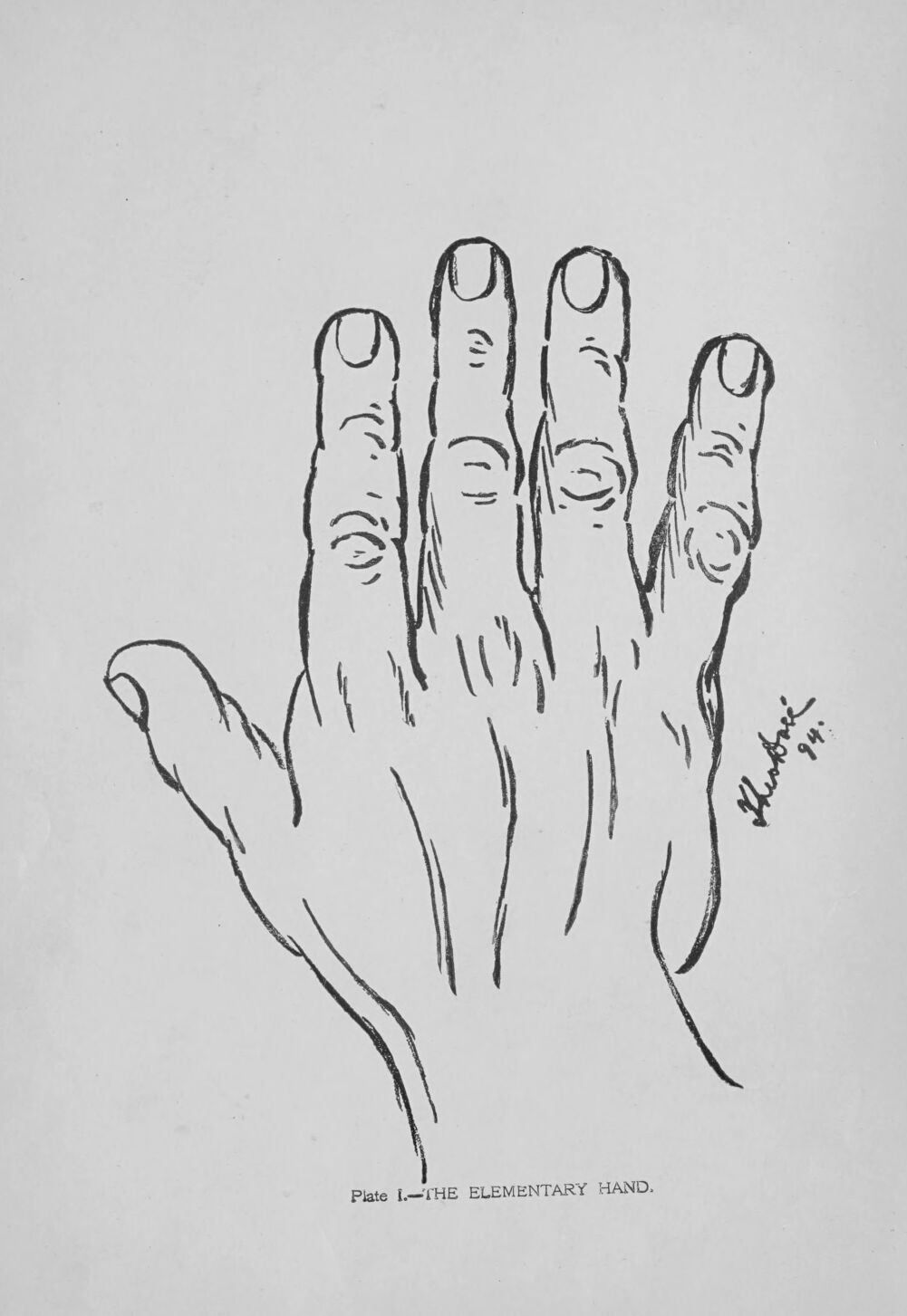
Plate I.—THE ELEMENTARY HAND.