The thumb is in every sense so important that it calls for special attention, not only in the domain of cheirognomy, but also in its relation to cheiromancy. The truth of palmistry could rest upon the solid foundation given by the study of the thumb alone, in its relation to the most important characteristics of the subject.
In every age the thumb has played a conspicuous part, not only in the hand, but also in the world itself. It is a well-known fact that among many of the tribes of Oriental nations, if the prisoner, when brought before his captors, cover his thumb by his fingers, he is in this dumb but eloquent fashion giving up his will and independence, and begging for mercy. We find in the war annals of the children of Israel instances of their cutting off the thumbs of their enemies. Gipsies, in their judgment of character, make the thumb the great foundation for all their remarks. Being interested with gipsies in my early life, I know this for a fact, for I have seen and watched them from the position, angle, and general appearance of the thumb make their calculations accordingly. In India they have a variety of systems by which they read the hand, but here, again, they make the thumb the center and foundation, no matter what system they work out. The Chinese also believe in palmistry, and they, too, base their remarks on the position of the thumb itself. Again, it is an interesting fact to notice that even in Christianity the thumb has played an important rôle, the thumb representing God; the first finger Christ, the indicator of the will of God, and the only finger on the hand that has, by virtue of its position, the power to point, or to stand upright independent of the rest; the second representing the Holy Ghost, as the attendant to the first. In the Greek church the bishop alone gives the blessing by the thumb and first and second fingers, representing the p. 46 Trinity; the ordinary priest has to use the whole hand. And, again, in the old ritual of the English church, we find that in baptism the cross must be made by the thumb.
I do not wish to tire my readers by going into a lengthy dissertation upon the medical points which could be given by the hundred in proof of the importance of this member; but the most significant of all is that which relates to what is known in medical work as the “thumb center” of the brain. It is a well-known fact among the specialists of nerve diseases that by an examination of the thumb they can tell if the patient is affected or is likely to be affected by paralysis or not, as the thumb will indicate such a likelihood a long time before there has appeared the slightest trace of such a disease in any other part of the system. If it indicate such an affection, an operation is at once performed on the thumb center of the brain, and if that operation is successful (which is again shown by the thumb) they have baffled the disease and the patient is saved. And yet, in face of this, which is a well-known fact, there still are people who do not believe in the study of the hand. Within the last few years Dr. Francis Galton has demonstrated in London the marvelous accuracy by which criminals can be traced by the study of the corrugations of the skin of the thumb. En passant, the English government thought well of the idea, and even proposed to put it into practice—and yet that very government arrested and prosecuted palmists during the same year in almost every part of the country. Justice is indeed blind. Another very interesting point is the old idea of the midwives—an idea, by the way, that can easily be seen to contain a good deal of truth. They believed that if the child some days after birth was inclined to keep the thumb inside the fingers, it foreshadowed great physical delicacy, but if, seven days after birth, the thumb was still covered, then there was good reason to suspect that the child would be delicate mentally. If one will visit the asylums of the country, he cannot fail to notice that all congenital idiots have very weak, poor thumbs; in fact, some are so weak as not to be properly developed, even in shape. All weak-minded individuals have weak thumbs, and the man or woman who will stand talking with the fingers covering and concealing the thumb has little self-confidence or self-reliance. It is an interesting thing to watch the hands of people when dying. One will see that, as death approaches and the p. 47 reason goes, the thumb loses all power and drops in on the hand, but that if the reason has only faded temporarily the thumb still retains its power and there is every hope of life. It is D’Arpentigny who has said, “The thumb individualizes the man.” This is remarkably true, particularly when one follows out Sir Charles Bell’s discovery that in the hand of the chimpanzee, which is the nearest approach to the human, though well formed in every way, yet the thumb, if measured, does not reach the base of the first finger. The deduction to be made is, therefore, that the higher and better-proportioned the thumb, the more the intellectual faculties rule, and vice versâ. This point the student will prove by the most casual observation. The man with the short, clumsy, thick-set thumb is coarse and brutish in his ideas and animal in his instincts, while the man or woman with the long, well-shaped thumb is intellectual and refined, and in the attainment of a desire, or the carrying out of an object, such a person will use the strength of intellectual will, as opposed to that of brute force, which will be applied by the man with the thick, short formation. The thumb, therefore, should be long and firm upon the hand. It should not stand at right angles to the palm, nor yet should it lie too close to the side. It should have a slope toward the fingers, and yet not lie down on them. When it stands off the hand, at right angles to it, the nature will fly to extremes, from sheer independence of spirit. It will be impossible to manage or control such natures; they will brook no opposition, and they will be inclined to the aggressive in their manner and bearing. When the thumb is well formed, but lying down, cramped toward the fingers, it indicates the utter want of independence of spirit. It denotes a nervous, timorous, but cautious nature; it will be impossible to find out what such a person is thinking about or what he intends to do; he cannot be outspoken, because his nature is the reverse. If the thumb, however, is a long one, he will use his intellectual faculties to outwit his opponent, but if it be short and thick he will cautiously await his opportunity for any deed of violence that he may meditate. When a well-formed thumb, therefore, strikes the happy medium of these two extremes, the subject will have sufficient independence of spirit to give him dignity and force of character; he will also be properly cautious over his own affairs, and have strength of will and decision. It therefore stands: the long, well-formed p. 48 thumb denotes strength of intellectual will; the short, thick thumb, brute force and obstinacy; the small, weak thumb, weakness of will and want of energy.
From time immemorial the thumb has been divided into three parts, which are significant of the three great powers that rule the world—love, logic, and will.
The first or nail phalange denotes will.
The second phalange, logic.
The third, which is the boundary of the Mount of Venus, love.
When the thumb is unequally developed, as, for instance, the first phalange extremely long, we find that the subject depends upon neither logic nor reason, but simply upon will.
When the second phalange is much longer than the first, the subject, though having all the calmness and exactitude of reason, yet has not sufficient will and determination to carry out his ideas.
When the third phalange is long and the thumb small, the man or woman is a prey to the more passionate or sensual side of the nature.
One of the most interesting things in the study of the thumb is to notice whether the first joint is supple or stiff. When supple, the first phalange is allowed to bend back, and forms the thumb into an arch; when, on the contrary, the thumb is stiff, the first phalange cannot be bent back, even by pressure; and these two opposite peculiarities bear the greatest possible relation to character.
The supple thumb (Plate VIII.) is the distinctive peculiarity of the Latin races; the stiff joint is more the property of the Northern. The supple joint, for instance, is very rare among the Danes, Norwegians, Germans, English, and Scotch, whereas it is found in large numbers among the Irish, French, Spanish, Italians, and wherever these races have congregated. I hardly think that the theory of climatic influence bears out this point. I am more inclined to consider that the unconscious influence of the surroundings, prenatal or otherwise, has more to do with this peculiarity, for the characteristics that it shows in the individual are also the characteristics of the nation to which that individual belongs.
The Supple-Jointed Thumb
For example, the supple-jointed thumb, bending from the hand, is the indication of the extravagant person, not only in matters of money, but in thought; these are life’s natural spendthrifts—improvident of time, improvident of wealth. They have adaptability of temperament for both people and circumstances; they are quickly at home in whatever society they are thrown; they have the sentimental love of kindred and country, as opposed to the practical; they settle down easily to new work and new surroundings, and consequently they quickly make a home in whatever country they are placed.
The Firm-Jointed Thumb
Again, in a general way, the exact opposite of all this is found among the people with the stiff, firm joint (Plate VIII.). In the first place, they are more practical; they have a strong will and a kind of stubborn determination which makes them rather stronger in character, and which is a large element in their success. They are more cautious and secretive; they advance by slow steps where the other nature will act by leaps and bounds. Again, they are not erratic like the first mentioned; they stick to one thing; they carry out their purpose with a kind of resistless stubbornness; they have the practical idea of making the most out of their own home and their own country; they rule with strength; they have a keen sense of justice; they control self as they would control machinery; in war they are solid, strong, and resistless; in love they are undemonstrative, but firm and stanch; in religion their churches are plain, but solid; in art they have the strength of their own individuality.
The Second Phalange
The next important characteristic of the thumb is the shape and make of the second or middle phalange. It will be found that this varies greatly and is a decided indicator of temperament. It has two noticeable formations, namely, the narrow molded center or waist-like appearance (Fig. 3, Plate VIII.), and its opposite, which is full and more clumsy (Fig. 1, Plate VIII.).
In London, in 1892, when I published my “Book on the Hand,” which was to be followed later by this larger and fuller work, I called attention to p. 50 the great difference, as far as character is concerned, shown by these two formations. My statement that the waist-like appearance indicated tact aroused a good deal of interest, and as it was taken exception to by some of my critics, I will here endeavor to show in a logical way why such should be the case. In the first place, the student has by this time seen the truth of my remarks about the finer formation of the thumb being the indication of the greater development of the intellectual will, and the coarse formation that of the nature that will use more brute force in the accomplishment of an object. It therefore follows that the waist-like appearance, which is a portion of the finer development, indicates the tact born of mental power, whereas the fuller, coarser development indicates force in the carrying out of a purpose, in keeping with the characteristics of each nature.
When the first or nail phalange is thick and heavy, with a short, flat nail, it is a sure indication of the ungovernable passion of the subject. All brutal animal natures have such clubbed formations, the force of blind passion completely dominating whatever reason they possess. Such people, as a rule, also have the first joint stiff, and the two points together give that terrible obstinacy of purpose that drives the subject, once out of temper, into deeds of violence and crime. The flat first phalange, consequently, whether short or long, is more calm in matters of temper and more controlled by reason.
When the hand is hard the natural tendency toward energy and firmness indicated by the thumb is increased; consequently the subject with the hard, firm hand and the first phalange of the thumb well developed will be more resolute of purpose and more determined in the execution of his ideas than is the subject with the soft hand.
When the hand is soft the subject will be more inclined to use his will by fits and starts, but cannot be so much depended upon in the execution of his plans.
One very striking peculiarity to be found in this study of human nature through the medium of the hand is shown in the case of people with the supple or bending-back thumb. They rarely have the same keenness of moral consciousness that is found with those of the straight, firm development. They are generally more those impulsive children of nature in whom conscience in morals does not play so important a part.
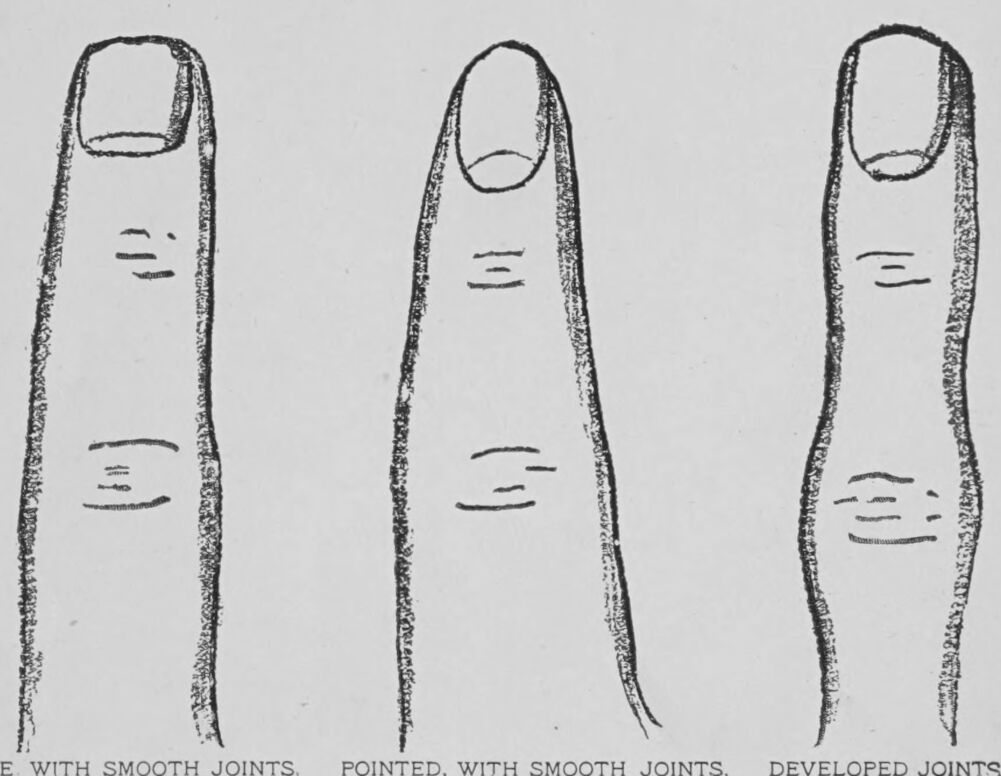
SQUARE WITH SMOOTH JOINTS.
POINTED, WITH SMOOTH JOINTS.
DEVELOPED JOINTS.
Plate IX