... Keep still, my heart,
Nor ask for peace, when care may suit thee best,
Nor ask for love, nor joy, nor even rest,
But be content to love, whate’er betide,
And maybe love will bring thee to Love’s side.
Cheiro.
The line of heart is naturally an important line in the study of the hand. Love, or the attraction of the sexes from natural causes, plays one of the most prominent parts in the drama of life, and as in the nature so in the hand. The line of heart, otherwise called the mensal (Plate XIII.), is that line which runs across the upper portion of the hand at the base of the Mounts of Jupiter, Saturn, the Sun, and Mercury.
The line of heart should be deep, clear, and well colored. It may rise from three important positions, as follows: the middle of the Mount of Jupiter, between the first and second fingers, and from the center of the Mount of Saturn.
When it rises from the center of Jupiter (d-d, Plate XX.), it gives the highest type of love—the pride and the worship of the heart’s ideal. A man with such a formation is firm, strong, and reliable in his affections; he is as well ambitious that the woman of his choice shall be great, noble, and famous—such a man would never marry beneath his station, and will have far less love-affairs than the man with the line from Saturn.
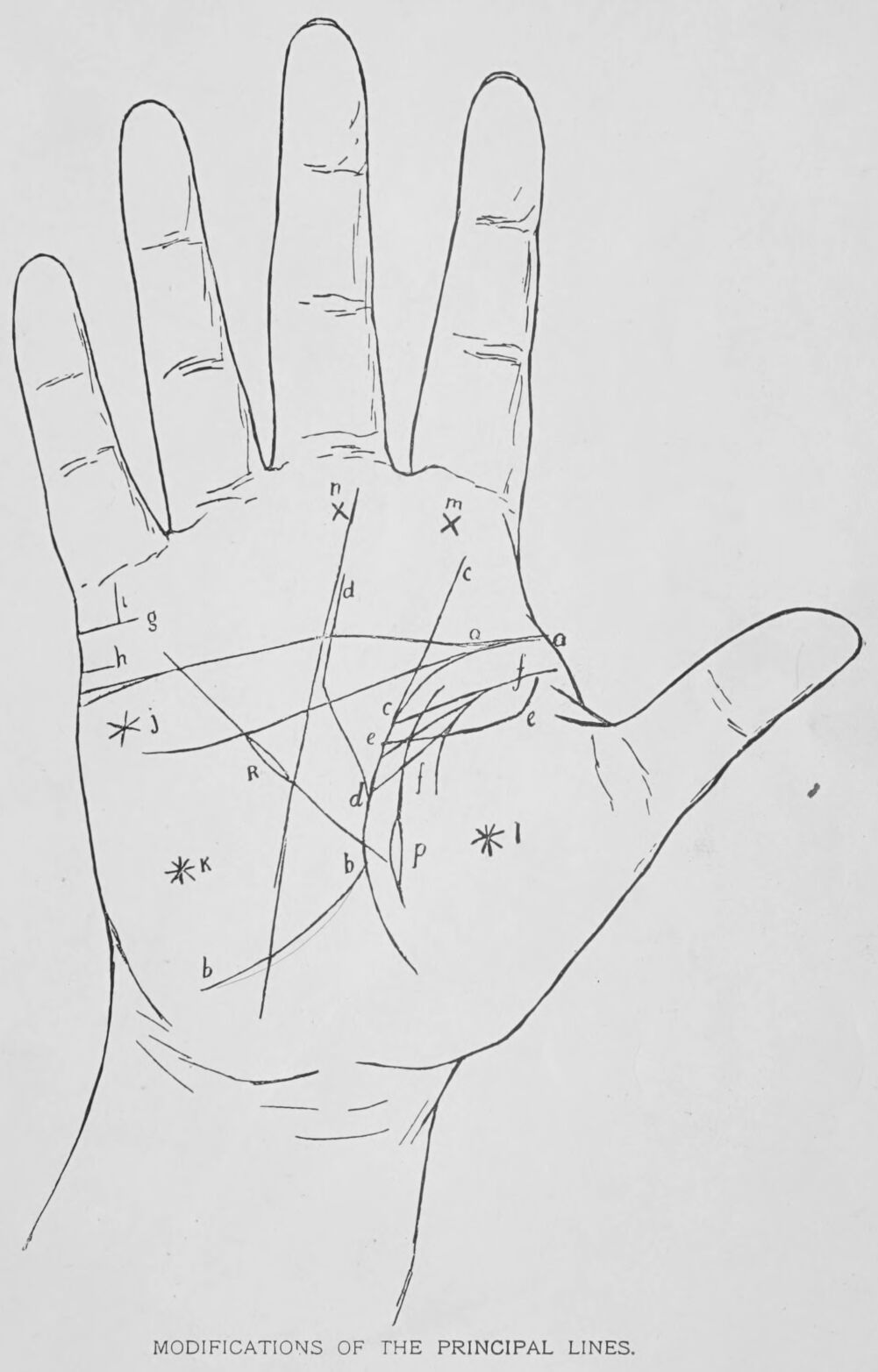
MODIFICATIONS OF THE PRINCIPAL LINES.
Plate XVIII.
Next we will consider the line rising from the Mount of Jupiter, even from the finger itself (e-e, Plate XX.). This denotes the excess of all the foregoing qualities; it gives the blind enthusiast, the man so carried away by his pride that he can see no faults, no failings in that being whom he so devotedly worships. Alas! such people are the sufferers in the world of affection: p. 99 when their idols fall, as idols will sometimes, the shock to their pride is so great that they rarely if ever recover from its effects; but the shock, it must be remarked, is more to their own pride than to the mere fact that the idol they worshiped had feet of clay. Poor worshiper! when wilt thou see that, though women be pure, they be not perfect; they are but human, and being human they are more fitting than if they were divine. Why, then, place them so high that they are the more likely to fall? Their place is by thy side, the companion of thy humanity, the sister part of all thy faults.
The line rising between the first and second fingers gives a calm but deeper nature in matters of love (f-f, Plate XX.). Such individuals seem to rest between the ideality given by Jupiter and the passionate ardor given by Saturn. They are quieter and more subdued in their passions.
With the line of heart rising from Saturn, the subject will have more passion in his attachments, and will be more or less selfish in satisfying his affections; in home life he is never so expressive or demonstrative as are those with the line from Jupiter. The excess of this is the same kind of line rising very high on the mount, often from the very finger of Saturn. Such a subject is far more passionate and sensual than any of the others. It is generally admitted that very sensual people are very selfish—in this case they are extremely so.
When the line of heart is itself in excess, namely, lying right across the hand from side to side, an excess of affection is the result, and a terrible tendency toward jealousy; this is still more accentuated by a very long line of heart rising to the outside of the hand and reaching the base of the first finger.
When the line of heart is much fretted by a crowd of little lines rising into it, it tells of inconstancy, flirtations, a series of amourettes, but no lasting affection (Plate XX.).
A line of heart from Saturn, chained and broad, gives an utter contempt for the subject’s opposite sex.
When the line of heart is bright red, it denotes great violence of passion.
When pale and broad, the subject is blasé and indifferent.
When low down on the hand and thus close to the line of head, the heart will always interfere with the affairs of the head.
When, however, it lies high on the hand, and the space is narrowed by the line of head being too close, the reverse is the case, and the head will so completely rule the affections that it gives a hard, cold nature, envious and uncharitable.
Breaks in the line tell of disappointment in affection—under Saturn, brought about by fatality; under the Sun, through pride; and under Mercury, through folly and caprice.
When the line of heart commences with a small fork on the Mount of Jupiter (j-j, Plate XVI.), it is an unfailing sign of a true, honest nature and enthusiasm in love.
A very remarkable point is to notice whether the line of heart commence high or low on the hand. The first is the best, because it shows the happiest nature.
The line lying so low that it droops down toward the line of head is a sure sign of unhappiness in affections during the early portion of the life.
When the line of heart forks, with one branch resting on Jupiter, the other between the first and second fingers, it is a sign of a happy, tranquil nature, good fortune, and happiness in affection; but when the fork is so wide that one branch rests on Jupiter, the other on Saturn, it then denotes a very uncertain disposition, and one that is not inclined to make the marital relations happy, through its erratic temperament in affection.
When the line is quite bare of branches and thin, it tells of coldness of heart and want of affection.
When bare and thin toward the percussion or side of the hand, it denotes sterility.
Fine lines rising up to the line of heart from the line of head denote those who influence our thoughts in affairs of the heart, and by being crossed or uncrossed denote if the affection has brought trouble or has been smooth and fortunate.
When the lines of heart, head and life are very much joined together, it is an evil sign; in all matters of affection such a subject would stick at nothing to obtain his or her desires.
A subject with no line of heart, or with very little, has not the power of feeling very deep affection. Such a person can, however, be very sensual, particularly p. 101 if the hand is soft. On a hard hand such a mark will affect the subject less—he may not be sensual, but he will never feel very deep affection.
When, however, the line has been there, but has faded out, it is a sign that the subject has had such terrible disappointments in affection that he has become cold, heartless, and indifferent.