The Girdle of Venus (Plate XIII.) is that broken or unbroken kind of semicircle rising between the first and second fingers and finishing between the third and fourth.
I must here state that I have never found this sign to indicate the sensuality so generally ascribed to it except when found on a broad, thick hand. Its real domain is usually on such hands as the conic and psychic. A little study will prove that this mark is as a rule associated with highly sensitive, intellectual natures, but natures changeable in moods, easily offended, and touchy over little things. It denotes a highly strung, nervous temperament, and when unbroken it certainly gives a most unhappy tendency toward hysteria and despondency.
People possessing this mark are capable of rising to the highest pitch of enthusiasm over anything that engages their fancy, but they are rarely twice in the same mood—one moment in the height of spirits, the next miserable and despondent.
When the girdle goes over the side of the hand and by so doing comes in contact with the line of marriage (k-k, Plate XVI.), the happiness of the marriage will be marred through the peculiarities of the temperament. Such subjects are peculiarly exacting, and hard to live with. If on a man’s hand, that man would want as many virtues in a wife as there are stars in the universe.
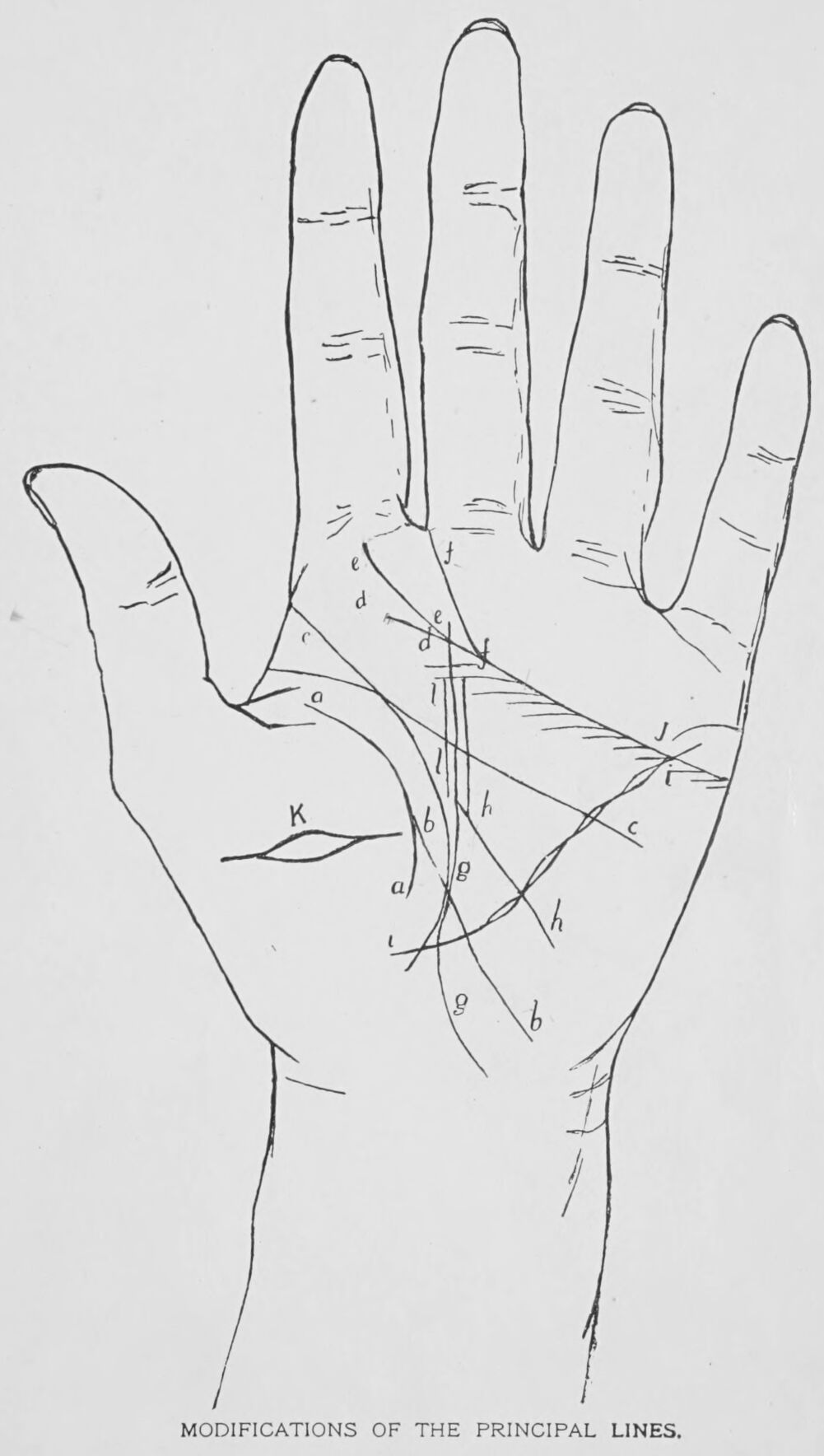
MODIFICATIONS OF THE PRINCIPAL LINES.
Plate XX.
The Ring of Saturn
The Ring of Saturn (Plate XII.) is a mark very seldom found, and is not a good sign to have on the hand. I have closely watched people possessing it, and I have never yet observed that they were in any way successful. It seems to cut off the Mount of Fate in such a peculiar way that such people never p. 113 gain any point that they may work for or desire. Their temperament has a great deal—it may have everything—to do with this, as I always find these people full of big ideas and plans, but with such want of continuity of purpose that they always give up half-way. (See also Plate XXV.)
The Three Bracelets
The bracelets (Plate XIII.) I do not consider of much importance in reading the lines, or in the study of the hand itself. There is, however, one strange and peculiar point with regard to them, and one that I have noticed contains a great deal of truth. I had been taught in my early life, always to observe principally the position of the first bracelet, the one nearest the hand, and that when I saw it high on the wrist, almost rising into the palm, particularly when it rose in the shape of an arch (m-m, Plate XVI.), I was always to warn my consultant of weakness in relation to the internal organs of the body—as, for instance, in the bearing of children. Afterwards in my life, when I took up this study in a more practical way, I found there was a great deal of truth in what I at first thought a superstition. In later years, by watching case after case, by going through hospitals, and from what my many consultants have told me in reference to their ailments, I have become convinced that this point deserves being recorded, and consequently I now give it for what it may be worth.
Another significance attached to the bracelets is that, if well and clearly defined, they mean strong health and a robust constitution, and this again, it is interesting to notice, bears out in a manner the point I have called attention to.