The square (Plate XV.) is one of the most interesting of the lesser signs. It is usually called “the mark of preservation,” because it shows that the subject is protected at that particular point from whatever danger menaced.
When the line of fate runs through a well-formed square, it denotes one of the greatest crises in the subject’s life in a worldly sense, connected with financial disaster or loss, but if the line goes right on through the square all danger will be averted. Even when the line of fate breaks in the center, the square is still a sign of protection from very serious loss.
When outside the line, but only touching it, and directly under the Mount of Saturn, it denotes preservation from accident.
When the line of head runs through a well-formed square, it is a sign of strength and preservation to the brain itself, and tells of some terrible strain of work or of anxiety at that particular moment.
When rising above the line of head under Saturn, it foretells a preservation from some danger to the head.
When the line of heart runs through a square, it denotes some heavy trouble brought on by the affections. When under Saturn, some fatality to the object of one’s affection (j, Plate XXI.).
When the life-line passes through a square, it denotes a protection from death, even if the line be broken at that point (k, Plate XXI.).
A square on the Mount of Venus inside the line of life denotes preservation from trouble brought on by the passions (l, Plate XXI.). When resting in the center of the Mount of Venus, it tells that the subject will fall into all kinds of danger through passion, but will always manage to escape.
When, however, lying outside the line of life and touching it from the p. 128 Plain of Mars, a square in such a place means imprisonment or seclusion from the world.
When on the mounts the square denotes a protection from any excess arising through the qualities of the mount:
On Jupiter, from the ambition of the subject.
On Saturn, from the fatality that shadows the life.
On the Sun, from the desire for fame.
On Mercury, from the restless, mercurial temperament.
On Mars, from danger through enemies.
On Luna, from an excess of imagination, or from the evil effects of some other line, as, for instance, a line of travel.
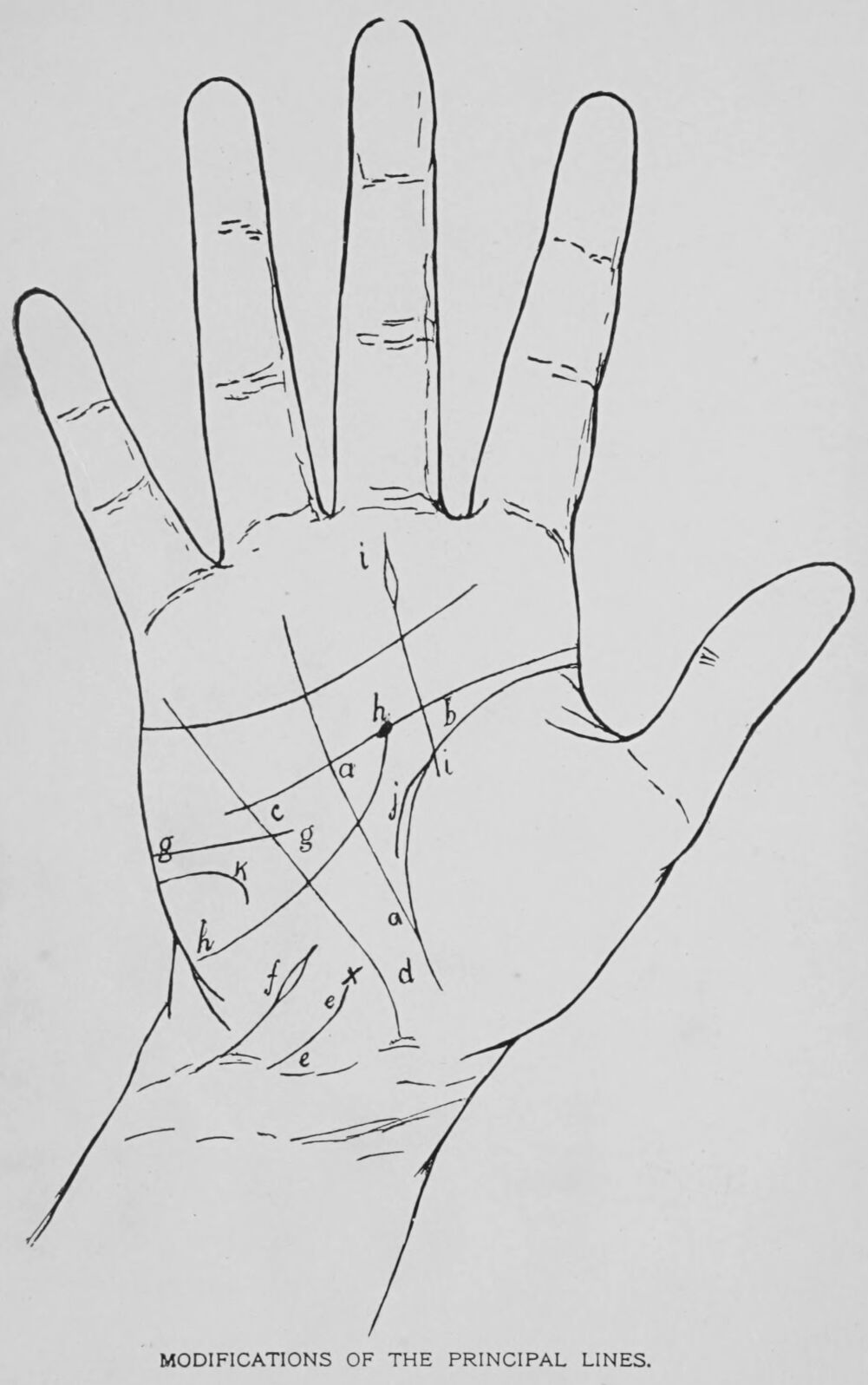
MODIFICATIONS OF THE PRINCIPAL LINES.
Plate XXII.