The rules in relation to the lines are, in the first place, that they should be clear and well marked, neither broad nor pale in color; that they should be free from all breaks, islands, or irregularities of any kind.
Lines very pale in color indicate, in the first place, want of robust health, and, in the second, lack of energy and decision.
Lines red in color indicate the sanguine, hopeful disposition; they show an active, robust temperament.
Yellow lines, as well as being indicative of biliousness and liver trouble, are indicators of a nature self-contained, reserved, and proud.
Lines very dark in color, almost black, tell of a melancholy, grave temperament, and also indicate a haughty, distant nature, one usually very revengeful and unforgiving.
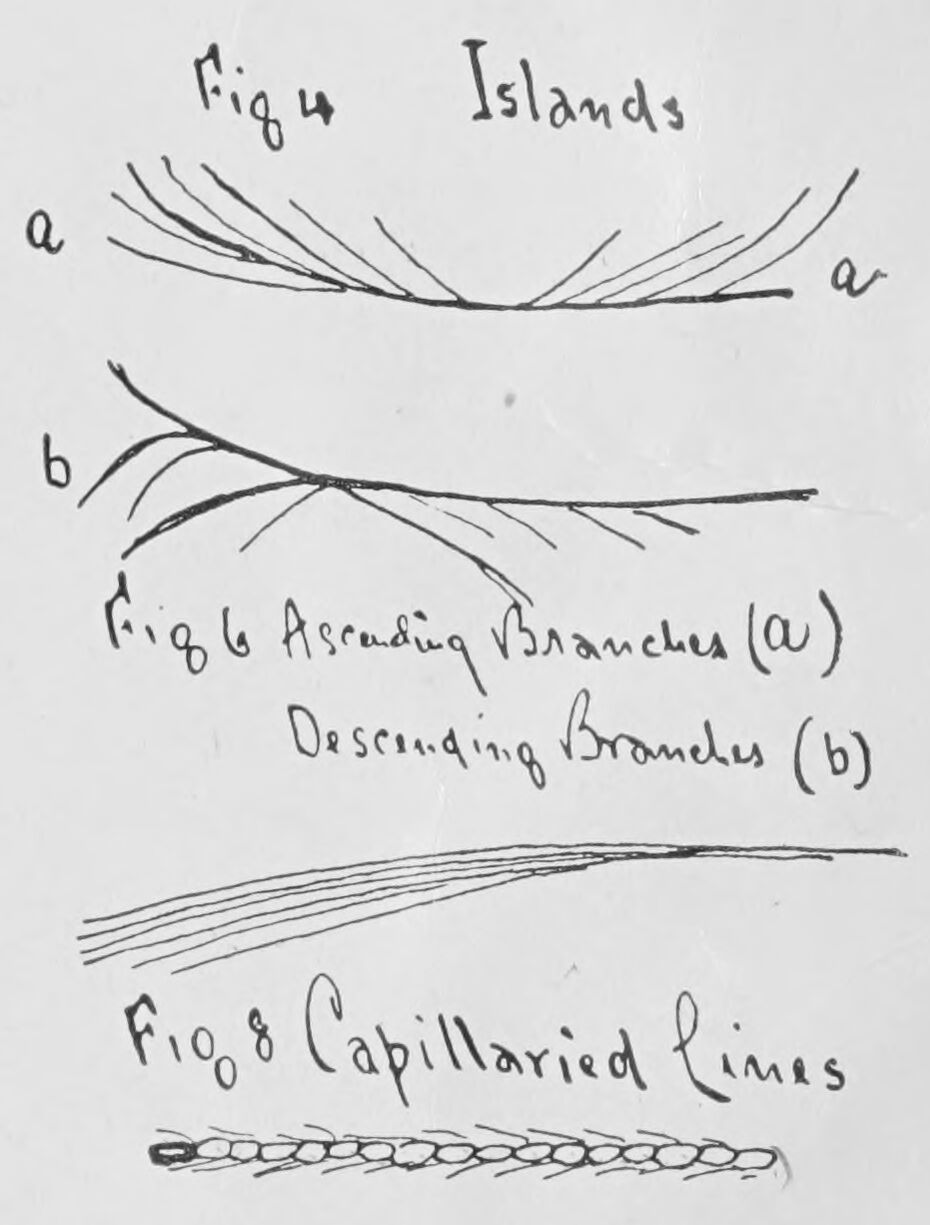
Plate XIV.—LINE FORMATIONS.
Lines may appear, diminish, or fade, which must always be borne in mind when reading the hand. The province of the palmist, therefore, is to warn the subject of approaching danger by pointing out the evil tendencies of his nature. It is purely a matter of the subject’s will whether or not he will overcome these tendencies, and it is by seeing how the nature has modified evils in the past that the palmist can predict whether or not evils will be overcome in the future. In reading the hand, no single evil mark must be accepted as decisive. If the evil is important, almost every principal line will show its effect, and both hands must be consulted before the decision can be final. A single sign in itself only shows the tendency; when, however, the sign is repeated by other lines, the danger is then a certainity. In answer to the question, Can people avert or avoid danger or disaster predicted in the hand? I answer that decidedly I believe that they can; but I say just as decidedly that they rarely if ever do. I know hundreds p. 75 of cases in my own experience where people were given accurate warnings which they did not realize till too late. The most remarkable example of this which I can recall was the case of a woman well known in London society. I warned her of an accident caused by animals which would make her infirm for the rest of her life, and which would happen at the very point of age that she had then reached. She promised that she would be careful, and departed. A week later, one dull foggy night, she ordered her horses; again she got a warning, this time through her husband, who begged her not to go out, as the horses were restive and the night bad. The horses were brought round, and with them the last warning: her coachman had been taken seriously ill, and a substitute had to take his place. Even this did not deter her, and she started. The coachman could have gone four different ways to reach her destination, but, strange to say, he took the most unlikely, and drove through Bond Street. It was in doing this that the most remarkable point in this example was reached. The man lost control of the horses; they took fright, dashed in on the sidewalk; the carriage was smashed against a lamp-post, and, by an extraordinary coincidence, its occupant was carried unconscious into my own hall. I am sorry to say that the prediction has proved only too true: she has never recovered from those injuries, and never will.
I make no comment on this strange story; I simply relate the facts as they occurred.
The above is only one example in many that could be cited to show that we rarely if ever will go by warnings, no matter in what way they may be given.
When an important line, such as the line of head or of life, is found with what is called a sister line (a-a, Plate XVI.), namely, a fine line running by its side, it is a sign that the main line is thus strengthened; consequently any break in the main line will be, as it were, bridged over by this mark, and the danger lessened or prevented. This is more often found in connection with the line of life than with any other.
If there is a fork at the end of any line, except that of life (Plate XVI.), it gives greater power to that line; as, for instance, on the line of head it increases the mentality, but makes more or less of a double nature.
When, however, the line ends in a tassel (b-b, Plate XVI.) it is a sign of weakness and destruction to any line of which it forms part, particularly at the end of the line of life, where it denotes weakness and the dissipation of all the nerve qualities.
Branches rising from any line (a-a, Plate XIV.) accentuate its power and strength, but all branches descending denote the reverse.
At the commencement of the line of heart, these lines are most important when considering the success of marriage for the subject: the ascending lines at this point indicate vigor and warmth of the affections (a-a, Plate XVII.); the descending, the opposite.
On the line of head ascending branches denote cleverness and ambitious talent (c-c, Plate XVI.), and on the line of fate they show success in all undertakings made at that particular point.
A chained formation in any line is a weak sign (Plate XIV.): if on the line of heart it denotes weakness and changeability of affection; if on the line of head, want of fixity of ideas, and weakness of intellect.
Breaks in any line denote its failure (c-c, Plate XVII.).
A wavy formation weakens the power of the line (b-b, Plate XVII.).
Capillary lines are those little hair-lines running by the side of the main line, sometimes joining it, sometimes falling from it; they denote weakness, like the chained formation (Fig. 8, Plate XIV.).
When the entire hand is covered with a network or multitude of little lines running aimlessly in all directions, it betrays mental worry, a highly nervous temperament, and a troubled nature.
As the little grains make mountains, so do these little points make this study great. I therefore recommend their close consideration.