The line of Mars (Plate XIII.) is otherwise known as the inner vital or inner life line. It rises on the Mount of Mars, and sweeps down by the side of the line of life, but is distinct in every way from those faint lines known as the attendant lines, of which I spoke a little earlier.
The general characteristic of the line of Mars is that it denotes excess of health on all square or broad hands; to a man of this type it gives a martial nature, rather a fighting disposition, and robust strength. It also denotes that while it runs close to the life-line the individual will be engaged in many quarrels, and will be subject to a great deal of annoyance which will bring all his martial or fighting qualities into play. It is always an excellent sign on the hand of a soldier.
When a branch shoots from this line out to the Mount of Luna (b-b, Plate XX.), it tells that there is a terrible tendency toward intemperance of every kind, through the very robustness of the nature, and the craving for excitement that it gives.
The other type of the line of Mars is found on the long narrow hand, and here it is generally by the side of a delicate fragile, line of life. Its characteristics in such a hand are that it supports the life-line, carrying it past any dangerous breaks, and giving vitality to the nature.
A broken line of life with such a line beside it will at the point of the break indicate closeness to death, but helped by this mark the subject will recover, through the great vitality given by the line of Mars.
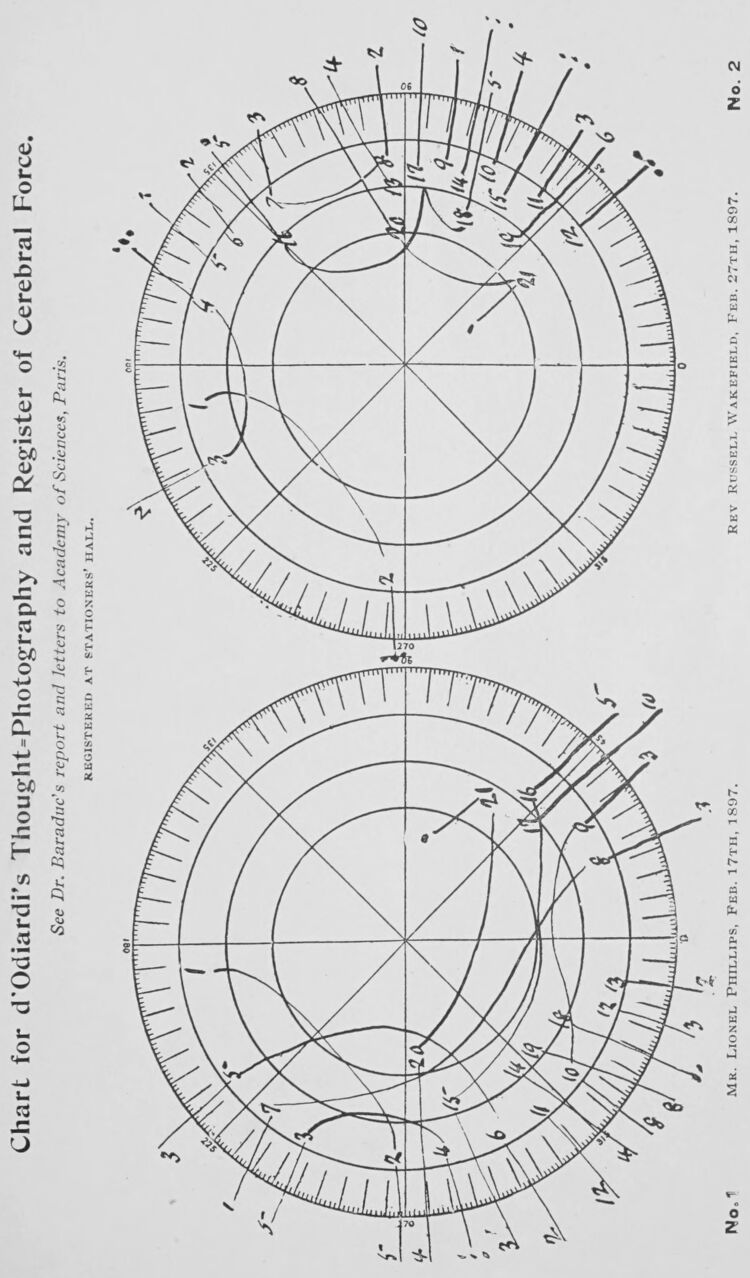
Chart for d’Odiardi’s Thought-Photography and Register of Cerebral Force.
See Dr. Baraduc’s report and letters to Academy of Sciences, Paris.
REGISTERED AT STATIONERS’ HALL.
No. 1 MR. LIONEL PHILLIPS, FEB. 17TH, 1897.
REV. RUSSELL WAKEFIELD, FEB. 27TH, 1897. No. 2
Explanation of Movement.
The needle started at 1, went to 2, from 2 to 3, from 3 to 4, and so on with the numbers marked inside the chart.
The numbers outside show the duration of the stoppage, viz.: in No. 1 chart it will be seen that at No. 2 movement the needle remained for five seconds before it moved to 3, whereas in No. 2 chart at No. 2 movement it would not remain steady.
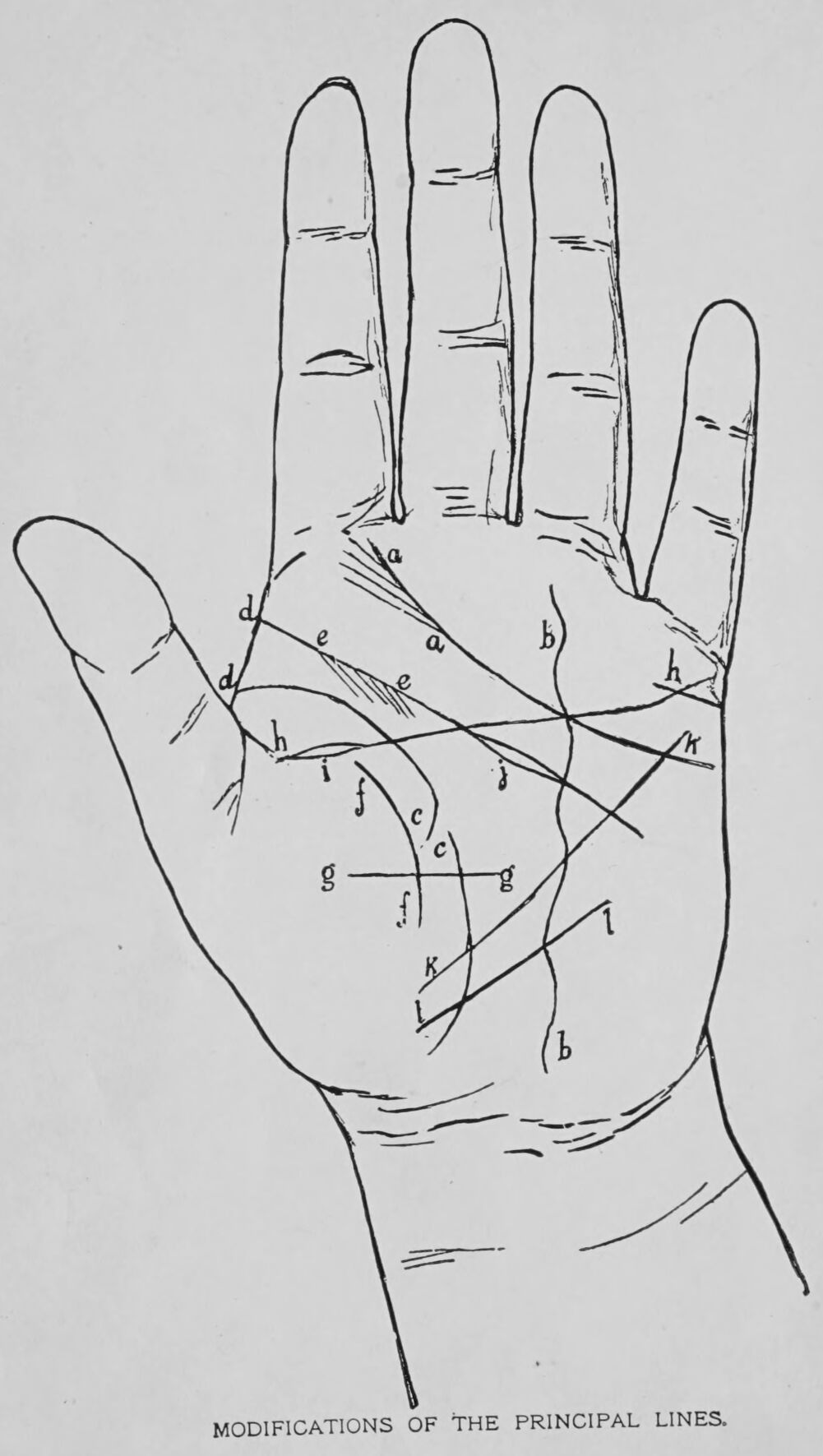
MODIFICATIONS OF THE PRINCIPAL LINES.
Plate XVII.