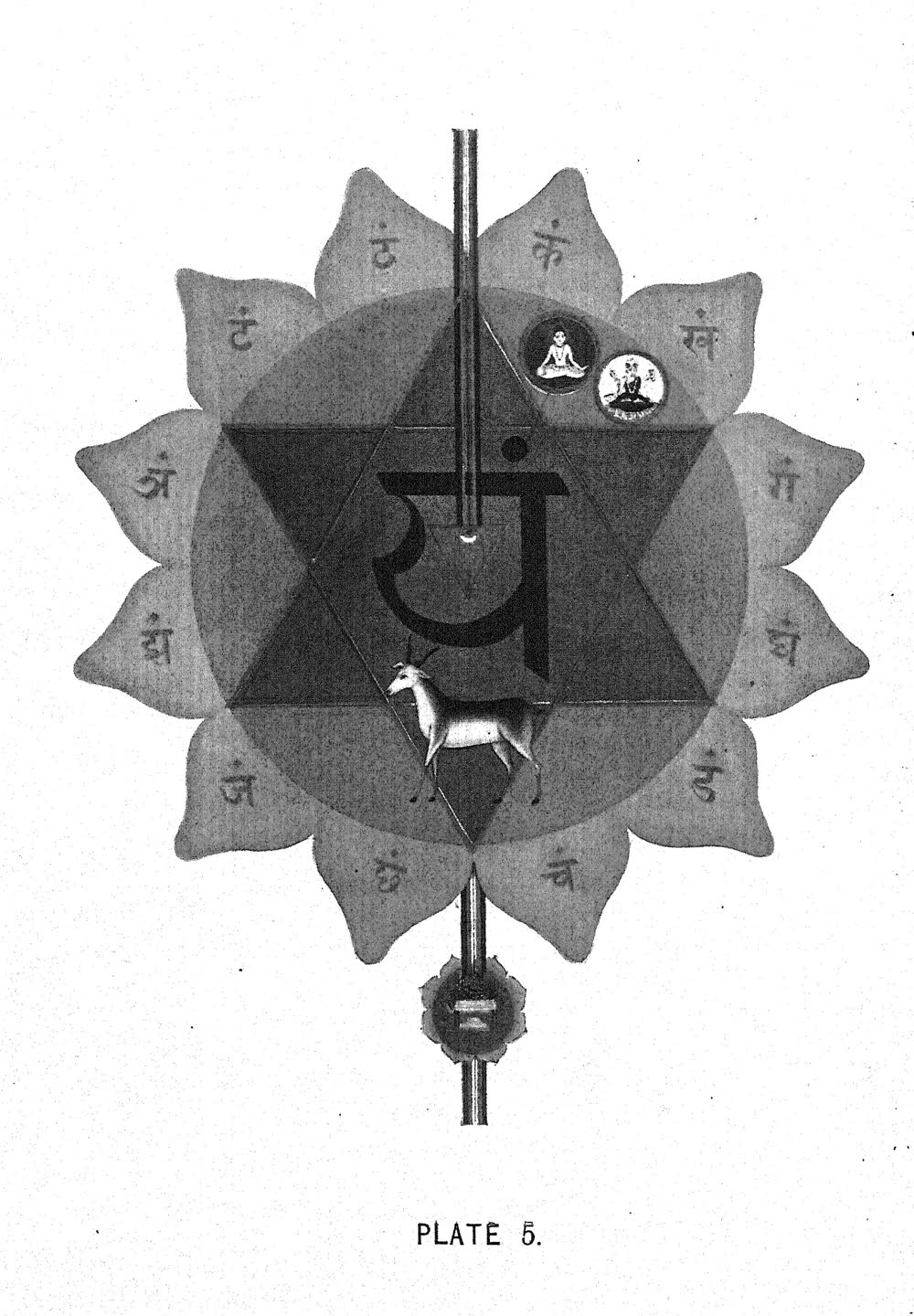
〈Plate V: a lotus drawn with its letters, its seed-mantra and its animal; the List of Illustrations (p. xv) names it Anāhata〉 PLATE 5.
Preliminary Verse
Now I speak of the first sprouting shoot (of the Yoga plant) of complete realisation of the Brahman, which is to be achieved, according to the Tantras, by means of the six Chakras and so forth in their proper order.
Commentary
“He alone who has become acquainted with the wealth1 of the six Lotuses2 by Mahā-yoga is able to explain the inner principles3 thereof. Not even the most excellent among the wise, nor the oldest (in experience), is able, without the mercy of the Guru,4 to explain the inner principles relating to the six Lotuses, replete as they are with the greatness of Sha, Sa, and Ha.”5
- 1 Parichita-shadambhoja-vibhava. p. 1
- 2 That is, the Shat-chakra; six centres, which are: Mūlādhāra Svādhishthāna, Manipūra, Anāhata, Vishuddha, and Ājnā. p. 1
- 3 Antas-tattva—i.e., relating to the shat-chakra. p. 1
- 4 Kripā-nātha, Lord of Mercyi.e., the Guru. p. 1
- 5 Sha, Sa, Ha. Sha=Final Liberation. Sa=Knowledge. Ha=Supreme Spirit; also Brahmā, Vishnu, and Shiva, respectively. p. 1
Now, the very merciful Pūrnānanda Svāmī, wishful to rescue the world sunk in the mire of misery, takes that task upon p. 2 himself. He does so to guide Sādhakas;6 to impart Tattvajnāna,7 which leads to Liberation; and also with the desire of speaking of the union of Kundalinī8 with the six Chakras.9
- 6 Those who practise Sādhanā, or spiritual discipline; here aspirants for Yoga. p. 2
- 7 Tattva-jnāna=Brahma-jnāna, or Brahman-knowledge. p. 2
- 8 The Devī as Shabda Brahman (Shabda-brahma-rūpā Kundalinī, v. 2, post) in the world of the body (Pindāndā), or Kshudra-brahmānda (microcosm). Verse 10 describes Her as She who maintains all beings in the world by inhalation and exhalation. Unmanifested “sound” assumes the form of Kundalī in the animal body (vv. 10, 11). p. 2
- 9 Mūlādhāra, etc. p. 2
“Now” (Atha).—The force of this particle is to show the connection of this book with the Author’s work entitled Shrī-tattva-chintāmani, the first five chapters of which deal with the rites and practices preliminary to Shat-chakranirūpana.10 In this book he speaks of the first shoot of the realisation of the Brahman.
- 10 Shat-chakra-nirūpana. Nirūpana=investigation, ascertainment into, and of, the six Chakras. This forms the sixth chapter of Pūrnānanda’s Shrī-tattva-chintāmani. p. 2
Paramānanda (Supreme Bliss) means Brahman, Who, says Shruti, is “Eternal (Nityam) and knowledge (Vijnānam) and Bliss (Ānandam)”.
“Following the Tantras” (Tantrānusārena)—i.e., following the authority of the Tantras.11
- 11 In which is to be found a detailed description of the process here described, known as Shat-chakra-bheda, or piercing of the six Chakras. p. 2
“First sprouting shoot” (Prathamāngkura)—i.e., the first steps which lead to realisation of the Brahman. The first cause of such realisation is achieved by knowledge of the six Chakras, the Nādīs,12 and so forth, which is the Tāntrika Yoga Sādhanā.
- 12 The “nerves,” or channels of energy (see v. 2). Nādī is derived from the root nad, “motion,” and means a channel (Vivara). p. 2
“Complete realisation” (Nirvāha).—The Sanskrit word means “accomplishment”; here, it is the accomplishment of the immediate experiential realisation of the Brahman.13
- 13 Brahma-sākshātkāra-rūpa-nishpattih. p. 2
“Achieved by means of the six Chakras and other things” (Shat-chakrādī-kramodgata)—i.e., attained by14 meditating on the p. 3 six Chakras, viz.: Mūlādhāra, Svādhishthāna, Manipūra, Anāhata, Vishuddha, and Ājnā and other things,15 viz.: on the Nādīs16, the Linggas,17 the five Elements,18 Shiva, Shakti, etc., connected with the six Chakras, in their order.
- 14 “Attained by.” This is Udgata, which literally means “sprung out of” or “sprouted out of”. p. 2
- 15 According to Shangkara, by “other things” are meant the Sahasrāra, etc. This Shangkara here and hereafter referred to is a commentator on this work, and not the philosopher Shangkarāchāryya. p. 3
- 16 See note 2, p. 5. p. 3
- 17 In three of the Chakras—viz., Svayambhu, Vāna, and Itara. p. 3
- 18 Vyoma-panchaka. p. 3
The order (Krama) is, first, meditation on them, next awakening of Kundalinī, and Her passage to the Brahma lotus and then Her return therefrom; the union of Shiva and Shakti, etc., and so forth.
“Order” (Krama) by which it is attained, and this is the same as Yoga practice.
The Author in substance says: “I speak of the first step (Angkura) of the practice which is the First Cause of the immediate or experiential realisation19 of the Brahman, brought about by a knowledge of the six Chakras, as is laid down in the Tantras.”
- 19 Brahma-sākshāt-kāra. p. 3
Verse 1
In the space outside the Meru,20 placed on the left and the right, are the two Shirās,21 Shashī22 and Mihira.23 The Nādī Sushumnā, whose substance is the threefold Gunas,24 is in the middle. She is the form of Moon, Sun, and Fire;25 Her body, a string of blooming Dhūstūra26 flowers, extends from the middle of the Kanda27 to the Head, and the Vajrā inside Her extends, shining, from the Medhra28 to the Head.
- 20 The spinal column. p. 4
- 21 i.e., Nādīs. p. 4
- 22 Moon—that is, the feminine, or Shakti-rūpā Nādī Idā, on the left. p. 4
- 23 Sun, or the masculine Nādī Pinggalā, on the right. p. 4
- 24 Meaning either (v. post) the Gunas, Sattva, Rajas, and Tamas; or, as “strings,” the Nādī Sushumnā with the Nādī Vajrā inside it, and the Nādī Chitrinī within the latter. p. 4
- 25 That is, as Chitrinī, Vajrinī and Sushumnā. p. 4
- 26 Dhatura fastuos. p. 4
- 27 The root of all the Nādīs (v. post). Kanda=Bulb. p. 4
- 28 Penis. p. 4
Commentary
Now, Yoga like that which is about to be spoken of cannot be achieved without a knowledge of the six Chakras and the Nādīs; the Author therefore describes the relative Nādīs in this and the following two verses.
“In the space outside” (Vāhya-pradeshe) the two Nādīs. Shashī and Mihira (Shashi-mihira-shire=the two Nādīs or Shirās, Shashī and Mihira). Shashī=Chandra (Moon); Mihira=Sūryya (Sun). These two Nādīs, which are in the nature of the Moon and Sun,29 are the Nādīs, Īdā and Pinggalā.
- 29 Chandrasvarūpinī and Sūryyarūpā. p. 4
“Meru.”—This is the Meru-danda, the backbone or spinal column, extending from the Mūla (root) or Mūlādhāra to the neck. This will be explained later.
“Placed on the left and the right” (Savya-dakshe nishanne).
“These two Nādīs.”—“The Idā is placed on the left, and the Pinggalā on the right of the Meru” says the Bhūta-shuddhi Tantra. The Sammohana Tantra30 speaks of their likeness to the Sun and Moon as follows:
- 30 Ch. iv, 5—6. The seventh verse, which is not quoted by the Commentator, runs: “Inside the Meru, she who extends from the Mūla to the place of Brahman is the fiery Sushumnā, the very self of all knowledge.” p. 5
“The Īdā Nādī on the left is pale, and is in the nature of the Moon31 (Chandrasvarūpinī). She is the Shakti-rūpā Devī,32 and the very embodiment of nectar (Amrita-vigrahā). On the right is the masculine Pinggalā, in the nature of the Sun. She, the great Devī, is Rudrātmikā,33 and is lustrous red like the filaments of the pomegranate flower.”
These two Nādīs go upward singly from the Mūla (i.e., Mūlādhāra), and, having reached the Ājnā Chakra, proceed to the nostrils.
The Yāmala says: “On its (i.e., the Meru’s) left and right are Idā and Pinggalā. These two go straight up, alternating from left to right and right to left, and, having thus gone round all the Lotuses, these auspicious ones proceed to the nostrils.”
The above passage shows the twofold and differing positions of the two Nādīs. They go upward alternating from left to right and right to left, and going round the Lotuses (Padma) they form a plait and go to the nostrils.
Elsewhere they are described as being placed like bows: “Know that the two Nādīs Īdā and Pinggalā are shaped like bows.”
Also:34 “She who is connected with the left scrotum is united with the Sushumnā, and, passing near by the right p. 6 shoulder-joint, remains bent like a bow by the heart, and having reached the left shoulder-joint passes on to the nose. Similarly, She that comes from the right scrotum passes on to the left nostril.”
- 34 Passage is from Prapanchasāra (Vol. III, Tantrik Texts), Ch. I, vv. 81, 82. There is a variant reading nādikā for nāsikā. p. 5
These two Nādīs which come from the left and right scrotum, when they reach the space between the eyebrows, make with the Sushumnā a plaited knot of three (Trivenī) and proceed to the nostrils.
They are also thus described: “In the Idā is the Devī Yamunā, and in Pinggalā is Sarasvatī, and in Sushumnā dwells Gangā.35 They form a threefold plait36 united at the root of the Dhvaja,37 they separate at the eyebrows, and hence it is called Trivenī-yoga, and bathing there38 yields abundant fruit.”
- 35 Sammohana Tantra, Ch. II, 13, thus: “In the Idā is the Devī Jāhnavī, and Yamunā is in Pinggala, and Sarasvatī is in Sushumnā”—all names of Indian sacred rivers. p. 6
- 36 This is also interpreted to mean that the three Nādīs conjoin at the three Granthis—Brahma-granthi, Vishnu-granthi and Rudra-granthi. p. 6
- 37 The penis. p. 6
- 38 By “bathing there,” etc., in the “rivers” is meant., when the mind is suffused with a full knowledge of this Chakra great benefit is thereby attained. p. 6
“Whose substance is the threefold Gunas” (Tritaya-gunamayī).—The compound word here used is capable of different interpretations. Reading Guna to mean “a string,” it would mean “made up of three strings”—viz., Sushumnā, Vajrā and Chitrinī.39 These three form one, but considered separately they are distinct. If Guna be read to mean “quality,” then it would mean “possessed of the qualities Sattva, Rajas and Tamas”. Now, the substance of Chitrinī is Sattva (Sattvagunamayī), of Vajrā, Rajas, and of Sushumnā, Tamas.
- 39 Sushumnā is the outermost sheath, and Chitrinī the innermost, and within Chitrinī is Brahmanādi, the channel along which Kundalī goes. p. 6
“Is in the middle” (Madhye)—i.e., in the middle or inside the Meru.
“She who is inside the Meru from the Mūla to the region of the Brahma-randhra,”40 etc.
- 40 Sammohana Tantra, II, 7; also occurs in Ch. XXVII, v. 52, of Rudrayāmala. p. 6
Tripurā-sara-sāmuchchaya says: “She who is within the hollow of the Danda, extending from the head to the Ādhāra” (i.e., Mūlādhāra), and so forth.
Some persons rely on the following passage of the Tantrachūdāmani, and urge that it shows that the Sushumnā is outside the Meru: “O Shivā, on the left of Meru is placed the Nādī Idā, the Moon-nectar, and on its right the Sun-like Pinggalā. Outside it (Tad-vāhye)41 and between these two (Tayor madhye) is the fiery Sushumnā.”
- 41 If Tad-vāhye be interpreted to mean outside these two, then this apparent contradiction is removed. Tadvāhye is formed either by Tasya vāhye or Tayor vāhye; if the latter, then the meaning would be outside the two. Those who rely upon this passage read Tad-vāhye as equal to Tasya vāhye. p. 7
But this is merely the opinion of these persons. Our Author speaks (in the following verse) of the Lotuses inside the Meru; and as the Sushumnā supports these she must needs be within the Meru.
“Form of Moon, Sun, and Fire” (Chandra-sūryyāgni-rūpā).—Chitrinī is pale, and is the form of the Moon, Vajrinī42 is Sunlike, and hence has the lustre of the filaments of the pomegranate flower; Sushumnā is fiery, and hence red. The Bhūtashuddhi Tantra, in describing the Sushumnā, supports these three descriptions. Sushumnā is the outermost and Chitrinī the innermost.
- 42 Vajrinī=vajrā. p. 7
“Inside it, at a height of two fingers’ breadth, is Vajrā, and so is Chitrinī; hence it is that Sushumnā is Trigunā; she is tremulous like a passionate woman; she is the receptacle of the three Gunas, Sattva and others, and the very form of Moon, Sun and Fire.”
“From the middle of the Kanda to the Head” (Kandamadhyāch chhirahsthā).—Kanda is the root of all the Nādīs. It is spoken of as follows: “Two fingers above the anus and two fingers below the Medhra43 is the Kanda-mūla, in shape like a bird’s egg, and four fingers’ breadth in extent. The Nādīs, 72,000 in number, emanate from it.” The Nādīs come out of this Kanda.
- 43 Medhra=penis. p. 7
Shirahsthā (placed in the head): By this is to be understood that she ends in the middle of the Lotus of twelve petals which is near the pericarp of the Sahasrāra, hanging downwards in the p. 8 head. See the opening verse of Pādukā-panchaka: “I adore the twelve-petalled Lotus that is the crown of the Nādī along the channel (Randhra)44 within which the Kundalī passes.”
- 44 This channel or passage within Chitrinī is Brahmanādī. p. 8
As the Chitrinī ends here, her Container, Sushumnā, also ends here. If it be taken to mean that she exists above the Sahasrāra, then there will be a contradiction to the description in the fortieth verse, where the Sahasrāra is spoken of as “shining in vacant space” (Shūnyadeshe prakāsham). If Sushumnā passes over it, there can be no vacant space.
There are some who contend that all the three Nādīs—Idā, Pinggalā, and Sushumnā—are inside the Meru, and quote the following as their authority from the Nigama-tattva-sāra: “The three Nādīs are said to be inside the Meru, in the middle of the back.” But this cannot be; all the Tantras say that the Idā and Pinggalā are outside the Meru, and on the authority of these our Author speaks of their being outside the Meru. Further, if they were inside the Meru they could not be bow-shaped and touch the hip and shoulder joints. The Nigama-tattva-sāra by the “three Nādīs” apparently means Sushumnā, Vajrā and Chitrinī, and not Idā, Pinggalā and Sushumnā.
The position of the Sushumnā from the Mūlādhāra to the head is thus described: “Sushumnā goes forward, clinging like a Chavya-creeper45 to the Meru, and reaching the end of the neck, O Beauteous One, she emerges and deflects, and, supporting herself on the stalk of the Shangkhinī,46 goes towards the region of Brahman (Brahma-sadana).”
Also cf.: “The other two are placed like bows. Sushumnā is the embodiment of Pranava;47 emerging from the backbone, she goes to the forehead. Passing between the eyebrows and united with Kundalī,48 she with her mouth49 approaches the Brahma-randhra.”
- 47 Pranavākriti—the mantra Ong. This means that Pranava manifests as the Sushumnā. p. 8
- 48 Devī Kundalinī; v. ante. p. 8
- 49 Her mouth has neared the Brahmarandhra. The locative here is Sāmīpye saptamī—that is, locative in sense of proximity. Sushumnā does not actually reach Brahmarandhra, but goes near it, ending near the twelve-petalled lotus. Cf. v. I, Pādukāpanchaka. p. 8
By this it becomes apparent that the backbone extends to the end of the back of the neck.
“Supporting herself on the stalk of Shangkhinī” (Shangkhinī-nālam ālambya). Shangkhinī is thus described:
Īshvara said: “Sarasvatī and Kuhu are on either side of Sushumnā; Gāndhārī and Hastijihvā again are on the right and left of Idā.”
And again: “Between Gāndhārī and Sarasvatī is Shangkhinī. The Nādī named Shangkhinī goes to the left ear.”
And also again: “Shangkhinī, emerging from the hollow of the throat, goes obliquely to the forehead, and then, O Ambikā,50 united with and twisted round Chitrinī, she thereafter passes to the head.”
- 50 “Mother,” a title of the Devī. p. 9
Hence she (Shangkhinī) starts from Kanda-mūla, proceeds between Sarasvatī and Gāndhārī and reaches the throat, and then one of her branches proceeds obliquely to the left ear and the other goes to the top of the head.
“Vajrā inside Her” (Madhyame ‘syāh)—i.e., inside Sushumnā.
There are some who contend that the Meru-danda extends from the feet to the Brahma-randhra, and quote in support the following passage from Nigama-tattva-sāra: “The bony staff which goes from the feet51 to the Brahma-randhra is called the Meru-danda of the fourteen Lokas.”
- 51 Pādādi Lit., beginning of the pāda; v. post. p. 9
But the backbone is the spinal bone (Meru-danda). It extends from the Mūla-kanda to the end of the back of the neck. This is self-evident, and no authority can alter things which are patent. Moreover, it is impossible for one piece of bone to go to the end of the feet, for then the legs could not be bent or stretched. The Meru therefore does not go below the Mūla (Mūlādhāra). The meaning of the passage from the Nigama-tattva-sāra becomes clear if we read Pāda to mean “leg,” and not “foot”. “Beginning of the pāda” (Pādādi) would then mean “where the legs begin”. The sense would then be that the bone which controls the whole body from the feet right up to the head is the Meru-danda, which is like a stick, and begins from the penis two fingers breadth above the Mūla-kanda. The Bhūtashuddhi Tantra says: “Within it and two fingers’ breadth above it are Vajrā and Chitrinī.”
Verse 2
Inside her52 is Chitrinī, who is lustrous with the lustre of the Pranava53 and attainable in Yoga by Yogīs. She (Chitrinī) is subtle as a spider’s thread, and pierces all the Lotuses which are placed within the backbone, and is pure intelligence.54 She (Chitrinī) is beautiful by reason of these (Lotuses) which are strung on her. Inside her (Chitrinī) is the Brahma-nādī,55 which extends from the orifice of the mouth of Hara56 to the place beyond, where Ādideva57 is.
- 52 That is, inside Vajrā, which is, again, within Sushumnā. p. 10
- 53 The Mantra “Om”. p. 10
- 54 Shuddhabodhasvarūpā. From her is derived Jnāna by those who are pure (Shangkara). p. 10
- 55 The Brahmanādī is not a Nādī separate from Chitrinī, but the channel in the latter. p. 10
- 56 Shiva; here the Svayambhu-lingga. p. 10
- 57 The Parama Bindu: v. ib. The Brahmanādī reaches the proximity of, but not the Ādi-deva Himself. p. 10
Commentary
“Inside Her” (Tanmadhye)—i.e., inside Vajrā.
“Lustrous with the lustre of the Pranava” (Pranava-vilasitā).—She absorbs the luminous character of the Pranava in Ājnāchakra when she passes through it. Cf. v. 37, post.
“Like a spider’s thread” (Lūtā-tantūpameyā).—She is fine like the spider’s thread.
“She pierces all the Lotuses,” etc. (Sakala-sarasijān meru-madhyāntara-sthān bhittvā dedīpyate).—She pierces the pericarp of the six Lotuses, and shines like a thread strung with gems.
There is a passage quoted as from the fourth Kānda of the Kalpa-Sūtra, and explained to mean: “In the hollow channel within Chitrinī are six Lotuses, and on the petals of these the Mahādevī Bhujanggī move about (viharanti).”
But this text, as it has given a plural verb to Bhujanggī58 in the singular, seems to be incorrect. But if it be said that it is the word of Shiva, and that the plural is used as singular, it would then have to be understood that the locative in the phrase “in the channel within Chitrinī” is used as an instrumental, and the correct meaning of the passage would in that case be “that Bhujanggī goes along the channel within Chitrinī. And as She passes in her upward movement She pierces the Chakras, and moves about on the petals of the Chakras”. Or it may also mean “that Bhujanggī goes along the hollow of the Chitrinī, and moves about on the petals of the six Lotuses within Sushumnā, and at length goes to Sahasrāra”.
- 58 Lit., “Serpent,” a name of Kundalinī. p. 11
From the above authority it is not to be concluded that the six Lotuses are in the hollow of Chitrinī.59
- 59 Vishvanātha, quoting from Māyā Tantra, says that all the six lotuses are attached to the Chitrinī (Chitrinī-grathitang). p. 11
“Inside her” (Tan-madhye).—Within Chitrinī is Brahmanādī. The word Nādī here means a channel (Vivara). It is derived from the root Nad, motion. The word Brahmanādī means the channel by which Kundalinī goes from the Mūlādhāra to the place of Parama-shiva. Kundalinī is a form of the Shabda-Brahman.60 From this it is certain that the inside of Chitrinī is hollow, and there is no other Nādī inside her.
- 60 Shabda-Brahma-rūpā Kundalinī. The Shabdabrahman (see Introduction) is the Chaitanya in all beings. p. 11
“The orifice of the mouth of Hara” (Hara-mukha-kuhara).—The orifice at the top of the Svayambhu-lingga in the Mūlādhāra. Ādideva is the supreme Bindu in the pericarp of the thousand-petalled Lotus.
The rest of the verse requires no explanation.61
- 61 Shangkara reads this verse in a slightly modified form, but the meaning is practically the same, the modifications being of a verbal character only. p. 11
Verse 3
She62 is beautiful like a chain of lightning and fine like a (lotus) fibre, and shines in the minds of the sages. She is extremely subtle; the awakener of pure knowledge; the embodiment of all Bliss, whose true nature is pure Consciousness.63 The Brahma-dvāra64 shines in her mouth. This place is the entrance to the region sprinkled by ambrosia, and is called the Knot, as also the mouth of Sushumnā.
Commentary
By this Shloka she is further described:
“Fine like a (lotus) fibre and shines” (Lasat-tantu-rūpā)—i.e., She is luminous, albeit fine like the fibre in the lotus-stalk; she shines because of the presence of Kundalinī.
“Embodiment of all bliss” (Sakala-sukha-mayī).—Sukha is here used as the equivalent of Ānanda, which means Spiritual Bliss. She is the source of all Bliss.65
- 65 Because, according to Vishvanātha, She drops nectar, and therefore contains all kinds of bliss. Shangkara says it is also capable of the interpretation, “It is blissful to all”. p. 12
“Whose true nature is pure consciousness” (Shuddha-bodha-svabhāvā).—Shuddha-bodha is Tattva-jnāna, She whose Nature66 is pure Consciousness.
- 66 Sva-bhāva is interpreted by Kālīcharana to mean one’s nature. Shangkāra interprets the word to mean the Jnāna which is the Paramātmā, or, in other words, divine or spiritual Jnāna. According to Shangkara, the reading is Shuddha-bhāva-svabhāvā. p. 12
“Brahma-dvāra”67 is the entrance and exit of Kundalinī in her passage to and from Shiva.
- 67 Door of Brahman. p. 13
“Her mouth” (Tadāsye)—the mouth of Brahmanādī, the orifice in the mouth of Hara.
“This place” (Tadetat)—i.e., the place near the entrance.
“The entrance to the region sprinkled by ambrosia” (Sudhā-dhāra-gamya-pradesha).—The region which is sprinkled by the ambrosia (Sudhā) which flows from the union68 of Parama Shiva and Shakti, and which is attained by the help of Shiva and Shakti dwelling in the Mūlādhāra.
- 68 Sāmarasya, a term which is ordinarily applied to sexual union (Strīpungyogāt yat saukhyang tat sāmarasyam)—here and elsewhere, of course, used symbolically. p. 13
“Knot” (Granthi-sthānam).—The place of the union of Sushumnā and Kanda.69
- 69 The root of all the Nādīs; see v. 1, ante. p. 13
“Is called”—that is, by those versed in the Āgamas.
Verse 4
Now we come to the Ādhāra Lotus.70 It is attached to the mouth of the Sushumnā, and is placed below the genitals and above the anus. It has four petals of crimson hue. Its head (mouth) hangs downwards. On its petals are the four letters from Va to Sa, of the shining colour of gold.
- 70 That is, Mūlādhāra-chakra, so called from its being at the root of the six Chakras; see hence to v. 12, post. p. 14
Commentary
After having described the Nādīs, the Author describes the Mūlādhāra Chakra in detail in nine verses beginning with the present.
“It is attached to the mouth of Sushumnā” (Sushumnāsya-lagnam).—The petals71 are on four sides of the place where the Kanda72 and Sushumnā meet.
“Below the genitals and above the anus” (Dhvajādho gudorddhvam).—From below the root of the genitals to Sushumnā.
“Four petals of crimson hue” (Chatuh-shonapatram).—The four petals are red in colour. Shona is the crimson colour of the red lotus.
“On its petals are the four letters from Va to Sa” (Vakārādisāntairyutam veda73-varnaih).—The four letters are Va, Sha (palatal), Sha (cerebral), and Sa.74 On each of the petals of the six p. 15 Lotuses the letters of the alphabet are to be meditated upon, going round in a circle from the right (Dakshināvartena). Cf. Vishvasāra Tantra: “The petals of the Lotuses are known to contain the letters of the alphabet, and should be meditated upon as written in a circle from the right to the left.”
Verse 5
In this (Lotus) is the square region (Chakra) of Prithivī,75 surrounded by eight shining spears.76 It is of a shining yellow colour77 and beautiful like lightning, as is also the Bīja of Dharā78 which is within.
- 75 Earth element, which is that of this Chakra. The form of this tattva is a square. p. 16
- 76 The Ashta shūla are shown thus:
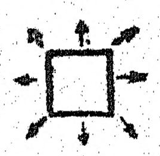 p. 16
- 77 The colour of the earth element which presides in this Chakra. Each Tattva manifests the form, colour, and action, of its particular vibration. p. 16
- 78 That is, the Bīja of Prithivī, the earth Tattva or “Lang”. See Introduction. p. 16
Commentary
In the pericarp of this Lotus is the square region of Prithivī, which is described in detail. On the eight sides of the square are eight shining spears. The region is of yellow colour.
Cf. “O Thou of dulcet speech, in the Mūlādhāra is the four-cornered region of Dharā, yellow in colour and surrounded by eight spears (Shūla) like Kulāchalas.”
Kulāchala is by some interpreted to mean the breast of a woman. According to this view, the tips of these spears are shaped like a woman’s breasts. Others understand by the expression the seven Kula Mountains.79
- 79 Mahendro Malayah Sahyah Shuktimān Rikshaparvatah
Vindhyash cha Pāripātrash cha saptaite kulaparvatāh
(quoted in Shabdastomamahānidhi). Some read Pāriputrah in place of Pāripātrah. Shangkara says that the spears are here because the Chakra is inhabited by Dākinī, who is one of the great Bhairavīs. p. 16
Cf. Nirvāna Tantra: “O Devī, the seven Kula Mountains viz., Nīlāchala, Mandara, Chandra-shekhara, Himālaya, Suvela, p. 17 Malaya, and Suparvata—dwell in the four corners.” According to this notion, the eight spears are likened to the seven Kula Mountains on Earth.
“Within it” (Tad-angke).—Inside the region of Prithivī (Dharā-mandala) is the Bīja of Earth—viz., “Lang”. This Bīja is also of a yellow colour. The phrase “shining yellow colour” (Lasat-pīta-varna) is descriptive of the Bīja also. So it has been said:
“Inside it is the Aindra Bīja (Bīja of Indra),80 of a yellow colour, possessed of four arms, holding the thunder in one hand, mighty81 and seated on the elephant Airāvata.”82
- 80 The Bīja of Indra and the Bīja of Earth are the same. p. 17
- 81 Mahā-bāhu, “possessed of great long arms”—sign of prowess. Cf. Ājānu-lambita-bāhu (arms reaching the knees). p. 17
- 82 The elephant of Indra. This and other animals figured in the Chakras denote both qualities of the Tattva and the Vehicles (Vāhana) of the Devatā therein. See Introduction. p. 17
Verse 6
Ornamented with four arms83 and mounted on the King of Elephants,84 He carries on his lap85 the child Creator, resplendent like the young Sun, who has four lustrous arms, and the wealth of whose lotus-face is fourfold.86
Commentary
This is the Dhyāna of the Dharā Bīja. The Bīja of Dharā or Prithivī is identical with that of Indra.
“On his lap” (Tad-angke)—i.e., in the lap of Dharā Bīja. The sense of this verse is that the Creator Brahmā dwells in the lap of Dharā Bīja. By “angka” (lap) is to be understood the space within the Bindu of Dharā Bīja. Cf. “In the Mūlādhāra is the Dharā Bījā, and in its Bindu dwells Brahmā, the image of a Child, and the King of the Immortals87 is mounted on an Elephant.”
- 87 i.e., Indra Deva. p. 18
The above quoted passage, it is urged, means “the King of the Immortals is in the lap of Dharā Bīja.” But according to our view as the Dharā Bīja and the Indra Bīja are the same, their identity is here spoken of; for it is also said “the letters of the Mantra are the Devatā; the Devatā is in the form of the Mantra (Mantra-rūpinī).”
Also cf. Nirvāna Tantra: “O beautiful one, the Indra Bīja is below the genitals. The very perfect and beautiful dwelling of Brahma is above Nāda, and there dwells Brahmā the Creator,88 the Lord of creatures.89
By “above Nāda” in this passage, we must understand that the abode of Brahmā is within the Bindu which is above Nāda. Some read “left of the genitals,” and thus there is a difference of opinion. The Shāradā says that the Ādhāras are various according to different views.
“Four lustrous arms” (Lasad-veda90-bāhu).—Some interpret the Sanskrit compound word to mean “in whose arms shine the four Vedas Sāma and others,” thus thinking of Brahmā as being possessed of two arms only. But Brahmā is nowhere described as holding the Vedas in his hands, and that he should be meditated upon as having four arms is clear from the following passage in Bhūta-shuddhi Tantra:
- 90 Veda is used to mean four, there being four Vedas. p. 19
“Know, O Shivā, that in its lap is the four-armed, red-coloured child91 Brahmā, who has four faces and is seated on the back of a swan.”92
“The wealth of whose lotus-face is fourfold” (Mukhāmbhoja-lakshmīh chatur-bhāga-bhedah).—By this is to be understood that Brahmā has four faces.
Some read the passage as “Chatur-bhāgaveda”; thus read the meaning practically is the same. If the Sanskrit text is read “Mukhāmbhoja-lakshmī-chatur-bhāgaveda,” the meaning would be, “the four different Vedas enhance the beauty of his lotus-faces”.93
- 93 The allusion is to the belief that the four Vedas came out of the four mouths of Brahmā. p. 19
As opposed to the opinion that Brahmā holds the four Vedas in his arms, the Vishva-sāra Tantra in the Brāhmī-dhyāna says: “Meditate on Brāhmī (Shakti) as red in colour and garbed in the skin of the black antelope, and as holding the staff,94 gourd,95 rosary of Rudrāksha beads,96 and making the gesture dispelling fear.”97 And in the Sapta-shatī Stotra98 it has been said that p. 20 Shiva and Shakti are to be meditated upon as having the same weapons.
Also cf. Yāmala: “The Ādi-Mūrti99 should be meditated upon as making the gestures of dispelling fear and granting boons,100 as also holding the Kundikā101 and rosary of Rudrāksha beads, and adorned with fine ornament.”
- 99 Brāhmī Shakti. p. 20
- 100 That is, the Varadamudrā, the hand being held in the same position as in note 8, p. 19, but with the palm held horizontally instead of vertically. p. 20
- 101 Kamandalu: a vessel with a gourd-shaped body, and handle at the top, used for carrying water, generally by ascetics. p. 20
This is how She should be meditated upon. The rest requires no explanation.
Verse 7
Here dwells the Devī Dākinī102 by name; her four arms shine with beauty, and her eyes are brilliant red. She is resplendent like the lustre of many Suns rising at one and the same time.103 She is the carrier of the revelation of the ever-pure Intelligence.104
Commentary
In this Shloka the Author speaks of the presence of Dākinī Shakti in the Ādhāra-padma. The sense of this verse is that in this Lotus the Devī Dākinī dwells.
“She is the Carrier of the revelation of the ever-pure Intelligence”105 (Prakāsham vahantī sadā-shuddha-buddheh)—that is, she, Dākinī Shakti, enables the Yogī to acquire knowledge of the Tattva (Tattva-jnāna). By meditating on her, which is part of Yoga practice, one acquires Tattva-jnāna. This Devī is the presiding Divinity of this region.
- 105 If the word “sadā” is read separately from “shuddha-buddhi,” it becomes an adverb qualifying “vahantī,” and the passage would then mean that “she ever carries revelation of Divine Knowledge”. p. 21
Cf. “The mouth106 (the lotus) has the letters Va, Sha (palatal), Sha (lingual), and Sa, and is presided over by Dākinī.”
- 106 Vaktra. This is possibly the transcriber’s mistake for “Padma” = lotus. p. 21
“Dākinī, Rākinī, Lākinī, Kākinī, as also Shākinī and Hākinī, are the queens of the six respective Lotuses.”107 Elsewhere is given the Dhyāna of Dākinī thus: “Meditate on her, the red, the red-eyed Dākinī, in the Mūlādhāra, who strikes terror into the hearts of Pashus,108 who holds in her two right hands the Spear109 and the Khatvānga,110 and in her two left hands the Sword111 and a drinking-cup filled with wine. She is fierce of temper and shows her fierce teeth. She crushes the whole host of enemies. She is plump of body, and is fond of Pāyasānna.112 It is thus that she should be meditated upon by those who desire immortality.” Elsewhere she is described as “bright with a Tilaka113 of vermillion, her eyes ornamented with collyrium, clad in black (antelope’s skin) and decked with varied jewels,” etc.
- 107 The Shāktānanda-tarangginī places them in a different order. See P. K. Shāstrī’s edition, p. 75. p. 22
- 108 The unillumined. See Introduction to Author’s Mahānirvāna. p. 22
- 109 Shūla. p. 22
- 110 A staff surmounted by a human skull. p. 22
- 111 Khadga, a kind of sword used in the sacrifice of animals. Some read Kheta. p. 22
- 112 A kind of milk pudding made of rice boiled in milk with ghee and sugar. p. 22
- 113 Here the mark borne by woman between the eyebrows showing that her husband is living—an auspicious mark. The Saubhāgyaratnākara says that Dākinī abides in Tvak Dhātu. p. 22
On the authority of the above passage, which occurs in a Dhyāna of Dākinī, she should be meditated upon as clad in black antelope skin.
The Devas Brahmā and others are to be meditated upon as having their faces down or up according to the frame of mind (Bhāva) of the Sādhaka.
The Shāktānanda-tarangginī114 quotes the following from the Māyā Tantra:
- 114 Fourth chapter; Prasanna Kumāra Shāstrī’s edition, pp. 78, 79. The passage in the text is incompletely quoted. p. 22
“Pārvatī asked: How can they be in the Lotuses which have their heads downward bent?
“Mahādeva said: The Lotuses, O Devī, have their heads in different directions. In the life of action115 they should be thought of as having their heads downward, but in the path of renunciation116 they are always meditated upon as having their heads upward turned.”
The rest is clear.
Verse 8
Near the mouth of the Nādī called Vajrā, and in the pericarp (of the Ādhāra Lotus), there constantly shines the beautifully luminous and soft, lightning-like triangle which is Kāmarūpa,117 and known as Traipura.118 There is always and everywhere the Vāyu called Kandarpa,119 who is of a deeper red than the Bandhujīva flower,120 and is the Lord of Beings and resplendent like ten million suns.
- 117 See Commentary, post. p. 24
- 118 This triangle, says Vishvanātha, citing Gautamīya Tantra, is Ichchhājnānakriyātmaka—that is, the powers of Will, Knowledge, and Action. See Introduction. p. 24
- 119 A form of the Apāna vāyu. Kandarpa is a name of Kāma the Deva of Love. p. 24
- 120 Pentapœtes Phœnicea. p. 24
Commentary
In this Shloka is described the triangle in the pericarp of the Mūla-Chakra.
“Near the mouth of the Nādī called Vajrā” (Vajrākhyā-vaktradeshe).—The mouth of the Vajrā is two fingers above that of the Sushumnā and below the base of the genitals.
“The triangle known as Traipura” (Trikonam traipurākhyam).—The triangle is so called because of the presence of the Devī Tripurā within the Ka inside the triangle, and the letter Ka is the chief letter of the Kāmabīja.121
- 121 That is, the Mantra “Klīng”; in Tantrarāja Shiva speaking to Devī says, “letter Ka is Thy form.” The Nityapūjāpaddhati, p. 80, mentions in this connection “Kang,” the Vīja of Kāminī. See Introduction. p. 24
Cf. Shāktānanda-tarangginī122: “Inside dwells the Devī Sundarī,123 the Paradevatā.”
“Soft” (Komala)—i.e., oily and smooth.
“Kāma-rūpa”124: that by which Kāma is caused to be felt—i.e., it is Madanāgārātmaka.125
Cf. “The triangle should be known as the charming Shaktipītha.”
This triangle is above the Dharā-vīja. Cf. Sammohana Tantra, speaking of Dharā-vīja: “Above it (Dharā-vīja) are three lines—Vāmā, Jyeshthā, and Raudrī.”
“Kandarpa.”—The presence in the Trikona of the Kandarpa-vāyu is here spoken of. It is everywhere (samantāt) that is extended throughout the triangle.
“Lord of Beings” (Jīvesha).—So called because the continuance of life depends on Kāma or Kandarpa.
It is said that “In the Kanda (heart) region dwells Prāna; and Apāna dwells in the region of the anus”. The air in the region of the anus is Apāna, and Kandarpa Vāyu accordingly is a part of Apāna Vāyu.126 It is also said that127 “Apāna draws Prāna, and Prāna draws Apāna—just as a falcon attached by a string is drawn back again when he flies away; these two by their disagreement prevent each other from leaving the body, but when in accord they leave it.”
The two Vāyus Prāna and Apāna go different ways, pulling at one another; and neither of them, therefore, can leave the body, but when the two are in accord—that is, go in the same direction—they leave the body. Kandarpa Vāyu, being a part of Apāna, also pulls at Prāna Vāyu, and prevents the latter from escaping from the body; hence Kandarpa Vāyu is the Lord of Life.
In v. 10 the Author describes Kundalinī as “She who maintains all the beings of the world by Inspiration and Expiration.”128 He himself has thus said that Prāna and Apāna are the maintainers of animate being.
- 128 The Inspired and Expired breath is Hangsah. p. 25
Verse 9
Inside it (the triangle) is Svayambhu129 in His Lingga-form,130 beautiful like molten gold, with His head downwards. He is revealed by Knowledge131 and Meditation,132 and is of the shape and colour of a new leaf. As the cool rays of lightning and of the full moon charm, so does His beauty. The Deva who resides happily here as in Kāshī is in form like a whirlpool.133
Commentary
In this verse he speaks of the presence of the Svayambhulingga in the triangle.
“Svayambhu in his Lingga-form” (Lingga-rūpī svayambhu)—i.e., here dwells the Shivalingga whose name is Svayambhu.
“Beautiful like molten gold” (Druta-kanaka-kalā-komala).—His body has the soft lustre of molten gold.
“His head downwards” (Pashchimāsya).—Cf. Kālī-kulāmrita: “There is placed the great Lingga Svayambhu, who is ever blissful, his head downward, active when moved by Kāma Bīja.
“Revealed by Knowledege and Meditation.” (Jnāna-dhyāna-prakāsha).—Whose existence is apprehended by us by Knowledge (Jnāna) and Meditation (Dhyāna). By Jnāna we realise the attributelessness, and by Dhyāna the attributefulness (of the Brahman). Such is Svayambhu.
“The shape and colour of new leaves” (Prathama-kishalayākārarūpa).—By this is conveyed the idea that the shape of the Svayambhu Lingga is tapering like a new unopened leaf-bud. Like the pistil inside the Champaka flower, it is broad at the bottom and tapers to a point at the end; this also shows that the Svayambhu-lingga is of a blue-green colour (Shyāma).
Cf. Shāktānanda-tarangginī: “O Maheshāni, meditate inside it (the triangle) upon the Svayambhu-lingga, who holds his head with an aperture therein downward—the beautiful and blue-green Shiva (Shivang shyāmala-sundaram).”
In the Yāmala occurs the following passage: “Meditate upon the very beautiful celestial triangle (Trikona) in the Mūlādhāra; within its three lines is Kundalī, charming like ten million lightning flashes in the dark blue134 clouds.”
- 134 Nīla. p. 27
This passage, which describes Kundalī as “lightning in the dark blue clouds”, goes to show that the Svayambhu-Lingga is also blue; but Nīla (blue) and Shyāma (dark green) belong to the same category, and hence there is no contradiction.
“As cool rays of lightning and of the full moon charm so does His beauty” (Vidyut-pūrnēndu-bimba-prakarakara135-chaya-snigdha-santāna-hāsī).—As the strong light of the moon and of lightning emits no heat, so is the light which emanates from the Svayambhulinga cool and pleasing, bringing gladness into the hearts of men.
- 135 Vishvanātha for Kara (ray) reads Rasa—that is, the nectar flowing from the Moon. p. 27
“The Deva who resides happily here as in Kāshī”136 (Kāshī-vāsī vilāsī).—Kāshī is the place sacred to Shiva, his favourite abode. By these two adjectives it is implied that the Svayambhu in the Ādhāra Lotus is happy as He is in His form of Vishveshvara in Kāshī, and He is as pleased to be here as at Kāshī. “Vilāsī” may also mean amorous because it has been said above, “moved by Kāma Bīja”. Vilāsī is indicative of His Lordship of the Universe.137
“Like a whirlpool” (Sarid-āvarta-rūpa-prakāra).—The whirling water on its outer edge creates a depression in the p. 28 middle and the centre thereof is raised like the shape of a conch.138
- 138 Shangkara says that he is so described because of his restless motion. p. 28
This Svayambhu is placed on the Kāma-bīja. This has been said in Kālī-Kulāmrita: “Surrounded by the filaments of the lotus, is the Shringāta139 and over this is the beautiful Mahā-lingga Svayambhu, with an opening on the top, ever happy, holding his head downwards, and active when moved by the Kāma-bīja.”
- 139 The triangular pyramidical seat of Kāma. p. 28
Elsewhere the following occurs: “There, in the pericarp, is the above-mentioned Dākinī, and the triangle (Trikona) within which is a small aperture and the red Kāma-bīja. There is also the Svayambhu Lingga, his head downward and of a ruddy hue.” This is, however, a different conception.
Verses 10 and 11
Over it140141 shines the sleeping Kundalinī, fine as the fibre of the lotus-stalk. She is the world-bewilderer,142 gently covering the mouth of Brahma-dvāra143 by Her own. Like the spiral of the conch-shell, Her shining snake-like form goes three and a half times round Shiva,144 and her lustre is as that of a strong flash of young strong lightning. Her sweet murmur is like the indistinct hum of swarms of love-mad bees.145 She produces melodious poetry and Bandha146 and all other compositions in prose or verse in sequence or otherwise147 in Sanskrita, Prākrita and other languages. It is She who maintains all the beings of the world by means of inspiration and expiration,148 and shines in the cavity of the root (Mūla) Lotus like a chain of brilliant lights.
- 140 Shangkara, unlike Kālīcharana, has annotated the two verses separately. p. 29
- 141 Svayambhu Lingga—that is, round It with Her body and over It with Her head. p. 29
- 142 Kundalinī is the Shakti whereby the Māyik world exists, at rest. In the Kūrma Purāna Shiva says: “This Supreme Shakti is in me, and is Brahman Itself. This Māyā is dear to me, by which this world is bewildered.” Hence the Devī in the Lalitā is called “Sarvamohinī” (all-bewildering). p. 29
- 143 See Commentary. p. 29
- 144 Shivopari. p. 29
- 145 Vishvanātha says She makes this sound when awakened. According to Shangkara, this indicates the Vaikharī state of Kundalinī. p. 29
- 146 Is a class of literary composition in which verse is arranged in the manner of a diagram or picture. p. 29
- 147 Bhedakrama and Atibhedakrama. p. 29
- 148 Vishvanātha quotes Dakshināmūrti as stating that during day and night man breathes in and out 21,600 times, taking both expiration and inspiration as the unit. See Introduction. p. 29
Commentary
In these two verses the author speaks of the presence of Kundalinī Shakti in the Svayambhu Lingga. It is the Devī Kundalinī who maintains the existence of individual beings (Jīva, Jīvātmā) by the functions of inspiration and expiration. She places them in individual bodies; She produces the humming sound resembling that of a swarm of bees, and is the source of Speech and She, as described below, dwells in the triangular hollow in the pericarp of the Mūlādhāra Lotus resting upon the Svayambhu Lingga.
“Shines fine as the fibres of the lotus-stalk” (Bisa-tantu-sodara-lasat-sūkshmā)—i.e., She is fine like the fibre of the lotus-stalk.
“World-bewilderer” (Jagan-mohinī)—i.e., She is Māyā in this world.
“Gently.”149—Madhuram.
- 149 Madhuram: this is used as an adjective, according to Shangkara, and means sweet. He says She is drinking nectar by the Brahmadvāra; as the nectar is coming through it, the Brahmadvāra is sweet. p. 30
“The mouth of Brahma-dvāra” (Brahma-dvāra-mukha)—the hollow on the head of Svayambhu Lingga.
“A strong flash of young lightning” (Navīna-chapalā-mālā-vilāsāspadā).—Lit., “possessed of the wealth of a strong flash of young lightning.” In youth every thing and person shows the characteristic qualities in a state of vigorous perfection. Hence a “young flash of lightning” means a strong flash.
“She produces melodious poetry etc.,” (Komalakāvya-bandda-rachanā-bhedātibheda-krama).—This shows the mode in which words are produced. The soft music produced by a combination of soft and melodious words descriptive of beauty, virtue, etc., in all its modulations, resulting from perfection of composition and regularity and irregularity in the disposition of words. By Bandha is here meant pictorial poetical composition in prose or verse arranged to look like a lotus (Padmabandha) a horse (Ashvabandha) and so on; and by Atibheda the author alludes to all the words in Sangskrita and Prākrita. By using the word “order, sequence,” the author emphasises the fact that these compositions and words come out in the order laid down in the Shāstras. Kundalinī produces, p. 31 both at random, and in set forms. Kundalinī produces words, Sangskrita and Prākrita, distinct and indistinct. She is the source from which all sound emanates.
Cf. Shāradā150: “Upon the bursting (unfolding) of the supreme Bindu arose unmanifested Sound151 (Avyakta-rava). It assumed the form of Kundalī in living bodies, and manifested itself in prose and verse by the aid of the letters of the Alphabet (lit., the essence of the letters).”
- 150 Ch. I, second line of v. 11 and v. 14, the intermediate verses are omitted. These run as follows: “That sound is called, by those versed in the Āgamas, Shabdabrahman. Some teachers define Shabdabrahman to mean Shabdārtha, others (grammarians) define it to mean Shabda; but neither of them is correct, because both Shabda and Shabdārtha are Jada (unconscious things). In my opinion, Shabdabrahman is the Chaitanya of all beings.” The Āgama in the text is Shruti; Rāghava quotes Shangkarāchāryya in Prapanchasāra, which speaks of men versed in Shruti. Chaitanya is the Brahman considered as the essence of all beings—that is, Chit and Shakti, or Chit in manifestation. p. 31
- 151 That is, the Principle or Cause of Sound. See Introduction. p. 31
By “Prose and Verse” all forms of speech are meant.
It has distinctly been said in Kādimata152: “By the action of the Ichchhā-Shakti of the Ātmā acting on Prāna-vāyu there is produced in the Mūlādhāra the excellent Nāda (Sound) called Parā.153 In its ascending movement it is thrown upward and opening out in the Svādhishthāna,154 it receives the name of Pashyantī; and again gently led up as before-mentioned, it becomes united in the Anāhata with Buddhi-tattva, and is named Madhyamā. Going upward again, it reaches the Vishuddha in the throat, where it is called Vaikharī; and from there it goes on towards the head, (upper part of, the throat, the palate, the lips, the teeth. It also spreads over the tongue from root to tip, and the tip of the nose; and remaining in the throat, the palate, and the lips, produces by p. 32 the throat and the lips the letters of the Alphabet from A to Ksha.”155
- 152 Tantrarāja (Vols. VIII and XII. Tantrik Texts), Ch. XXVI, vv. 5—9. p. 31
- 153 At pp. 120—122, Vol. II, Tantrik Texts, Vishvanātha speaks of Parā, Pashyantī, and the others Shaktis. The form of Nāda, says the Manoramā, should be known from the Guru. This Ichchhā-Shakti is Kālamayī. p. 31
- 154 Pashyantī is sometimes associated with Manipūra. See Introduction. p. 31
- 155 The sense of this, says the Manoramā, is that Nāda which has four stages (Avasthāchatushtayātmaka) does after passing through the different centres mentioned in the Text assume the form of the 51 letters. p. 32
It is needless to quote more.
Elsewhere has Kundalinī been thus described: “Meditate upon Devī Kundalinī, who surrounds the Svayambhu-Lingga, who is Shyāmā and subtle, who is Creation itself,156 in whom are creation, existence, and dissolution,157 who is beyond the universe158 and is consciousness159 itself. Think of Her as the One who goes upwards.”160
Also: “Meditate upon the Devī Kundalinī as your Ishta-devatā,161 as being ever in the form of a damsel of sixteen in the full bloom of her first youth, with large and beautifully formed breasts, decked with all the varied kinds of jewels, lustrous as the full moon, red in colour, with ever restless eyes.”162
“Red (Raktā) as regards Sundarī”, so says the Author of the Shāktānandataranginī. Kundalinī, as a matter of fact should always be meditated upon as red (Raktā) in colour.163
- 163 The Shāktānandataranginī says: She is only to be meditated upon as red only when the object of worship is Tripurā. The text may also be read as meaning that “red” is an attribute applicable to Shrī Sundarī—that is, the Devī Tripurasundarī. p. 32
Shyāmā (which ordinarily denotes “colour”) is here meant to signify something different. In all Tantras and all Tāntrika collections Kundalinī is described to be like lightning. “Shyāmā is the name given to a woman who is warm in winter and cool in summer, and has the lustre of molten gold.”164 This is what is p. 33 meant here and colour is not intended. Thus the apparent discrepancy is removed.
- 164 This is a quotation from the Alangkāra Shāstra (Rhetoric). p. 32
The Kangkāla-mālinī Tantra describes Kundalinī in the Brahma-dvāra, and before the piercing of the Chakras, thus: “She, the Brahman Itself, resplendent like millions of moons rising at the same time, has four arms and three eyes. Her hands make the gestures165 of granting boons and dispelling fear, and hold a book and a Vīnā.166 She is seated on a lion, and as She passes to her own abode167 the Awe-inspiring One (Bhīmā) assumes different forms.”
Verse 12
Within it168 reigns dominant Parā,169 the Shrī Parameshvarī, the Awakener of eternal knowledge. She is the Omnipotent Kalā170 who is wonderfully skilful to create, and is subtler than the subtlest. She is the receptacle of that continuous stream of ambrosia which flows from the Eternal Bliss. By Her radiance it is that the whole of this Universe and this Cauldron171 is illumined.
- 168 Svayambhu lingga, round which Kundalī is coiled. p. 34
- 169 According to Shangkara, Parā is in Kundalinī. She is called Brahmānī by Vishvanātha, who quotes the Svachchhandasanggraha. In Kundalinī is the Parā state of Shabda. p. 34
- 170 Vide post. p. 34
- 171 Katāha—that is, the lower half of the Brahmānda, and as such cauldron-shaped. p. 34
Commentary
He is now speaking of the Staff-like Parā Shakti, who is like a straight thread above Kundalinī, who is coiled round Svayambhu-Lingga. The Shrī Parameshvarī, whose radiance illumines this Universe172 and its cauldron, dwells in the Svayambhu Lingga above where Kundalinī is coiled and holds supreme sway.
- 172 Brahmānda—egg of Brahmā. p. 34
“Omnipotent” (Paramā).—She is the Māyā who is able to do that which is impossible.173
- 173 So the Devī Purāna (Ch. XLV), speaking of this power of the Supreme, says:
Vichitra-kāryyakāranā chintitātiphalapradā
Svapnendrajālaval loke māyā tena prakīrtitā.
Paramā may also mean Parang mīyate anayā iti Paramā—i.e., She by whom the Supreme “is measured,” in the sense (for the Supreme is immeasurable) that She who is one with the Supreme, is formative activity. See Introduction. Vishvanātha, quoting an unnamed Tantra, says that this Māyā is within Kundalinī, and this Paramā is Paramātmasvarūpā. p. 34
“Kalā” is a form of Nāda Shakti (Kalā Nāda-shakti-rūpā); and inseparate from Kundalinī.174
- 174 Kundalinyabheda-sharīrinī. p. 35
The Shāktānanda-tarangginī says: “Kalā is Kundalinī, and She, Shiva has said, is Nāda-shakti.”175
- 175 Nāda-shakti=Shakti as Nāda. See Introduction. p. 35
And it has also been elsewhere said: “Above it, meditate in your mind on Chitkalā united with Ī (Lakshmī) who is tapering of shape like the flame of a lamp, and who is one with Kundalī.”
Cf. Kālikā-Shruti: “Man becomes freed of all sins by meditating upon Kundalinī as within, above, and below the flame, as Brahmā, as Shiva, as Sūra,176 and as Parameshvara Himself; as Vishnu, as Prāna, as Kālāgni,177 and as Chandra.”178
By “within the flame” is meant the excellent Kalā (=Nādarūpā) above Kundalinī’s threefold coil. This is what has been said by the author of this Lalitārahasya.
“She (Parā) is wonderfully skilful to create” (Ati-kushalā)—i.e., She it is who possesses the wonderful skill and power of creation.
“She is the receptacle of that continuous stream of ambrosia flowing from Eternal Bliss (Brahman)” (Nityānanda-paramparāti-vigalat-pīyūsha-dhārā-dharā).—By Eternal Bliss (Nityānanda) is meant the Nirguna or Attributeless Brahman. Paramparā means “connected step by step”. From Nityānanda, which is Nirguna Brahman, there arises (in Its aspect as) Saguna Brahman; from Saguna Brahman, Shakti; from Shakti, Nāda; from Nāda, Bindu; and from Bindu, Kundalinī.179 Chit-kalā is another form of Kundalinī. It is thus that the ambrosia comes step by step to Parameshvarī, the Chitkalā. She is Nityānandaparamparā—that is, She belongs to the chain of emanation from Nityānanda downwards; and She is p. 36 Ativigalat-pīyūsha-dhārādharā—that is, She is the receptacle of the stream of ambrosia which flows copiously from Nityānanda.180
This compound word may be interpreted to mean that She holds the copious flow of ambrosia caused by her union with the Brahman. From Nityānanda this nectar comes to Para-Bindu, and passes through the Ājnā Chakra, Vishuddha Chakra, etc., till it reaches the Mūlādhāra, and this nectar is that of which She is the receptacle. To interpret it to mean this, the entire word is read as one,
Verse 13
By meditating thus on Her who shines within the Mūla Chakra, with the lustre of ten million Suns, a man becomes Lord of speech and King among men, and an Adept in all kinds of learning. He becomes ever free from all diseases, and his inmost Spirit becomes full of great gladness. Pure of disposition by his deep and musical words, he serves the foremost of the Devas.181
- 181 That is, Brahmā, Vishnu, Shiva, etc. p. 37
Commentary
In this verse the Author speaks of the benefit to be derived from meditating on Kundalinī. By Mūla Chakra is meant the Mūlādhāra. “It is the root of the six Chakras—hence its name.”
“Within” (Mūla-chakrāntara-vivara-lasat-koti-sūryya-prakāsham).—She shines in the Mūlādhāra Chakra like ten million suns shining at one and the same time.
“His deep and musical words” (Vākyaih kāvya-prabandhaih).—His speech is musical and full of meanings, as in a poetical composition.
“He serves” (Sevate).182—He uses his words in hymns of praise and for purposes of a like nature. He pleases them by words of adoration.
- 182 That is by his mastery over words he becomes like to Brihaspati Guru of the Devas (Shangkara). p. 37
“All the foremost of the Devas” (Sakala-sura-gurūn).—The word Guru here means excellent, and the Author by Sura-gurūn means Brahmā, Vishnu, and Shiva, the principal Devas. Amara says that “adding the words Singha (lion), Shārdūla (tiger), Nāga (serpent), etc., to a male name implies excellence”.
Summary
The Mūlādhāra is a Lotus of four petals. The petals are red, and have the letters Va, Sha (palatal), Sha (cerebral), Sa, in colours of gold. In the pericarp is the square Dharā-mandala surrounded by eight spears, and within it and in the lower part is the Dharā-bīja183 who has four arms and is seated on the elephant Airāvata. He is yellow of colour, and holds the thunderbolt184 in his hands. Inside the Bindu of the Dharā-bīja is the Child Brahmā, who is red in colour, and has four hands with which he holds the staff,185 the gourd,186 the Rudrāksha rosary, and makes the gesture which dispels fear.187 He has four faces. In the pericarp there is a red lotus on which is the presiding Divinity of the Chakra (Chakrādhishthātrī), the Shakti Dākinī. She is red and has four arms, and in her hands are Shūla,188 Khatvāngga,189 Khadga,190 and Chashaka.191 In the pericarp there is also the lightning-like triangle, inside which are Kāma-vāyu and Kāma-bīja,192 both of which are red. Above this is the Svayambhu Lingga which is Shyāma-varna,193 and above and round this Lingga is Kundalinī coiled three and a half times, and above this last upstands, on the top of the Lingga, Chit-kalā.194
- 183 “Lang.” p. 38
- 184 Vajra. p. 38
- 185 Danda. p. 38
- 186 Kamandalu. p. 38
- 187 Abhayamudrā; v. 19, ante, n. 8. p. 38
- 188 Spear. p. 38
- 189 Skull-mounted staff. p. 38
- 190 Sword. Khadga is a heavy sacrificial sword. p. 38
- 191 Drinking-cup. p. 38
- 192 “Klīng.” p. 38
- 193 Its colour. p. 38
- 194 Described in v. 12 as another form of Kundalinī. p. 38
(This is the end of the first section.)195
- 195 Prakarana. The commentator divides the text and his commentary into eight sections. p. 38
Verse 14
There is another Lotus196 placed inside the Sushumnā at the root of the genitals, of a beautiful vermilion colour. On its six petals are the letters from Ba to Purandara,197 with the Bindu198 superposed, of the shining colour of lightning.
Commentary
Having described the Mūlādhāra, he describes the Svādhishthāna Chakra in five verses beginning with the present. This verse says that at the root of the genitals there is, distinct from the Mūlādhāra, another Lotus, of a beautiful vermilion colour.
“Placed inside the Sushumnā” (Saushumna199-madhyaghatitam).—The place of this Chakra or Padma is within Sushumnā.
- 199 Saushumna: Shangkara reads this word to mean the Brahmanādī which is within Sushumnā, and says that the suffix “in” by which the change is affected is used in the sense of “relating to,” and not “placed within”. p. 39
“At the root of the genitals” (Dhvaja-mūladeshe).
“Of a beautiful vermilion colour” (Sindūra-pūra-ruchirāruna).—This Lotus is of the charming red colour of vermilion.
“On its six petals” (Angga-chhadaih).—It is surrounded by its six petals which are the letters.200
- 200 V. ante, Introduction. p. 39
“The letters” (Bādyaih savindu-lasitaih Purandarāntaih).—By Purandara is meant the letter La, it being the Bīja of Purandara or Indra. Each of these letters from Ba to La is on each petal of the lotus. They have the Bindu over them, and are of the shining colour of lightning. The above may also mean that the lustre of the letter is caused by their union with the Bindus placed over them.
Verse 15
Within it201 is the white, shining, watery region of Varuna, of the shape of a half-moon,202 and therein, seated on a Makara,203 is the Bīja Vang, stainless and white as the autumnal moon.
Commentary
Here the Author speaks of the presence of the watery region of Varuna in the pericarp of the Svādhishthāna. This watery region (Ambhoja-mandalam) is in shape like the half-moon (Ardhendurūpalasitam), and is luminously white (Vishadaprakāsham).
The Shāradā says: “The region of water is lotus (shaped) that of earth is four-cornered204 and has the thunderbolt (Vajra) and so forth.” Rāghava-bhatta,205 in describing it, says: “Draw a half-moon, and draw two Lotuses on its two sides.” The Great Teacher206 says that “the region of water is like the light of the Lotus-united Half-Moon”.
Then he speaks of the Varuna-bīja. This Bīja is also white, and is seated on a Makara, which is the Carrier207 of Varuna. He has the noose in his hand.
- 207 Vāhana. p. 41
Cf. “(Meditate) upon the white Bīja of Varuna (within the Lotus). Varuna is seated on a Makara, and carries the noose (Pāsha). And above him208 (that is, in the Bindu) meditate on Hari209 who is blue of colour (Shyāma) and four-armed.”
The Va in Varuna Bīja belongs to the Ya class—i.e., to the group Ya, Ra, La, Va. This becomes clear from the arrangement of the letters in Kulākula Chakra and in Bhūtalipi Mantra.
The rest is clear.
Verse 16
May Hari, who is within it,210 who is in the pride of early youth, whose body is of a luminous blue beautiful to behold, who is dressed in yellow raiment, is four-armed, and wears the Shrī-vatsa,211 and the Kaustubha,212 protect us!
- 210 i.e., Vishnu is within “the lap” of the Bindu of Vang. p. 43
- 211 Lit., Favourite of Shrī or Lakshmī—an auspicious curl on the breast of Vishnu and his Avatāra, Krishna. It is said to symbolically represent Prakriti. See Ahirbudhnya Samhitā, 52, 92, citing also the Astrabhūshana Adhyāya of Vishnu Purāna, I, 22. p. 43
- 212 A great gem worn by Vishnu, which is said to symbolically signify the souls (see authorities in last note). These are said to be united with the Kaustubha of the Lord (Vishnutilaka, II, 100). p. 43
Commentary
The Author here speaks of the presence of Vishnu in the Varuna Bīja.
“Within it” (Angkadeshakalita)—i.e., in the Bindu above Varuna Bīja, in the same way as Brahmā is in the lap of Dharā Bīja. The same explanation applies by analogy to the description of the other Lotuses.
“Whose body, etc.” (Nīla-prakāsha-ruchira-shriyam).—Lit., He possesses the enchanting beauty of blue effulgence; i.e., his body is of a luminous blue beautiful to behold.
“Wears Shrīvatsa and Kaustubha.”—The following is his Dhyāna in the Gautamīya Tantra: “On his heart is the gem Kaustubha, lustrous as ten thousand Suns shining at the same p. 44 time, and below it is the garland213 with the lustre of ten thousand moons. Above Kaustubha is Shrī-vatsa, which also is luminous like ten thousand moons.”
- 213 Vanamālā: the name for a large garland descending to the knee. It is defined as follows:
Ājānulambinī mālā sarvartu-kusumojjvalā
Madhye sthūlakadambādhyā vanamāleti kīrtitā.
(That is said to be Vanamālā which extends down to the knee, beauteous with flowers of all seasons, with big Kadamba flowers in the middle.) This garland is celestial because in it the flowers of all the seasons are contained. p. 44
The Tantrāntara speaks of the weapons in the hands of Hari: “(Meditate on) Him who has the noose in His hand, and on Hari who is in his lap, and has four arms, and holds the Conch,214 Discus,215 Mace,216 and Lotus,217 is dark blue (Shyāma) and dressed in yellow raiment.”
By “who has the noose in his hand” is meant Varuna as he has been described in the verse preceding the Text quoted.
Elsewhere he (Hari) is spoken of as “clad in yellow raiment, benign of aspect, and decked with a garland”.218
- 218 The garland symbolises the elements; as the club, Mahat; the couch, Sāttvika Ahangkāra; the bow, Tāmasika Ahangkāra; the sword, knowledge; its sheath, ignorance; discus the mind and the arrows the senses. See authorities cited at p. 43, ante. p. 44
We have seen that, in the Mūlādhāra, Brahmā is seated on the Hangsa, and we should therefore think of Vishnu as seated on Garuda.219
- 219 The Bird King, Vāhana of Vishnu, p. 44
Verse 17
It is here that Rākinī always dwells.220 She is of the colour of a blue lotus.221 The beauty of Her body is enhanced by Her uplifted arms holding various weapons. She is dressed in celestial raiments and ornaments, and Her mind is exalted222 with the drinking of ambrosia.
- 220 Dwells (Bhāti): the Sanskrit word literally means “shines”—‘here’ that is, in the Svādhishthāna. p. 45
- 221 Of the colour of a blue lotus (Nīlāmbujodara-sahodarakānti-shobhā); lit., Her radiant beauty equals the interior of the blue lotus. p. 45
- 222 Matta-chittā; for she drinks the nectar which drops from Sahasrāra. She is exalted with the divine energy which infuses Her. p. 45
Commentary
In this Shloka the Author speaks of the presence of Rākinī in the Svādhishthāna.
Cf. Rākinī-dhyāna elsewhere: “Meditate on Rākinī, who is blue of colour (Shyāmā). In Her hands are a spear,223 a lotus, a drum224 and a sharp battle-axe.225 She is of furious aspect. Her three eyes are red, and her teeth226 show fiercely. She, the Shining Devī of Devas, is seated on a double lotus, and from one of her nostrils there flows a streak of blood.227 She is fond of white rice,228 and grants the wished-for boon.”
As Rākinī is within another lotus229 in this Lotus, therefore should the six Shaktis everywhere be understood to be in a red lotus as in the Mūlādhāra.
- 229 There is another smaller Lotus in each of the main lotuses on which the Shakti sits, p. 45
Verse 18
He who meditates upon this stainless Lotus, which is named Svādhishthāna, is freed immediately from all his enemies,230 such as the fault of Ahangkāra231 and so forth. He becomes a Lord among Yogīs, and is like the Sun illumining the dense darkness of ignorance.232 The wealth of his nectar-like words flows in prose and verse in well-reasoned discourse.
Commentary
In this verse is described the benefit derived from the contemplation of the Svādhishthāna Lotus.
“Svādhishthāna.”—“By Sva is meant the Para-Linga (Supreme Linga), and hence the Lotus is called Svādhishthāna.”233
- 233 This is from v. 58 of Ch. XXVII of the Rudra-yāmala. p. 46
“Fault of Ahangkāra and so forth” (Ahangkāra-doshādi).—By this is implied the six evil inclinations: Kāma (lust), Krodha (anger), etc. These six,234 which are the six enemies of Man, are destroyed by contemplation on the Svādhishthāna Lotus. By contemplation upon it are also destroyed the darkness of Māyā, and Moha,235 and the Sun of knowledge (Jnāna) is acquired. The rest is clear.
Summary of Verses 14 to 18
The Svādhishthāna Chakra is of the colour of vermilion, and has six petals. On its six petals are the six letters Ba, Bha, Ma, Ya, Ra, and La, with the Bindu placed thereon. They are of the colour of lightning. In the pericarp of this Lotus is the region of water in the form of an eight-petalled Lotus, with a half-moon in its centre. This region is white. Inside this latter is the Varuna Bīja “Vang,” seated on a Makara, with a noose in his hand. In the lap of the latter (i.e., in the hollow of the Bindu) is Vishnu seated on Garuda. He has four hands, and is carrying the Shangkha (conch shell), Chakra (discus), Gadā (mace), and Padma (lotus). He is dressed in yellow raiment, wears a long garland (Vana-mālā) round his neck, the mark Shrīvatsa and the gem Kaustubha on his breast, and is youthful in appearance. On a red lotus in the pericarp is the Shakti Rākinī. She is Shyāma-varnā,236 and in her four hands she holds the Shūla (spear or trident), Abja (lotus), Damaru (drum), and Tangka (battle-axe). She is three-eyed and has fierce projecting fangs,237 and is terrible to behold. She is fond of white rice,238 and a stream of blood runs from Her nostril.
(Here ends the second section)
Verse 19
Above it,239 and at the root of the navel, is the shining Lotus of ten petals,240 of the colour of heavy-laden rain-clouds. Within it are the letters Da to Pha, of the colour of the blue lotus with the Nāda and Bindu above them. Meditate there on the region of Fire, triangular in form and shining like the rising sun. Outside it are three Svastika marks,241 and within, the Bīja of Vahni himself.242
Commentary
The Manipūra Chakra is described in this and the two following verses.
“Shining lotus of ten petals” (Dashadala-lasite)243—i.e., the Lotus which shines by reason of its ten petals.
- 243 Shangkara reads Dasha-dala-lalite—i.e., the charming lotus of ten petals. p. 48
“Of the colour of heavy rain-clouds” (Pūrnamegha-prakāshe)—i.e., of a dark hue.
“Within it are the letters,” etc. (Nīlāmbhoja-prakāshair upahitajathare dādi-phāntaih sachandraih).
The ten letters from Da (cerebral) to Pha, with the Bindu placed above them, are of the colour of the blue lotus, and are each of them on the ten several petals. The letters are Da, Dha, Na, Ta, Tha, Da, Dha, Na, Pa, Pha. By Sachandraih which qualifies Varnaih is meant that the letters have Bindu and Nāda over them, for these two go together.
“Like the rising Sun” (Aruna-mihira-samam)—i.e., like the young sun.
“Svastika Marks.”244—These three marks or signs are on three sides of the triangle.
- 244 i.e., like a cross
 p. 49
Rāghava-bhatta says245: “A Svastika sign is made by the crossing of two straight lines going in four different directions.” In this region of Fire is Ram the Bīja of Fire.
- 245 In the note to v. 23 of Ch. I of the Shāradā Tilaka, p. 49
Verse 20
Meditate upon Him (Fire) seated on a ram, four-armed, radiant like the rising Sun. In His lap ever dwells Rudra, who is of a pure vermilion hue. He (Rudra) is white with the ashes with which He is smeared; of an ancient aspect and three-eyed, His hands are placed in the attitude of granting boons and of dispelling fear.246 He is the destroyer of creation
- 246 That is, making Vara and Abhaya Mudrās, v. ante, pp. 20, 21. p. 50
Commentary
Elsewhere the Dhyāna of Vahni is as follows: “Seated on a ram, a Rudrāksha rosary in one hand, and the Shakti247 in the other.”
- 247 Vahni’s or Fire’s weapon. Bhāskararāya says it is the weapon which is called in Maharashtra Sāmti. p. 50
As there are no weapons placed in the other hands it is to be inferred that the other two hands are in the attitude of granting boons and of dispelling fear; that is how He is described to be in other Dhyānas of Him.
Rudra should here be meditated upon as seated on a bull.
“He is white ... smeared” (Bhasmāliptāngga-bhūshā-bharana-sita-vapuh).—The ashes with which his body is smeared and the ornaments he is wearing make him look white (though his hue is red).
Verse 21
Here abides Lākinī, the benefactress of all. She is four-armed, of radiant body, is dark248 (of complexion), clothed in yellow raiment and decked with various ornaments, and exalted with the drinking of ambrosia.249 By meditating on this250 Navel Lotus251 the power to destroy and create (the world) is acquired. Vānī252 with all the wealth of knowledge ever abides in the lotus of his face.
Commentary
“Decked with various ornaments” (Vividha-virachanālangkritā).—She who is decorated with gems and pearls arranged in varied and beautiful designs.
Cf. Lākinī-dhyāna elsewhere: “Let the excellent worshipper meditate upon the Devī Lakinī, who is blue and has three faces, and three eyes (to each face), fierce of aspect, and with Her teeth protruding.253 In Her right hand She holds the thunderbolt and the Shakti,254 and in the left She makes the gestures255 of dispelling fear and of granting boons. She is in the pericarp of the navel lotus, which has ten petals. She is fond of meat (Māngsāshī),256 and p. 52 her breast is ruddy with the blood and fat which drop from Her mouth.”
The navel lotus is called Mani-pūra. The Gautamīya Tantra says.257 “This Lotus is called Manipūra because it is lustrous like a gem.”258
Summary of Verses 19 to 21
The Nābhi-padma (Navel Lotus) is of the colour of the rain-cloud, and has ten petals; on each of its petals are each of the ten letters Da, Dha Na, Ta, Tha, Da, Dha, Na, Pa, and Pha, of a lustrous blue colour, with the Bindu above each of them. In the pericarp of this Lotus is the red Region of Fire, which is triangular in shape, and outside it, on its three sides, are three Svastika signs. Within the triangle is the Bīja of Fire—“Rang”. He (Bīja of Fire) is red in colour and is seated on a ram, is four-armed, and holds in his hands the Vajra (thunderbolt) and the Shakti weapon, and makes the signs of Vara and of Abhaya.259 In the lap of Vahni Bīja is Rudra, red of colour, seated on the bull, who, however, appears to be white on account of the ashes which He smears on his body. He is old in appearance. On a red lotus in the pericarp of this Lotus is the Shakti Lākinī. She is blue, has three faces with three eyes in each, is four-armed, and with Her hands holds the Vajra and the Shakti weapon, and makes the signs of dispelling fear and granting boons. She has fierce projecting teeth, and is fond of eating rice and dhal, cooked and mixed with meat and blood.260
(Here ends the third section)
Verse 22
Above that, in the heart, is the charming Lotus,261 of the shining colour of the Bandhūka flower,262 with the twelve letters beginning with Ka, of the colour of vermilion, placed therein. It is known by its name of Anāhata, and is like the celestial wishing-tree,263 bestowing even more than (the supplicant’s) desire. The Region of Vāyu, beautiful and with six corners,264 which is like unto the smoke in colour, is here.
- 261 The Anāhata, or heart Lotus, seat of the air element, the sign of which is described as hexagonal, is here. See Introduction. p. 53
- 262 Pentapœtes Phœnicea. p. 53
- 263 Kalpa-taru. Shangkara says the Kalpa-taru, one of the celestial trees in Indra’s heaven, grants what is asked; but this gives more, since it leads him to Moksha. p. 53
- 264 Shatkona—that is, interlacing triangles. See Plate V. See Introduction and Rudrayāmala, Ch. XXVII, v. 64. p. 53
Commentary
The Anāhata Lotus is described in the six verses beginning with this.
This Lotus should be meditated upon in the heart; the verb dhyāyet is understood. The twelve letters beginning with Ka, that is, letters Ka to Tha are on the petals.
“It is known by its name Anāhata” (Nāmnā’nāhata-sangjnakam).—“It is so called by the Munis because it is here that the sound of Shabdabrahman is heard, that Shabda or p. 54 sound which issues without the striking of any two things together.”265
- 265 Vishvanātha quotes (p. 121, Vol. II, Tantrik Texts) the following: “Within it is Vāna Lingga, lustrous like ten thousand suns, also Sound which is Shabdabrahmamaya (whose substance is Brahman), and is produced by no cause (Ahetuka). Such is the lotus Anāhata wherein Purusha (that is, the Jīvātmā) dwells.” As to Shabdabrahman see Rāghavabhatta’s Comm. on Shāradā, Ch. I, v. 12. p. 54
“Wishing-tree”266 is the tree in Heaven which grants all one asks; as it is like the Kalpataru, so it bestows more than is desired.
- 266 Surataru=Kalpa-taru. p. 54
“Region of Vāyu” (Vāyor mandalam.—In the pericarp of this Lotus is the Vāyu-mandala.
Verse 23
Meditate within it on the sweet and excellent Pavana Bīja,267 grey as a mass of smoke,268 with four arms, and seated on a black antelope. And within it also (meditate) upon the Abode of Mercy,269 the Stainless Lord who is lustrous like the Sun,270 and whose two hands271 make the gestures which grant boons and dispel the fears of the three worlds.
- 267 i.e., Vāyu, whose Vīja is “Yang”. p. 55
- 268 This smoke, Shangkara says, emanates from the Jīvātmā which is in the form of a flame. p. 55
- 269 Shangkara reads “ocean of mercy”. (Karunāvāridhi.) p. 55
- 270 Hangsa, the Sun—a name also of the Supreme. Cf. “Hrīng the Supreme Hangsa dwells in the brilliant heaven.” See the Hangsavatī Rik of Rigveda IV—40 quoted in Mahānirvāna Tantra, vv. 196, 197, Ch. V. Hangsa is from Han=Gati, or motion. It is called Āditya because it is in perpetual motion (Sāyana). Hangsa is also the form of the Antarātmā, see v. 31, post. This Rik also runs in Yajurveda, X, 24, and XII, 14, and in some of the Upanishads. p. 55
- 271 This shows that the Bīja has hands and feet (Shangkara). p. 55
Commentary
In this verse the Author speaks of the presence of the Vāyu Bīja in the Anāhata Chakra.
“Pavana Bīja” (Pavanākshara)—i.e., the Bīja Yang.
“Grey as a mass of smoke” (Dhūmāvalī-dhūsara).—It has the greyish colour of smoke by reason of its being surrounded by masses of vapour.
“A black antelope,” which is noted for its fleetness, is the Vāhana (carrier) of Vāyu. Vāyu carries his weapon, “Angkusha,”272 in the same way that Varuna carries his weapon, “Pāsha.”273
He next speaks of the presence of Īsha in the Vāyu Bīja. Everywhere Shiva is spoken of as having three eyes,274 hence Īsha also has three eyes.
- 274 The third eye, situate in the forehead in the region of the pineal gland, is the Eye of Wisdom (Jnānachakshu). p. 56
Elsewhere it is said: “Meditate upon him as wearing a jewelled necklet and chain of gems round his neck, and bells on his toes, and also clad in silken raiment.” In the same way of him it has also been said: “The beautiful One possessed of the soft radiance of ten million moons, and shining with the radiance of his matted hair.”
Īsha should therefore be thought of as clad in silken raiment, etc.
Verse 24
Here dwells Kākinī, who in colour is yellow like unto new lightning,275 exhilarated and auspicious; three-eyed and the benefactress of all. She wears all kinds of ornaments, and in Her four hands She carries the noose and the skull, and makes the sign of blessing and the sign which dispels fear. Her heart is softened with the drinking of nectar.
- 275 Nava-tadit-pītā—i.e., where there is more thunder than rain, when the lightning shows itself very vividly. Pītā is yellow; Kākinī is of a shining yellow colour. p. 57
Commentary
In this verse the Author speaks of the presence of the Shakti Kākinī.
“Exhilarated”276 (Mattā)—that is, She is not in an ordinary, but in a happy, excited mood.
- 276 Shangkara gives unmattā (maddened or exalted) as equivalent of Mattā. p. 57
“With the drinking of nectar,” etc. (Pūrna sudhā-rasārdra-hridayā).—Her heart is softened to benevolence by the drinking of nectar; or it may be interpreted to mean that Her heart is softened by the supreme bliss caused by drinking the excellent nectar which drops from the Sahasrara. Her heart expands with the supreme bliss. Kākinī should be thought of as wearing the skin of a black antelope.
Compare the following Dhyāna of Kākinī where She is so described: “If thou desirest that the practice of thy Mantra be p. 58 crowned with success, meditate on the moon-faced, ever-existent277 Shakti Kākinī, wearing the skin of a black antelope, adorned with all ornaments,”278
- 277 Nityām. If this is not stutī, possibly the word is nityam, “always”. p. 58
- 278 Vishvanātha, in his commentary on the Shatchakra, gives the following Dhyāna of Kākinī: “Meditate on Kākinī whose abode is in Fat (Meda-sangsthām) holding in Her hands Pāsha (noose), Shūla (trident), Kapāla (skull), Damaru (drum). She is yellow in colour, fond of eating curd and rice (Dadhyanna). Her beautiful body is in a slightly bending pose (Svavayavanamitā). Her heart is made joyous by the draught of rice wine (Vārunī).” The Saubhāgya-ratnākara cites Seven Dhyānas of the Seven Shaktis or Yoginīs—Dākinī and others which show that each has her abode in one of the seven Dhātus. The Seventh Shakti Yakshinī is not mentioned in this book. p. 58
Verse 25
The Shakti whose tender body is like ten million flashes of lightning is in the pericarp of this Lotus in the form of a triangle (Trikona). Inside the triangle is the Shivalingga known by the name of Vāna. This Lingga is like shining gold, and on his head is an orifice minute as that in a gem. He is the resplendent abode of Lakshmī.
Commentary
In this Shloka is described the triangle Trikona which is in the pericarp of this Lotus.
“Shakti in the form of a triangle” (Trikonābhidhā Shaktih).—By this we are to understand that the apex of the Triangle is downward.279
- 279 As it is a Trikona Shakti it must have its apex downwards as in the case of the Yoni. p. 59
This Trikona is below the Vāyu Bīja, as has been said elsewhere. “In its lap is Īsha. Below it, within the Trikona is Vāna-Lingga.”
“On his head,” etc. (Maulau sūkshma-vibheda-yung manih).—This is a description of Vāna-Lingga. The orifice is the little space within the Bindu which is within the half-moon which is on the head of the Lingga.
Elsewhere we find the following description: “The Vāna-Lingga within the triangle, decked in jewels made of gold—the Deva with the half-moon on his head; in the middle is an excellent red lotus.”
The red lotus in this quotation is one below the pericarp of the heart lotus; it has its head turned upwards, and has eight petals. It is in this lotus that mental worship (Mānasapūjā) p. 60 should be made.280 Compare the following: “Inside is the red eight-petalled lotus. There is also the Kalpa-tree and the seat of the Īshta-deva under a beautiful awning (Chandrātapa), surrounded by trees laden with flowers and fruits and sweet-voiced birds. There meditate on the Īshta-deva according to the ritual281 of the worshipper.”
“Orifice minute as.”—He here speaks of the Bindu which in the head of the Vāna Lingga. As a gem has a minute orifice in it (when pierced to be threaded), so has this Lingga.282 By this is meant that the Bindu is in the head of the Shiva Lingga.
- 282 The Lingga itself is not pierced, but it carries the Bindu, which has an empty space (Shūnya) within its circle. p. 60
“The resplendent abode of Lakshmī.”283—By this one must know the great beauty of the Lingga, due to a rush of desire.284
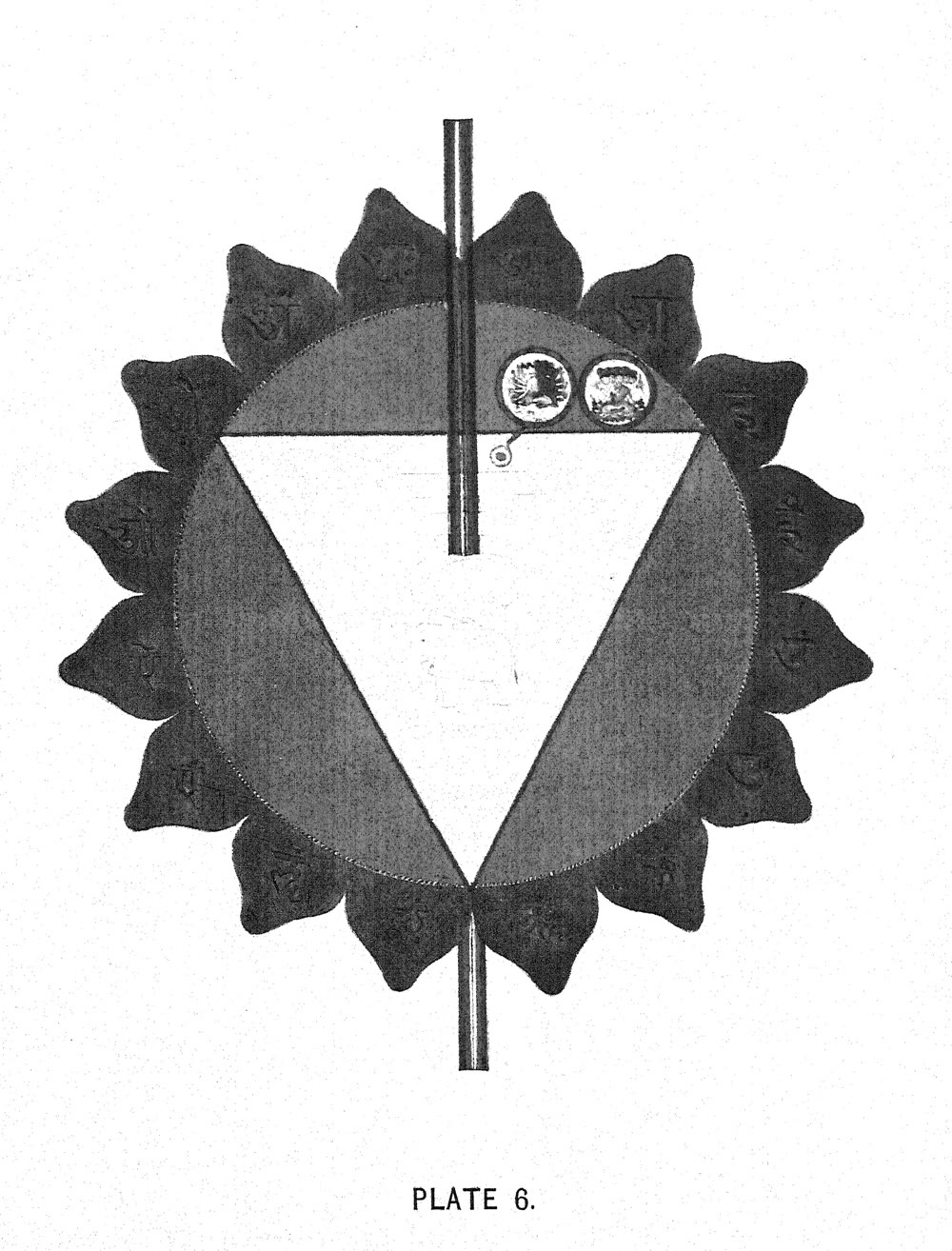
〈Plate VI: a lotus drawn with its letters, its seed-mantra and its animal; the List of Illustrations (p. xv) names it Visuddha〉 PLATE 6.
Verse 26
He who meditates on this Heart Lotus becomes (like) the Lord of Speech, and (like) Īshvara he is able to protect and destroy the worlds. This Lotus is like the celestial wishing-tree,285 the abode and seat of Sharva.286 It is beautified by the Hangsa,287 which is like unto the steady tapering flame of a lamp in a windless place.288 The filaments which surround and adorn its pericarp, illumined by the solar region, charm.
Commentary
In this and the following verse he speaks of the good to be gained by meditating on the Heart Lotus.
“He who meditates on this Lotus in the Heart becomes like the Lord of Speech”—i.e., Brihaspati, the Guru of the Devas—and able like Īshvara the Creator to protect and destroy the worlds. Briefly, he becomes the Creator, Protector, and Destroyer, of the Worlds.
He speaks of the presence of the Jīvātmā which is Hangsa,289 in the pericarp of this Lotus. The Jīvātmā is like the steady flame of a lamp in a windless place, and enhances the beauty of this Lotus (Anila-hīna-dīpa-kalikā-hangsena sang-shobhitam). Hangsa is the Jīvātmā. He also speaks of the presence of the Sūryya-mandala in the pericarp of this Lotus.
- 289 Vishvanātha quotes a verse in which this Hangsa is spoken of as Purusha. p. 61
“The filaments which surround and adorn its pericarp, illumined by the solar region, charm” (Bhānormandala-manditāntara-lasat-kinjalka-shobhādharam).—It is beautified by reason of the filaments which surround the pericarp being tinged by the rays of the Sun. The rays of the Sun beautify the filaments, and not the space within the pericarp. The filaments of the other Lotuses are not so tinged, and it is the distinctive feature of this Lotus. By the expression “the Mandala of Sūrya (Bhānu)” the reader is to understand that all the filaments in the pericarp are beauteous with the rays of the Sun, and not a portion of them.
All over the pericarp is spread the region of Vāyu. Above it is the Region of Sūryya; and above these the Vāyu Bīja and Trikona, etc., should be meditated upon. This is quite consistent. In mental worship the mantra is “Mang—salutation to the Region of Fire with his ten Kalās,”290 etc. From texts and Mantras like this we therefore see that the regions of Vahni (Fire), Arka (Sun), and Chandra (Moon), are placed one above the other.
- 290 Kalā=digits or portions of Shakti. p. 62
“Īshvara”—i.e., Creator.
“Able to protect and destroy the world” (Rakshā-vināshe kshamah)—i.e., it is he who protects and destroys. The idea meant to be conveyed by these three attributes is that he becomes possessed of the power of creating, maintaining, and destroying, the Universe.291
- 291 By reason of his unification with the Brahma-substance. p. 62
Verse 27
Foremost among Yogīs, he ever is dearer than the dearest to women.292 He is pre-eminently wise and full of noble deeds. His senses are completely under control. His mind in its intense concentration is engrossed in thoughts of the Brahman. His inspired speech flows like a stream of (clear) water. He is like the Devatā who is the beloved of Lakshmī293 and he is able at will to enter another’s body.294
Commentary
“Dearer than the dearest to women” (Priyāt priyatamah kāntākulasya)—i.e., because he is skilful to please them.295
- 295 Karmmakushalah. “Dearer than their husbands” (Shangkara). p. 63
“His senses are completely under control” (Jitendriyaganah)—i.e., he is one who should be counted among those that have completely subjugated their senses.
“His mind ... Brahman” (Dhyānāvadhāna-kshamah).—Dhyāna is Brahma-chintana, and Avadhāna means steady and intense concentration of the mind. The Yogī is capable of both.
“His inspired speech flows like a stream of (clear) water” (Kāvyāmbu-dhārā-vaha).—The flow of his speech is compared to an uninterrupted flow of water, and it is he from whom it flows.
“He is like the Devatā who is the beloved of Lakshmī” (Lakshmī-ranggana-daivatah).—He becomes like the Deva who is the beloved p. 64 of Lakshmī. Lakshmī, the Devi of Prosperity, is the spouse of Vishnu. This compound word is capable of another meaning. It may mean: One who has enjoyed all prosperity (Lakshmī) and all good fortune (Ranggana) in this world and who goes along the path of liberation. It has therefore been said: “Having enjoyed in this world the best of pleasures, he in the end goes to the abode of Liberation.”296
- 296 Iha bhuktvā varān bhogān ante mukti-padam brajet. p. 64
“Another’s body” (Para-pura).—He is able at will to enter the enemy’s fort or citadel (Durga), even though guarded and rendered difficult of access. And he gains power by which he may render himself invisible, fly across the sky, and other similar powers. It may also mean “another man’s body”.297
- 297 The Siddhi by which Yōgīs transfer themselves into another’s body, as Shangkarāchāryya is said to have done. The latter interpretation is preferable, for such an one will not have enemies, or if he have will not seek to overcome them. p. 64
Summary of Verses 22 to 27
The Heart Lotus is of the colour of the Bandhūka298 flower, and on its twelve petals are the letters Ka to Tha, with the Bindu above them, of the colour of vermilion. In its pericarp is the hexagonal299 Vāyu-Mandala, of a smoky colour, and above it Sūryya-Mandala, with the Trikona lustrous as ten million flashes of lightning within it. Above it the Vāyu Bīja, of a smoky hue, is seated on a black antelope, four-armed and carrying the goad (angkusha). In his (Vāyu-bīja’s) lap is three-eyed Īsha. Like Hangsa (Hangsābha), His two arms extended in the gestures of granting boons and dispelling fear. In the pericarp of this Lotus, seated on a red lotus, is the Shakti Kākinī. She is four-armed, and carries the noose (Pāsha), the skull (Kapāla), and makes the boon (Vara) and fear-dispelling (Abhaya) signs. She is of a golden hue, is dressed in yellow raiment, and wears every variety of jewel and a garland of bones. Her heart is softened by nectar. In the middle of the Trikona is Shiva in the form of a Vāna-Lingga, with the crescent moon and Bindu on his head. He is of a golden colour.
He looks joyous with a rush of desire.300 Below him is the Jīvātmā like Hangsa. It is like the steady tapering flame of a lamp.301 Below the pericarp of this Lotus is the red lotus of eight petals, with its head upturned. It is in this (red) lotus that there are the Kalpa Tree, the jewelled altar surmounted by an awning and decorated by flags and the like, which is the place of mental worship.302
(Here ends the fourth section)
Verses 28 and 29
In the throat is the Lotus called Vishuddha, which is pure and of a smoky purple hue. All the (sixteen) shining vowels on its (sixteen) petals, of a crimson hue, are distinctly visible to him whose mind (Buddhi) is illumined. In the pericarp of this lotus there is the Ethereal Region, circular in shape, and white like the full Moon.303 On an elephant white as snow is seated the Bīja304 of Ambara,305 who is white of colour.
- 303 Ether is the element of this Chakra, the sign (Mandala) of this Tattva being a circle (Vritta-rūpa). See Introduction. p. 66
- 304 Manu=Mantra=(here) “Hang”. p. 66
- 305 Ambara=the Ethereal Region; the word also means “apparel”—“Vyomni, vāsasi” (Amara-kosha). On an elephant of the colour of snow is seated Ambara, white in colour in his Bīja form. The Sanskrit is capable of another meaning: “On an elephant is seated the Bīja whose raiment is white.” p. 66
Of His four arms, two hold the noose306 and goad,307 and the other two make the gestures308 of granting boons and dispelling fear. These add to His beauty. In His lap309 there ever dwells the great snow-white Deva, three-eyed and five-faced, with ten beautiful arms, and clothed in a tiger’s skin. His body is united with that of Girijā,310 and he is known by what his name, Sadā-shiva,311 signifies.
- 306 Pāsha. p. 66
- 307 Angkusha. p. 66
- 308 Mudrā; v. pp. 20, 21, ante. p. 66
- 309 Of the Nabhovīja or “Hang”. p. 66
- 310 “Mountain-born,” a title of the Devī as the daughter of the Mountain King (Himavat—Himālaya). The reference is here to the Androgyne Shiva-Shakti form. See Commentary. p. 66
- 311 Sadā=ever. Shiva=the Beneficent One. Beneficence. p. 66
Commentary
The Vishuddha Chakra is described in four verses beginning with these.
“Because by the sight of the Hangsa the Jīva attains purity, this Padma (Lotus) is therefore called Vishuddha (pure)—Ethereal, Great, and Excellent.”312
- 312 See Rudrayāmala, Ch. XXVII, v. 67. p. 67
“In the region of the throat is the Lotus called Vishuddha.”—Pure (Amala, without impurity) by reason of its being tejo-maya313 (its substance is tejas), and hence free from impurity.
- 313 Fire purifies. p. 67
“All the vowels” (Svaraih sarvaih)—i.e., all the vowels beginning with A-kāra and ending with Visarga—altogether sixteen in number.
“Shining on the petals” (Dala-parilasitaih).—The vowels being sixteen in number, the number of petals which this lotus possesses is shown by implication to be sixteen also.
Elsewhere this has been clearly stated: “Above it (Anāhata) is the Lotus of sixteen petals, of a smoky purple colour; its petals bear the sixteen vowels, red in colour, with the Bindu above them. Its filaments are ruddy, and it is adorned by Vyoma-mandala.”314
- 314 The Ethereal Circle. p. 67
“Distinctly visible” (Dīpitam).—These letters are lighted up, as it were, for the enlightened mind (Dīpta-buddhi).
“Whose mind (buddhi) is illumined” refers to the person whose buddhi, or intellect, has become free from the impurity of worldly pursuits as the result of the constant practice of Yoga.
“The Ethereal Region circular in shape, and white like the full Moon” (Pūrnendu-prathita-tama-nabhomandalam vrittarūpam).—The Ethereal Region is circular in shape (Vrittarūpa), and its roundness resembles that of the full Moon, and like the Moon it is also white. The Shāradā says: “The wise know that the Mandalas participate in the lustre of their peculiar elements.”315 The Mandalas are of the colour of their respective Devatās and elements: Ether is white, hence its Mandala is also white.
- 315 That is, each Mandala (i.e., square, circle, triangle, etc.) takes after the characteristics of its elements. (Vide Shāradā-tilaka I. 24) p. 67
“In the pericarp of this lotus is the circular Ethereal Region” (Nabhō-mandalam vritta-rūpam).—In the lap of this white Ambara (or Ethereal Region) ever dwells Sadā-shiva, who is spoken of in the second of these two verses.
“On an elephant white as snow is seated” (Hima-chchhāyā-nāgopari lasita-tanu).—This qualifies Ambara.
Nāga here means an Elephant, and not a serpent. The Bhūta-shuddhi clearly says: “Inside it is the white Bīja of Vyoma on a snow-white elephant.” Literally, “His body shows resplendent on an elephant,” because He is seated thereon.
“The Bīja of Ambara” (Tasya manoh).—Tasya manoh means literally “His mantra,” which is the Bīja of Ether or Hang.316
- 316 The Bīja of a thing is that thing in essence. p. 68
“His four arms, (two of) which hold the Pāsha (noose), Angkusha (goad), and (the other two) are in the gesture granting boons and dispelling fear, add to his beauty” (Bhujaih pāshābhītyangkusha-vara-lasitaih shobhitāmgasya).—The meaning, in short, is that in His hands He is carrying the pāsha and angkusha, and making the gestures of dispelling fear and granting boons.
“In the lap of his Bīja” (Tasya manor angke).—He is here in His Bīja form—in the form of Hang which is Ākāsha-Bīja. This shows the presence of the Bīja of Ether in the pericarp of this Lotus, and we are to meditate upon it as here described.
“The snow-white Deva whose body is united with (or in-separable from) that of Giri-jā” (Girijābhinna-deha).—By this is meant Arddha-nārīshvara.317 The Deva Arddhanārīshvara is of a golden colour on the left, and snow-white on the right. He dwells in the lap of Nabho-bīja. He is described as “the Deva Sadā-shiva garbed in white raiment. Half His body being inseparate from that of Girijā, He is both silvern and golden”. He is also spoken of as “possessed of the down-turned digit (Kalā) of the Moon which constantly drops nectar”.318
The Nirvāna Tantra,319 in dealing with the Vishuddha Chakra, says: “Within the Yantra320 is the Bull, and over it a lion Seat (Singhāsana). On this is the eternal Gaurī, and on Her right is Sadā-Shiva. He has five faces, and three eyes to each face; His body is smeared with ashes, and He is like a mountain of silver. The Deva is wearing the skin of a tiger, and garlands of snakes are His ornaments.”
- 319 Patala VIII. The text translated is incorrect. In Rasikamohana Chattopādhyāya’s Edition it runs: “Within the Yantra is the bull, half whose body is that of a lion.” This is consistent with the Arddha-nārīshvara, as the bull is the Vāhana (carrier) of Shiva, and the lion of the Devī. p. 69
- 320 That is Shat-kona yantra. p. 69
The Eternal Gaurī (Sadā Gaurī) is there as half of Shiva’s body. She is in the same place spoken of as “the Gaurī, the Mother of the Universe, who is the other half of the body of Shiva”.
“With ten beautiful arms” (Lalita-dasha-bhuja).—The Author here has said nothing of what weapons the Deva has in His hands. In a Dhyāna elsewhere He is spoken of as carrying in His hands the Shūla (trident), the Tangka (battle-axe), the Kripāna (sword), the Vajra (thunderbolt), Dahana (fire), the Nāgendra (snake-king), the Ghantā (bell), the Angkusha (goad), Pāsha (noose), and making the gesture dispelling fear (Abhītikara).321 In meditating on Him, therefore, He should be thought of as carrying these implements and substances and making these gestures in and by His ten arms. Great (Prasiddha lit known) here well known for his greatness. The rest can be easily understood.
- 321 This gesture is called also Astra or a weapon which is thrown because it throws goodness on the Sādhaka. p. 69
Verse 30
Purer than the Ocean of Nectar is the Shakti Shākinī who dwells in this Lotus. Her raiment is yellow, and in Her four lotus-hands She carries the bow, the arrow, the noose, and the goad. The whole region of the Moon without the mark of the hare322 is in the pericarp of this Lotus. This (region) is the gateway of great Liberation for him who desires the wealth of Yoga and whose senses are pure and controlled.
- 322 The “Man in the Moon”. p. 70
Commentary
Here the Author speaks of the presence of Shākinī in the pericarp of the Vishuddha Lotus.
“Purer than the Ocean of Nectar” (Sudhāsindhoh323 Shuddhā).—The Ocean of Nectar is white and cool and makes immortal. Shākinī, who is the form of light itself (Jyotih-svarūpā) is white and heatless.
- 323 Sudhāsindhu, says Shangkara, is Chandra (Moon). She is purer and whiter than the nectar in the moon. The translation here given is according to the construction of Shangkara and Vishvanātha, who read Sudhāsindhoh in the ablative. Kālīcharana, however, reading it in the possessive case, gives the meaning “pure like the ocean of Nectar,” which is the innermost ocean of the seven oceans, which surrounds the jewelled island (Manidvīpa). p. 70
In the following Dhyāna of Shākinī She is described in detail: “Let the excellent Sādhaka meditate in the throat lotus on the Devī Shākinī. She is light itself (Jyotih-svarūpā); each of Her five beautiful faces is shining with three eyes. In Her lotus hands She carries the noose, the goad, the sign of the book, and makes the Jnānamudrā.324 She maddens (or distracts) all the mass of p. 71 Pashus,325 and She has her abode in the bone.326 She is fond of milk food, and elated with the nectar which She has drunk.”
By the expression “She is light itself” in the above Dhyāna, it is meant that She is white, whiteness being characteristic of light. The two Dhyānas differ as regards the weapons the Devī has in her hands. This is due to differences in the nature of the Sādhaka’s aim.327
- 327 The nature of the Dhyāna (meditation) varies with the aim which a Sādhaka wishes by his worship. See Tantrarāja. Tantrik Texts Vols. VIII and XII. p. 71
The Devī is in the lunar region (Chandramandala) within the pericarp. The Prema-yoga Taramginī says: “Here dwells the Shakti Shākinī in the auspicious region of the Moon.”
“In this Lotus” (Kamale)—i.e., in the pericarp of the Vishuddha Chakra.
“In this pericarp is the spotless region of the Moon, without the mark of a hare” (Shasha-parirahita), conveys the same meaning. The spots on the moon are called “the sign of the hare,” “the stain on the moon”. She is likened to the Stainless Moon.
“The gateway of great liberation” (Mahā-moksha-dvāra).—This is attributive of Mandala, the lunar region, and is used in praise of the Mandala. It is the gateway of Liberation, of Nirvānamukti, for those who have purified and conquered their senses, among other practices; by meditating on this in the path of Yoga they attain liberation (Mukti).
“Who desires the wealth of Yoga” (Shriyamabhimata-shīlasya).—By Shrī is meant “the wealth of Yoga”. For him who by his very nature desires the wealth of Yoga, that is the gateway of Liberation. This clearly explains the meaning of Shuddhendriya, whose senses are pure and controlled.
In the pericarp of this Lotus is the Nabho-mandala (ethereal region): inside the latter is the triangle (Trikona); inside the triangle is the Chandra-mandala; and inside it is the Nabho-bīja328: and so forth. Cf. “Think of the full moon in the triangle within the pericarp; there think of the snowy Ākāsha seated on an elephant, and whose raiment is white. There is the Deva Sadā-Shiva.” “Whose raiment is white” qualifies Ākāsha.
- 328 The Bīja of Ether—Hang. p. 71
Verse 31
He who has attained complete knowledge of the Ātmā (Brahman) becomes by constantly concentrating his mind (Chitta) on this Lotus a great Sage,329 eloquent and wise, and enjoys uninterrupted peace of mind.330 He sees the three periods,331 and becomes the benefactor of all, free from disease and sorrow and long-lived, and, like Hangsa, the destroyer of endless dangers.
Commentary
In this verse he speaks of the good gained by meditating on the Vishuddha Chakra.
“Who has attained,” etc. (Ātma-sampūrna-yoga).332—He whose knowledge of the Ātman is complete by realisation of the fact that It is all-pervading. Ātman=Brahman.
- 332 The word Yoga is here used as equivalent of Jnāna. p. 72
According to another reading (Ātta-sampūrna-yoga), the meaning would be “one who has obtained perfection in Yoga”. Hence the venerable Teacher333 has said: “One who has attained complete knowledge of the Ātmā reposes like the still waters of the deep.” The Sādhaka who fixes his Chitta on this Lotus, and thereby acquires a full knowledge of the Brahman, becomes a knower (Jnānī)—i.e., becomes possessed of the knowledge of all the Shāstras without instruction therein. His Chitta becomes peaceful; he becomes “merciful towards all, not looking for any return therefor. p. 73 He is constant, gentle, steady, modest, courageous, forgiving, self-controlled, pure and the like, and free from greed, malice and pride.”334
“He sees the three periods” (Tri-kāla-darshī)—i.e., by the knowledge acquired by Yoga he sees everything in the past, present, and future. Some say that the meaning of this is that the Yogī has seen the Self (Ātmā), and, as all objects of knowledge are therein, they become visible to him.
“Free from disease and sorrow” (Rogashokapramuktah)335—i.e., by having attained Siddhi in his mantra he becomes free from diseases and long-lived, and by reason of his having freed himself from the bonds of Māyā he feels no sorrow.
- 335 Cf. Sarvarogaharachakra in Shrī Yantra. p. 73
“Like Hangsa, the destroyer of endless dangers” (Niravadhi-vipadāng dhvangsa-hangsa-prakāshah).—From acts good and evil various dangers (Vipat) arise. The Sādhaka becomes like the Hangsa which is the Antarātmā that dwells by the pericarp of the Sahasrāra,336 for he can destroy all such dangers and in the result open the gate of Liberation (Moksha). Hangsa is the form of the Antarātmā. The rest is clear.
- 336 That is, the Hangsa is in the twelve-petalled Lotus below the Sahasrāra. Shangkara and Vishvanātha call Hangsa the Sun. p. 73
Summary of the Vishuddha Chakra
At the base of the throat337 is the Vishuddha Chakra, with sixteen petals of smoky purple hue. Its filaments are ruddy, and the sixteen vowels, which are red and have the Bindu above them, are on the petals. In its pericarp is the ethereal region (Nabho-mandala), circular and white. Inside it is the Chandra-mandala, and above it is the Bīja Hang. This Bīja is white and garmented in white,338 seated on an elephant, and is four-armed. In his four hands he holds the Pāsha (noose) and the Angkusha (goad), and makes the Vara-mudrā and the Abhaya-mudrā. In his lap is Sadā-shiva, seated on a p. 74 great lion-seat which is placed on the back of a bull. He is in his form of Arddhanārīshvara, and as such half his body is the colour of snow, and the other half the colour of gold. He has five faces and ten arms, and in his hands he holds the Shūla (trident), the Tangka (battle-axe), the Khadga (sacrificial sword), the Vajra (thunderbolt), Dahana,339 the Nāgendra (great snake), the Ghantā (bell), the Angkusha (goad), the Pāsha (noose), and makes the Abhaya-mudrā. He wears a tiger’s skin, his whole body is smeared with ashes, and he has a garland of snakes round his neck. The nectar dropping from the down-turned digit of the Moon is on his forehead. Within the pericarp, and in the Lunar Region and seated on bones, is the Shakti Shākinī, white in colour, four-armed, five-faced and three-eyed, clothed in yellow, and carrying in Her hand a bow, an arrow, a noose, and a goad.
Verse 31A
The Yogī,340 his mind constantly fixed on this Lotus, his breath controlled by Kumbhaka,341 is in his wrath342 able to move all the three worlds. Neither Brahmā nor Vishnu, neither Hari-Hara343 nor Sūryya344 nor Ganapa,345 is able to control his power (resist him).
- 340 This verse has not been taken into account either by Kālīcharana or Shangkara. It is given by Bala-deva in his text, and his Commentary is also here given. It is in Tripurāsāra-samuchchaya, Ch. V, 26. p. 75
- 341 Retention of breath in Prānāyāma is Kumbhaka. p. 75
- 342 This is praise (Stutivāda) of his great powers—that is, were he to get angry he could move the three worlds. p. 75
- 343 See Commentary. p. 75
- 344 Sun. See Commentary. p. 75
- 345 Ganesha. p. 75
Commentary
“His breath controlled by Kumbhaka” (Ātta-pavana).—Literally it means, who has taken the air in, which is done by Kumbhaka.
“Hari-Hara.”—The Yugala (coupled) form, consisting of Vishnu and Shiva combined.
“Sūryya” (Kha-mani).—This word means the jewel of the sky, or Sūryya.
(Here ends the fifth section)
Verse 32
The Lotus named Ājnā346 is like the Moon, (beautifully white). On its two petals are the letters Ha and Ksha, which are also white and enhance its beauty. It shines with the glory of Dhyāna.347 Inside it is the Shakti Hākinī, whose six faces are like so many moons. She has six arms, in one of which She holds a book348; two others are lifted up in the gestures of dispelling fear and granting boons, and with the rest She holds a skull, a small drum,349 and a rosary.350 Her mind is pure (Shuddha-chittā).
- 346 Ājnā—command. See Commentary. The Tantrāntara Tantra calls this Chakra the house of Shiva (Shivageha). p. 76
- 347 The state of mind which is acquired by meditation (Dhyāna). p. 76
- 348 Vidyām mudrām dadhānā, i.e., she is making the gesture of Vidyā or Pustaka Mudrā and those of dispelling fear and granting boons. It is not that she is carrying a book in her hand. See post. p. 76
- 349 Damaru. p. 76
- 350 Rosary with which “Recitation” (japa) of mantra is done. p. 76
Commentary
The Author now describes the Ājnā Chakra between the eyebrows in the seven verses beginning with this.
“Lotus named Ājnā” (Ājnā-nāma).—“Ājnā of the Guru is communicated here, hence it is called Ājnā.” Here between the eyebrows is the Ājnā (Command), which is communicated from above, hence it is called Ājnā. This Lotus which is well known is here.351
- 351 It is here that the Ājnā of the Guru is communicated (Gautamīya Tantra, cited by Vishvanātha). See Rudrayāmala, Ch. XXVII, v. 68, which says that the Guru’s Ājnā is communicated (Gurorājneti). p. 76
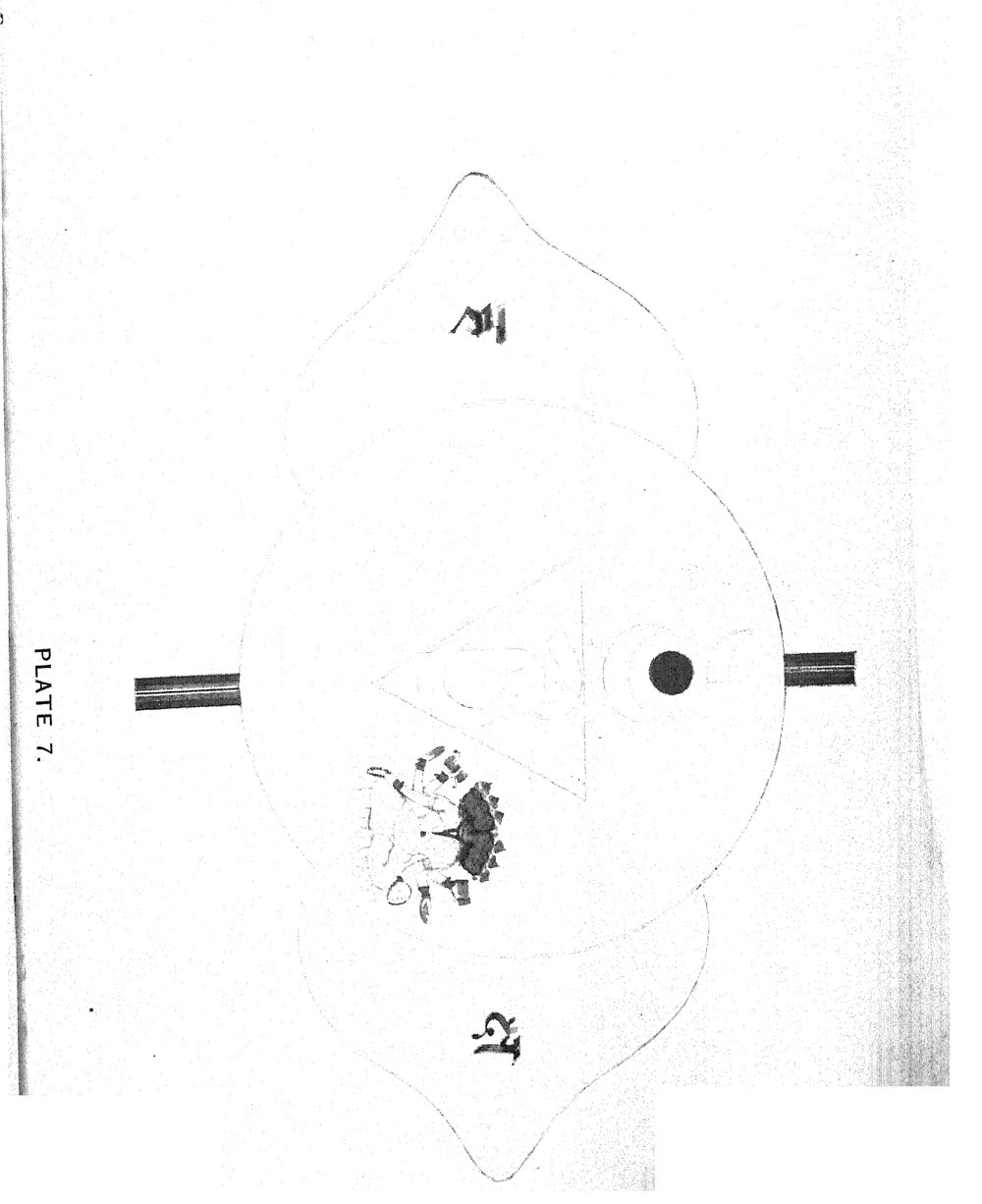
〈Plate VII, set sideways: a lotus drawn with its letters, its seed-mantra and its animal; the List of Illustrations (p. xv) names it Ājnā〉 PLATE 7.
This Lotus is between the eyebrows, as the following shows: “Going upwards after entering the throat and palate, the white and auspicious Lotus between the eyebrows is reached by Kundalī. It has two petals on which are the letters Ha and Ksha, and it is the place of mind (Manas).”
The following are descriptions of the Lotus:
“Like the Moon, beautifully white” (Hima-kara-sadrishang).—This comparison with Chandra (Himakara) may also mean that this Lotus is cool like the moonbeams (the moon being the receptacle of Amrita, or Nectar, whose characteristic is coolness), and that it is also beautifully white.
It has been said in “Īshvara-kārtikeya-sangvāda”:352 “Ājnā Chakra is above it; it is white and has two petals; the letters Ha and Ksha, variegated in colour, also enhance its beauty. It is the seat of mind (Manas).”
- 352 i.e., the Sammohana Tantra. p. 77
“Two petals” (Netra-patra).—The petals of the lotus.
“The letters Ha and Ksha, which are also white” (Ha-kshābhyāng kalābhyām parilasitavapuh su-shubhram).—These two letters are by their very nature white, and by their being on the white petals the whiteness thereof is made more charming by this very excess of whiteness.353 The letters are called Kalās because they are Bījas of Kalās.354
“It shines with the glory of Dhyāna” (Dhyāna-dhāma-prakāsham)—that is, its body shines like the glory of Dhyāna Shakti.
“Hākinī.”—He next speaks of the presence of the Shakti Hākinī here. The force of the pronoun Sā (She) in addition to Her name is that She is the well-known Hākinī.
“The gestures of dispelling fear and granting boons” (Mudrā).—This word stands for both Mudrās. There should be six weapons in Her hands, as She has six hands. There are some who read Vidyā and Mudrā as one word, Vidyā-mudrā, and interpret it to mean Vyākhyāmudrā—the gesture that conveys learning or knowledge—and speak of Her as possessed of four arms. Different p. 78 manuscripts give different readings. Various manuscripts read these as two words. The wise reader should judge for himself
In a Dhyāna in another place She is thus described: “Meditate upon Her, the divine Hākinī. She abides in the marrow355 and is white. In Her hands are the Damaru, the Rudrāksha rosary, the skull, the Vidyā (the sign of the book), the Mudrā (gesture of granting boons and dispelling fear). She is fond of food cooked with Turminī, and is elated by drinking ambrosia. She is well seated on a white Lotus, and Her mind is exalted by the drink of the King of the Devas gathered from the Ocean.”
- 355 Majjasthā. According to another reading (chakrasthā) abides in the chakra. p. 78
The rest is clear.
Verse 33
Within this Lotus dwells the subtle mind (Manas). It is well known. Inside the Yoni in the pericarp is the Shiva called Itara,356 in His phallic form. He here shines like a chain of lightning flashes. The first Bīja of the Vedas,357 which is the abode of the most excellent Shakti, and which by its lustre makes visible the Brahma-sūtra,358 is also there. The Sādhaka with steady mind should meditate upon these according to the order (prescribed).
Commentary
He speaks of the presence of Manas in this Lotus.
“Subtle” (Sūkshma-rūpa).—The Manas is beyond the scope of the senses; that being so, it may be asked, What is the proof of its existence? The answer is, It is well known or universally accepted (Prasiddha) and handed down from Anādipurusha generation after generation as a thing realised, and is hence well known. The evidence of the Shāstras, also, is that this Manas selects and rejects.359 Here is the place of the Manas. The presence of Manas is above the first Bīja of the Vedas as will appear from what is about to be spoken of.
- 359 Sangkalpavikalpātmaka. This is the lower Manas, and not that referred to in the Commentary to v. 40, post. As to the mental faculties, see Introduction. p. 79
“Phallic form” (Lingga-chihna-prakāsham).—He next speaks of the presence of the Shiva-lingga360 in the Yoni which is within p. 80 the pericarp. The Itara-Shiva who is there is in His phallic form, and within the Yoni. Within the triangle in the pericarp dwells Itara-shivapada361—i.e., the Shiva known by the name of Itara. This Lingga is in the phallic form and white. As has been said in the Bhūta-shuddhi Tantra: “Inside it is the Lingga Itara, crystalline and with three eyes.” This Lingga resembles continuous streaks of lightning flashes (Vidyun-mālāvilāsam).
“First Bīja of the Vedas” (Vedānām ādibījam).—He then speaks of the presence of the Pranava362 in the pericarp of this Lotus. In the pericarp there is also the first Bīja—i.e., Pranava.
- 362 Om. p. 80
“Which is the abode of the most excellent Shakti” (Paramakula-pada).—Kula=Shakti which is here of a triangular form. Parama means most excellent, by reason of its resembling lightning and the like luminous substances; and Pada means place—i.e., the triangular space. Hence this Bīja—namely, the Pranava—we perceive is within the triangle. This is clearly stated in the following text:
“Within the pericarp, and placed in the triangle, is Ātmā in the form of the Pranava, and above it, like the flame of a lamp, is the charming Nāda, and Bindu which is Makāra,363 and above it is the abode of Manas.”
- 363 The letter Ma; that is, it is Makārarūpa or Ma before manifestation. p. 80
Now, if the Paramakulapada364 be the container (Ādhāra) of and therefore inseparate from the Pranava, how is it that it is separately mentioned as one of the sixteen Ādhāras spoken of in the following passage? For it has been said that “the sixteen Ādhāras hard of attainment by the Yogī are Mūlādhāra, Svādhishthāna, Mani-pūra, Anāhata, Vishuddha, Ājnā-chakra, Bindu, Kalāpada, Nibodhikā, Arddhendu, Nāda, Nādānta, Unmanī, Vishnu-vaktra Dhruvamandala,365 and Shiva.”
The answer is that the second Kalāpada is not the one in the Ājnā Chakra, but is in the vacant space above Mahānāda which is spoken of later. This will become clear when dealing with the subject of Mahānāda.
“Which makes manifest the Brahma-sūtra” (Brahma-sūtra-prabodha).—Brahma-sūtra=Chitrinī-nādī. This Nādī is made visible by the lustre of the Pranava. In v. 3 this Nādī has been described as “lustrous with the lustre of the Pranava.”
The Sādhaka should with a steady mind meditate upon all these—viz., Hākinī, Manas, Itara Liṁga and Pranava—in the order prescribed. This is different to the order in which they are placed in the text by the author. But the arrangement of words according to their import is to be preferred to their positions in the text. The order as shown here should prevail. Thus, first Hākinī in the pericarp; in the triangle above her Itara Liṁga; in the triangle above him the Pranava; and last of all, above the Pranava itself, Manas should be meditated upon.
Verse 34
The excellent Sādhaka, whose Ātmā is nothing but a meditation on this Lotus, is able quickly to enter another’s body366 at will, and becomes the most excellent among Munis, and all-knowing and all-seeing. He becomes the benefactor of all, and versed in all the Shāstras. He realises his unity with the Brahman and acquires excellent and unknown powers.367 Full of fame and long-lived, he ever becomes the Creator, Destroyer, and Preserver, of the three worlds.
Commentary
In this verse he speaks of the good to be gained by the Dhyāna of this Lotus.
“Most excellent amony Munis” (Munīndra).—A Muni is one who is accomplished in Dhyāna and Yoga368 and other excellent acquirements. The suffix Indra means King or Chieftain, and is added to names to signify excellence.
- 368 Dhyānayogādisampannah.—The word may also mean one who is an adept in Dhyānayoga and other acquirements. p. 82
“Versed in all the Shāstras” (Sarva-shāstrārthavettā).—Such an one becomes proficient in the Shāstras and in Divine knowledge, and thus he becomes all-seeing (Sarva-darshī)—i.e., able to look at things from all points by reason of his being possessed of wisdom and knowledge which harmonises with Shāstras, manners, and customs.
“He realises,” etc. (Advaitāchāra-vādī).—He knows that this Universe and all material existence is the Brahman, from such sayings of Shruti as, “The worlds are Its Pāda (that is Angshas)”: “All that exists is the Brahman”;369 and, “I am the Deva, and no one else; I am the very Brahman, and sorrow is not my share.”370 He knows that the Brahman alone is the Real (Sat), and everything else is unreal (Asat), and that they all shine by the light of the Brahman.371 The man who by such knowledge is able to realise the identity of the Individual with the Supreme Spirit372 (Jīvātmā and Paramātmā), and preaches it, is an Advaitavādī.
- 369 ‘Pādo ’sya vishvā bhūtānīti.’ ‘Tadidang sarvvang Brahma.’ The Chhā.-Up. reads (3. 12. 6), ‘Pādo’sya sarvā bhūtāni’ and (3. 14. 1), ‘Sarvaṁ khalvidam Brahma’—which mean the same things. p. 83
- 370 Ahang devo na chānyo’smi Brahmaivāsmi na shokabhāk. p. 83
- 371 Brahmaivaikang sad-vastu tadanyad asat prapancha-samudāyas tu Brahma-bhāsatayā bhāsate. p. 83
- 372 Jīvātma-paramātmanor aikyachintanam. p. 83
“Excellent and unknown powers” (Paramāpūrva-siddhi)—that is, most exalted and excellent powers.
“Full of fame” (Prasiddha)—i.e., famous by reason of his excellence.
“He ever becomes,” etc. (So’pi kartā tri-bhuvana-bhavane sanghritau pālane cha).—This is Prashangsā-vāda;373 or it may mean that such Sādhaka becomes absorbed in the Supreme on the dissolution of the body, and thus becomes the source of Creation, Preservation, and Destruction.
- 373 i.e., Stuti-vāda, or praise; or, as we should say, compliment, which, while real in the sense of the presence of a desire to praise that which is in fact praiseworthy, is unreal so far as regards the actual words in which that desire is voiced. p. 83
Verse 35
Within the triangle in this Chakra ever dwells the combination of letters374 which form the Pranava. It is the inner Ātmā as pure mind (Buddhi), and resembles a flame in its radiance. Above it is the half (crescent) moon, and above this, again, is Ma-kāra,375 shining in its form of Bindu. Above this is Nāda, whose whiteness equals that of Balarāma376 and diffuses the rays of the Moon.
- 374 That is, a and u, which by Sandhi becomes O, and with anusvāra (ṁ) thus form the Pranava, or mantra Om. p. 84
- 375 The letter M in its Bindu form in Chandra-vindu. p. 84
- 376 Shangkara reads it as “Jaladhavala, etc.,” and explains it by “white like water”. The last portion may also mean “smiling whiteness equals that of the Moon”. p. 84
Commentary
The author desires to speak of the presence of the Pranava in the Ājnā Chakra and says that in this Chakra, and within the triangle which has already been spoken of, ever dwells the combination of the letters A and U which by the rules of Sandhi makes the thirteenth vowel O. This combination of letters is Suddha-buddhyantarātmā—i.e., the innermost Spirit manifesting as pure intelligence (Buddhi). The question may be asked if the thirteenth vowel (O) is that. To obviate this the author qualifies it by saying “above it is the half Moon, etc.” It is by adding the half Moon (Nāda) and Bindu to O that the Pranava is formed.
He next gives its attributes:
“Resembles a flame in its radiance” (Pradīpābhajyotih).—But how can this thirteenth vowel by itself be Shuddha-buddhyantarātmā? He therefore says:
“Above it is the crescent moon” (Tadūrdhve chandrārdhah).
“And above this, again, is Ma-kāra, shining in its form of Bindu” (Tad-upari vilasadbindu-rūpī Ma-kārah).—It is thus shown that by the placing of the crescent moon and the Bindu377 over the thirteenth vowel the Pranava is completely formed.
- 377 That is, Anusvāra. p. 85
“Above this is Nāda” (Tadūrdhve nādo’sau)—i.e., above the Pranava is the Avāntara (final or second) Nāda, which challenges as it were the whiteness of Baladeva and the Moon (Baladhavala-sudhādhāra-santāna-hāsī). By this he means to say that it is extremely white, excelling in whiteness both Baladeva and the rays of the Moon.378
- 378 Sudhādhārasantāna, Vishvanātha says, means a multitude of moons. p. 85
Some read Tadādye nādo’sau (in the place of Tadūrdhve nādo’sau), and interpret it as, “Below Bindu-rūpī Ma-kāra is Nāda”. But that is incorrect. The text says, “Above this, again, is Ma-kāra, shining in its form of Bindu,” and there is Nāda below it; that being so, it is useless to repeat that Nāda is below.
Besides, this Nāda is beyond the Nāda which forms part of the Pranava, and is part of the differentiating (Bhidyamāna) Parabindu placed above the Pranava. If, however, it be urged that it is necessary to state the details in describing the special Pranava (Vishishta-Pranava), and it is asked, “Why do you say a second Nāda is inappropriate?” then the reading Tadādye nādo’sau may be accepted.
But read thus it should be interpreted in the manner following: “This Nāda shown below the Bindu-rūpī Ma-kāra is Bala-dhavala-sudhādhāra-santāna-hāsī (v. ante), and the Nāda first spoken of is also so described. Such repetition is free from blame on the authority of the maxim that “the great are subject to no limitations”.
Verse 36
When the Yogī closes the house which hangs without support,379 the knowledge whereof he has gained by the service of Parama-guru, and when the Chetas380 by repeated practice becomes dissolved in this place which is the abode of uninterrupted bliss, he then sees within the middle of and in the space above (the triangle) sparks of fire distinctly shining.
- 379 Nirālamba-purī. Nirālamba (v. post) means that which has no support—viz., that by which the mind’s connection with the world has been removed and realisation of the infinite established. Ākāsha-māngsī=whose flesh or substance is Ākāsha (Rājanirghantu Dict.). p. 86
- 380 See next page and Introduction. p. 86
Commentary
Having described the Pranava, he now speaks of its union (with Chetas), i.e., Pranavayoga.
The Yogī should close the house (Puraṁ baddhvā)—i.e., he should, with his mind set on the act, close the inner house; or, in other words, he should make Yoni-mudrā381 in the manner prescribed, and thus effectually close the inner house. The use of the word Pur used shows that the Yoni-mudrā is meant. Then, when his Chetas by repeated practice (Abhyāsa) or meditation on the Pranava becomes dissolved (Līna) in this place (the Ājnāchakra), he sees within and in the space above the triangle wherein the Pranava is, sparks of Fire382 (Pavana-suhridāng kanān), or, to put it plainly, sparks of light resembling sparks of fire appear before his mental p. 87 vision above the triangle on which the Pranava rests. It is by Yoni-mudrā that the inner self (Antah-pur) is restrained and detached from the outside world, the region of material sense. The Manas cannot be purified and steadied unless it is completely detached from the material sphere. It is therefore that the mind (Manas) should be completely detached by Yoni-mudrā.
Yoni-mudrā, which detaches the Manas from the outside world, is thus defined: “Place the left heel against the anus, and the right heel on the left foot, and sit erect with your body and neck and head in a straight line. Then, with your lips formed to resemble a crow’s beak,383 draw in air and fill therewith your belly. Next384 close tightly your ear-holes with the thumbs, with your index-fingers the eyes, the nostrils by your middle fingers, and your mouth by the remaining fingers. Restrain the air385 within you, and with the senses controlled meditate on the Mantra whereby you realise the unity (Ekatvam) of Prāna and Manas.386 This is Yoga, the favourite of Yogīs.”
- 383 That is, by Kākī-mudrā. Shruti says that when Vāyu is drawn in by this Mudrā and stopped by Kumbhaka steadiness of mind is produced. p. 87
- 384 These and following verses occur in Shāradā Tilaka, Ch. XXV, vv. 45, 46. The first portion of this passage describes Siddhāsana. p. 87
- 385 That is, by Kumbhaka. p. 87
- 386 That is, recite the Hangsa or Ajapāmantra, or breathing in Kumbhaka. p. 87
That steadiness of mind is produced by restraint of breath through the help of Mudrā, has been said by Shruti. “The mind under the influence of Hangsa387 moves to and fro, over different subjects; by restraining Hangsa the mind is restrained.”
- 387 The Jīvātmā manifesting as Prāna. p. 87
“Closes the house” (Puraṁ baddhvā).—This may also mean Khecharī Mudrā.388 This latter also produces steadiness of mind.
- 388 One of the Mudrās of Hatha-yoga. See Introduction. p. 87
As has been said, “As by this the Chitta roams in the Brahman (Kha),389 and as the sound of uttered word390 also roams the p. 88 Ether (Kha), therefore is Khecharī Mudrā honoured by all the Siddhas.”
- 389 Kha has three meanings—viz., Ether, Brahman, and space between eyebrows (Ājnā). Brahmānanda, the Commentator of the Hathayogapradīpikā, adopts the last meaning in interpreting this verse (Ch. III, v. 41,) and in commenting on v. 55 of the Hathayogapradīpikā gives it the meaning of Brahman. p. 87
- 390 Lit., tongue. p. 87
The Chitta is Khechara391 when, disunited from Manas and devoid of all attachment to all worldly things, it becomes Unmanī.392
- 391 What moves about in the sky or ether. It is Manas which deprives the Chitta of freedom by causing attachment to the world. On being disunited from Manas it moves freely in the ether, going its own way. p. 88
- 392 Unmanī is there where, to coin a word, the “Manasness” of Manas ceases. See note to v. 40. Ut=without, and manī is from Manas. p. 88
As has been said,393 “the Yogī is united with Unmanī; without Unmanī there is no Yogī.” Nirālambā means that which has no support—namely, that from which the mind’s connection with the world has been removed.
- 393 This is from Jnānārnava Tantra, Ch. XXIV, v. 37. p. 88
“The knowledge whereof he has gained by the service of his Parama-guru” (Parama-guru-sevā-suviditām).—Parama is excellent in the sense that he has attained excellence in Yoga practice (by instructions) handed down along a series of spiritual preceptors (Gurus), and not the result of book-learning.394
- 394 Which is well recognised to be insufficient in these matters. p. 88
“Serving the Guru.”—Such knowledge is obtained from the Guru by pleasing him by personal services (Sevā). Cf. “It can be attained by the instructions of the Guru, and not by ten million of Shāstras.”
“The abode of uninterrupted bliss” (Su-sukha-sadana)—i.e., this is the place where one enjoys happiness that nothing can interrupt. This word qualifies place (Iha-sthāne—i.e., Ājnā-chakra).
“Sparks of fire distinctly shining” (Pavana-suhridām pravilasita-rūpān kanān).—These sparks of Fire shine quite distinctly.
Elsewhere it is clearly stated that the Pranava is surrounded by sparks of light: “Above it is the flame-like Ātmā, auspicious and in shape like the Pranava, on all sides surrounded by sparks of light.”
Verse 37
He then also sees the Light395 which is in the form of a flaming lamp. It is lustrous like the clearly shining morning sun, and glows between the Sky and the Earth.396 It is here that the Bhagavān manifests Himself in the fulness of His might.397 He knows no decay, and witnesseth all, and is here as He is in the region of Fire, Moon, and Sun.398
- 395 Jyotih. p. 89
- 396 See Commentary, post. p. 89
- 397 Pūrna-vibhava, which, however, as Kālīcharana points out post, may be interpreted in various ways. According to Vishvanātha, the second chapter of the Kaivalya-Kalikā Tantra contains a verse which says that the presence of the all-pervading Brahman is realised by His action, as we realise the presence of Rāhu by his action on the sun and moon. p. 89
- 398 That is, the triangle on Manipītha within the A-ka-tha triangle. See v. 4 of the Pādukāpanchaka. p. 89
Commentary
Yogīs such as these see other visions beside the sparks of light. After seeing the fiery sparks they see the light.
“Then” (Tadanu)—i.e., after seeing the sparks spoken of in the preceding Shloka.
He then describes this Light (Jyotih).
“Glows between the Sky and the Earth” (Gagana-dharanī-madhyamilita).—This compound adjective qualifies Jyotih or Light.
Gagana (sky) is the sky or empty space above Shangkhinī Nādī (see verse 40, post), and Dharanī (Earth) is the Dharā-mandala in the Mūlādhāra. This light also extends from the Mūlādhāra to the Sahasrāra.399
- 399 The particle vi in the text is used in an inclusive sense. p. 89
He next speaks of the presence of Parama Shiva in the Ājnā Chakra.
“It is here” (Iha sthāne)—i.e., in the Ājnā Chakra; Parama Shiva is here, as in the Sahasrāra. Bhagavān is Parama Shiva.
“Manifests Himself” (Sākshād bhavati)—i.e., He is here.400
- 400 He is seen here. p. 90
“In the fulness of His might” (Pūrna-vibhava).—This compound word which qualifies Bhagavān is capable of various interpretations.
Pūrna-vibhava may also be interpreted in the following different ways:
(a) Pūrna may mean complete in Himself, and vibhava infinite powers, such as the power of creation, etc. In that case the word would mean: “One who has in Him such powers, who is the absolute Creator, Destroyer, and Supporter, of the Universe.”
(b) Vibhava, again, may mean “the diversified and limitless creation,” and pūrna “all-spreading”. In this sense Purna-vibhava means “He from whom this all-spreading and endless (vast) creation has emanated.” Cf. “From whom all these originated, and in whom having originated they live, to whom they go and into whom they enter” (Shruti).401
- 401 Tait Up., 3. 1. 1. p. 90
(c) Vibhava, again, may mean “omnipresence,” and Pūrna “all-spreading”. It would then mean: “He who in His omnipresence pervades all things.”
(d) Pūrna402 may also mean the quality of one whose wish is not moved by the result and is not attached to any object. Pūrna-vibhava would then mean one who is possessed of that quality.
- 402 Phalānupahita-vishayitānāspadechchhākatvaṁ: He whose wish is not moved by the result, and is not attached to any object; or, in other words, He whose ways are inscrutable to us, subject as we are to limitations (Māyā). p. 90
All things except Ātmā pass away. The omnipresence of the ethereal region, (Ākāsha) etc., is not ever-existent. The Nirvāna Tantra (Ch. IX) speaks of the presence of Parama Shiva in the Ājnā Chakra in detail.
“Above this (i.e., Vishuddha) Lotus is Jnāna Lotus, which is very difficult to achieve; it is the region403 of the full Moon, and p. 91 has two petals.” Again: “Inside it, in the form of Hangsah, is the Bīja of Shambhu”; and again: “Thus is Hangsah in Manidvīpa,404 and in its lap is Parama Shiva, with Siddha Kālī405 on his left. She is the very self of eternal Bliss.” By lap is meant the space within the Bindus which form the Visarga at the end of Hangsah.406
- 403 Pūrna-chandrasya mandalam. p. 90
- 404 The isle of gems in the Ocean of Ambrosia. The Rudrayāmala says that it is in the centre of the Ocean of nectar outside and beyond the countless myriads of world systems, and that there is the Supreme abode of Shrīvidyā. p. 91
- 405 A form of Shakti. p. 91
- 406 i.e., the two dots which form the aspirate breathing at the end of Hangsah. p. 91
So it has been said in describing the Sahasrāra: “There are the two Bindus which make the imperishable Visarga.407 In the space within is Parama Shiva.” As It is in the Sahasrāra so It is represented here.408
We are to understand that these two, Shiva and Shakti, are here in union (Bandhana) in the form of Parabindu, as the letter Ma (Ma-kārātmā), and that they are surrounded (Āchchhādana) by Māyā.409 “She the Eternal One stays here (Ājnā Chakra) in the form of a grain of gram,410 and creates beings (Bhūtāni).” Here the Parama Shiva as in the form of a gram dwells, and according to the Utkalādimata411 also creates.
“As He is in the region of Fire, Moon, and Sun” (Vahneh shashimihirayor mandalamiva).—As the presence of Bhagavān in these regions is well known, so is He here. Or it may be that the author means that as He in the shape of a grain of gram dwells in the regions of Fire, Moon, and Sun, in the Sahasrāra, so does He dwell here also. We shall describe the Arka, Indu, and Agni Mandala in the Sahasrāra later. In Pītha-pūjā the Pūjā of Paramātmā and p. 92 Jnānātmā should be performed on the Mandalas of Sun (Arka), Moon (Indu), and Fire (Agni). By Paramātmā Parama Shiva is meant, and by Jnānātmā Jnāna Shakti. The Bindu should be meditated upon as like the grain of gram, consisting of the inseparable couple412—namely, Shiva and Shakti.
- 412 The grain referred to is divided in two under its encircling sheath. p. 92
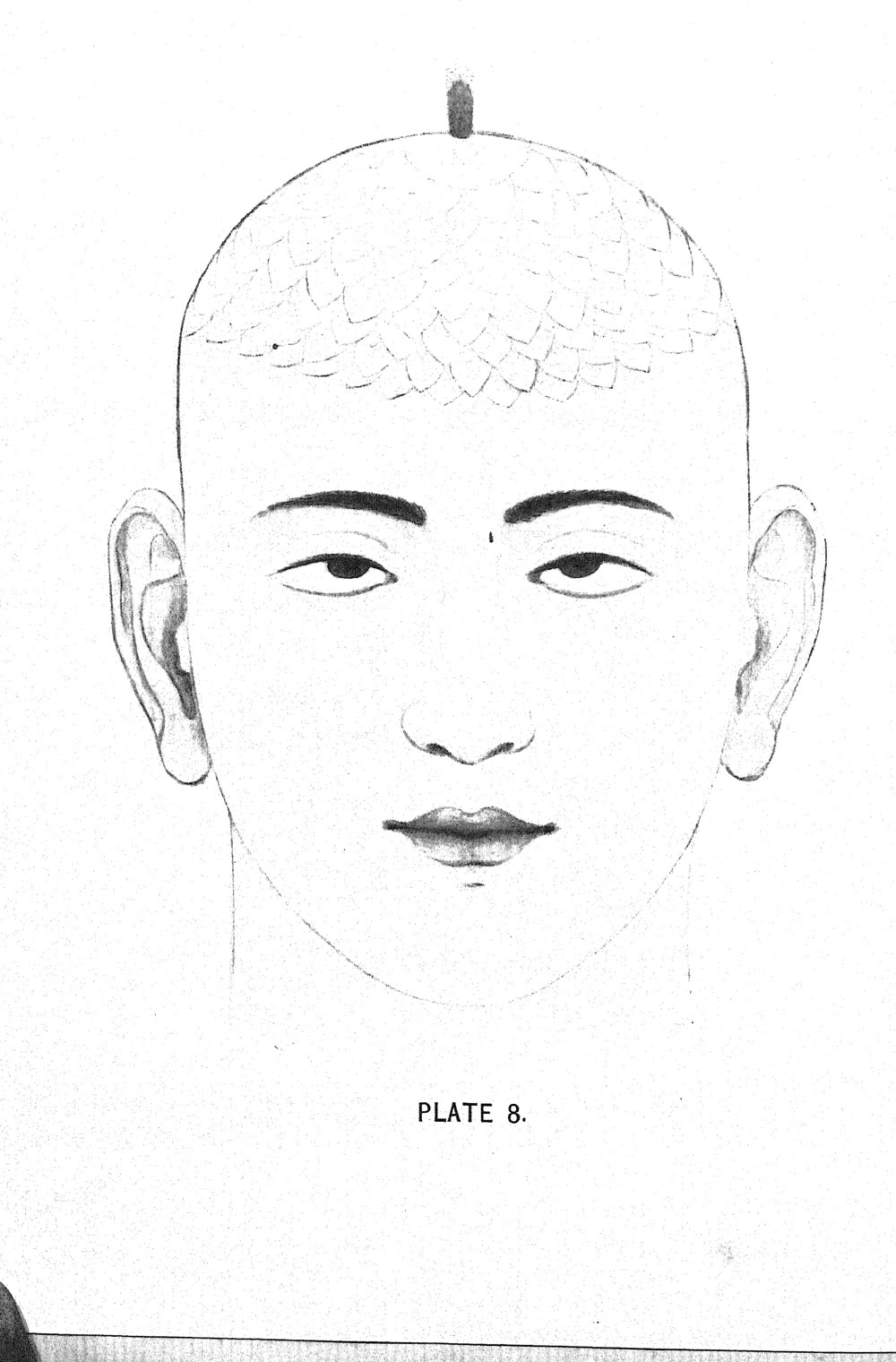
〈Plate VIII: a head in outline with a lotus over the crown; the List of Illustrations (p. xv) names it Sahasrāra〉 PLATE 8.
Verse 38
This is the incomparable and delightful abode of Vishnu. The excellent Yogī at the time of death joyfully places his vital breath (Prāna),413 here and enters (after death) that Supreme, Eternal, Birthless, Primeval Deva, the Purusha, who was before the three worlds, and who is known by the Vedānta.
- 413 Compare Bhagavad-Gītā, Ch. VIII, vv. 9 and 10, and the commentary of Shangkarāchāryya and Madhusūdana Sarasvatī on those verses. p. 93
Commentary
He now speaks of the good to be gained by giving up the Prāna by Yoga in the Ājnā Chakra.
This verse means: The excellent Yogī (Yogīndra) at the time of death (Prāna-nidhane) joyfully (Pramuditamanāh) places his Prāna (Prānang samāropya) in the abode of Vishnu in the Ājnā Chakra (Iha sthāne Vishnoh—i.e., in the abode of Bhagavān in the Bindu already described), and passes away, and then enters the Supreme Purusha.
“At the time of death” (Prāna-nidhane)—i.e., feeling the approach of death.
“Joyfully” (Pramudita-manāh)—Glad in mind in the enjoyment of the blissful union with Ātmā. (Ātmānandena hrishta-chittah.)
“Vishnu”=Bhagavān=Parama Shiva (see previous Shloka).
“Here” (Iha sthāne)—i.e., in the Bindu in the Ājnā Chakra spoken of above.
“Places the prāna here” (Iha sthāne prānang samāropya)—i.e., he places it on the Bindu already spoken of. He describes Purusha as Eternal.
“Eternal” (Nityam).—Indestructible (Vināsharahitam).
“Birthless” (Aja).
“Primeval” (Purāna).—He is the one known as the Purāna Purusha.414
- 414 According to Shangkara, it is an adjective, and means “He who is the cause of Creation,” and the like. p. 94
“Deva” means he whose play is Creation, Existence, and Destruction.
“Who was before the three worlds” (Tri-jagatām ādyam).415—By this the implication is that He is the Cause of all as He preceded all.
- 415 That is, the three spheres Bhūh, Bhuvah, Svah the Vyāhriti of the Gāyatrī. p. 94
“Known by the Vedānta” (Vedānta-vidita).416—Vedāntas are sacred texts dealing with the inquiry concerning the Brahman. He is known by a Knowledge (Jnāna) of these.
- 416 Shangkara reads Vedānta-vihita, and explains the expression to mean “this is the teaching of the Vedānta”. p. 94
The way the Prāna is placed (Prānāropana-prakāra) in the place of Vishnu is described below: Knowing that the time for the Prāna to depart is approaching, and glad that he is about to be absorbed into the Brahman, the Yogī sits in Yogāsana and restrains his breath by Kumbhaka. He then leads the Jīvātmā in the heart to the Mūlādhāra, and by contracting the anus417 and following other prescribed processes rouses the Kundalinī. He next meditates upon the lightning-like, blissful Nāda, which is thread-like and whose substance is Kundalī (Kundalinī-maya). He then merges the Hangsa which is the Paramātmā in the form of Prāna418 in the Nāda, and leads it along with the Jīva through the different Chakras according to the rules of Chakra-bheda to Ājnā Chakra. He there dissolves all the diverse elements from the gross to the subtle, beginning with Prithivī, in Kundalinī. Last of all he unifies Her and the Jīvātmā with the Bindu whose substance is Shiva and Shakti (Shiva-shakti-maya); which having done, he pierces the Brahmarandhra and leaves the body, and becomes merged in the Brahman.
Summary of the Ājnā Chakra, Verses 32 to 38
The Ājnā Chakra has two petals and is white. The letters Ha and Ksha, which are white,419 are on the two petals. The presiding Shakti of the Chakra, Hākinī, is in the pericarp. She is white, has six faces each with three eyes, and six arms, and is seated on a white lotus. With Her hands She displays Vara-mudrā and Abhaya-mudrā,420 and holds a Rudrāksha rosary, a human skull, a small drum, and a book. Above Her, within a Trikona, is Itara-Lingga, which is lightning-like, and above this, again, within another Trikona, is the inner Ātmā (Antarātmā), lustrous like a flame. On its four sides, floating in air, are sparks surrounding a light which by its own lustre makes visible all between Mūla and the Brahma-randhra. Above this, again, is Manas, and above Manas, in the region of the Moon, is Hangsah, within whom is Parama Shiva with His Shakti.
(Here ends the sixth section)
[Vishvanātha,421 in the Commentary to the Shatchakra, gives under this verse a description, taken from the Svachchhandasaṁgraha, of the region beyond the Ājnā—that is, beyond the Samashti or collective or cosmic Ājnā: “Within the Bindu is a space a hundred million Yojanas422 in expanse, and bright with the brightness of ten million suns. Here is the Lord of the State beyond Shānti (Shāntyatīteshvara), with five heads and ten arms and lustrous as a mass of lightning flashes. On His left is Shāntyatītā Manonmanī. Surrounding them are Nivritti, Pratishthā, Vidyā, and Shāntī.423 Each of these is adorned with a moon and has five heads and ten arms. This is Bindu Tattva. Above Bindu is Arddhachandra, with the Kalās of the latter—namely, Jyotsnā, Jyotsnāvatī, Kānti, Suprabhā, Vimalā. Above Arddhachandra is Nibodhikā, with the Kalās of the latter—Bandhatī, p. 96 Bodhinī, Bodhā, Jnānabodhā, Tamopahā. Above Nibodhikā is Nāda and its five Kalās—Indhikā, Rechikā, Ūrddhvagā, Trāsā, and Paramā. On the lotus above this last is Īshvara, in extent a hundred million Yojanas, and lustrous as ten thousand moons. He is five-headed, and each head has three eyes. His hair is matted, and he holds the trident (Shūla). He is the one who goeth upwards (Ūrddhvagāmī), and in His embrace (Utsaṁga) is the Kalā Ūrddhvagāminī.”]
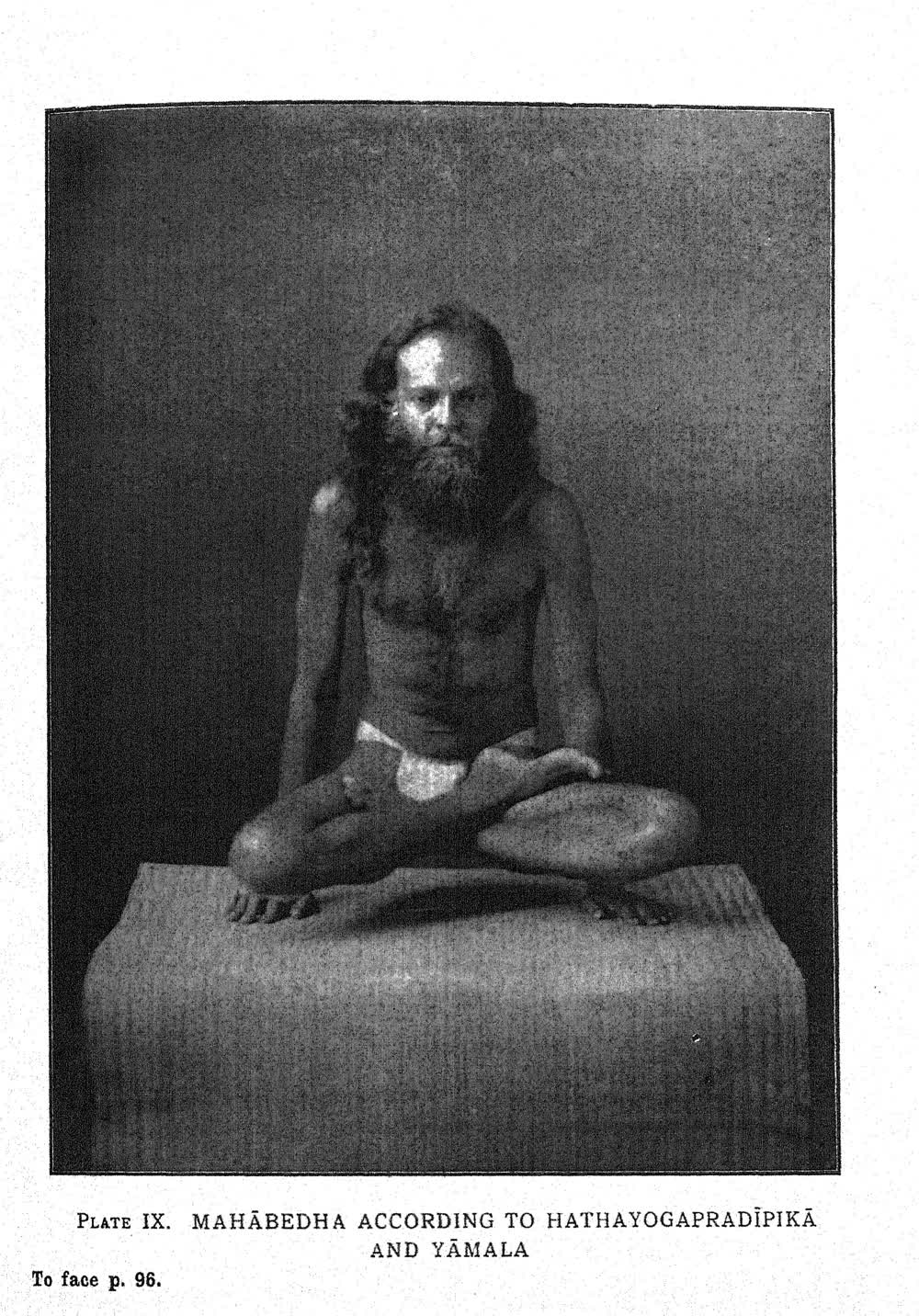
〈Plate IX: a photograph of a yogī seated in a posture〉 PLATE IX. MAHĀBEDHA ACCORDING TO HATHAYOGAPRADĪPIKĀ AND YĀMALA. To face p. 96.
Verse 39
When the actions of the Yogi are through the service of the Lotus feet of his Guru in all respects good, then he will see above it (i.e., Ājnā-chakra) the form of the Mahānāda, and will ever hold in the Lotus of his hand the Siddhi of Speech.424 The Mahānāda which is the place of dissolution of Vāyu425 is the half of Shiva, and like the plough in shape,426 is tranquil and grants boons and dispels fear, and makes manifest pure Intelligence (Buddhi).427
- 424 That is, all powers of speech. p. 97
- 425 Vāyoh layasthānam. Shangkara defines it by saying: Etat sthānam vāyoh virāma-bhūtam—this is the place where vāyu ceases to be. p. 97
- 426 That is, Shiva is Hakāra; and if the upper part of Ha is removed, the remaining portion of the letter has the form of an Indian plough. p. 97
- 427 Shuddha-buddhi-prakāsha. p. 97
Commentary
He now wishes to describe the intermediate causal body (Kāranāvāntara-sharīra)428 situate above Ājnā Chakra and below Sahasrāra, and says: When the actions of the Yogī are, through the service of the Lotus feet of his Guru, in all respects good—that is, when he excels by intense concentration of the mind in Yoga practice—he then sees the image of Mahānāda above it p. 98 (above Ājnā Chakra), and he becomes accomplished in speech (Vāk-siddha).
- 428 Kāranāvāntarasharīra. Kārana=cause; Avāntara=secondary or intermediate or inclusive; Sharīra=body. Body is so called because it wastes and fades. It is derived from the root Shri, to wane. Kāranāvāntara-sharīra would thus mean “the intermediate Sharīra of the Cause.” The primary cause is the Great Cause. Its effects are also intermediate causes of that which they themselves produce; they are thus secondary or intermediate causal bodies. Taking the Sakala Parameshvara to be the first cause, Mahānāda is one of its effects and a Kāranāvāntarasharīra as regards that which it produces and which follows it. p. 97
“Actions in all respects good” (Sushīla).—The good inclination for Yoga practice rendered admirable by strong and undivided application thereto. This result is obtained by serving the Guru.
The author then qualifies Nāda, and says it is the place of dissolution of Vāyu (Vāyor laya-sthānam). The Rule is “things dissolve into what they originate from.” Hence, although in Bhūta-shuddhi and other practices it has been seen that Vāyu dissolves into Sparsha-tattva,429 and the latter in Vyoma,430 Vāyu dissolves in Nāda also. We have the authority of Revelation (Shruti) for this:
“Prithivī, the possessor of Rasa (Rasa-vatī), originated from Ī-kāra.431 From Ka-kāra, who is Rasa, the waters and Tīrthas432 issued; from Repha (Ra-kāra) originated Vahni-tattva433; from Nāda came Vāyu,434 which pervades all life (Sarva-prānamaya). From Bindu originated the Void435 which is empty of all things and is the Sound-container. And from all these436 issued the twenty-five Tattvas which are Guna-maya. All this Universe (Vishva), which is the mundane egg of Brahmā, is pervaded by Kālikā.”
- 431 The Bīja Krīng is here being formed. Kakāra=Kālī; Ra-kāra=Brahmā as fire; Īkāra=Mahāmāyā. Anusvāra or Chandrabindu (Ng) is divided into two—viz., Nāda, which is Vishvamātā, or Mother of the Universe; and Bindu, which is Duhkhahara, or remover of pain (Bījakosha). p. 98
- 432 Places of pilgrimage where the devotees bathe. It also means sacred waters. p. 98
- 433 Fire. p. 98
- 434 Air. p. 98
- 435 Gagana, or Ether. p. 98
- 436 That is, from Krīng as composed of Ka+Ra+Ī+Ng. p. 98
We should therefore realise in our mind that at the time the letters of the Kālī-mantra437 are merged into that which is subtle, Vāyu is absorbed in Nāda.
- 437 Krīng. p. 98
“Half of Shiva” (Shivārddha).—By this is meant that here Shiva is in the form of Arddha-nārīshvara. Half is Shakti which is Nāda.
“Like a plough” (Sirākāra).—The word Sirā is spelt here with a short i, and in Amara-Kosha it is spelt with a long ī; but it is clearly the same word, as it begins with a dental s.
Cf. “Above it is Mahānāda, in form like a plough, and lustrous” (Īshvara-kārtikeya-Sangvāda).438
- 438 i.e., Sammohana Tantra. Ed., R. M. Chattopadhyāya. p. 99
If the text is read as “Shivākāra instead of Sirākāra,” then the meaning would be that the Nāda is Shiva-Shaktimaya.439
- 439 That is, its substance is Shiva and Shakti. p. 99
Cf. Prayoga-sāra: “That Shakti which tends towards the seat of Liberation440 is called male (Pungrūpā—that is, Bindu) when, quickened by Nāda, She turns towards Shiva441 (Shivonmukhī).” It is therefore that Rāghava-Bhatta has said that “Nāda and Bindu are the conditions under which She creates”.442
- 440 Nirāmaya-padōnmukhī=she who is turned to the place of Liberation: that is Shakti in the supreme state. p. 99
- 441 Tending towards, intent on, or with face uplifted to, Shiva, that is here tending to creation. That is, the first state is Chit. Nāda is the Mithah-samavāya of Shakti and Bindu. The establishment of this relation quickens Her to turn to Shiva for the purpose of creation when She appears as male, or Bindu. p. 99
- 442 Tasyā eva shakter nādabindū srishtyupayogyarūpau (Upayoga is capacity or fitness for creation). p. 99
It has elsewhere been said: “She is eternal443 existing as Chit (Chinmātrā)444: when being near the Light She is desirous of change, She becomes massive (Ghanī-bhūya) and Bindu.”
- 443 According to another reading this part would mean “She who is the Tattva”. p. 99
- 444 She is there, existing as Chit, with whom she is completely unified. She “measures Chit”—that is, coexists with and as Chit, and is also formative activity. The above translation is that of the text, but the verse has been quoted elsewhere as if it were Chinmātrajyotishah, and not Chinmātrā jyotishah, in which case the translation would be: “She who when near Jyotih, which is mere consciousness, becomes desirous of change, becomes massive and assumes the form of Bindu.” p. 99
So in the word of the honoured (Shrimat) Āchārya:445 “Nāda becomes massive and the Bindu.” Now, taking all these into consideration, the conclusion is that Shakti manifests herself as Nāda-bindu, like gold in ear-rings made of gold.446
Nāda and Bindu again are one—that is the deduction.
Verse 40
Above all these, in the vacant space447 wherein is Shangkhinī Nādī, and below Visarga is the Lotus of a thousand petals.448 This Lotus, lustrous and whiter than the full Moon, has its head turned downward. It charms. Its clustered filaments are tinged with the colour of the young Sun. Its body is luminous with the letters beginning with A, and it is the absolute bliss.449
- 447 This place is called the Supreme Ether (Parang-vyoma) in the Svachchhandasanggraha, cited by Vishvanātha. Parama-vyoma is the name given in the Pancharātra to the Highest Heaven or Vaikuntha. See Ahirbudhnya, 49. p. 101
- 448 The Sahasrāra is called Akula, according to the Svachchhanda saṁgraha, cited by Vishvanātha. p. 101
- 449 Kevalānanda-rūpam, i.e., Brahman Bliss. p. 101
Commentary
The Āchāryya enjoins that Sādhakas who wish to practise Samādhi Yoga “should before such time with every consideration and effort dissolve all things in their order from the gross to the subtle in Chidātmā”.450 All things, both gross and subtle, which make up creation should first be meditated upon. As the knowledge thereof is necessary, they are here described in detail.
- 450 The Ātmā considered as Chit. p. 101
The five gross elements—Prithivī451 and so forth—have been spoken of as being in the five Chakras from Mūlādhāra to Vishuddha. In the Bhūmandala452 in the Mūlādhāra there are the following—viz., feet, sense of smell, and Gandha-tattva,453 for this is their p. 102 place. In the Jala-mandala,454 similarly, are the hands, sense of taste, and Rasa-tattva.455 In the Vahni-mandala456 are the anus, the sense of sight, and Rūpa-tattva.457 In the Vāyumandala,458 the penis, sense of touch, and Sparsha-tattva.459 In the Nabho-mandala460 are speech, the sense of hearing, and Shabda-tattva.461 These make fifteen tattvas. Adding these fifteen to Prithivī and so forth, we get twenty gross tattvas.
- 451 Earth, Water, Fire, Air, Ether. p. 101
- 452 Region of the Earth Element, or Mūlādhāra Chakra. p. 101
- 453 Smell principle or Tanmātra. p. 101
- 454 Svādhishthāna, which is the region of Water (Jala). p. 102
- 455 Principle of taste. p. 102
- 456 Mani-pūra, which is the region of Fire (Vahni). p. 102
- 457 Principle of sight. p. 102
- 458 Anāhata, which is the region of Air (Vāyu). p. 102
- 459 Principle of touch. p. 102
- 460 Vishuddha, which is the region of Ether (Nabhas). p. 102
- 461 Principle of sound. p. 102
We next proceed to the subtle forms. In the Ājnā Chakra the subtle Manas has been spoken of. Others have been spoken of in the Kangkāla-mālinī Tantra (Ch. II) when dealing with the Ājnā Chakra: “Here constantly shines the excellent Manas, made beautiful by the presence of the Shakti Hākinī. It is lustrous, and has Buddhi,462 Prakriti,463 and Ahangkāra,464 for its adornment.”
From the above the presence of the three subtle forms—viz., Buddhi, Prakriti, and Ahangkāra—in this place becomes clear. We must, however, know that Ahangkāra is not placed in the order shown in the above quotation. We have seen that from the Mūlādhāra upwards the generated is below the generator; that which is dissolved is below what it is dissolved into, and we also know that the Shābdakrama is stronger than Pāthakrama.465 We must remember that Vyoma is dissolved in Ahangkāra, and hence the latter is next above Vyoma. Cf. “In Ahang-kāra, Vyoma with sound should be dissolved, and Ahangkāra again in Mahat.” Ahangkāra, being the place of dissolution, comes first above Vyoma, and above it are Buddhi and Prakriti.
- 465 That is, the actual arrangement of things as compared with the order in which they are stated. p. 102
The Shāradātilaka (I. 17, 18) speaks of their connection as Janya (effect, generated) and Janaka (cause, generator).
“From the unmanifest (Avyakta) Mūlabhūta, Paravastu when Vikrita originated Mahat-tattva,466 which consists of the Gunas and Antah-karana. From this (Mahat-tattva) originated Ahang-kāra, which is of three kinds according to its source of generation.”467 By Vikriti which means change is here meant reflection or image (Prativimba)468 of the Paravastu, and as such reflection it is Vikriti; but as it is the Prakriti of Mahat-tattva, etc., it is also called Prakriti.469 Cf. “Prakriti is the Paramā p. 104 (Supreme) Shakti, and Vikriti is the product thereof.”470 It has also been shown before that the Prakriti of the Para Brahman is but another aspect of Him (Prativimbasvarūpinī).
- 466 Mahat-tattva is a Vikriti of Prakriti. The Mulabhūta avyakta (unmanifested root-being) corresponds with the Sāngkhyan Mūla-prakriti. Here, as Rāghava Bhatta says, Tattvasrishti is indicated (Comm. to Ch. I, vv. 17, 18 of Shāradā), and interprets (Ch. I. vv. 17, 18) thus: Unmanifest Mūlabhūta Paravastu may mean either the Bindu or Shabda Brahman. By Vikrita is meant readiness or proneness to create (Srishtyunmukha). From this Bindu or Shabda Brahman emanates Mahat-tattva by which is meant the Padārtha Mahat: which is known as Buddhi-tattva in Shaiva-mata. This Mahat or Buddhi-tattva consists of the three Gunas—Sattva, Rajas and Tamas. That is, it includes Manas, Buddhi, Ahang-kāra and Chitta. These four are the product (Kārya) of the Gunas as cause (Kārana), and the cause (Kārana) inheres (Upachāra) in the effect (Kārya). After quoting the words of Īshāna-Shiva Rāghava remarks that Vāmakeshvara tantra also says that from the Unmanifest Shabda Brahman originates Buddhi-tattva wherein Sattva guna is manifest. He then distinguishes the Sāngkhya view according to which the State of equilibrium of Sattva, Rajas and Tamas is Prakriti, which is also called Pradhāna and Avyakta. This is the Supreme (Paravastu). From a disturbance in the equilibrium of the Gunas arises Mahat. This Mahat consists of Gunas and is the cause of the Antahkaranas. By Gunas according to this are meant the five Tanmātras Shabda, Sparsha, etc. According to this view also from Prakriti comes Mahat and from the latter Ahangkāra.
Rāghava thus shows the different ways in which the text of Shāradā can be interpreted from the Shākta, Shaiva and Sāngkhya points of view. p. 103 - 467 Srishtibheda—that is, one Ahangkāra is the result of the predominance of Sattva, another of Rajas, and a third of Tamas. p. 103
- 468 That is in the sense of product. In Shaivashāktadarshana, Mūla-prakriti is itself a product of the Shivashaktitattva for the Self becomes object to itself. p. 103
- 469 That is, as regarded from the point of view of the Paravastu it is an effect, but regarded in relation to that which it produces it is a cause. p. 103
- 470 Vikritih prativimbatā—in a mirror one is seen, but the image is not oneself. p. 104
According to Shāradātilaka, Mahat-tattva is the same as Buddhi.471 Īshāna-Shiva says: “The objective Prakriti,472 which is evolved by Shakti, is when associated with Sattva-guna, Buddhitattva. It is this Buddhi that is spoken of as Mahat in Sānkhya.”
Mahat-tattva consists of the Gunas and the Antah-karana. The Gunas are Sattva, Rajas, and Tamas. The Shāradā-tilaka says: “Antah-karana is the Manas, Buddhi, Ahang-kāra, and Chitta, of the Ātmā.473 All these are comprised in the term Mahat-tattva.
- 473 See Introduction. p. 104
Now, a question may be raised—namely, If Manas be within Mahat-tattva, what of that which has been said in v. 33, where Manas has been spoken of as having an independent existence? But the answer to that is, that that Manas is the product of Ahangkāra, and Rāghava-Bhatta quotes a text which says: “In so much as the other Manas is the one which selects and rejects (Sa-sangkalpavikalpaka),474 it is known to be the product of Tejas.”475 Thus it is that, as Manas and other Tattvas in the Ājnā Chakra are placed in their order, Ahang-kāra and others should be known as being placed above them. In the Ājnā Chakra are Hākinī, Itara-limga, Pranava, Manas, Ahangkāra, Buddhi, and Prakriti, placed consecutively one above the other. No place being assigned to Chandra-mandala, which has been spoken of before, it should be taken to be placed above all these. If it be asked, Why is it not below all these? then the reply is that it has been said in the Sammohana Tantra: “Moon (Indu) is in the forehead, and above it is Bodhinī Herself.” From this it would appear that Indu and Bodhinī are above Ājnā Chakra, placed one above p. 105 the other without anything intervening between them. Bodhinī is above all the rest.
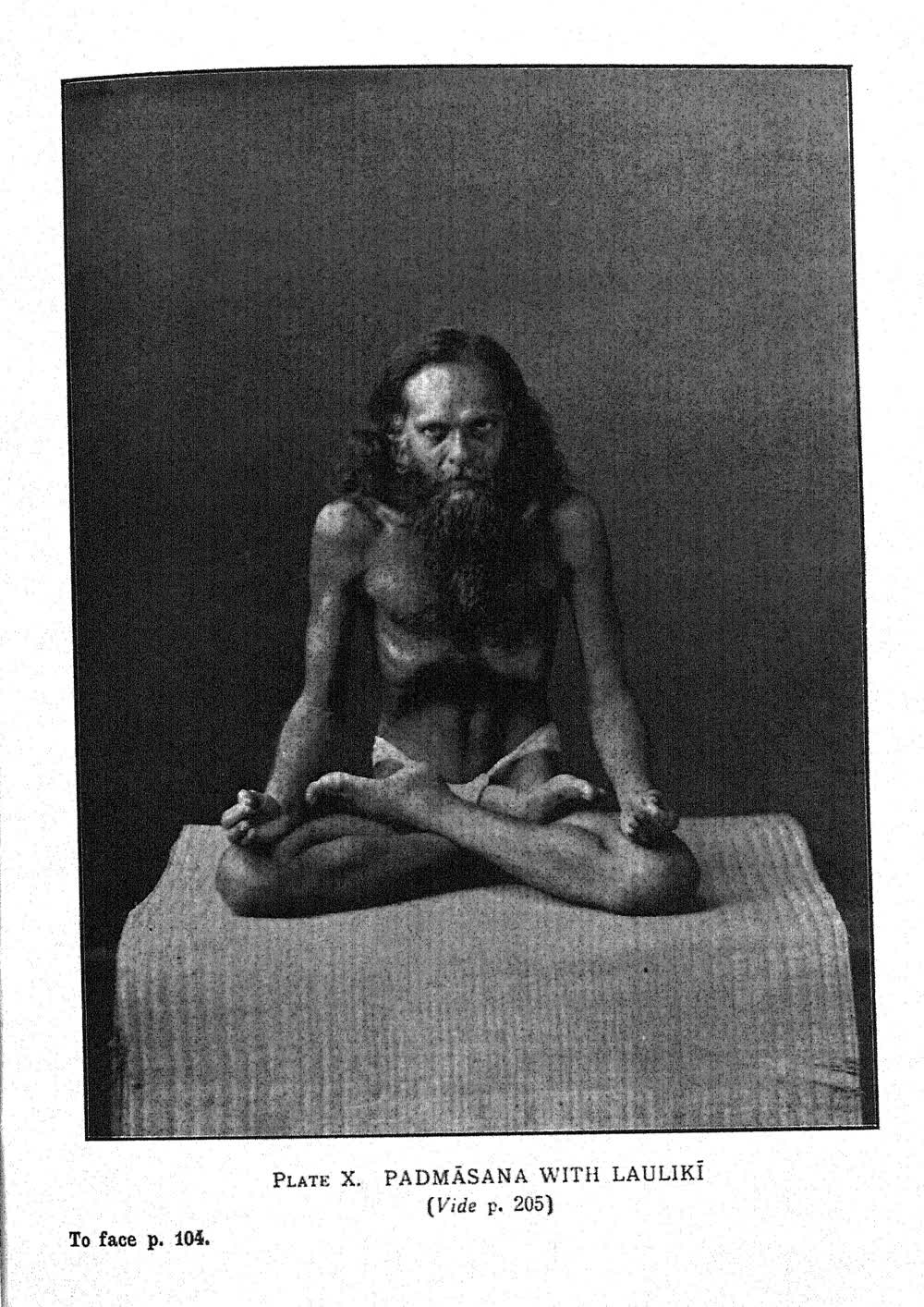
〈Plate X: a photograph of a seated yogī〉 PLATE X. PADMĀSANA WITH LAULIKĪ (Vide p. 205). To face p. 104.
The Sammohana Tantra speaks of the Cause (Kāranarūpa) as above Ājnā Chakra: “Indu (the Moon, here—Bindu) is in the region of the forehead, and above it is Bodhinī Herself. Above Bodhinī shines the excellent Nāda, in form like the half (crescent) moon; above this is the lustrous Mahānāda, in shape like a plough; above this is the Kalā called Ānjī, the beloved of Yogīs. Above this last is Unmanī,476 which having reached one does not return.”
- 476 In this passage Ānjī is Samanī. The Bhūtashuddhi (see post), makes a distinction too between Ānjī and Samanī. These are the Avāntarasharīras of the First Cause enumerated in Layakrama. The text quoted from the Shāradā gives the Srishti-krama. p. 105
In the above passage, in the words “above it is Bodhinī,” the word “it” stands for the forehead or Ājnā Chakra.
The Bhūta-shuddhi Tantra speaks of the existence of the Bindu below Bodhinī: “Devi, above Vindu and Mātrārdhā is Nāda, and above this, again, is Mahānāda, which is the place of the dissolution of Vāyu.” Mātrārddhā is Mātrārddha Shakti.477
- 477 Mātrārddhā. In the Devī Bhāgavata there occurs the expression Arddha-mātrā (which is a name for Nāda) in I, 1, v. 55, and III, 5, v. 29, and Nīlakantha defines it to mean Param padam=the supreme state, or the Brahman. The expression Arddha-mātrā also occurs in Chandī, I, 55, in practically the same sense. Gopāla Chakravartī quotes a passage which says “Arddhamātrā is attributeless (Nirguna), and realisable by the Yogī.” He quotes another passage which says: “Om—this is the three Vedas, three Lokas, and after the three Lokas Mātrārddha is the fourth—the Supreme Tattva.” See Chandī “Tvamudgīthe arddhamātrāsi,” and Devībhāgavata, I, 5, v. 55. Shruti says: “Thou art the Arddhamātrā of Pranava, Gāyatrī, and Vyāhriti.” Here the unity of Devī and Brahman is shown. She is Brahman united with Māyā (Māyāvishishtabrahmarūpinī). The Nādabindu Upanishad (v. 1) says: “A-kāra is the right wing (of Om figured as a bird), U-kāra is the other (left) wing, Ma-kāra the tail, and Arddhamātrā the head. Sattva is its body, and Rajas and Tamas are its two feet. Dharma is its right eye, and Adharma is its left eye. The Bhūr-loka is its feet, the Bhuvarloka its knees; the Svarloka is its middle, the Maharloka its navel; Janaloka is the heart, Tapoloka its throat, and Satyaloka the place between the eyebrows.” See also Brahmavidyā Up., v. 10. p. 105
The following passage from Brihat-tri-vikrama-sanghitā proves that the Arddha-mātrā means Shakti: “Lustrous like the young p. 106 Sun is Akshara, which is Bindumat (Bindu itself); above it is Arddhamātrā, associated with the Gāndhārarāga.”478
- 478 The third of the seven primary subtle tones. p. 106
As both the above passages point to the same thing, we must take it that Arddha-mātrā and Bodhinī are identical. Bindu, Bodhinī, and Nāda, are but different aspects of the Bindu-maya-para-shakti.
The Shāradā-tilaka says: “From the Sakala Paramēshvara,479 who is Sat, Chit, and Ānanda, Shakti emanated; from Shakti, again, emanated Nāda; and Bindu has its origin from Nāda. He who is Para-Shakti-maya manifests Himself in three different ways. Bindu and Nāda and Bīja are but His different aspects. Bindu is Nādātmaka,480 Bīja is Shakti, and Nāda, again, is the union or relation of the one to the other.481 This is spoken of by all who are versed in the Āgamas.”482
- 479 Shāradā, Ch. I, vv. 7—9. Sakala, as opposed to Nishkala or Nirguna, means united with Kalā, which according to Sāngkhya is Sāmyāvasthā of the Gunas which is Prakriti. According to the Vedantists (of the Māyā Vāda), Kalā is Avidyā. In the Shaiva Tantra Kalā is Shakti (Rāghava Bhatta). p. 106
- 480 Another text has Shivātmaka—that is, Vindu is the Shiva aspect. p. 106
- 481 Samavāya=kshobhya-kshobhaka-sambandha—lit., connection which is the connection of reciprocity. p. 106
- 482 See Introduction. p. 106
“Para-Shakti-maya”: Para=Shiva; hence Shiva-Shakti-maya=Bindu. The Bindu who is above the forehead is Nādātmaka—that is, Shivātmaka.483 Bīja is Shakti as Bodhinī (Bodhinī-rūpam). Nāda is the connection between the two whereby the one acts upon the other; hence it is Kriyā Shakti. Above these three is Mahānāda. This has already been shown.
- 483 In the Benares edition as also in Rasika Mohana Chattopādhyāya’s edition of the Shāradātilaka the text reads Shivātmaka, as if qualifying Vīja, which seems erroneous. p. 106
“Above this is Kalā,” etc.: Kalā=Shakti. Ānjī=a crooked, awry, bent line. This is in shape like a bent or crooked line over a letter. This Shakti appeared in the beginning of creation. Cf. Pancha-rātra: “Having thus seen, the Supreme Male in the beginning of creation makes manifest the eternal Prakriti who is p. 107 the embodiment of Sat, Chit, and Ānanda, in whom484 are all the Tattvas, and who is the presiding (Adhishthātrī) Devī of creation.”
- 484 Rāghava reads “Samastatattvasamghātmasphurtyadhishthatrirūpinīm”—which means “who is the Devi presiding over or directing the evolution or manifestation of all the mass of Tattvas”. p. 107
Also elsewhere: “From the unmanifested (Avyakta) Paramēshvara, the united Shiva and Shakti, emanated the Ādyā (first) Devī Bhagavatī, who is Tripura-sundarī, the Shakti from whom came Nāda, and thence came Bindu.”
“Above it is Unmanī,” etc.: Cf. “By going where ‘Manasness’ (Manastva) of Manas ceases to be, is called Unmanī, the attainment of which is the secret teaching of all Tantras.”485
- 485 Vishvanātha, quoting Svachchhandasamgraha, which speaks of Unmanī as above Samanā, says that in the Unmanī stage there is no cognition of and no distinction is made between Kāla and Kalā; there is no body, and no Devatās, and no cessation of continuity. It is the pure and sweet mouth of Rudra. Cf. Vrittihīnam manah in the Shiva-Samhitā, V, 219. p. 107
The state of Unmanī is the Tattva which means the dispelling of the attachment prompted by Manas towards worldly objects.
Unmanī, again, is of two kinds: (1) Nirvāna-kalā-rūpā, which also has its place in the Sahasrāra486; (2) Varnāvalī-rūpā, which also has its place in this region. Cf. Kangkāla-mālinī: “In the pericarp of the Sahasrāra, placed within the circle of the moon, is the seventeenth Kalā, devoid of attachment.487 The name of this is Unmanī, which cuts the bond of attachment to the world.”
Cf. also: “By mental recitation of the Mālā-varna (rosary of letters) is Unmanī the granter of Liberation (attained).” Mālā-varna=Varnāvalī-rūpa.
The Bhūta-shuddhi speaks of the Samanī below Unmanī. “Next is the Vyāpikā Shakti (Diffusive Energy) which people know as Ānjī. Samanī488 is over this, and Unmanī is above all.’ This (Samanī) also is an intermediate aspect (Avāntararūpa) of Parashakti.
- 488 Vishvanātha speaks of it as Samanā, and says that She is Chidānandasvarūpā (that is, Chit and Ānanda), and the cause of all causes (Sarvakāranakāranam.) p. 107
We now get the following:
Above Ājnā Chakra is the second Bindu—which is Shiva (Shiva-svarūpa). Above Bindu is the Shakti Bodhinī in shape like an Arddha-mātrā; next is Nāda which is the union of Shiva and Shakti, in shape like a half (crescent) moon; next (above this) is Mahānāda, shaped like a plough; above Mahānāda is the Vyāpikā Shakti, crooked (Ānjī) in shape; above this last is Samanī and highest of these all is Unmanī. This is the order in which the seven causal forms (Kārana-rūpa) are placed.
There is no need to go into further detail. Let us then follow the text.
Wishing to describe the Sahasrāra he speaks of it in ten more verses.
“Above all these” (Tadūrddhve).—Above every other that has been described or spoken before.
“Over the head of the Shamkhinī Nādī”—a sight of which has been given to the disciple.
“Vacant space” (Shūnya-desha)—that is, the place where there are no Nādīs; the implication is that it is above where Sushumnā ends.
“Below Visarga is the lotus of a thousand petals.”—This is the purport of the Shloka. Visarga is in the upper part of the Brahma-randhra. Cf. “(Meditate) in that aperture on Visarga the ever blissful and stainless.” There are other similar passages.
“Its body is luminous with,” etc. (Lalātādyaih varnaih pravilasitavapuh).—The word Lalāta stands for the first vowel, A. By this we are to understand that the second Lakāra (L) is to be left out in counting the letters of the Alphabet. In counting the fifty letters, the second Lakāra489 is always left out.
- 489 Vaidika Lakāra (La). p. 108
If the text is read as “Lakārādyaih varnaih,” as is done by some, we must leave Ksha-kāra out in counting the letters. The fifty-one letters cannot be taken to be in the petals of the Sahasrāra.490 With fifty-one letters repeated twenty times, p. 109 the number is 1,020, and repeated nineteen times is 969. By leaving out Ksha-kāra we are freed of this difficulty. By “Lakārādyaih” it is not meant that the letters are to be read Viloma.491 The Kangkāla-mālinī in the following passage distinctly says that it is to be read Anuloma492: “The Great Lotus Sahasrāra is white, and has its head downward, and the lustrous letters from A-kāra (A), ending with the last letter before Kshakāra (Ksha), decorate it.” Here it is distinctly stated that the letter Ksha is left out.
Akārādi-ksha-kārāntaih: This compound, Ksha-kāranta, if formed by Bahu-vrihi-samāsa,493 would mean that Kshakāra is left out of calculation.
- 493 A form of Sanskrit verbal compound. p. 109
There is nothing said of the colour of the letters, and, as the Mātrikā (letters) are white, they are to be taken as being white on the Sahasrāra petals. These letters go round the Sahasrāra from right to left.494
- 494 Dakshināvarta—the opposite way to that in which the hands of a clock work. p. 109
Some read Pravilasita-tanuh in place of pravilasita-vapuh, and say that, as the word padma alternatively becomes masculine in gender (vā pungsi padmam), therefore the word Tanu, which qualifies a word in the masculine gender, is itself masculine. That cannot be. The verb Nivasati (=is, dwells) has for its nominative Padmam, and, as it ends with the Bindu (m), it is in the neuter gender and not masculine. For in that case it would have ended with visarga (i.e., h), and its adjective, tanu, would also end with a visarga. The word tanu (if their reading is accepted) would be in the neuter; therefore it cannot end with a Bindu. And if there is no Bindu the metre becomes defective. Therefore the correct reading is Pravilasita-vapuh.
The rest is clear.
Verse 41
Within it (Sahasrāra) is the full Moon, without the mark of the hare,495 resplendent as in a clear sky. It sheds its rays in profusion, and is moist and cool like nectar. Inside it (Chandra-mandala), constantly shining like lightning, is the Triangle,496 and inside this, again, shines the Great Void497 which is served in secret by all the Suras.498
- 495 The man in the moon. p. 110
- 496 The A-ka-thādi triangle according to Vishvanātha. p. 110
- 497 Shūnya=Bindu—that is, the Parabindu, or Īshvara, having as its centre the abode of Brahman (Brahmapada). In the northern Shaiva and Shākta schools Sadāshiva and Īshvara are the Nimesha and Unmesha aspects of the experience intermediate between Shiva Tattva and Shuddhavidyā, the former being called Shūnyātishūnya. The positions of the Sun and Moon circles in the Sahasrāra and of the twelve-petalled lotus with the Kāmakalā are given in the Text. p. 110
- 498 i.e., Devas. p. 110
Commentary
He here speaks of the existence of the Chandra-mandala in the pericarp of the Sahasrāra.
“Resplendent as in a clear sky” (Shuddha)—seen in a cloudless sky (nirmalo-daya-vishishta).
“Is moist and cool,” etc. (Parama-rasa-chaya-snigdha-santānahāsī).—Snigdha which means moist here implies the moisture of the nectar. Parama-rasa (Amrita) is free from heat. Hence the meaning of this compound word: Its rays are cool and moist, and produce a feeling of smiling gladness.
The Kangkāla-mālinī speaks of the presence of Antarātmā, etc., in the upper portion of the space below Chandra-mandala. In dealing with the Sahasrāra, it says: “In its pericarp, O Deveshī, is the Antarātmā. Above it is the Guru. The Mandalas of Sūryya p. 111 and Chandra are also there. Above this is Mahāvāyu, and then the Brahma-randhra. In this aperture (Randhra) is Visarga, the ever blissful Brahman. Above this (Tadūrddhve) last is the Devī Shangkhinī, who creates, maintains, and destroys.”
“Within Chandra-mandala constantly shines, like lightning, the triangle” (Trikonam tasyāntah vidyudakārarūpam). That is the shining triangle is there.
“Inside this shines the Great Void” (Tadantah shūnyam sphurati).—That which as a void within is, the body of the Parabindu (Paravindusharīram). Within the triangle the excellent Bindu (Shūnya) shines, or within the triangle the Shūnya which is the excellent Bindu shines.
Cf. Todala Tantra, 6th Ullāsa: “The Supreme Light is formless (Nirākāra), and Bindu is imperishable. Bindu means the void (Shūnya), and implies Guna also.”499
- 499 When it assumes the form of Bindu, It is with the operating Gunas, for then It is Sakala. p. 111
“Served in secret” (Sevitang chātiguptam).—The rule is, “Eating (Āhāra), evacuation (Nirhāra), sexual intercourse (Vihāra), and Yoga, should be done in secret by him who knows the Dharma.” Hence Suras (Devas) serve or worship It in secret.
Verse 42
Well concealed, and attainable only by great effort, is that subtle Bindu (Shūnya) which is the chief root of Liberation, and which manifests the pure Nirvāna Kalā with Amā Kalā.500 Here is the Deva who is known to all as Parama Shiva. He is the Brahman and the Ātmā of all beings. In Him are united both Rasa and Virasa,501 and He is the Sun which destroys the darkness of nescience502 and delusion.503
- 500 There are seventeen Kalās (digits) of the Moon, but the nectar-dropping Amā and the Nirvānakalā are only at this stage revealed. The other Kalās are mentioned in Skanda Purāna, Prabhāsa Khanda. p. 112
- 501 The Bliss of liberation and that arising from the union of Shiva and Shakti; vide post. p. 112
- 502 Ajnāna. p. 112
- 503 Moha. This verse occurs in Tripurā-sāra-samuchchaya, ch. V, 40. p. 112
Commentary
The sense is that the void (Shūnya) is very secret and subtle, being, as described later, like the ten millionth part of the end of a hair. It is attainable only by great effort consisting of long and incessant performance of Dhyāna and like practices. It makes manifest the purity of the sixteenth Kalā of the moon along with Nirvāna Kalā—i.e., the void (Antāh-shūnya) along with the Amā Kalā and Nirvāna Kalā within the triangle is realised (Prakāsham bhavati) by meditation (Dhyāna). It is the source of all the mass of great Bliss, which is Liberation. Some, however, read Sakala-shashi-kalā-shuddha-rūpa-prakāsham as qualifying the great Void within the triangle, and read ‘sakala’ to mean with all the sixteen kalās and say that the Para Bindu manifests the moon with such kalās. This requires consideration. When it was said that the p. 113 Trikona (triangle) is within the full moon, the repetition of it is useless. Furthermore, in the previous verse we have got “served by the Suras”. The term “service” as applied to a void is inappropriate. The object of service is the Bindu within the triangle. If it be said that the Void should be worshipped by reason of the presence of the Para Bindu, then the Para Bindu being there present there is no void.
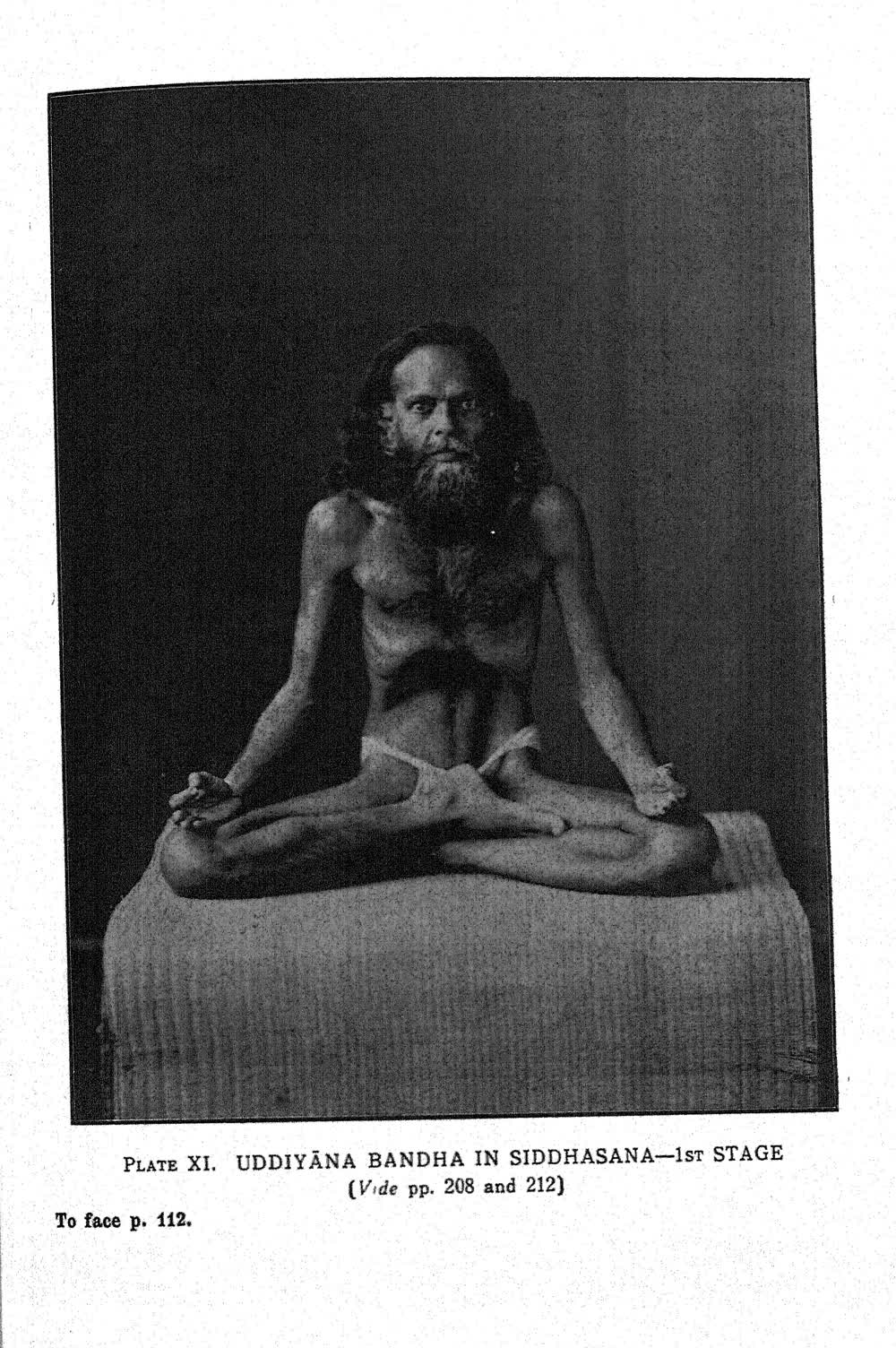
〈Plate XI: a photograph of a seated yogī〉 PLATE XI. UDDIYĀNA BANDHA IN SIDDHĀSANA—1ST STAGE (Vide pp. 208 and 212). To face p. 112.
“Well concealed” (Suguptam).—By reason of its being like the ten millionth part of a hair.
“By great effort” (Yatnāt)—i.e., by long-continued practice of meditation (Dhyāna) and so forth.
“Chief root” (Parang kandam.504)—Para usually means supreme, excellent; here chief, principal. Kanda=Mūla.
- 504 Kanda means bulb or root. The Yoginīhridaya says that this Kanda is the subtle Parānanda-kandabindurūpa, or the root of supreme Bliss in Bindu form (Vishvanātha). p. 113
“Liberation,” etc. (Atishaya-paramāmodasantāna-rāshi).—The compound word means, literally, continuity of all the mass of great and supreme bliss, and this is Liberation (Moksha).
“Manifests, etc., Amākalā” (Sakala-shashi-kalā-shuddha-rūpa-prakāsham).—This compound word is to be broken up as follows:
Sakala=with the Kalā: Kalā here meaning Nirvāna Kalā. In the word Shashi-kalā the Kalā means Amākalā, the sixteenth Kalā, or digit, of the moon. Shuddha=pure; the lustre is not obscured by anything.
The sense is that the Parabindu, though subtle and otherwise imperceptible, is seen by meditation (Dhyāna) with the Amā Kalā and Nirvāna Kalā in the Trikona. If Sugopyam be read in place of Suguptam, then it would be qualified by Yatnāt.
Some read Sakala-shashi-kalā-shuddha-rūpa-prakāsham to qualify Shūnya in the previous verse, and say Shūnya means “vacant space,” but that is absurd.505
- 505 According to the Commentator, it qualifies Kanda. Bindu is the circle O; the void is the Brahmapada or space within. p. 113
Next he speaks of the presence of Parama Shiva in the pericarp of the Sahasrāra.
“Paramashiva”506 (Paramashiva-samākhyāna-siddha). He who is known by the name Parama Shiva.
- 506 Vishvanātha says that this Shiva is the Saguna Shiva. p. 113
“The Brahman” (Kharūpī).507—Kha=Ātmā, the spirit.
- 507 Cf. Shruti “Khang Brahma” Chhā. 4—10—5 Brah. 5—1—1. p. 114
“The Ātmā of all beings” (Sarvātmā).—Sarva=all (beings). He is the Jīvātmā, but in fact there is no distinction between Jīvātmā and Paramātmā. The Ātmā is the Jīva. The Adhyātma Rāmāyana says: “The Jīvātmā is merely another name (Paryyāya) for the Paramātmā. When by the instructions of the Āchāryya and the Shāstras their oneness is known, then the disciple possesses Mūlavidyā concerning Jīvātmā and Paramātmā.”
The Shruti also, when it says “That thou art”—Tat tvam asi,508—identifies the Tvam (Thou) with the Tat (That).
- 508 “That Thou art.” See Introduction. p. 114
“Rasa and Virasa” (Rasa-virasamita).—Rasa is Paramānanda-rasa—i.e., the experience of Supreme Bliss.509 Virasa is the bliss which is the product of the union of Shiva and Shakti. He is both. Or Rasa may mean the natural attachment to worldly enjoyment, and Virasa detachment from it. The meaning would then be: in Him is the Supreme Bliss arising from his detachment from worldly enjoyment.510
“The Sun”=Hangsa. As the sun dispels darkness, so does He dispel nescience (Ajnāna) and delusion (Moha).
Verse 43
By shedding a constant and profuse stream of nectar-like essence,511 the Bhagavān512 instructs the Yati513 of pure mind in the knowledge by which he realises the oneness of the Jīvātmā and the Paramātmā. He pervades all things as their Lord, who is the ever-flowing and spreading current of all manner of bliss known by the name of Hangsah Parama (Parama-hangsah).
- 511 As appears from the Commentary post, this may be variously translated as follows: “By shedding a constant and profuse stream of nectar resembling the silvery beams of the Moon,” or “By unremitting and nectar-like words strong for the destruction of the darkness of delusion,” or “By constant repetition of the word which is nectar-like in its mercy and contains the essence of the Brahma-mantra.” p. 115
- 512 That is, the Lord as the possessor of the six forms of Aishvaryya. p. 115
- 513 Self-controlled, whose mind is unified with the object of worship. p. 115
Commentary
“Constant and profuse” (Niravadhi atitarām).
“By shedding a stream of nectar-like essence” (Sudhā-dhārā-sāram vimunchan).—The compound word can be made up and interpreted in four different ways:
1. Shedding a stream of nectar-like essence.
2. The Ādhāra (receptacle) of Sudhā (nectar) is Sudhādhāra, by which is meant the Moon; Āsāra is what flows therefrom, a stream. Now, what flows from the Moon is Nectar, which is silvery; hence the whole word means “the silvery beams of the moon”. This adjective proves that the qualified noun is white or transparent like the moon. Shedding=Vimunchan.
3. Āsāra may, again, mean “what is uttered,” “word”. Sudhādhāra=receptacle of sweetness, which is a quality of nectar; p. 116 hence Sudhādhārāsāram=nectar-like or ambrosial word. The meaning of Niravadhi would then be “at all times,” and Atitarām would mean “powerful in destroying the darkness of ignorance or delusion”. Vimunchan should then mean “uttering”.
4. Sudhā, again, may mean “nectar of mercy,” and Sāra is “essence”—i.e., the essence of Brahma-mantra; and Dhārā is a stream (continuous repetition) of the merciful word containing the essence of the Brahma-mantra.
“Instructs the Yati,” etc. (Bhagavān nirmala-mater yateh svātma-jnānam dishati).
“Yati.”—He whose mind intently rests upon the Devatā of his worship.
Knowledge by which, etc., Paramātmā (Svātma-jnāna): Svam=Jīvātmā and Ātmā=Paramātmā; and Jnāna514 that by which one knows—namely, the Tāraka-brahma-mantra, which leads to a knowledge of the Paramātmā, and thereby helps the worshipper to realise the oneness of the Jīvātmā and Paramātmā. Dishati=Upadishati (instructs). The above qualifying expressions imply that the qualified noun is the Guru, as instructions regarding Tāraka-brahma-mantra proceed from Him. So it qualifies “Parama-shiva” in the preceding verse, as He is the Guru. Cf. Guru-tattva-nirūpana in Lalitā-rahasya.
- 514 Jnāna is spiritual knowledge or wisdom, and Vijnāna is the knowledge of the material world (science). p. 116
After describing Guru as “the well-known and excellent Purusha who is ever fond515 of enjoyment with the Self (Ātma-ratipriya),” it goes on to say: “His beloved is the lustrous One who may be gained with difficulty by the Brahma-vartma (Brahman road). The Parama Brahman is but the effulgence of Her lotus feet.”
- 515 i.e., who is engrossed in. p. 116
By the above passage is meant that the great beauty of Her lotus feet overspreads the heart-lotus of Parama Shiva who is Para Brahman. The place for the feet of the lustrous (Tejo-rūpā) Beloved (Shakti) of the Guru is on the breast of the Guru,516 and not on that of any other Purusha. Hence Paramas Shiva and the Guru are one and the same.
- 516 This is in praise of Shakti, without whom Shiva is Shava (a corpse) and unable to move. p. 116
The Nirvāna Tantra also says517: “In the Lotus in the head is Mahādeva—the Parama Guru: there is in the three worlds no one, O Deveshi, who is so deserving of worship as He. O Devi, meditate on His form,518 which includes all the four Gurus.”519
- 517 This passage occurs in the 3rd Patala of the Nirvāna Tantra (Rasika Mohana Chattopādhyāya’s Edition, p. 3), and is in answer to the following question of the Devi: “The Deva who is in the Turīyadhāma (the fourth state) is unquestionably the Paramātmā: if he be placed in the Lotus in the head, how can obeisance be made to him outwardly?” That is, How can the Sādhaka bow to him who is in the head which is itself bowed? p. 117
- 518 The passage as quoted by the Commentator reads “Tadangsham” (his part); in R. M. Chattopādhyāy’s Edition it reads “Tadrūpam” (his form), which reading is here adopted. p. 117
- 519 i.e., Guru, Paramaguru, Parāparaguru, and Parameshthiguru. p. 117
This Parama Shiva is outside the triangle in the pericarp, and above the Hangsah of which we speak below.
The Kangkāla-mālinī Tantra520 says: “In the pericarp of this Lotus, O Deveshī, is the Antarātmā, and above it the Guru. The Mandalas of Sun and Moon are also there.” And after having spoken of the presence of different things in their order up to Mahā-shangkhinī, it then proceeds: “Below it, O Deveshi, is the Trikona (triangle), placed in the Mandala of Moon; and having meditated there on the undecaying Kalā, (one should meditate) within it upon the seventeenth Kalā, by name Nirvāna, which is like a crescent” (Kutilā).521
- 520 This passage occurs in Patala II (p. 3 of R. M. Chattopādhyāya’s Edition), which in its entirety runs thus: “In it (Sahasrāra), O Deveshi, is the Antarātmā, and above it Vāyu, and above Mahānāda is Brahmarandhra. In the Brahmarandhra is Visarga, which is Eternal Peace and Bliss. (Peace—Niranjana, which also means stainless, free from delusion.) Above it is the Devī Shangkhinī, the Creatrix, Maintainer, and Destructress. Having meditated on the Triangle placed below, He thinks that Kailāsa (the paradise of Shiva) is there. O Mahādevī, by placing the undisturbed Chetas (heart or mind) here one lives in bliss to the full term of one’s life (Jīva-jīvī) free from all ills, and for such a one there is no rebirth. Here constantly shines Amā Kalā, which knows neither increase nor decay, and within it, again, is the seventeenth digit, known as Nirvāna Kalā. Within Nirvāna Kalā is the fiery Nibodhikā. Above it is unmanifested Nāda, effulgent as ten million suns. It is the excellent Nirvāna Shakti, the cause of all. In this Shakti it should be known that Shiva who is changeless and free from illusion abides.” p. 117
- 521 See Jnānārnava Tantra, XXIV, 36. p. 117
The above passage speaks of the presence of Amā Kalā, and so forth, within the triangle in the Chandra Mandala. The Guru therefore is below them and above Antarātmā. Now, if it be asked how it is that, the Kangkāla-malinī having placed the Guru over the Antarātmā, the Guru is spoken of as placed above Hangsah? the answer is that the Antarātmā and the Hangsah are one and the same.
Cf. Guru-dhyāna in Kangkāla-malinī522: “Meditate on your Guru seated on a shining throne (Simhāsana) placed on the excellent Antarātmā between Nāda and Bindu,” etc. Also elsewhere: “Meditate on your Guru, who is the image of Shiva Himself, as seated on the Hangsa-pītha which is Mantramaya.” Also cf. the Annadā-kalpa Tantra523: “Meditate on your Guru in the white Lotus of a thousand petals in the head; He is Parama Shiva seated on the Hangsa among the filaments.”
On a careful consideration of the above authorities, the identity of Hangsa with Antarātmā becomes clear. By the expression “one’s own Guru, who is Parama Shiva,” it is to be understood that Parama Shiva Himself is the Guru.
The following passage, which relates to the Sahasrāra, shows that Parama Shiva is in the triangle: “Within (or near) it (Sahasrāra) is the lightning-like Triangle, and within the Triangle are the two Bindus which make the imperishable Visarga. There in the empty void is Parama Shiva.”
These conflicting views lead to the conclusion that the Guru is within the triangle in the pericarp of the upturned Lotus of twelve petals, below the pericarp of the Sahasrāra and inseparable from it. This has been made clear in the Pādukā-panchaka Stotra.524 From these passages it is not to be inferred that the Guru is within the triangle in the pericarp of the Sahasrāra. The triangular Hangsa is below the middle triangle; otherwise it would conflict with the authority of the Kangkāla-mālinī Tantra.
- 524 See notes to v. 7 of the Pādukā-Panchaka. p. 118
“He pervades all things as their Lord” (Samāste sarveshah)—i.e., in this pericarp dwells He who is the Lord of All. Now, p. 119 by saying that Parama Shiva is there it has been said that Īshvara (Lord) is there; then why this repetition? But there is an object in so doing, as the following qualifying expressions will show. The Sarvesha (Lord of All) is the Hangsah—i.e., He is the Mantra “Hang-Sah.”
Cf. Prapancha-sāra: “She whose name is Tattva is Chinmātrā525: when by proximity to the Light she wishes to create,526 She becomes massive (Ghanibhūya) and assumes the form of Bindu. Then in time She divides Herself in two: the one on the right is Bindu, and that on the left side is Visarga. The right and left are respectively distinguished as male and female. Hang is the Bindu, and Sah is the Visarga; Bindu is Purusha, and Visarga is Prakriti; Hangsah is the union of Prakriti and Purusha, who pervade the Universe.”
The Mahākālī Tantra speaks clearly on the subject (Patala I): “In the empty space527 in the Chandra Mandala528 which is within the Sahasrāra, adorned with a celestial gateway, are the letters Hang and Sah, over which (meditate on) Him who is pure like rock crystal and dressed in pure white silken raiment, and so forth.” Here the letters Hang and Sah are explicitly spoken of.
Or if Hangsa and Parama be read separately as Hangsa and Parama, it would mean “He who is known as Hangsa and Parama”. The Author himself speaks of Him as Hangsah in the forty-ninth verse. Or if the two words be read together, then the meaning would be “He who is known by the name of Parama-hangsah,” by one of the exceptional rules of Karmadhāraya Samāsa this word having been formed, the word ‘antah’ being omitted. Cf. Āgama-kalpa-druma: “He is called Parama-hangsah, pervading all that is moving and motionless.”
“Who is the ever flowing,” etc. (Sakala-sukha-santāna-laharī-parīvāha)—i.e., in Him becomes manifest in every possible way all kinds of imperishable and increasing happiness; that is, He is, as it were, an interminable chain of happiness.
It has previously been said that this Hangsa is below Parama Shiva.
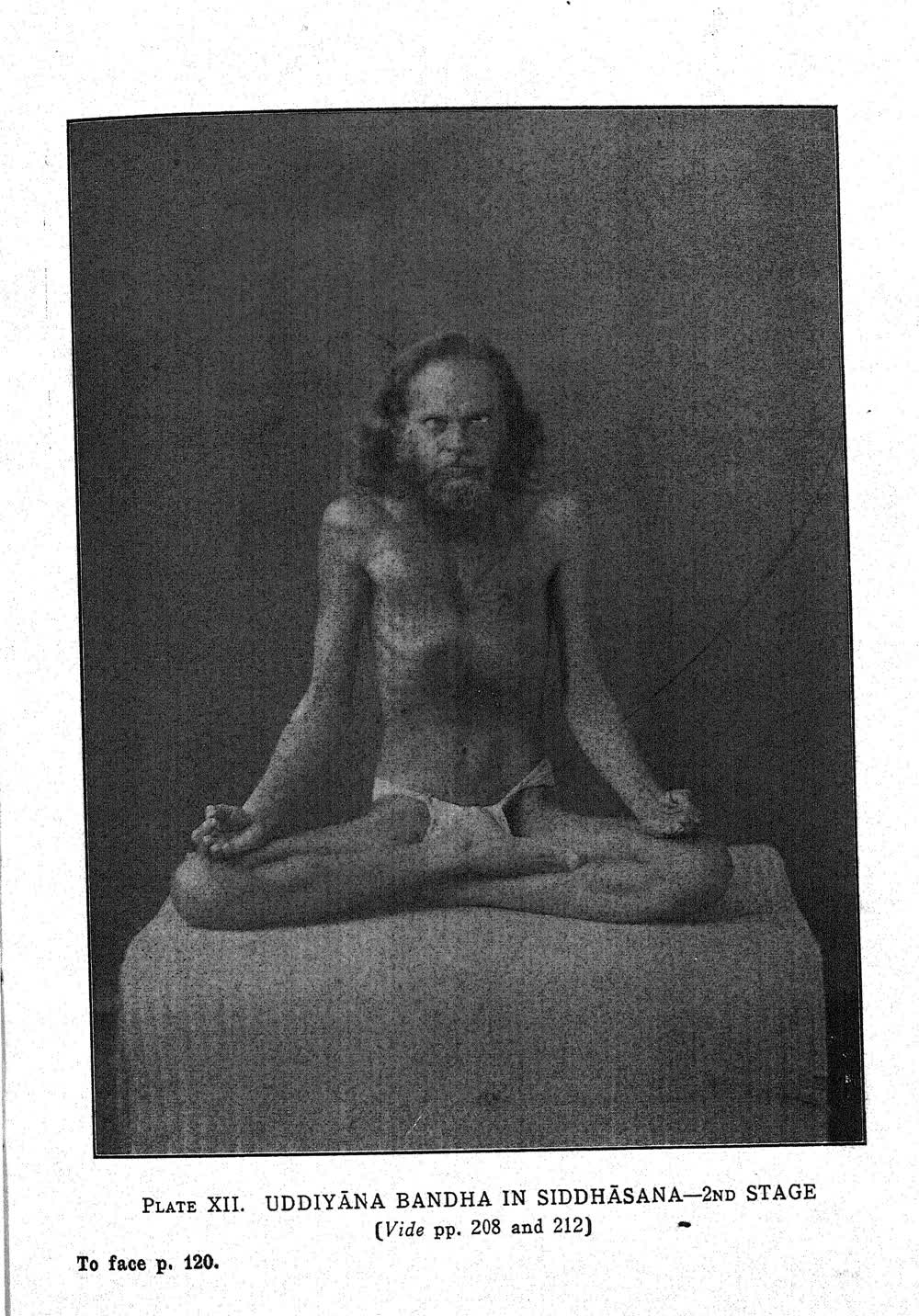
〈Plate XII: a photograph of a seated yogī〉 PLATE XII. UDDIYĀNA BANDHA IN SIDDHĀSANA—2ND STAGE (Vide pp. 208 and 212). To face p. 120.
Verse 44
The Shaivas call it the abode of Shiva529; the Vaishnavas call it Parama Purusha530; others, again, call it the place of Hari-Hara.531 Those who are filled with a passion for the Lotus feet of the Devī532 call it the excellent abode of the Devī; and other great sages (Munis) call it the pure place of Prakriti-Purusha.533
Commentary
As Hangsah, who has in Him all the Devatās (Sarvadevatāmaya), and others, are in this pericarp, it is the place of the Devatās of worship of all classes of worshippers, such as Shaivas, Shāktas, etc.
“The Shaivas”—i.e., the worshippers of Shiva—call it the place of Shiva.
“The Vaishnavas534 call it Parama Purusha”—i.e., the place of the Parama Purusha, or Vishnu.
- 534 Worshippers of Vishnu. p. 121
“Others, again” (Kechid apare)—i.e., others who are worshippers of Hari-Hara, or, in other words, United Vishnu and Shiva and not of Shiva alone or Vishnu alone, call it the place of Hari-Hara.535 They do not call it either the place of Hari (Vishnu) or of Shiva (Hara) but the place of their united selves.
- 535 Hari-Hara-padam. p. 121
“Other great sages536” (Munīndrā apyanye).—By this the author here means the worshippers of the “Hangsah” Mantra who call it the pure place of Prakriti-Purusha. Hangsah is the union of Prakriti and Purusha,537 hence it is the place of Prakriti and Purusha.
The above shows that, as this Lotus is the dwelling-place of the Para Bindu, in which are all the Devatās, each worshipper calls it the place of the Devatā of his own separate worship.
Verse 45
That most excellent of men who has controlled his mind538 and known this place is never again born in the Wandering,539 as there is nothing in the three worlds which binds him. His mind being controlled and his aim achieved, he possesses complete power to do all which he wishes, and to prevent that which is contrary to his will. He ever moves towards the Brahman.540 His speech, whether in prose or verse, is ever pure and sweet.
- 538 Chitta. p. 123
- 539 Sangsāra, the world of birth and rebirth to which men are impelled by their Karma. p. 123
- 540 The interpretation of Vishvanātha is here adopted, according to which Kha=Brahman. As the term also means the “air” or “ether,” the text is capable of translation as “He is able to roam the sky”. p. 123
Commentary
In this verse he speaks of the fruit of a complete knowledge of the Sahasrāra. The idea sought to be conveyed is that a knowledge of this place should be gained as a whole and in detail.
“Who has controlled his mind” (Niyata-nija-chitta)—i.e., he who has controlled and concentrated the inner faculties on this place. Such an one becomes free from Sangsāra, or, in other words, he is released from bondage, as there is nothing to bind or attract him in these worlds. By bondage is meant the Māyik bonds of virtue (Punya) and sin (Pāpa).
The Bhāgavata says: “If the action which is the product of the operation of the Gunas is attributed to the self, then such p. 124 (false) attribution is bondage and Sangsāra and servitude.” Also cf. Bhagavad-Gītā: “O Son of Kuntī, Man is bound by action which is the product of his own nature (Sva-bhāva).”541
- 541 Ch. XVIII, v. 60. p. 124
To inhabit this body for the purpose of undergoing Pāpa (sin) and Punya (virtue) is bondage. In heaven one enjoys (the fruit of) Punya, and in the nether world (Pātāla) one suffers sorrow, and on earth man is subject to both Pāpa and Punya. For the Tattva-jnānī (him who knows the truth) there is neither Punya nor Pāpa, which are the causes of bondage; his accumulated (Sanchita) Karma of merit (Punya) and demerit (Pāpa) is also destroyed. He is in consequence under no bondage whether in heaven (Svarga), earth (Martya), or nether world (Pātāla), and he is not truly embodied.542 Such a one stays on earth so long only as he has not worked out what he has begun. He is liberated though living (Jīvanmukta), and attains complete Liberation on the dissolution of the body.
- 542 Na sharīrī bhavati—though he has a body, he is not of it. p. 124
The Kulārnava Tantra says: “Those who have the Brahman in the heart can acquire neither merit by performing a hundred horse sacrifices, nor demerit by killing a hundred Brāhmanas.” The Gītā (III, 18) also says: “For him there is nothing in this world that should or should not be done. For such a one there is no dependence on any being.”543
- 543 Telang’s Translation: “He has no interest at all in what is done, and none whatever in what is not done, in this world; nor is any interest of his dependent on any being” (p. 54, Sacred Books of the East, Vol. VIII). p. 124
The Subodhinī544 interprets this verse to mean that the “knower” (Tattvajnānī) acquires no merit by the performances of actions nor demerit by the omission thereof.
- 544 That is, Shrīdhara-svāmī’s Commentary on the Gītā. p. 124
Shruti545 speaks of the destruction of accumulated (Sanchita) Punya and Pāpa: “When Manas, which is now selecting and now rejecting, is dissolved in That; when Pāpa and Punya are destroyed (lit., burnt), Sadāshiva, who is Shakti and Ātmā p. 125 (cf. Hangsah, ante), is Shānta546.” Cf. Bhagavad-Gītā: “And so the fire of knowledge destroys all actions.”547
“Complete power” (Samagrā shaktih)—i.e., power which enables him to do everything. By power, or Shakti, is meant ability to do all he desires to do548 and counteract all harm, to fly across the air,549 and to become possessed of great powers of speech and of poetic composition.
Verse 46
Here is the excellent (supreme) sixteenth Kalā of the Moon. She is pure, and resembles (in colour) the young Sun. She is as thin as the hundredth part of a fibre in the stalk of a lotus. She is lustrous550 and soft like ten million lightning flashes, and is down-turned. From Her, whose source is the Brahman, flows copiously the continuous stream of nectar551 (or, She is the receptacle of the stream of excellent nectar which comes from the blissful union of Para and Parā).552
- 550 Kālīcharana reads “Vidyotitā,” but Shangkara reads “Nityoditā,” “constantly shining.” p. 126
- 551 Alternative reading of Commentator: Nityānanda-paramparātivigalat-pīyūsha-dhārā-dharā. Paramparā may mean “in a continuous course,” or Param may mean Shiva and Parā, Shakti. This difference in meaning is due to the different ways in which these words may be read. p. 126
- 552 Parā, according to Shangkara, may mean Parā, Pashyantī, Mudhyamā, and Vaikharī collectively. Para and Parā are the Bindurūpa Shiva and Shakti. p. 126
Commentary
Verses 41 and 42 speak of the presence of Amākalā, Nirvāna-kalā, and Para Bindu, within the triangle in the pericarp of the Sahasrāra. He now desires to describe them by their distinctive attributes, and speaks in this verse of the distinctive features of Amā-kalā.
“Excellent or supreme” (Parā)—i.e., She is Chit Shakti. In the Prabhāsa-khanda occurs the following passage: “The excellent Māyā who maintains the bodies of all that have bodies.” This is attributive of Amā.
“The sixteenth Kalā of the Moon” (Chandrasya shodashī).—By this we are to understand that he is speaking of Amā-kalā.553
- 553 Vishvanātha says that this Amā-kalā is Ūrddhavashaktirūpā, or the upward (towards the Brahman) moving Shakti. p. 127
“Pure” (Shuddhā)—i.e., stainless.
“She resembles,” etc. (Shishu-sūryya-sodara-kalā).—By this the redness of this Kalā is indicated.
“Thin as the hundredth part of a fibre in the stalk of the lotus” (Nīraja-sūkshma-tantu-shatadhā-bhāgaika-rūpā).—Thin like a hundredth part of the fibre in the lotus-stalk split lengthwise.
“Whose source is the Brahman” (Nityānanda-paramparā).—Nityānanda=Pūrnānanda=Brahman.
“Flows,” etc. (Ativigalat-pīyūsha-dhārā-dharā).—If the last two compound words be read as one long compound word, as follows, Pūrnānanda-paramparātivigalat-pīyūsha-dhārā-dharā, the meaning of it will be as given within brackets at the end of the verse. Ānanda will then mean the joy of union, and Param-Parā will then mean Shiva and Shakti.
Para=Bindurūpa, Shivā. Parā=Prakriti, Shakti. Ānanda is the joy which arises from the union of the two, and from such union flows the nectar of which Amā-kalā is the receptacle.
Verse 47
Inside it (Amā-kalā) is Nirvāna-kalā, more excellent than the excellent. She is as subtle as the thousandth part of the end of a hair, and of the shape of the crescent moon. She is the ever-existent Bhagavatī, who is the Devatā who pervades all beings. She grants divine knowledge, and is as lustrous as the light of all the suns shining at one and the same time.
Commentary
In this verse the Nirvāna Kalā is described.
“Inside it” (Tadantargatā)—i.e., placed in the lap554 of Amā-kalā. The Kalā has already been described555 as the “crescent seventeenth Kalā placed within Amā, and known by the name of Nirvāna-kalā.”
“More excellent than the excellent” (Parā paratarā).—The Amā-kalā is excellent; this is more excellent than Amā. If ‘Parātparatarā’ be accepted for ‘Parā paratarā,’ then the meaning will be that She is the most excellent.
“She is as subtle ... hair” (Keshāgrasya sahasradhā vibhajitasyaikāngsha-rūpā).—She is equal in dimension to the thousandth part of the end of a hair, so very subtle is She.
“Of the Shape of the crescent Moon” (Chandrārdhāmga-samāna-bhamguravatī)—like Amākalā she is in shape like the crescent.
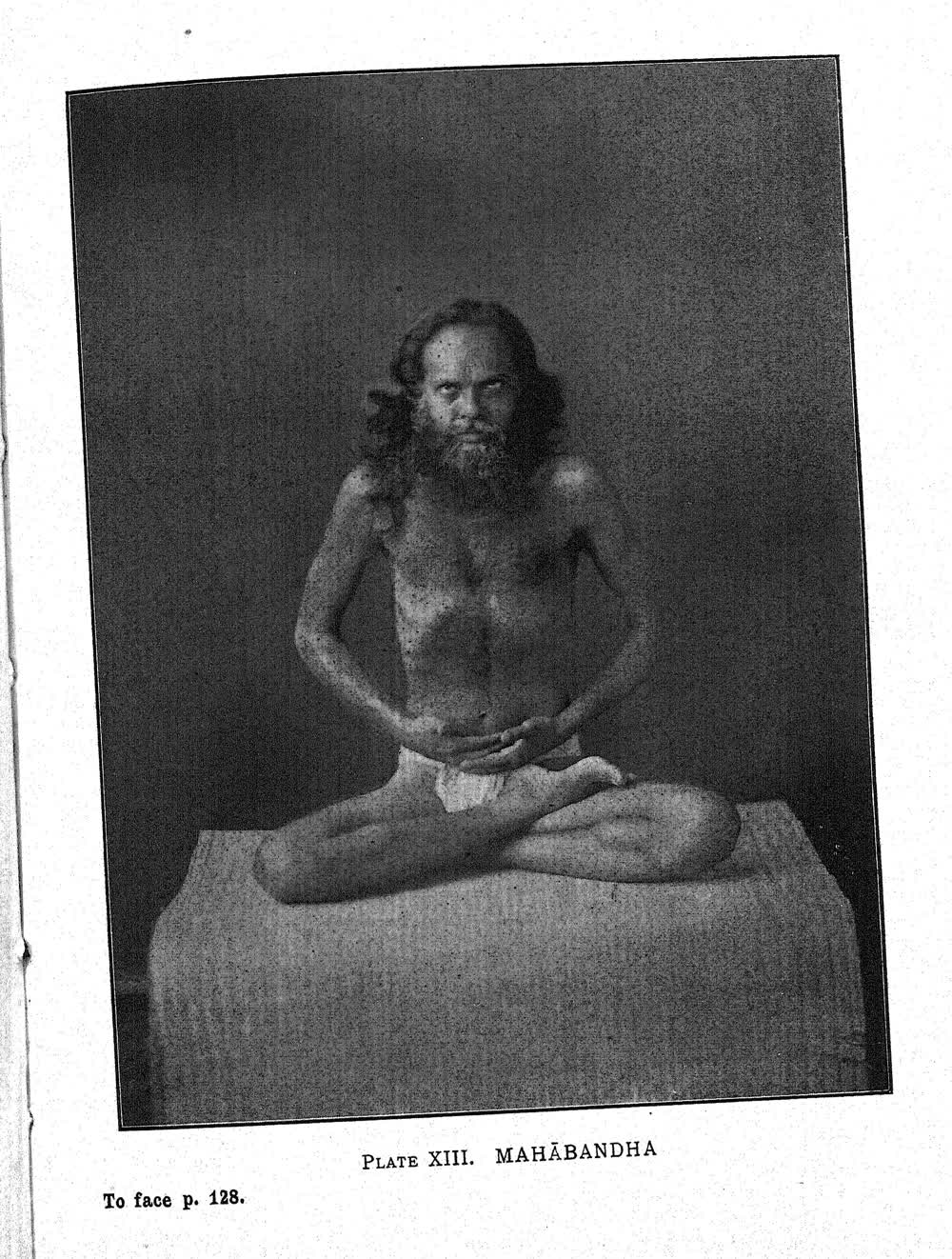
〈Plate XIII: a photograph of a seated yogī〉 PLATE XIII. MAHĀBANDHA. To face p. 128.
“That Devatā who pervades all beings” (Bhūtānām adhidaivatam).—Adhi-daivatam=Hārdda-chaitanyam,556 and this Kalā is Hārdda-chaitanya-svarūpā of all beings.
- 556 Hārdda-chaitanyam. Amara defines Hārdda to mean Prema, Sneha—i.e., affection, love. That is, the Ishtadevatā worshipped in the heart; the Shakti who is Herself the heart of the Lord. The word is derived from hrid=heart. The Devatā also exists as what is called the Hārddakalā. See Introduction. p. 129
“She grants divine knowledge” (Nitya-prabodhodayā)—i.e., She grants Tattva-jnāna, or knowledge of the Brahman.
“And is lustrous etc.” (Sarvārka-tulya-prabhā).—There are twelve suns (Dvādashāditya). “When all the twelve suns are shining”—such is Her lustre. This adjective also implies that She is red.
Verse 48
Within its middle space (i.e., middle of the Nirvānakalā) shines the Supreme and Primordial Nirvāna Shakti557; She is lustrous like ten million suns, and is the Mother of the three worlds. She is extremely subtle, and like unto the ten-millionth part of the end of a hair. She contains within Her the constantly flowing stream of gladness,558 and is the life of all beings. She graciously carries the knowledge of the Truth (Tattva)559 to the mind of the sages.
- 557 This is, according to Vishvanātha, the Samanāpada or Samanī Shakti. This state is not free from the multitude of bonds (Pāshajāla). p. 130
- 558 Prema. See notes, post. p. 130
- 559 This word “Tattva” has by Vishvanātha been said to be Shivābhedajnānam—i.e., the non-distinction between Shiva and Shivā. p. 130
Commentary
He now speaks of the Para-Bindu.
“Its” (Etasyāh)—i.e., of the Nirvāna Kalā.
“Middle” (Madhya-deshe).—Within the lap.560
- 560 That is, within the crescent. According to Vishvanātha the locative indicates proximity and means near the middle but slightly above it. p. 130
“The Supreme and Primordial Nirvāna Shakti” (Paramāpūrva-nirvāna-shaktih=paramā apūrva-nirvāna-shaktih).—Paramā561—i.e., the Supreme Brahman as Shakti. Apūrvā—i.e., She before whom there was nothing, She having appeared at the beginning of creation.
- 561 This word has been defined by Shangkara to mean “She who is as great as the Para or Supreme”. Vishvanātha says it means “She who measures futurity (Para=Uttarakāla)”—that is, all future time is in Her control. p. 130
“Shines” (Vilasati paramā)562—i.e., dwells resplendent.
- 562 Paramā—She who is coexistant or of equal degree with the Supreme (Para) or she who knows the Supreme. This is as applied to Māyā. p. 131
“Mother of the three worlds” (Tri-bhuvana-jananī)—i.e., She is the origin of the Universe which comprises Svarga, Martya, and Pātāla and the like.563
- 563 Heaven, Earth, and Netherworld. p. 131
“She is extremely subtle, like unto the ten-millionth part of the end of a hair” (Keshāgrasya koti-bhāgaikarūpā’tisūkshmā).—As She is like the ten-millionth part of the end of a hair, She is extremely subtle.
“She contains within Her the constantly flowing stream of gladness” (Niravadhi-vigalati-prema-dhārā-dharā).—Prema is the tenderness of mind produced by feeling of gladness; that is, She holds within Her the stream of excellent nectar which has its origin in the blissful union of Shiva and Shakti, and which flows incessantly.
“Is the life of all beings” (Sarveshāng jīva-bhūtā—i.e., animated being is but a part of Her.
Cf. “O Devī, as sparks fly forth from a flame, so does the Parabindu (as Jīva) issue from Her (Nirvāna Shakti), and becomes knowing564 when it touches the Earth.”565
- 564 Samjnāyuktah. i.e., Jīva-consciousness. It may also mean ‘becomes endowed with a name’. Name and form characterise the world as Sat, Chit and Ānanda do Brahman. Cf. Asti bhāti priyang rūpang nāma chetyangsha-panchakam
Ādyang trayang Brahma-rūpang jagadrūpang tato dvayam. p. 131 - 565 Yadā bhūmau patati tadā samjnāyukto bhavati. The creation of Jīva is here spoken of. The Text quoted in from Nirvānatantra I. p. 131
By “Her” is meant the Shakti who is in the Parabindu, who is both Shiva and Shakti; and from Her emanates the Jīva.
Nirvāna Shakti is situated below Nirvāna-kalā, and over Nibodhikā,566 which is Nāda-rūpā.567 Cf. “Placed within Nirvāna (Kalā) is the fiery (Vahnirūpā) Nibodhikā, who is unmanifested Nāda568; above it is the supreme Nirvāna-Shakti, who is the cause p. 132 of all and is possessed of the lustre of ten million suns. It is in Her that there is the Brahman569 who is the changeless Shiva570 it is here that Kundalī Shakti enjoys with Paramātmā.”
- 566 See Introduction, and note to v. 40, particularly the portion dealing with Nāda, Bodhinī and Bindu. p. 131
- 567 That is Shakti, as Nāda. p. 131
- 568 Avyakta-nāda—unmanifested sound. p. 131
- 569 Niranjana. This word may either be equal to Nih+anjana (i.e., stainless) or Nih+anjana (unaffected by pleasure or pain, unmoved). It is one of the aspects of the Brahman. p. 132
- 570 Nirvikāra. Some read Nirvikalpa, or of unconditioned consciousness. Nirvikalpa is also the last stage of Samādhi, in which there are no (Nir) specific distinctions (Vikalpa): and no “this” and “that.” p. 132
Nibodhikā is a phase of Avyakta-nāda (Avyakta-nādātmikā), and is fire-like. Rāghava-bhatta says: “Nāda exists in three states. When Tamo-guna is dominant, it is merely sound unmanifest (Avyakta-nāda)571 in the nature of Dhvani; when Rajo-guna is more dominant, there is sound in which there is somewhat of a placing of the letters572; when the Sattvaguna preponderates, Nāda assumes the form of Bindu.”573 Hence Nāda, Bindu, and Nibodhikā, are respectively the Sun, the Moon, and Fire,574 and their activities are Jnāna, Ichchhā, and Kriyā. Jnāna, again, is Fire, Ichchhā the Moon, and Kriyā the Sun. This has been said in the Shāradā. Therefore, insomuch as it has been said that Nirvāna Shakti is above the fiery (Vahnirūpā) Nibodhikā, the wise should conclude that Nirvāna-Shakti is placed above the Mandalas of the Sun, the Moon, and Fire.
- 571 Tamo-gunādhikyena kevaladhvanyātmako’vyaktanādah. p. 132
- 572 Raja ādhikyena kinchidvarna-baddha-nyāsātmakah. The sense appears to be that the letters exist anyhow together in massive undifferentiated form. p. 132
- 573 Sattvādhikyena vindu-rūpah. p. 132
- 574 Tatash cha nāda-vindu-nibodhikā arkendu-vahni-rupāh. Jnāna is Fire, because it burns up all action. When the result of action is realised, action ceases (see note to v. 45). Ichchhā is the Moon, because Ichchhā is the precursor of creation and is eternal. The Moon contains the Amā-kalā, which knows neither increase nor decay. Kriyā is the Sun, because like the Sun it makes everything visible. Unless there is striving there cannot be realisation and manifestation. Cf. “As one Sun makes manifest all the Lokas” (Gītā).
The Text will be made clearer if an arrangement be made in the following groups: (1) Nāda, Sun, Kriyā; (2) Bindu, Moon, Ichchhā; (3) Nibobhikā, Fire, Jnāna. But see Introduction. p. 132
This has been clearly stated in the Kulārnava Tantra, in the Para-Brahma-dhyāna, which begins, “The Bindu-rūpa Para p. 133 Brahma in the Sahasrāra,” and ends, “Beautified by the three Mandalas within the triangle in the pericarp.” By three Mandalas are meant the Mandalas of Sun, Moon, and Fire. We shall show that the Nirvāna-Shakti is in the form of Para-bindu (Para-bindu-rūpā).
Verse 49
Within Her is the everlasting place called the abode of Shiva,575 which is free from Māyā, attainable only by Yogīs, and known by the name of Nityānanda. It is replete with every form of bliss,576 and is Pure Knowledge itself.577 Some call it the Brahman; others call it the Hangsa. Wise men describe it as the abode of Vishnu, and righteous men578 speak of it as the ineffable place of knowledge of the Ātmā, or the place of Liberation.
- 575 Shiva-padam or state of Shiva. This, Vishvanātha says, is the Unmanī state of Shakti where there is neither Kāla nor Kalā, time nor space. It is the body of Shiva (Shivatanu). It is then said Unmanyante Parashivah. The following verse which occurs in Padma Purāna (Uttara Khanda, ch. 78, v. 43) puts the idea in a more popular form. It says:
Shaivāh Saurāsh cha Gāneshāh Vaishnavāh Shaktipūjakāh.
Māmeva prāpnuvanti hi varshāmbhah sāgarang yathā.
“Shaivas, Sauras, Gāneshas, Vaishnavas and Shāktās all verily come to me like rain water the ocean.” p. 134 - 576 Sakalasukhamayam. Vishvanātha reads here Paramakulapadam, which he interprets as Param Akula-padam, or the abode of the Supreme Shiva, who is known as Akula, as Kula is Shakti. It is so called because it is here that the universe finds its rest. p. 134
- 577 Shuddha-bodha-svarūpam. p. 134
- 578 Sukritinah. p. 134
Commentary
He speaks of the Para-Brahma-sthāna (place of Para Brahma) in the Void within Nirvāna Shakti.
“Within Her” (Tasyāh madhyāntarāle)—i.e., within Nirvāna579 Shakti in Her form of Param Bindu, i.e., the empty space within the Bindu.
- 579 Vishvanātha says Samanā. p. 135
“Abode of Shiva” (Shivapadam).—This is the place of the Brahman.
“Free from Māyā” (Amalam)—i.e., free from the impurity of Māyā.
“Called”—i.e., called by those who know the Tattva.
“Attainable only by Yogīs” (Yogi-gamyam).—On account of its extreme subtlety, it is beyond the scope of word and mind, is attainable by Yogīs by pure Jnāna580 only.
- 580 Spiritual knowledge, as it is said: Mokshe dhīr jnānam anyatra vijnānang shilpashāstrayoh. The knowledge which gains Moksha (Liberation) is called Jnāna, other forms of knowledge, such as fine arts, and the Shāstras being Vijnāna. p. 135
“Some call it”—i.e., the Vedāntists (Vaidāntikas) call it.
“Ineffable” (Kimapi)—i.e., wonder-inspiring.
“Place of the knowledge of the Ātmā” (Ātma-prabodham).—The place where the Ātmā is seen or realised.
“Liberation” (Moksha)—i.e., where one is liberated from Māyā by which one is surrounded.
Now be good enough to mark the following: the Parabindu which is Prakriti and Purusha is surrounded581 by Māyā, and is within the triangle in the pericarp of the Lotus of a thousand petals. So it has been said:
- 581 Māyābandhanāchchhādita-prakriti-purushātmaka-para-vinduh. p. 135
“In the Satya-loka is the formless and lustrous One; She has surrounded Herself by Māyā, and is like a grain of gram; devoid of hands, feet, and the like. She is Moon, Sun, and Fire. When casting off (Utsrijya) the covering (Bandhana) of Māyā, She becomes of two-fold aspect (Dvidhā bhitvā) and Unmukhī,582 then on the division or separation of Shiva and Shakti583 arises creative ideation.”584
- 582 By Unmukhī is meant that She becomes intent on creation. p. 135
- 583 Shiva-Shakti-vibhāgena. By division or separation is not meant that Shiva is really divided or separated from Shakti—for the two are ever one and the same—but that Shakti, who exists latently as one with the Brahman in dissolution, appears to issue from It on creation as the manifested universe. p. 135
- 584 Srishti-kalpanā. That is, the subject knows itself as object. p. 135
The word “Satya-loka” in the above passage means Sahasrāra.
Also cf. “The attributeless Bindu is without doubt the Cause (of the attainment) of Siddhis. Some say that the Deva who is one, stainless (Niranjana), all embracing (Mahāpūrna) and united with the primordial Shakti as in the form of a grain of gram585 is Brahmā, and by some, again, He is called Vishnu; by others, again, He is called the Deva Rudra.”
- 585 Chanaka, which under its outward sheath contains two undivided halves. p. 136
The luminous empty space within the Nirvāna Shakti (i.e., the outer circle of the Parabindu), which is more minute than the ten-millionth part of the end of a hair, is, according to the author, the abode of Brahman (Brahmapada). Cf. “Within it586 is Parabindu, whose nature it is to create, maintain, and destroy. The space within is Shiva Himself and Bindu587 is Parama-kundalī.”
Also: “The circumference (Vritta) is the Kundalinī-Shakti, and She possesses the three Gunas. The space within, O Beloved Maheshāni, is both Shiva and Shakti.”588
- 588 Jnānārnava Tantra, XXIV, 21. p. 136
This Bindu is, according to some, Īshvara, the Cause of All. Some Paurānikas call Him Mahā-Vishnu; others call Him Brahma Purusha.
Cf. “There was neither day nor night, neither the firmament nor the earth, neither darkness nor any other light; there was That the Brahma-Male,589 imperceptible to hearing, and the other sources of knowledge united with Pradhāna.”590
The Shāradā591 says: “The eternal Shiva should be known both as Nirguna (attributeless) and Saguna (possessed of attributes). He is Nirguna when (considered as) disassociated from the workings of Prakriti, but when Sakala (i.e., so associated with Prakriti) He is Saguna.”592
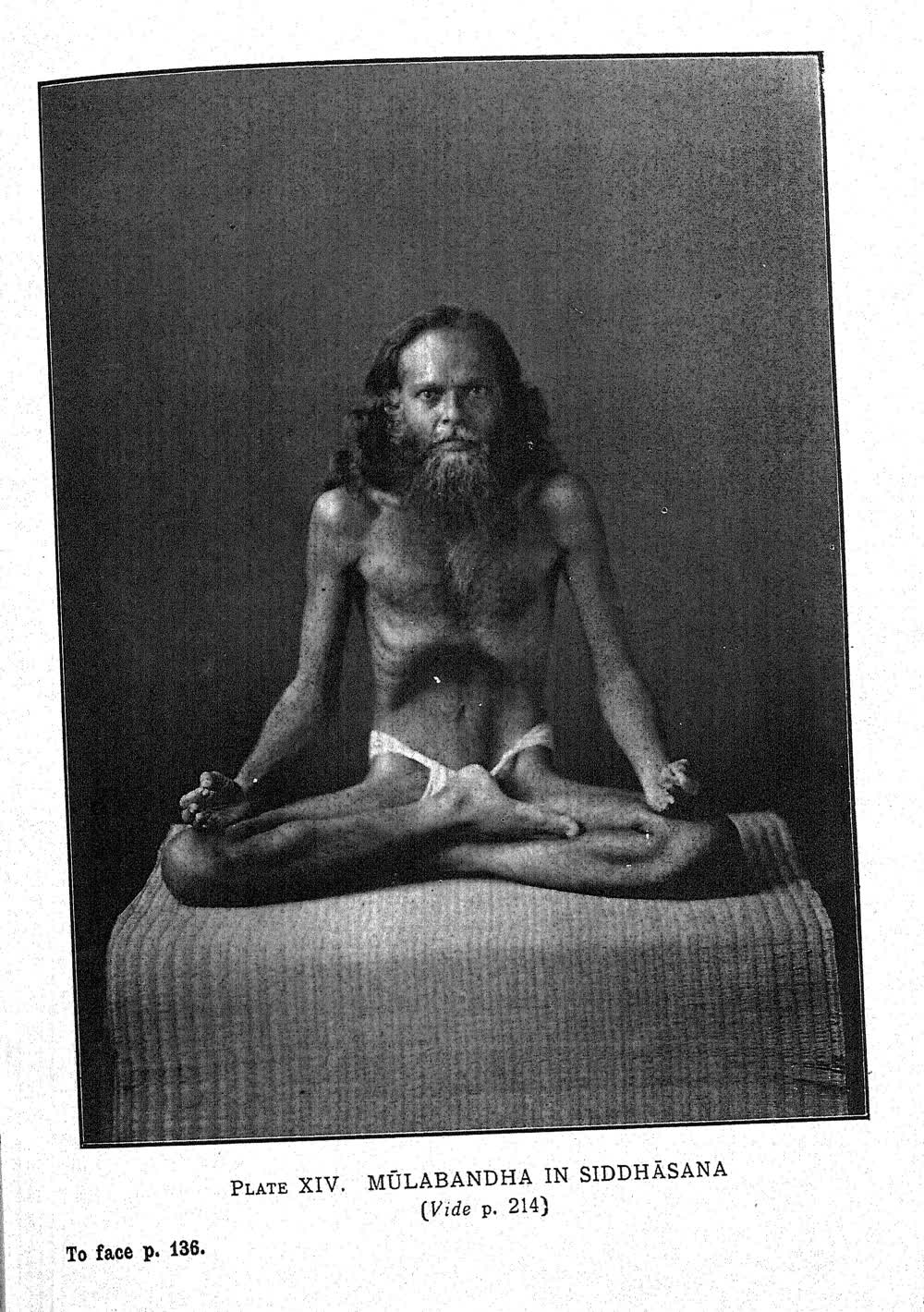
〈Plate XIV: a photograph of a seated yogī〉 PLATE XIV. MŪLABANDHA IN SIDDHĀSANA (Vide p. 214). To face p. 136.
This shows that the Bindu is Saguna Brahman. We should know that Saguna Brahman is in reality but one, though He is called by different names according to the inclinations of men. There is no need to go into further details.
Summary of Verses 41 to 49
Above (the end) of the Sushumnā Nādī is the Lotus of a thousand petals; it is white and has its head downward turned; its filaments are red. The fifty letters of the Alphabet from A to La, which are also white, go round and round its thousand petals twenty times. On its pericarp is Hangsah, and above it is the Guru who is Parama-Shiva Himself. Above the Guru are the Sūryya and Chandra Mandalas, and above them Mahāvāyu. Over the latter is placed Brahmarandhra, and above it Mahāshangkhinī. In the Mandala of the Moon is the lightning-like triangle within which is the sixteenth Kalā593 of the Moon, which is as fine as the hundredth part of the lotus-fibre, and of a red colour, with its mouth downward turned. In the lap of this Kalā is the Nirvāna-Kalā, subtle like the thousandth part of the end of a hair, also red and with the mouth downward turned. Below Nirvāna Kalā is the Fire called Nibodhikā, which is a form of Avyaktanāda.594 Above it (Nibodhikā), and within Nirvānakalā, is Para Bindu, which is both Shiva and Shakti. The Shakti of this Para Bindu is the Nirvāna Shakti, who is Light (Tejas) and exists in the form of Hangsah (Hangsarūpā), and is subtle like the ten-millionth part of the end of a hair. That Hangsah is Jīva. Within the Bindu is the void (Shūnya) which is the Brahmapada (place of the Brahman).
According to the view expressed in the fifth chapter of the Āgama-kalpa-druma and other works, the triangle A-Ka-Tha595 is in the pericarp of the Sahasrāra. At its three corners are three Bindus: the lower Bindu at the apex of the triangle is Ha-kāra,596 and is male (Purusha); and the two p. 138 Bindus at the corners constitute the Visarga in the form Sa597 and represent Prakriti. Hangsah which is Purusha and Prakrit thus shows itself in the form of three Bindus. In its middle is Amākalā, and in Her lap is Nirvāna-Shakti, and the vacant space within Nirvāna-Shakti is Parabrahman. It has been said: “Within the Mandala of the moon in the white Lotus of a thousand petals shines like lightning the triangle A-Ka-Tha united with Ha-La-Ksha.598 Within it, is the excellent (Para) Bindu (Shūnya), placed below Visarga. In this region is the downward-turned sixteenth Kalā, of the colour of the rising Sun, in shape like the crescent moon who discharges a stream of nectar, and within Her is Parā Shakti, possessing the effulgence of ten million suns. She is as subtle as the thousandth part of the Lotus fibre, and is Chidātmikā.599 Within Her is Bindu who is the Niranjana Purusha, who is beyond mind and speech and is Sachchidānanda, and Visarga (who is also there) is Prakriti. Hangsa who is both Pung600 and Prakriti shines by His own effulgence.”
- 595 That is, the letters arranged in the form of the triangle referred to in v. 4 of Pādukā-panchaka. The Devī is Mātrikā-mayī. p. 137
- 596 viz., Hang representing the “Male” Bindu. p. 137
- 597 That is, literally “standing Sa,” or Visarga in the form Sa. The letter Sa, or more strictly Sa without the vowel, changes into Visargah; thus, Tejas become Tejah, Rajas Rajah. p. 138
- 598 These Varnas are inside the triangle A-Ka-Tha. p. 138
- 599 Of the nature of Chit. Cf. definition of Māyā-Shakti in Tattva Sandoha 14. p. 138
- 600 The Male, Purusha. p. 138
Those who follow this view, place Sa-kāra over the Bindu, and place the Guru above Visarga601 and Bindu which together make Hangsah. But this cannot be right. The Nirvāna Tantra speaks of the Guru as worshipping the Para Bindu-rūpa-Shakti, and as being close to Her and in the act of worphipping Her. The worshipper should always sit at a level lower than, and in front of the object of worship, and never at a higher level than, and behind the object of worship. Cf. Nirvāna602: “Meditate upon the Niranjanā Devī within the Satya-loka in the Chintāmanigriha603 as p. 139 placed on the jewelled throne or lion-seat (Simhāsana), and on your Guru as being near Her and worshipping Her.”
- 601 Lit., Generator of Visargah (see note 5, ante, p. 136), for from Sa Visarga comes. p. 138
- 602 Nirvāna Tantra, Ch. X. p. 138
- 603 The room made of Chintāmani stone which grants all desires, described in the Rudrayāmala and Brahmānda Purāna. The Lalitā refers to it as being the place or origin of all those Mantras which bestow all desired objects (Chintita). p. 138
The Mahākālī Tantra, moreover, speaks explicitly of the presence of the Guru over the two letters Hang and Sah.604 It is to be understood that if there be any texts which differ from, or add to those here adopted, then they must be taken to refer to different methods and opinions.
- 604 In the Jnānārnava Tantra (I, v, 13) it is said: “O Pārvatī, in Ha-kāra with Bindu (Hang) is Brahmā and, O Maheshvarī, the two Bindus of Visarga (Sah) are Hari and Myself. By reason of this inseparable connection men in this world speak of Hari-Hara.” p. 139
This is the end of seventh section.
Verse 50
He whose nature is purified by the practice of Yama, Niyama, and the like,605 learns from the mouth of his Guru the process which opens the way to the discovery of the great Liberation. He whose whole being is immersed in the Brahman then rouses the Devī by Hūng-kāra, pierces the centre of the Limga, the mouth of which is closed, and is therefore invisible, and by means of the Air and Fire (within him) places Her within the Brahmadvāra.606
Commentary
Having described the Chakras ending with the Sahasrāra, he now wishes to speak of the union of Kundalinī, and preliminary to that he refers to the mode of rousing Kundalinī.607
- 607 In the Yoga-process known as Shatchakrabheda, generally described in the Introduction, but which practically must be learned of the Guru. p. 140
The sense conveyed by this verse is that the man who has attained success in Yoga learns from his Guru the process, which consists of contracting the heart, rousing Kundalinī by the power of the air and fire, and so forth608; and having learned it from the mouth of his Guru, he rouses Kundalinī, attacking Her with air and fire, and by uttering the Kūrchcha “Hūng” and piercing the mouth of the Svayambhu Limga places Kundalinī within Brahmadvāra, or, in other words, within the mouth of the Nādī Chitrinī.
- 608 The Commentator Shangkara, citing Goraksha Sanghitā, says that air makes the fire go upwards, and the fire awakens Kundalinī and She also goes upwards. p. 140
“He whose nature is purified” (Sushīla)—i.e., the man who regularly practises Yama and so forth, and has trained himself.
“By practising Yama, Niyama,” etc. (Yama-niyama-samabhyāsa-shīla).—It must be observed that it is not merely by the practice of Yama and Niyama that perfection in the preliminary Yoga practices609 is attained. But the Sādhaka has by practice to destroy such inclinations as lust, anger, and the like, which interfere with Yoga, and cultivate others, such as controlling the inner air, steadiness of mind, and so forth, which are helpful in Yoga practice. It is because of this that in v. 54 the Author has used the word “Yamādyaih” in the plural. Practising Yama and the like is necessary, however, for those whose minds are disturbed by lust and other propensities. If, however, a man by reason of merit and good fortune acquired in a previous birth, and by his nature, is free from anger, lust, and other passions, then he is capable of real Yoga without the preliminary practices. This must be well understood.
- 609 Amga-yoga. See Introduction, and Vishvanātha citing Gautamīya Tantra (Tāntrik Texts, Vol. II, p. 133, ed. A. Avalon). p. 141
“From the mouth of his Guru” (Shrī-nātha-vaktrāt).—The process cannot be learnt without the instructions of the Guru. Hence it has been said: “It can be learnt from the Guru alone, and not from ten million Shāstras.”
“Process” (Krama).—Steps, order.
“Which opens the way to the discovery of the great Liberation” (Mahā-moksha-vartma-prakāsha).—By this is meant the ‘process’ by which the entrance into the channel of the Nādī Chitrinī is opened out. ‘Way of Liberation’ (Moksha-vartma) is the way through the channel within Chitrinī. The ‘discovery’ (Prakāsha) is made of this by making one’s way through it.
“He” (Sah)—i.e., the man who has distinguished himself by his success in Yoga practices.
“Whose whole being is immersed in the Brahman” (Shuddha-buddhi-svabhāva610).—Shuddha-buddhi means the Brahman, and he whose Svabhāva (own being) is in Him. This compound word may also mean “He whose being (Bhāva) by reason of the p. 142 purity of his mind (Shuddha-buddhi) is immersed in the Spirit (Sva=Ātmā).”
- 610 Shangkara reads prabhāva, and renders the passage as “He whose power is due to the purity of the Buddhi”. p. 141
“Rouses the Devī by Hūng-kāra” (Hūng-kārenaiva Devīm).—The Āgama-kalpa-druma says: “Then having mentally recited Hangsa, gently contract the anus.”611 It therefore follows that in moving Kundalinī the Hangsa Mantra should be uttered. The Author of the Lalitārahasya, following this, says that in moving Kundalinī the Mantra “Hūng Hangsah” should be employed. But, from the fact that the part is to be contracted after the Hangsa Mantra is recited, the intention appears to be that the Jīvātmā, which is of the shape of the flame of a lamp, should by the recitation of the Hangsa Mantra be brought from the heart to the Mūlādhāra, and then moved along with Kundalinī.
- 611 Shanair ākunchayed gudam—that is, by Ashvinī-mudrā. p. 142
The Āgama-kalpa-druma in a subsequent passage says: “Raising and again raising the Shakti with the Ātmā from the abode of Brahmā,612 the excellent Sādhaka should (and so forth).” This shows that She should be led away along with Ātmā or Jīvātmā. The Kālī-Kulāmrita has: “Having led Jīva from the heart by the Hangsa Mantra to the Mūla Lotus,613 and having roused the Paradevatā Kundalinī by Hūng-kāra.” The Kangkālamālinī says: “O daughter of the King of Mountains, having drawn the Jīvātmā by the Pranava, let the Sādhaka move Prāna and Gandha614 with Kundalinī by the aid of the ‘So’ham’ Mantra, and make the Devī enter the Svādhishthāna.”
The wise should, from the above texts, understand that the Jīvātmā should be brought from the heart by the aid of either the Pranava or Hangsa Mantra, and then Kundalinī should be roused by the Kūrchcha-bīja alone.
“The mouth of which is closed,” etc. (Guptam).—This word may be read either as an adjective qualifying Limga, and mean unmanifested by reason of its mouth being closed,615 or may be read as an adverb qualifying “places,” and then the word would mean “imperceptibly.”
- 615 On the top of the Lingga is Nādabindu—i.e., Chandra Bindu. The mouth is the Bindu which Kundalinī pierces. p. 142
In the Āgama-kalpa-druma, Panchamashākhā, the mode of rousing the Kundalinī, is described in detail thus: “Having seated oneself in the Padmāsana posture, the two hands should be placed in the lap. Thereafter, having mentally recited the Hangsa Mantra, the anus should be gently contracted. One should then repeatedly raise the air by the same way,616 and having raised it let him pierce the Chakra. I now speak of its process. In the Mūlādhāra Lotus is a very beautiful triangle. Inside it is Kāma,617 (lustrous) like ten million young suns; above Him (Kāma), and surrounding Svayambhu-Limga, is Kundalī Shakti.” Also cf. “As the result of excitation by the Kāmāgni and the action of the Kūrchcha-mantra on Her, She is seized with desire for Para-Hangsa.”618
The Bhūta-shuddhi619 also says: “O Shivā, the Sādhaka should contract the chest (lit., heart), letting his breath remain there,620 and he should control the base of the throat and other parts of the body,621 and then suddenly opening the door by means of a key-like motion (Kunchikā)622 and (the fire of desire) should be kindled, O Parameshvarī, by means of the air (Pavana).” “Then the Serpent,623 who is sleeping on the Limga in the Mūlādhāra and who is stung by the heat of the fire, should be awakened in the Limga at the mouth of the Yoni and by the heat, (of her desire) be led forcibly upwards.”624 “Move the air into the p. 144 Nādī according to the rules of Kumbhaka (retention of breath) and the method shown by the Guru. Let the Jīva thus controlled be led by the concealed passage, and by the upward breath make all the Lotuses turn their heads upwards. Having fully awakened Her, let the wise one lead Her to Bhānu (the Sun) at the summit of the Meru (i.e., the Sahasrāra).”
- 619 This passage is obscure, and cannot be traced in the only published edition of the Tantra, but is similar to certain passages in the Hathayogapradīpikā which deals with Bhūtashuddhi. It seems to contain passages from various texts to illustrate the process of Bhūtashuddhi. The Commentator has, however, more clearly described the process in his own words. p. 143
- 620 He thus closes the passage of the upward breath. p. 143
- 621 That is, the chest and the anus, thus closing the passage of the upward and downward airs. p. 143
- 622 That is, the motion of the Kāma vāyu spoken of post. p. 143
- 623 Nāginī, one of the names of Kundalī. p. 143
- 624 That is, the Trikona in the Mūlādhāra which surrounds the Svayambhu Limga. p. 143
Now pay attention to the procedure established by a careful consideration of the above texts625: The Yogī should sit in the proper posture and place his two hands with palms upwards in his lap, and steady his mind (Chitta) by the Khecharī Mudrā. He should next fill the interior of his body with air and hold it in by Kumbhaka,626 and contract the heart.627 By so doing the escape of the upward breath is stopped. Then, when he feels that the air within him from the belly to the throat is tending downward through the channels in the Nādīs, he should contract the anus and stop the downward air (Apāna); then, again having raised the air, let him give the Kāma628 within the triangle in the pericarp of the Mūlādhāra Lotus a turn from the left to the right (Vāmāvartena); by so doing the fire of Kāma there is kindled, and Kundalinī gets heated (excited) thereby. He should then pierce the mouth of the Svayambhu Limga, and through its aperture with the aid of the “Hūng” Bīja, lead Her who desires union629 with Parama-Shiva, within the mouth of the Chitrinī-Nādī. This is the clear sense of texts.
- 625 The passages in quotation marks are here cited from different books on Hathayoga. p. 144
- 626 Retention of breath in Prānāyāma. p. 144
- 627 Hridayam ākunchayet—that is, by Jālandhara Bandha, etc. See Introduction. p. 144
- 628 Kāma-vāyu. p. 144
- 629 Sāma-rasya, a term used on the material plane to denote sexual union. p. 144
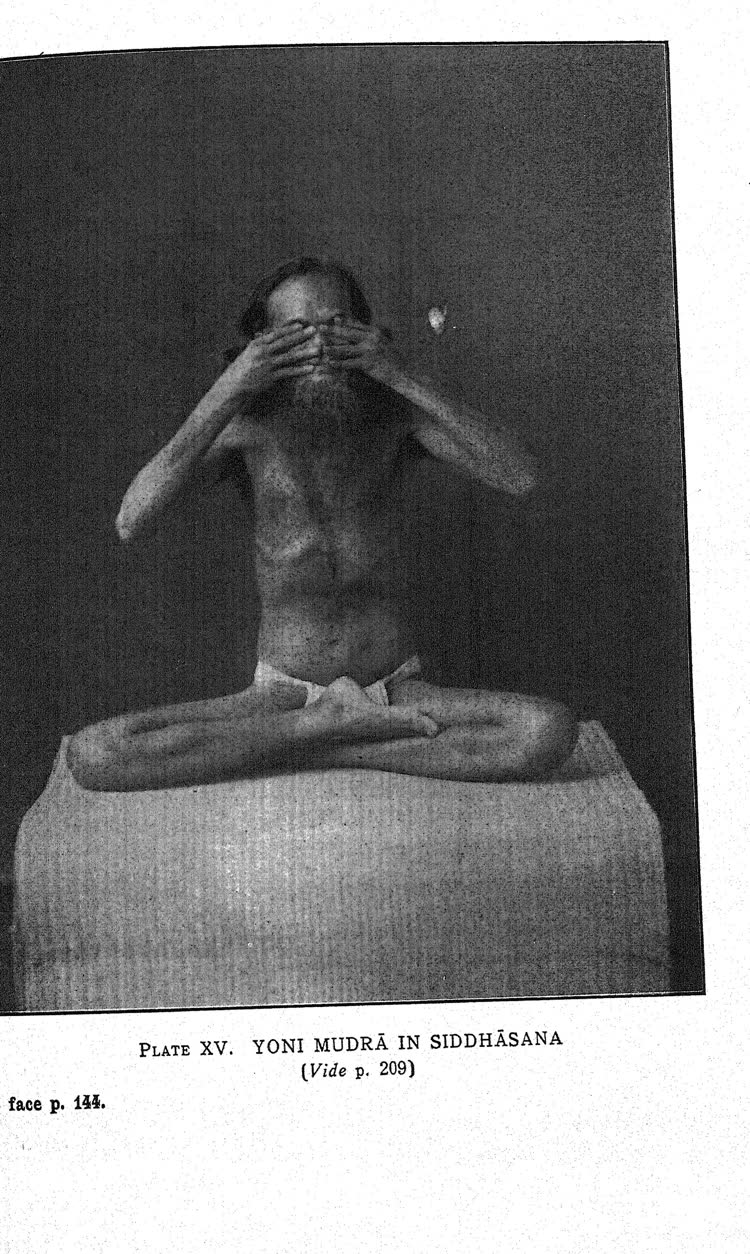
〈Plate XV: a photograph of a seated yogī covering his eyes, ears and mouth with his fingers〉 PLATE XV. YONI MUDRĀ IN SIDDHĀSANA (Vide p. 209). To face p. 144.
Verse 51
The Devī who is Shuddha-sattvā630 pierces the three Limgas, and, having reached all the lotuses which are known as the Brahma-nādī lotuses, shines therein in the fulness of Her lustre. Thereafter in Her subtle state, lustrous like lightning and fine like the lotus fibre, She goes to the gleaming flame-like Shiva the supreme Bliss, and of a sudden produces the bliss of Liberation.
- 630 A form of embodied Chaitanya. See Commentary, post. p. 145
Commentary
Now he speaks of the mode of the Union of Kundalinī (with Shiva). The meaning of this verse, in brief, is that the Devī Kundalinī pierces the three Limgas—viz., Svayambhu, Bāna, and Itara631—and by so doing makes a passage for Herself; and when she reaches the lotuses in (or appertaining to) the Nādī called Brahma-nādī she shines in the fulness of Her lustre in these lotuses. Then, when in Her subtle form, fine like the lotus fibre, She approaches Shiva, who is Supreme Bliss632 Itself, and who is in His Bindu form in the pericarp of the Sahasrāra, She brings to the Sādhaka the Bliss of eternal Liberation633 when that is least expected.
“Pierces” (Bheda) means making a passage through that which is obstructed.
“Shuddha-satvā.”—Sattva, Ati-sattva, Parama-sattva, Shuddha-sattva, and Vishuddha-sattva, are the five different degrees of p. 146 Chaitanya pervading the body.634 Shuddha-sattvā is therefore the fourth (Turīyā) stage. By Brahmanādī is meant Chitrinī. The Lotuses are the six Lotuses which are strung upon Chitrinī.
- 634 Sharīrāvachchhinna-chaitanya. p. 146
“The three Limgas” (Limga-trayam).—The three Limgas already described. By this we are to understand that the six Chakras and five Shivas are included. She pierces all these, which altogether make fourteen knots (Granthi).
The Shāktānanda-taramginī speaks of “Her who goes along the Channel of Brahman635 having pierced the fourteen knots”.636
The Svatantra Tantra speaks of the distinctive features of Limga and Shiva.
“The Devī goes to Brahman (Nishkala)637 after having pierced the Shivas placed in the six Chakras. As She reaches each of the different Chakras, She acquires the beauty characteristic of each and bewitches Maheshāna638; and having there repeatedly enjoyed Him who is filled with joy, She reaches the Eternal One (Shāshvata). He is said to be transpierced (Bhinna), as He is bewitched by Parā.”
The Māyā Tantra says: “The Devī goes along the Shaktimārga, piercing the three Limgas in the Chakras in each of Her different forms639 (Tattadrūpena), and having attained union (in the Sahasrāra) with Nishkala (Brahman) She is satisfied.” Tattadrūpena—i.e., in the forms Vaikharī, Madhyamā, and Pashyantī.
- 639 That is, She unites, in Her passage along the Nādi, with each of the Linggas in that form of Hers which is appropriate to such union. p. 146
It has been said that640 “The first state (Bhāva) is Vaikharī, and Madhyamā is placed in the heart; between the eyebrows is the Pashyantī state, and the Parā state is in the Bindu”.641 The meaning of the above quotation is that the four sound-producing p. 147 (Shabdotpādikā) Shaktis—viz., Parā, Pashyantī, Madhyamā, and Vaikharī—are identical with Kundalinī (Kundalinyabheda-rūpā). Hence at the time when Kundalinī starts to go to Sahasrāra She in Her form of Vaikharī bewitches Svayambhu Limga; She then similarly bewitches Vāna-Limga in the heart as Madhyamā, and Itara Limga between the eyebrows as Pashyantī, and then when she reaches Para Bindu She attains the stage of Parā (Parā-bhāva).
The Method of Chakra-bheda is thus described: “O Parameshvarī, let the Sādhaka carry along with Her the Lotuses which are on the Chitrinī, and which have their origin in the mud of blood and fat.642 Let him643 enter the channel (Nāla)644 on the left, from below, and in this way Chakra-bheda (piercing the Chakra) is effected. After having thus pierced the six Chakras, She along with Jīva should be led as the rider guides a trained mare by the reins.”
- 642 Lotuses grow in the mud, and these Lotuses grow in the blood and fat of the body. The process described is Kundalinī-yoga, or, as it is called in the Tippanī of Shangkara, Bhūta-shuddhi. p. 147
- 643 As the Sādhaka, who has taken the Jīvātmā from the heart to the Mūlādhāra, and thus identifies himself with Kundalinī, it is he who enters. p. 147
- 644 That is, the Nādī. p. 147
Also cf. “The Devī should be led by the Hangsa Mantra to the Sahasrāra through the points of union of the six Chakras (with the Nādī) along the road of Sushumnā.”
“Gleaming flame-like” (Sūkshma-dhāmni pradipe).—The gleam is the Hangsa, which is the luminous energy (Tejas) of the Para Bindu, in its aspect as Nirvānā Shakti (Nirvānashaktyātmaka). The Parama Shiva shines with it.
We now describe how the joy of Liberation is brought about.
The Devī by dissolving Kundalinī in the Para Bindu effects the Liberation of some Sādhakas through their meditation upon the identity of Shiva and Ātmā in the Bindu. She does so in the case of others by a similar process, and by their meditation on Shakti.645 In other cases, again, this is done by the concentration of thought on the Parama Purusha, and in other case by the meditation of the Sādhaka on the bliss of union in the Bindu of Shiva and Shakti.
- 645 Shaktyātmakachintana; or it may mean meditation on the union of Shiva and Shakti. p. 147
The Māyā Tantra says646: “Those who are learned in Yoga say that it is the union of Jīva and Ātmā. According to others (i.e., Shaivas) it is the experience of the identity of Shiva and Ātmā. The Āgama-vādīs proclaim that Yoga647 is the knowledge (Jnāna) relating to Shakti. Otherwise men say that the knowledge of the Purāna Purusha is Yoga, and others, again, the Prakriti-vādīs, declare that the bliss of union of Shiva and Shakti is Yoga.”648 By “union of Jīva and Ātmā” is meant Samādhi. By Yoga is meant that by which oneness is attained with the Paramātmā. Having spoken of Samādhi, he then deals with the different kinds of Yoga in Dhyāna. By “bliss of union (Sāmarasya) of Shiva and Shakti” is meant the sense of enjoyment arising from the union of male and female.649
- 646 These verses also occur in Ch. XXV, vv. 1, 2, of Shāradā Tilaka. By “union of Jīva and Ātmā” is meant the realisation of the identity of the individual with the supreme spirit as indicated in the Mahāvākya “Tat tvam asi (That thou art).” By Purāna Purusha the Purusha in Sāmkhya Darshana is meant the Vaishnavas understand by it Nārāyana (collective humanity). By “knowledge of Shakti” is meant the Knowledge that Shakti is inseparate from Shiva. p. 148
- 647 Shaktyātmakajnāna. p. 148
- 648 Sāmarasyātmakam jnānam. Tantrāntara says that Sāmarasaya is the Dhyāna of a Kulayogī. p. 148
- 649 Strīpumyogāt yat saukhyang sāmarasyang prakīrtitam. In other words, the bliss of Union of Shiva and Shakti, of which sexual union is the material type. p. 148
The Brihat Shrīkrama speaks of the manner in which this is to be meditated upon: “They with the eye of knowledge650 see the stainless Kalā, who is united with Chidānanda651 on Nāda. He is the Mahādeva, white like pure crystal, and is the effulgent First Cause (Vimba-rūpanidāna),652 and She is Parā the lovely woman of beauteous body653 whose limbs are listless by reason of Her great passion”.654
By Kalā in the above is meant Kundalinī. Vimba-rūpa-nidāna qualifies Para-shiva or Chidānanda. Chidānanda is the Bindu-rūpa Shiva or Para Shiva.
It has also been said elsewhere: “Having united Kundalī with the Shūnya-rūpa655 Parashiva, and having caused the Devī so united to drink the excellent nectar from their union, She by the same way should be brought back to the Kula cavity.”656
“Having brought them together and meditated upon Their union,657 let the Deha-devatā658 be satisfied with the nectar which flows from such a union.”
The Gandharva-mālikā speaks of a different process: “The Sahasrāra is the beautiful and auspicious place of Sadāshiva. It is free from sorrow and divinely beautiful with trees which always bear and are adorned by flowers and fruits. The Kalpa Tree659 adds to its beauty. This tree contains all the five “elements,” and is possessed of the three Gunas. The four Vedas are its four branches. It is laden with beautiful unfading flowers which are yellow, white, black, red, green, and of variegated colour. Having meditated on the Kalpa Tree in this manner, then meditate upon the jewelled altar below it. O Beauteous One, on it is a beautiful bed adorned with various kinds of cloth and Mandāra flowers, and scented with many kinds of scents. It is there that Mahādeva constantly stays. Meditate upon Sadāshiva, who is like the purest crystal, adorned with all kinds of gems, long-armed,660 and of enchanting beauty. He is ever gracious and smiling. In His ears are ear-rings, and a chain of gems goes round His neck. A garland of a thousand lotuses resting on his neck adorns His body. He has eight arms and three eyes like the petals of the lotus. On His two feet He wears thinkling toe-ornaments, and His body is Shabda-Brahma (Shabda-Brahma-maya). O Lotus-eyed One, meditate thus on His gross Body (Sthūla-vapuh). He is the p. 150 quiescent, corpse-like661 Deva within the Lotus who is void of all action.”
Also: “Meditate upon the Devī Kundalinī who encircles the Svayambhu Limga. Lead the Devī, with the aid of the Hangsa Mantra to the Sahasrāra, where, O Parameshvarī, is the great Deva Sadāshiva. And then place there the beautiful Kundalinī, who is excited by Her desire. Kundalinī, O Beloved, then wakes up and kisses the lotus-mouth of Shiva who is gladdened by the scent of Her lotus-like mouth, and, O Deveshi, She then enjoys Sadāshiva but a very little while when immediately, O Devi, O Parameshvarī, there issues nectar. This nectar issuing from their union is of the colour of lac.662 With this nectar, O Deveshi, should the Para Devatā663 be satisfied. Having thus satisfied the Devatās in the six Chakras with that ambrosial stream, the wise one should by the same way bring Her back to Mūlādhāra. The mind should in this process of going and coming be dissolved there.664 O Pārvatī, he who practises this Yoga day by day is freed from decay and death, and is liberated from the bondage of this world.”
Other similar processes should be looked for in other Tantras.
Verse 52
The wise and excellent Yogī rapt in ecstasy,665 and devoted to the Lotus feet of his Guru, should lead Kula-kundalī along with Jīva to Her Lord the Parashiva in the abode of Liberation within the pure Lotus, and meditate upon Her who grants all desires as the Chaitanyarūpā Bhagavatī.666 When he thus leads Kula-Kundalinī, he should make all things absorb into Her.
Commentary
Having spoken of the Dhyāna-yoga of Kundalinī, he now speaks of the Samādhiyoga of Kundalinī. The substance of this verse is that the wise (Sudhī) and excellent Yogī (Yogīndra) intent on the attainment of Samādhi should first of all lead Her who has been roused, who then, taking with Her Jīva, reaches the Brahmadvāra, causing the absorption into Herself of everything as She moves along. When She who is the Ishtadevatā and the giver of all good fruits is led up to Her Lord and is united with Him, the Para Bindu, she should be meditated upon as the Supreme (Parā, i.e., Para Bindu, Parambindusvarūpām). When She has been led to Her Lord Shiva, the Para-Bindu, and has been united with Him, She should be meditated upon as the Ishtadevatā who grants good fruit.
He should there (in the Sahasrāra) dissolve the Para-Bindu in the Chidātmā,667 which is in the void within the Bindu, and should meditate upon Her (Kundalinī) as Shuddhachaitanyarūpā.668 He thus realises the identity of Jīva and Ātmā, p. 152 being conscious within himself that “I am He” (So ‘ham); and having dissolved the Chitta he remains unmoved, by reason of his full and all-pervading Knowledge.
The Revered Preceptor (Shrīmat Āchāryya)669 has said: “The wise one should absorb the Kārana670 Ma-kāra into the Chidātmā, and realise: ‘I am Chidātmā, I am eternal, pure (Shuddha), enlightened (Buddha), liberated (Mukta); I am That which alone is (Sat), without a second (Advaya); I am Supreme Bliss wherein is all bliss and Vāsudeva’s very self, I am—Om.’671 Having realised that the mind (Chitta) is the discriminator, he absorbs it into its witness.672 Let not the mind (Chitta) be distracted when it is absorbed into Chidātmā. Let him (the Sādhaka) rest in the fulness of his Illumination like a deep and motionless ocean.”
- 669 That is, Shangkarāchāryya. p. 152
- 670 That is, the Bindu is Makāra. It is the Kārana or Cause of all. p. 152
- 671 Chidātmāhang nitya-shuddha-buddha-mukta-sadadvayah Paramānanda-sandoho’hang vāsudevo’ ham om iti. p. 152
- 672 That is, the Ātmā, of which it is said Ātmā sākshī chetah kevalo nirgunash cha. p. 152
“Ma-kāra.”673: This is said for those who are Sādhakas of the Pranava. By Kārana is here meant Para-Bindu. By “I am Vāsudeva” (Vāsudevo’ham) the Vāishnavas are alluded to (vide ante, vv. 44, 49).
- 673 The Bindu is the Ma-kāra. p. 152
We thus see that the worshipper of any particular Devatā should realise that Kundalinī is one with the object of his worship. In Pranava worship, for instance, the worshipper realises his identity with the Ongkāra; in other forms of worship he realises his identity with Kundalinī, who is embodied by all the Mantras of different worshippers.
The Tantrāntara says: “The King among Yogīs becomes full of Brahma-bliss by making his mind the abode of the great void which is set in the light of the Sun, Moon, and Fire.”674
- 674 That is, in the region of the Sahasrāra. See 4 v. of the Pādukā-panchaka. p. 152
“Lead Kundalī along with Jīva” (Jīvena sārddhang nītvā).—The Jīvātmā which is the Hangsa, in form like the tapering flame of a light, should be brought to the Mūlādhāra from its place in the heart, and then led along with Kundalinī.
“Abode of Liberation” (Mokshe dhāmani).—This qualifies Pure Lotus (Shuddhapadma).675 It is here that Liberation is attained.
- 675 Shankara reads it as Shuklapadma, white lotus. p. 153
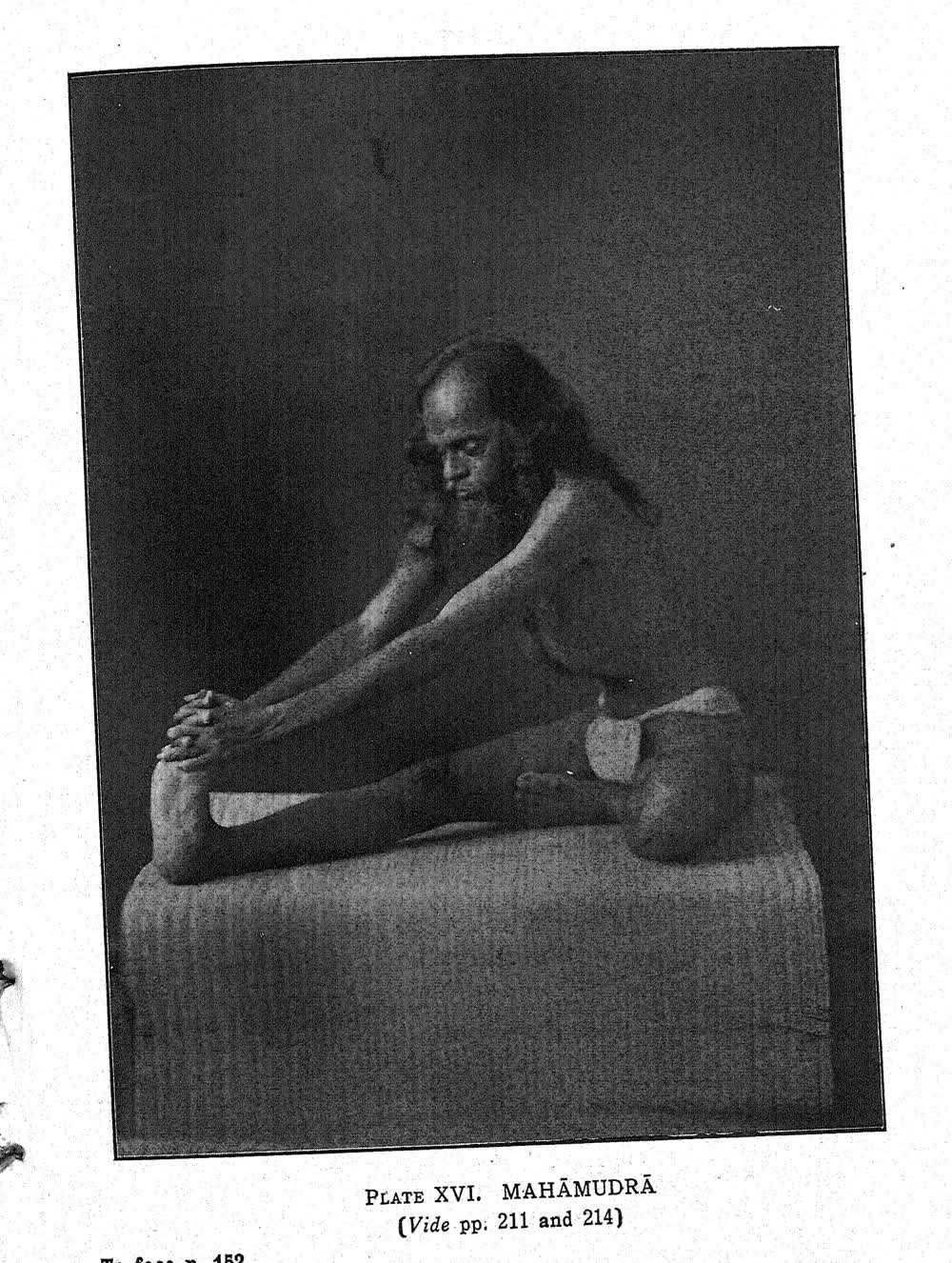
〈Plate XVI: a photograph of a yogī seated with one leg stretched out, holding its foot〉 PLATE XVI. MAHĀMUDRĀ (Vide pp. 211 and 214). To face p. 152.
“Devoted to the two Lotus feet of his Guru” (Guru-pāda-padma-yugalālambī).—This qualifies Yogīndra (excellent yogī). The Author means that Siddhi can only be attained by the instructions of the Guru. The Sādhaka should therefore seek shelter at his feet.
“Rapt in ecstasy” (Samādhau yatah).—The Kulārnava Tantra (ix, 9) defines Samādhi thus: “Samādhi is that kind of contemplation676 in which there is neither ‘here’ nor ‘not here,’ which is illumination and is still like the ocean, and which is the Void Itself.”677
Also elsewhere: “The Munis declare that the constant realisation of the identity of the Jīvātmā with the Paramātmā is Samādhi, which is one of the eight limbs (Amga) of Yoga.”678 Patanjali defines “Yoga to be the control of the modifications (or functions) of Chitta (Yogash chittavrittinirodhah).”
- 678 This is from Shāradā Tilaka, Ch. XXV, v. 26. p. 153
Rapt (Yatah)—i.e., he who constantly and with undivided attention practises it.
“When he leads Kula-Kundalinī, he should make all things absorb into her” (Laya-vashāt nītvā).679 Below is shown the process of absorption:
- 679 Vishvanātha reads it as Naya-vashāt. p. 153
“O Deveshī, the Lang-kāra680 should next be meditated upon in the Triangle; there should also Brahmā and then Kāma-deva be contemplated. Having fixed Jīva there with the utterance of the Pranava, let him lead the Woman, who is longing for the satisfaction of Her passion,681 to the place of Her husband,682 O Queen of the Devas. O Great Queen, O beloved of my life, let him think of Ghrāna (Prithivī), and meditate on the p. 154 adorable Shakti Dākinī. O Daughter of the Mountain, O Queen of the Ganas,683 O Mother, all these should be led into Prithivī.”
Also: “Then, O Great Queen, the blessed Prithivī should be absorbed into Gandha, and then, O Daughter of the Mountain King, the Jīvātmā should be drawn (from the heart) with the Pranava (Mantra), and the Sādhaka should lead Prāna,684 Gandha,685 and Kundalinī, into Svādhishtāna with the Mantra So’ham.”
And also: “In its (Svādhishthāna) pericarp should Varuna and Hari686 be meditated upon. And, O Beauteous One, after meditating on Rākinī687 all these and Gandha (smell) should be absorbed into Rasa (taste), and Jīvātmā, Kundalinī, and Rasa, should be moved into Manipūra.”
And again: “O thou of beautiful hips688 (Sushroni), in its689 pericarp the Sādhaka should meditate upon Fire, and also on Rudra, who is the destroyer of all, as being in company with the Shakti Lākinī and beautiful to behold. And, O Shivā, let him next meditate on the lustrous sense of vision, and absorb all these and Rasa (taste) into Rūpa (Sight), and thereafter lead Jīvātmā, Kundalinī, and Rūpa, into Anāhata.”
And again: “Let him meditate in its690 pericarp on Vāyu, who dwells in the region of Jīva, as also on the Yoni-Mandala, which is made beauteous by the presence of the Bāna-Limga. Let him there also meditate on Vāyu691 as united with Rākinī and touch (Tvagindriya or Sparsha), and there, O Thou who purifiest, Jīva, Kundalinī, and Rūpa, should be placed in Sparsha (Touch), and then Jīva, Kundalinī, and Sparsha, should be placed in the Vishuddha.”
And again: “Let him meditate in its692 pericarp on the Ethereal region,693 and on Shiva accompanied by Shākinī; and having placed Speech (Vāk), and Hearing (Shrotra), in Ether, let him, O daughter of the Mountain, place all these and Sparsha in Shabda (Sound), and place Jīva, Kundalinī, and Shabda, in the Ājnā Chakra.”
The above passages are from Kangkālamālinī Tantra.
“Triangle” in the above is the Triangle in the Mūlādhāra, from which the commencement is made. Lang-kāra should be meditated upon as within this Triangle. Leading of Jīva with the use of the Pranava is a variant practice. “Visarga-nāsha-kāminī”: By Visarga is meant the agitation caused by an access of Kāma (desire). The compound word means She who is striving to satisfy Her desire (Kāma). The bringing of Jīva by the Hangsa Mantra is according to the teaching of some. “Place of her husband” (Patyau pade): This is the Bindu, the Shiva in the Lotus of a thousand petals. Sādhaka should lead Her there.
The Bīja Lang, Brahmā, Kāmadeva, Dākinī-Shakti, and the sense of smell (Ghrānendriya)—all these are absorbed into Prithivī, and Prithivī is absorbed into the Gandha-tattva. Jīvātmā, Kundalinī, and Gandha-tattva, are drawn upward by the Pranava, and brought into the Svādhishthāna by the So’ham Mantra. This is the process to be applied right through. After leading Jīva, Kundalinī, and Shabda-tattva, into Ājnā Chakra, Shabda-tattva should be absorbed into Ahangkāra which is there, and Ahangkāra into Mahat-tattva, and Mahat-tattva into Sūkshma-prakriti, whose name is Hiranya-garbha, and Prakriti again into Para-bindu.
The Mantra-tantra-prakāsha says: “Let Vyoma (Ether) be absorbed into Ahangkāra, and the latter with Shabda into Mahat, and Mahat, again, into the unmanifest (Avyakta) supreme (Para) Cause (Kārana) of all the Shaktis. Let the Sādhaka think attentively that all things beginning with Prithivī are absorbed into Vishnu,694 the Cause who is Sat, Chit, and Ānanda.”
- 694 Vishnu is specified by this particular Tantra, but it may be any other Devatā who is the Ishtadevatā of the Sādhaka (see p. 151). p. 155
That is, Mahat, which is all Shaktis (Sarvashakti), should be absorbed into Sūkshma-prakriti, who is known by the name of Hiranya-garbha, and that Prakriti should be absorbed into Para, by which is meant the Cause in the form of Parabindu. In this connection the Āchāryya has laid down the rule that the gross should be dissolved into the subtle.695 Cf.: “It should be attentively considered and practised that the gross is absorbed into the subtle, and all into Chidātmā.” The absorption of all things, beginning with Prithivī and ending with Anāhata,696 takes place in the aforesaid manner; that being so, the feet and the sense of Smell (Ghrānendriya) and all pertaining to Prithivī are dissolved in the place of Prithivī, as they inhere in Prithivī.
Similarly, the hands, the sense of Taste (Rasanendriya), and all that pertains to Water, are dissolved in the region of Water. In the region of Fire (Vahni-sthāna) are dissolved the anus, the sense of Vision (Chakshurindriya), and all that pertains to Fire. In the region of Air (Vāyu-sthāna) the genitals, the sense of Touch (Tvāgindriya), and all that pertains to Vāyu, are dissolved. In the place of Ākāsha are dissolved the sense of Speech (Vāk) and hearing (Shrotrendriya) and all that pertains to Ākāsha (Ether).
In the Ājnā Chakra the dissolution of Ahangkāra, Mahat, Sūkshmaprakriti, and so forth, takes place, each dissolving into its own immeditate cause. The letters of the alphabet should then be absorbed in the reverse order (Viloma), beginning with Ksha-kāra and ending with A-kāra. By “all things” it is meant that “Bindu,” “Bodhinī,” and so forth, which have been shown above to be causal bodies (Kārana-Sharīra), should be dissolved in a reversed order (Vilomena) into the Primordial Cause (Ādikārana)—the Para Bindu. Thus the Brahman alone remains.
The process is thus described: “The Sādhaka, having thus made his determination (Sangkalpa), should dissolve697 the letters of the Alphabet in the Nyāsa-sthāna.698 The dissolution of Ksha p. 157 is in La, and La in Ha; Ha, again, is dissolved into Sa, and Sa into Sha, and thus it goes on till A is reached. This should be very carefully done.”
Also699: “Dissolve the two letters into Bindu, and dissolve Bindu into Kalā. Dissolve Kalā in Nāda, and dissolve Nāda in Nādānta,700 and this into Unmanī, and Unmanī into Vishnuvaktra701; Vishnuvaktra should be dissolved into Guruvaktra.702 Let the excellent Sādhaka then realise that all the letters are dissolved in Parama Shiva.”
- 699 Here is shown the Anuloma process. The two letters are Ha and Ksha. p. 157
- 700 i.e., that which is beyond Nāda. See Introduction. p. 157
- 701 Pung-Bindu; v. post. p. 157
- 702 That is, the mouth of the Supreme Bindu (cited from Shāradātilaka, Ch. V, vv. 134-136). Also cf. Shāradā, Ch. XII, 123, and Kulārnava IV, 76. p. 157
By Vishnuvaktra is meant Pung-Bindu. “The Sūryyabindu is called the Face, and below are Moon and Fire.” “Bindu is said to be the Male, and Visarga is Prakriti.”703
- 703 Cf. Shāradā, Ch. XXV, v. 51. Also Nityāshodashikā, I, 201, and Kāma-Kalāvilāsa (Vol. X, Tantrik Texts). p. 157
All these authorities imply the same thing, and go to prove that it is the “mouth of Vishnu” (Vishnu-vaktra) where dissolution should take place. The following from Keshavāchāryya704 also leads to the same conclusion: “Lead Her (Unmanī) into the Male, which is the Bindu; lead Bindu into Parātmā, and Parātmā into Kāla-tattva, and this latter into Shakti, and Shakti into Chidātmā, which is the Supreme (Kevala), the tranquil (Shānta), and effulgent.”
- 704 Also called Keshava Bhāratī—a great Vaishnava teacher who initiated Shrī Chaitanya the greatest among latter day Vaishnavas into Sannyāsa or the path of Renunciation. p. 157
We have seen that each dissolves into its own immediate cause. Nādānta is therefore dissolved in Vyāpikā Shakti, the Vyāpikā Shakti in Unmanī, and Unmanī in Samanī705 and Samanī in Vishnuvaktra. When the letters have been thus dissolved, all the six Chakras are dissolved, as the petals of the Lotuses consist of letters.706
The Vishvasāra Tantra says: “The petals of the Lotuses are the letters of the Alphabet, beginning with A.”707 The Sammohana Tantra708 describes the dissolution709 of the Lotuses and the petals thus: “Dissolve the letters from Va to Sa of the petals in Brahmā,710 and dissolve Brahmā in the Lotus of six petals which contains the letters Ba to La, and which is called Svādhishthāna. Do this as the Guru directs.” And so forth. And ending with:
“The wise one should then dissolve it (Vishuddha) in the (Lotus of) two petals which contains the two letters Ha and Ksha, and dissolve the two letters which are in the latter lotus into Bindu, and dissolve Bindu into Kalā.”711
- 711 That is, the Bindu of the Ājnā Chakra is dissolved into Kundalinī. p. 158
We thus see that the four letters in the Mūlādhāra are dissolved therein and Mūlādhāra is dissolved in Svādhishthāna. Proceeding in this way till the Ājnā Chakra is reached, the letters Ha and Ksha which are there are also dissolved at this place. Then the Lotus itself is dissolved into Bindu, Bindu into Bodhinī, and proceeding in this way as already shown everything is dissolved into Para Bindu. When the Ājnā Chakra is dissolved all that it contains in its pericarp—Hākinī, Itara-Liṁga, Pranava—are unable to exist without support, and therefore after the dissolution into Prakriti these also are dissolved into Para Bindu.
Verse 53
The beautiful Kundalī drinks the excellent red712 nectar issuing from Para Shiva, and returns from there where shines Eternal and Transcendent Bliss713 in all its glory along the path of Kula,714 and again enters the Mūlādhāra. The Yogī who has gained steadiness of mind makes offering (Tarpana) to the Ishta-devatā and to the Devatās in the six centres (Chakra), Dākinī and others, with that stream of celestial nectar which is in the vessel715 of Brahmānda, the knowledge whereof he has gained through the tradition of the Gurus.
- 712 Shangkara says it is so coloured because it is mixed with the menstrual fluid, which is symbolic, like the rest of this erotic imagery. Red is the colour of the Rajoguna. p. 159
- 713 Brahman is Eternity and Bliss. p. 159
- 714 The Channel in the Chitrininādī. p. 159
- 715 The vessel is Kundalinī. p. 159
Commentary
He now speaks of what should be done after all the different kinds of Yoga described have been understood. The meaning of this verse is that the beautiful Kundalī drinks the excellent nectar issuing from Para Shiva, and having emerged from the place of Eternal and Transcendental Bliss, She passes along the path of Kula and re-enters Mūlādhāra. The Yogī, after having understood the different matters mentioned (Tat-tad-dhyānānantaram), should think of the inseparate union716 of Shiva and Shakti, and with the p. 160 excellent nectar produced from the bliss of such union with Para Shiva make offering (Tarpana) to Kundalinī.
- 716 Sāmarasya. p. 159
“Path of Kula” (Kula-patha).—The path of Brahman, the channel in Chitrinī.
Kundalī drinks the nectar with which Tarpana is made to her. The following authority says: “Having effected their union and having made (Her drink),” etc. It follows, therefore, that She is made to drink. The nectar is red like the colour of lac.
“From there where shines Eternal and Transcendent Bliss” (Nityānanda-mahodayāt)—that is, She returns from the place where eternal and transcendental Bliss is enjoyed—i.e., where the Brahman is clearly realised.
“Again enters Mūlādhāra” (Mūle vishet).—She has to be brought back in the same way as She was led upward. As She passed through the different Limgas and Chakras in their order (Chakra-bheda-kramena) when going upward, so does She when returning to the Mūlādhāra.
The Revered Great Preceptor says: “Kuharinī,717 Thou sprinklest all things with the stream of Nectar which flows from the tips of Thy two feet; and as Thou returneth to Thy own place Thou vivifieth and maketh visible all things that were aforetime invisible, and on reaching Thy abode Thou dost resume Thy snake-like coil and sleep.”718
“As Thou returneth Thou vivifieth and maketh visible.” This describes the return of Kundalī to Her own place. As She returns She infuses Rasa719 into the various things She had previously absorbed into Herself when going upward, and by the infusion of Rasa, She makes them all visible and manifest. Her passage was Layakrama,720 and Her return Srishti-krama.721 Hence p. 161 it has been said: “Kundalī, who is Bliss,722 the Queen of the Suras,723 goes back in the same way to the Ādhāra724 Lotus.”
- 719 Rasa: sap, sap of life—that is, She re-vitalises them. p. 160
- 720 See v. 52 and next note. p. 160
- 721 That is, She recreates or revives as She returns to her own abode; just as She “destroys” or absorbs all things on Her upward progress. p. 160
- 722 Mudrākārā—that is, Ānandarūpinī; for Mudrā=Ānandadāyinī. Mudrā is derived from Mud=ānanda (bliss)+Rāti=dadāti (gives): Mudrā therefore means that which gives bliss. p. 161
- 723 Sura=Deva. Here the different Devas in the Chakras. p. 161
- 724 i.e., Mūlādhāra. p. 161
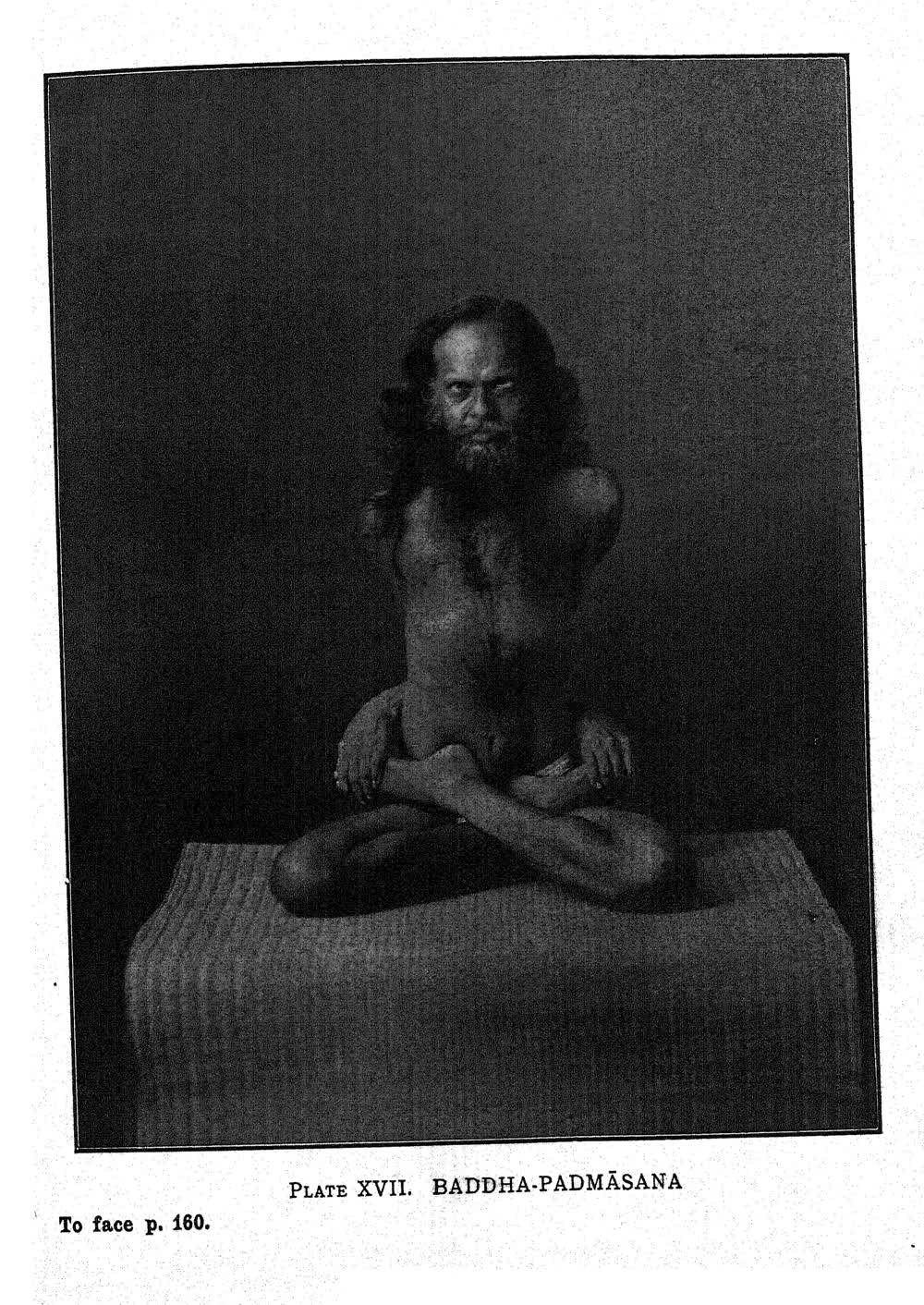
〈Plate XVII: a photograph of a yogī seated in the lotus posture, his arms crossed behind him〉 PLATE XVII. BADDHA-PADMĀSANA. To face p. 160.
The Bhūta-shuddhi-prakarana has the following: “Let the Tattvas Prithivī, etc., in their order, as also Jīva and Kundalinī, be led back from Paramātmā and each placed in its respective position.” She is then particularly described: “She is lustrous when first She goes, and She is ambrosial725 when She returns.”
- 725 Because ambrosia (Amrita) gives life. p. 161
“Stream of celestial nectar” (Divyāmritadhārā).—This is the excellent nectar which, as has already been shown, is produced by the union726 of Shiva and Shakti, and runs in a stream from the Brahmarandhra to the Mūlādhāra. It is for this reason that the Author says in v. 3 that “the Brahmadvāra which shines in Her mouth is the entrance to the place sprinkled by ambrosia.”
- 726 Sāmarasya. p. 161
“Knowledge whereof he has gained through the tradition of the Gurus” (Yoga-paramparā-viditayā).—This qualifies “Stream of Nectar”. It means that the knowledge is gained from instructions (in Yoga practice) handed down traditionally through the succession of Gurus.
“Which is in the vessel of Brahmānda” (Brahmāndabhānda-sthitam).—This qualifies Amrita (nectar).727 The vessel or support (Bhānda) on which the Brahmānda (universe) rests is Kundalinī. Kundalinī is the Bhānda as She is the Source (Yoni) of all.
- 727 Vishvanātha reads this as an adjective qualifying Daivatam, and this seems more in consonance with the text. The Brahmānda is compared to a Bhānda, and the Devatās are in that. The offering is then made with that stream of nectar to the Devatās who are in the Universe. Or, according to Kālīcharana, offering is made to the Devatās of the Amritā which Kundalī has drunk. p. 161
By Daivatam728 is meant the Ishtadevatā and Dākinī and others in the six Chakras. It has been said: “O Deveshī, with this nectar should offering (Tarpana) be made to the Paradevatā, and then having done Tarpana to the Devatās in the six Chakras,” and so forth.
- 728 Daivatam is the collective form of Devatās. p. 161
Verse 54
The Yogī who has, after practice of Yama, Niyama, and the like,729 learnt this excellent method from the two Lotus Feet of the auspicious Dīkshā-guru,730 which are the source of uninterrupted joy, and whose mind (Manas) is controlled, is never born again in this world (Samsāra). For him there is no dissolution even at the time of Final Dissolution.731 Gladdened by constant realisation of that which is the source of Eternal Bliss,732 he becomes full of peace and foremost among all Yogīs.733
Commentary
He here speaks of the good to be gained by knowing the method of Yoga practice.
“From the lotus feet of his auspicious Dīkshā-guru, which are the source of uninterrupted joy” (Shrī-dīkshā-guru-pāda-padma-yugalāmoda-pravāhodayāt).—Āmoda means joy or bliss; and by Pravāha is meant uninterrupted and continuous connection. Āmoda-pravāha therefore means Nityānanda, or “Eternal Bliss”. Bliss such as this comes from the Lotus feet of the Guru, which also lead to a knowledge of Yoga practice.
The Dīkshā-guru is here spoken of as he is the first to initiate, and also by reason of his pre-eminence. But in his absence refuge p. 163 may be sought with other Gurus. It has therefore been said: “As a bee desirous of honey goes from one flower to another, so does the disciple desirous of knowledge (Jnāna) go from one Guru to another.”734
- 734 This is from Ch. XII, of Niruttara Tantra. This verse also occurs in Kulārnava (Tantrik Text, Vol. V), Ch. XIII, 132. p. 163
“Gladdened by constant realisation of that which is the source of Eternal Bliss” (Nityānanda-paramparā-pramudita)—i.e., who is united with the Stream of Eternal Bliss.
“Foremost among the good” (Satām agranī)—i.e., he is counted to be foremost among the good who are the Yogīs.
Verse 55
If the Yogī who is devoted to the Lotus Feet of his Guru, with heart unperturbed and concentrated mind, reads this work which is the supreme source of the knowledge of Liberation, and which is faultless, pure, and most secret, then of a very surety his mind735 dances at the Feet of his Ishta-devatā.
- 735 Chetas or Chitta. p. 164
Commentary
He here speaks of the good to be gained by the study of the verses relating to the six Chakras.
“Heart unperturbed” (Svabhāva-sthitah)—i.e., engrossed in his own true spiritual being.
“Concentrated mind” (Yatāntarmanāh)—i.e., he who by practice of Yoga has steadied and concentrated his mind on the inner spirit (Antarātmā).
The rest is clear.
Here ends the Eighth Section of the Explanation of the Verses descriptive of the Six Chakras, forming part of the Shrītattvachintāmani, composed by Shrī-Pūrnānandayati.