Particularly as regards health, and the diseases likely to affect the subject, the nails will be found to be remarkably sure guides. Medical men in both London and Paris have lately taken up this study of the nails with great interest. Often a patient does not know, or for the moment forgets, what his parents have suffered or died from; but an examination of the nails will in a few seconds disclose important hereditary traits. I will first treat of the health side of the question, then of the disposition, as shown by this study.
In the first place, the care of the nails does not alter or affect their type in the slightest degree: whether they are broken by work or polished by care, the type remains unchanged. For instance, a mechanic may have long nails, and the gentleman at ease may have very short, broad ones, though he manicure them every morning.
Nails are divided into four distinct classes: long, short, broad, and narrow.
Long Nails
Long nails never indicate such great physical strength as the short, broad type. Very long nailed persons are more liable to suffer from chest and lung trouble, and this is more accentuated if the nails are much curved, both from the top back toward the finger and across the finger (Fig. 7, Plate X.). This tendency is even more aggravated if the nail is fluted or ribbed (Fig. 10, Plate X.).
This type of nail, when shorter, indicates throat trouble, such as laryngytis, asthma, and bronchial affections (Plate X.).
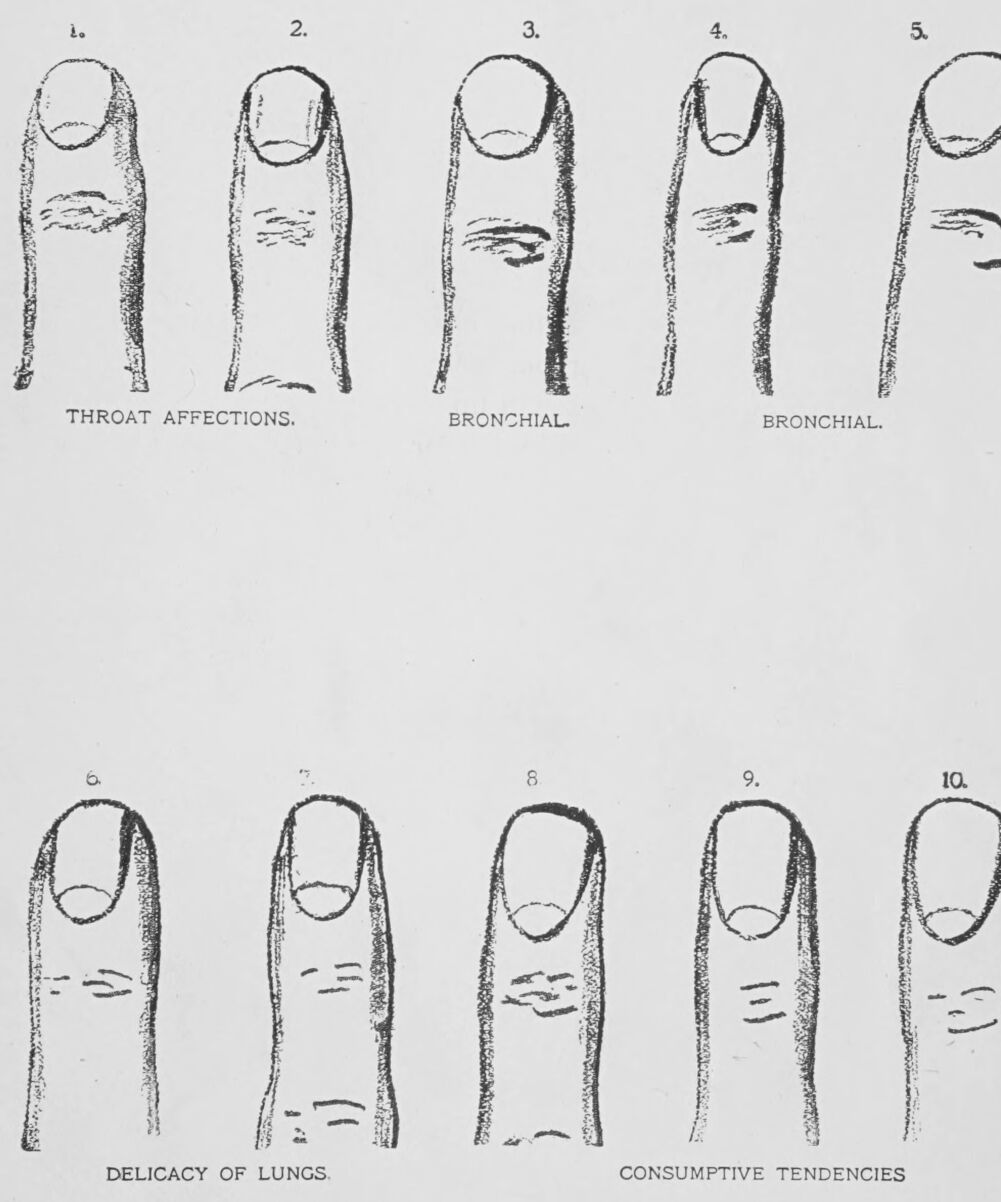
Plate X.—NAILS.
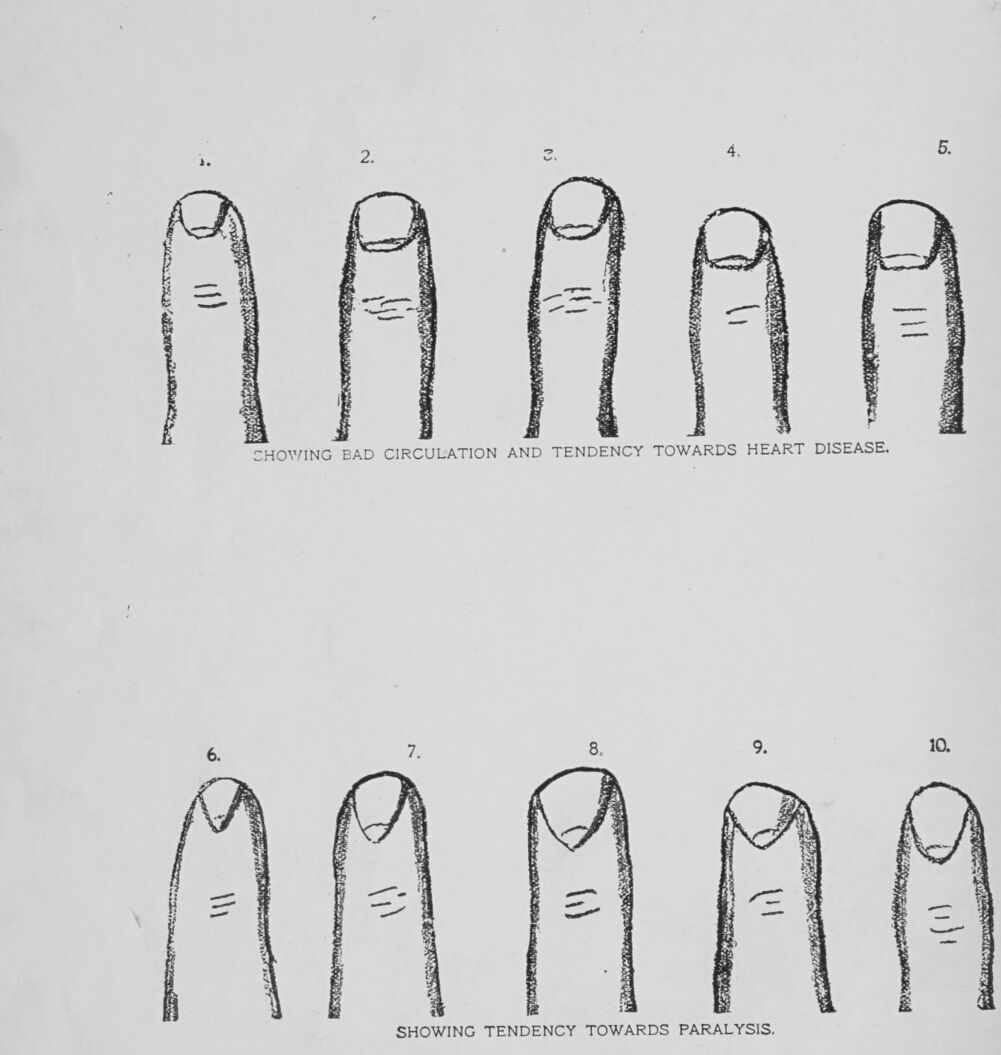
Plate XI.—NAILS.
Long nails, very wide at the top and bluish in appearance, denote bad circulation proceeding from ill-health or nervous prostration. This is very p. 59 often the case with the hands of women between the ages of fourteen and twenty-one and forty-two and forty-seven.
Short Nails
Short, small nails run in whole families in which there is a tendency toward heart disease (Plate XI.).
Short nails, thin and flat at the base, with little or no moons, are sure signs of weak action of the heart, and, generally speaking, heart disease.
Large moons indicate good circulation.
Short nails, very flat and sunken, as it were, into the flesh at the base, show nerve diseases (Plate XI.).
Short nails, very flat and inclined to curve out or lift up at the edges, are the forerunners of paralysis, particularly if they are white and brittle as well as flat. If the latter is the case the disease is more advanced (Fig. 9, Plate XI.).
Short-nailed people have a greater tendency to suffer from heart trouble and from diseases affecting the trunk and lower limbs than those with long nails.
Long-nailed persons are more liable to trouble in the upper half of the system—in the lungs, chest, and head.
Natural spots on the nails are signs of a highly strung nervous temperament; when the nails are flecked with spots the whole nervous system requires a thorough overhauling.
Thin nails, if small, denote delicate health and want of energy. Nails very narrow and long, if high and much curved, threaten spinal trouble, and never promise very great strength.
Disposition as Shown by the Nails
In disposition, long-nailed individuals are less critical and more impressionable than those with short nails. They are also calmer in temper and more gentle.
Long nails show more resignation and calmness in every way. As a rule their owners take things easily. Such nails indicate great ideality; they also p. 60 show an artistic nature, and their owners, as a rule, are fond of poetry, painting, and all the fine arts. Long-nailed persons, however, are rather inclined to be visionary, and shrink from looking facts in the face, particularly if those facts are distasteful.
Short-nailed individuals, on the contrary, are extremely critical, even of things relating to self; they analyze everything with which they come into contact; they incline to logic, reason, and facts, in opposition to the visionary qualities of the long-nailed. Short-nailed individuals make the best critics; they are quicker, sharper and keener in their judgment; they are, as well, fond of debate, and in an argument they will hold out till the very last; they have a keener sense of humor and of the ridiculous than the long-nailed; they are quick and sharp in temper, and are more or less skeptical of things they do not understand.
When the nails are broader than they are long, they indicate a pugnacious disposition, also a tendency to worry and meddle and to interfere with other people’s business.
Nails short by the habit of biting indicate the nervous, worrying temperament.
I do not pay any attention to the spots on the nails, except as a sign of illness through nervous strain.