A Suggestive Theory.
If the exponent of palmistry has to read hands through a curtain, without seeing his subject, the hair growing on the hand, although seemingly unimportant, to a thorough student becomes a study of very great note and magnitude. A slight knowledge of the laws that govern the growth of hair will not, therefore, be out of place. The hair is used by nature to fulfil a great many useful purposes in connection with the body. I will give those only that are necessary to the student of this particular study, namely, the cause of the color of the hair, of its coarseness and fineness, as illustrative of disposition.
In the first place, each hair is in itself a fine tube; these tubes are in connection with the skin and the skin nerves. These hairs or tubes are, literally speaking, escape-valves for the electricity of the body, and by the color they take in the passage of that electricity, so should the student be able to determine certain qualities of temperament of which he would otherwise be ignorant. For example: If there is a large amount of iron or pigment in the system, the flow of this electricity through the hair forces it into these tubes and makes the hair black, brown, blond, gray, or white, as the case may be. Individuals with blond or fair hair, therefore, have less iron and dark pigment in the system. As a rule they are more languid, listless, gentle, and more influenced by people and surroundings than those of the darker type.
People with very dark hair, although often less energetic in work, will have more passion in temper, will be more irritable and more energetic in affection than those of the fairer type, and so in every degree of shade until we come to the extreme opposite of the dark type, namely, those with red p. 62 hair. If we will examine hair, we will find that red hair is coarser in quality as a rule than either black, brown, or blond. Now, being coarser or larger, the tube itself is, consequently, wider, and therefore shows the greater quantity of electricity that escapes, and of which these natures have the greatest amount. It is not that they have as much pigment as the dark people, but having the greater supply and force of electricity, they are consequently the more excitable and quicker to rouse to action than either the black, brown, or blond.
When the system gets old, or becomes enfeebled by excess or dissipation, the electricity, not being generated in such large quantities, is nearly or entirely consumed by the system itself; the pigment is no longer forced into these hair tubes, and consequently they commence to grow white at the outer ends, and so on, till the entire hair or tube becomes white. It is the same in the case of a sudden shock or grief—the hair often stands on end from the force of the nervous electric fluid rushing through these tubes; reaction naturally sets in immediately, and the hair often becomes white in a few hours. Very rarely can the system recover from such a strain, and consequently very rarely will the hair resume its color.
In America more people are to be found with white hair than, I think, in any other country in the world. This theory accounts for the fact, when it is remembered that no people go through so much, or live under such high pressure, as do the Americans. The climate of the country has, I consider, a great deal to do with their temperament; the brightness and brilliance of the atmosphere, even in winter, the peculiar nerve-stimulating quality of the air, all combine to cause its men and women to press forward with a keen spirit of competition, both in work and in amusement. This theory of the color of the hair has never, to my knowledge, been put forward in this way before. I commend it to the attention of those who do not lose sight of the fact that in the Book of Nature nothing is so small that it may not give us knowledge, and as knowledge is power, let us therefore not be ashamed to seek it, even in little things.
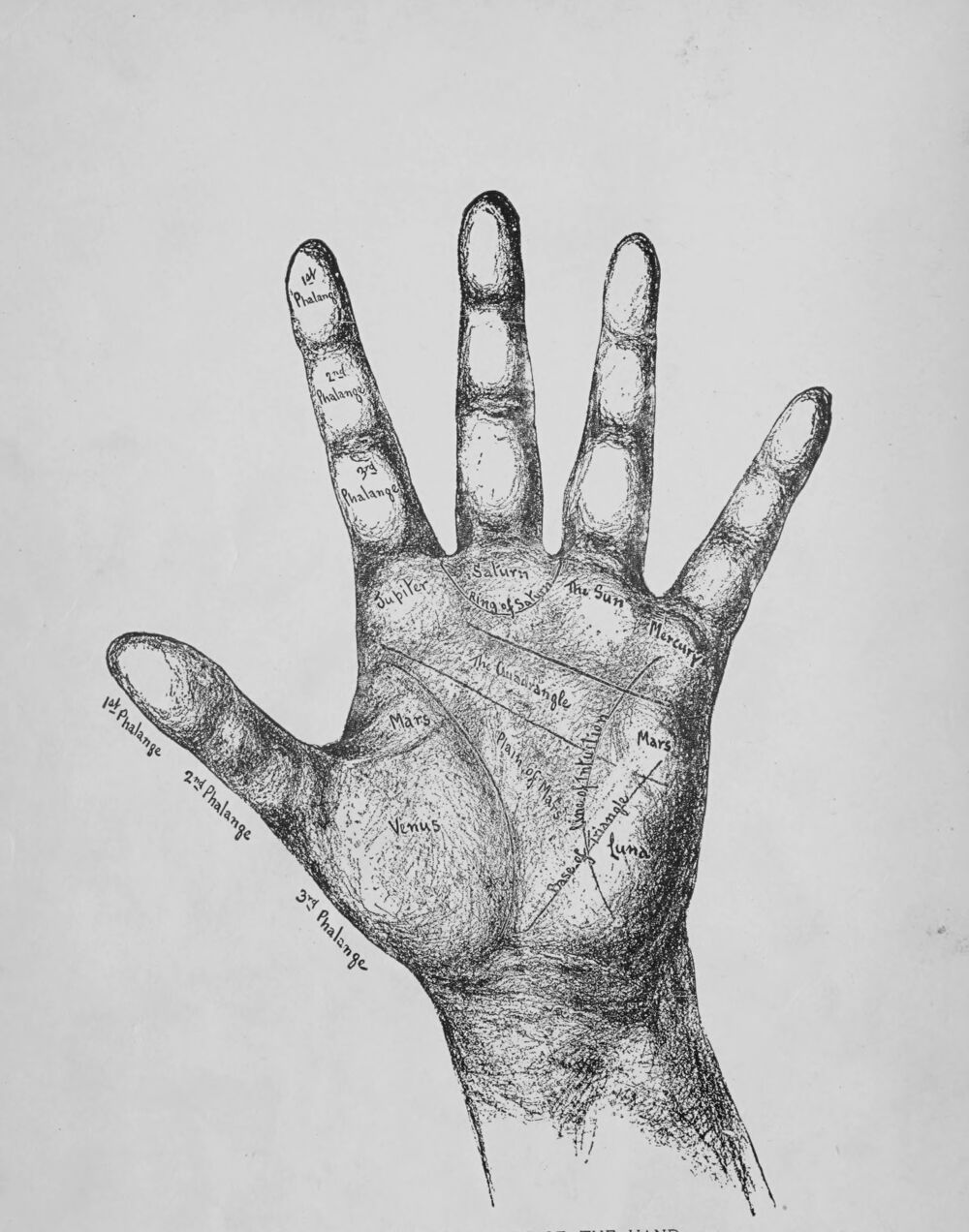
Plate XII.—THE MOUNTS OF THE HAND.