The square hand means the palm square at the wrist, square at the base of the fingers, and the fingers themselves square (Plate II.). Such a type is also called the useful, because it is found in so many walks of life. With this type the nails as well are generally short and square.
People with such a hand are orderly, punctual, and precise in manner, not, however, from any innate grace of nature, but more from conformity to custom and habit. They respect authority, they love discipline, they have a place for everything and everything is kept in its place, not only in their household, but in their brains. They respect law and order, and are slaves to custom; they are not quarrelsome, but are determined in opposition; they prefer reason to instinct, peace to war, and are methodical in work and in habit. They are endowed with great perseverance, but are tenacious, not resigned; they are not enthusiastic over poetry or art; they ask for the material, they win success in practical things. In religion they will not go to extremes; they prefer substance to show, and dogma to ideas. They are not adaptable to people, or versatile; they have little originality or imagination, but in work they have great application, force of character, strength of will, and often outdistance their more brilliant and inspirational rivals. They naturally love the exact sciences, and all practical study. They encourage agriculture and commerce; they love home and the duties of home, but are not demonstrative in affection. They are sincere and true in promises, stanch in friendship, strong in principle, and honest in business. Their greatest fault is that they are inclined to reason by a twelve-inch rule, and disbelieve all they cannot understand.
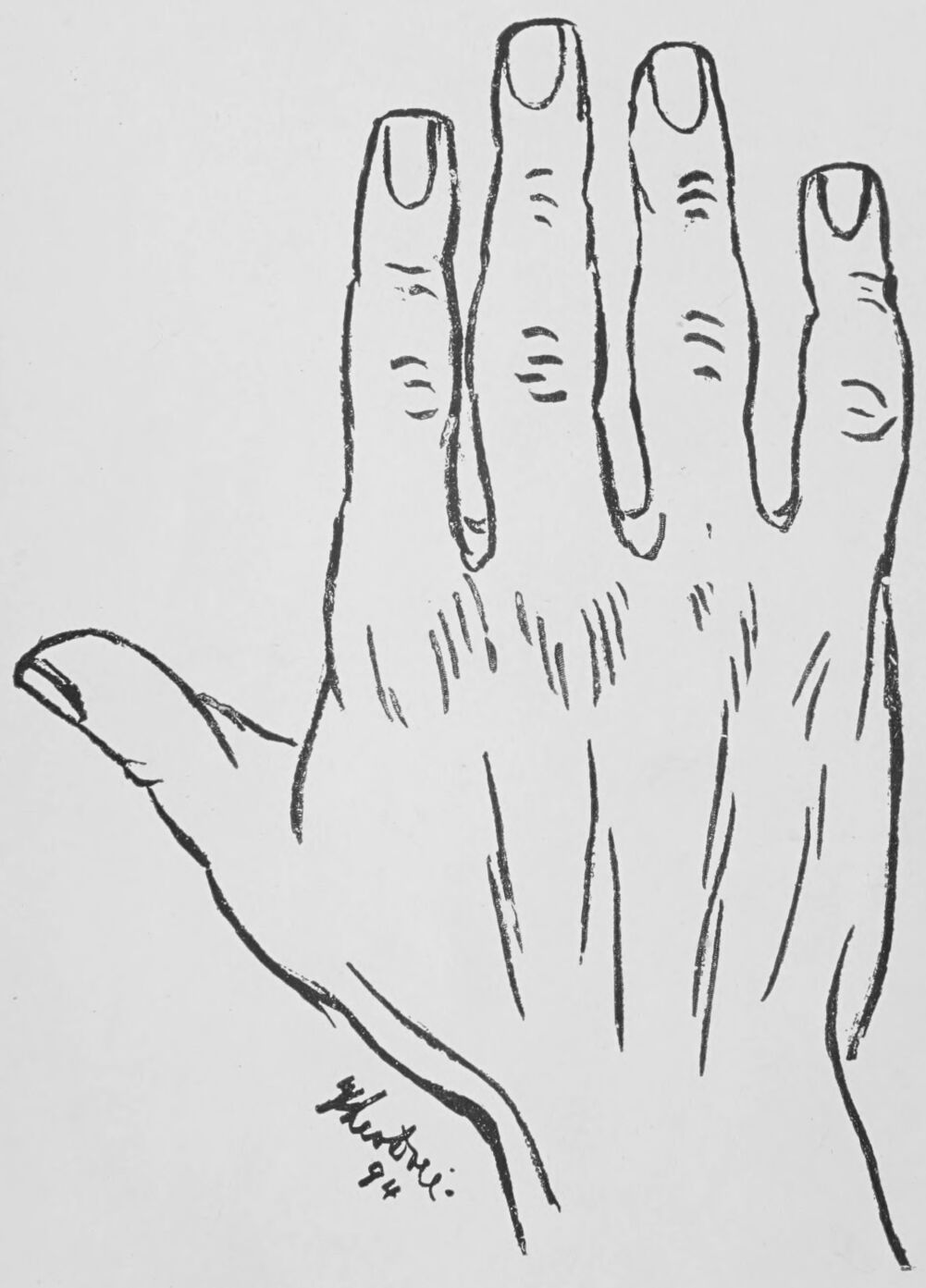
Plate II.—THE SQUARE, OR USEFUL HAND.
The Square Hand with Short Square Fingers
This peculiarity is very often found, and very easily recognized. The subject with such a type is materialistic in every sense of the term. He would be the kind of man who would say: “Except I hear with my ears and see with my eyes, I cannot believe.” And even then I very much doubt if such a man would be convinced. It also denotes an obstinate kind of nature, as a rule, narrow-minded. These people make money, but by plodding; they may not be miserly, but they are business-like and practical; they like to accumulate wealth; it is the material they seek.
The Square Hand with Long Square Fingers
The next modification is the square hand with very long fingers. This denotes a greater development of mentality than the square hand with short fingers. It denotes logic and method, but in a greater degree than possessed by the purely square type, which, tied down by rule and custom, must follow the beaten track. This hand, on the contrary, though submitting everything to scientific examination, will not be so influenced by prejudice, but will proceed cautiously and thoroughly to logical conclusions, and will find its vocation in a scientific career, or in one involving logic and reason.
The Square Hand with Knotty Fingers
This type is generally found with long fingers, and gives, in the first place, extreme love of detail. It is also fond of construction; it builds plans from any given point to any known possibility; it may not produce great inventors, but it will produce good architects, mathematicians, and calculators, and if it applies itself to medical work, or to science of any kind, it will choose some specialty and use its love of detail in the perfection of its own particular study.
The Square Hand with Spatulate Fingers
This is the hand of invention, but always on practical lines. Men with this formation run the gamut in invention, but on a practical plane. They p. 30 make useful things, instruments, and household articles, and are, as well, good engineers. They love mechanical work of almost every kind, and the finest useful mechanism has been turned out by men with the square hand and the spatulate fingers.
The Square Hand with Conic Fingers
Now, though at first sight it may appear strange to say that musical composition comes under this head, yet a little consideration will show that such not only is the case, but that there is a logical reason that it should be so. In the first place, the square hand is more the hand of the student. It gives more the power of application and continuity of effort, while the conic fingers give the intuitive and inspirational faculties. The musical composer, no matter how imaginative, no matter how inspired in ideas, is certainly not without the student’s side to his character. If we consider, for a moment, the quality of brain and the disposition which is absolutely necessary, we will understand more clearly why the hand must be thus wonderfully balanced—why the inspirational, imaginative nature must be linked to that of the thoughtful, the solid, the methodical, and that which also proceeds from the foundation of the known—as, for instance, harmony and counterpoint—to reach the world of the unknown, through the gates of imagination and idealism. I have given great study to the hands of musical people, and I find this rule invariable. I find that the same also applies to literary people, those who from the foundation of study build up the ivy-clad towers of romance. It is here that the student of palmistry is often discouraged. He imagines that because a man or woman leads an artistic life, be it musical or literary, that the shape of the hand must be what is commonly called the conic or artistic; but the smallest observation of life will show that though the people with the purely conic or artistic hands have the artistic nature and the appreciation of what is artistic, yet they may not have—and I have more often observed that they have not—the power or the ability to bring their ideas before the world in the same masterful way in which the mixed square and conic do. A man of a very artistic spirit, with the conic hand, once said to me: “It is sufficient for the artist to be the artist to his own inner nature; the approbation of the world is, after all, only the vulgar hallmark p. 31 on what he knows is gold.” “Yes,” I reply, “sufficient for your own nature, perhaps, but not sufficient for the world that expects the diamond to shine and the gold to glitter. If the flower made itself, then might it refuse to allow its perfume to scent the earth.” On the contrary, the square type will exert its powers to the greatest advantage of all mankind.
The Square Hand and Psychic Fingers
The square hand with purely psychic fingers is rarely found, but an approach to it is often seen in the form of the square palm combined with long, pointed fingers and long nails. Such a formation causes people to start well, and mean well, but makes them subservient to every mood and caprice. An artist with such a type will have a studio of unfinished pictures, and the business man will have his office filled with unfinished plans. Such a blending of types the extreme opposite of each other makes a nature too contradictory to ever succeed.
The Square Hand and Mixed Fingers
This is a type that is very often seen, and more so among men than among women. It consists of every finger being different in shape, sometimes two or three, sometimes all. It is often found that the thumb of such a hand is supple, or bends back very much in the middle joint; the first finger is generally pointed, the second square, the third spatulate, and the fourth pointed. Such a hand indicates great versatility of ideas; at times such a man will be full of inspiration, again he will be scientific and extremely logical; he will descend from the most imaginative idea to the most practical; he will discuss any subject with the greatest ease; but from want of continuity of purpose, he will rarely, if ever, rise to any great height of power or success.
I have not space at my disposal to thus give the subdivisions of every type, but this is an example for the student of how the seven types may be divided.