At this stage we are in a position to pass to a consideration of the Chakras, which may shortly be described as subtle centres of operation in the body of the Shaktis or Powers of the various Tattvas or Principles which constitute the bodily Sheaths. Thus the five lower Chakra from Mūlādhāra to Vishuddha are centres of the Bhūta, or five forms of sensible matter. The Ājnā and other Chakras in the region between it and the Sahasrāra are centres of the Tattvas constituting the mental sheaths, whilst the Sahasrāra or thousand-petalled lotus at the top of the brain, is the blissful abode of Parama Shiva-Shakti which is the state of pure Consciousness.
A description of the Chakras involves, in the first place, an account of the Western anatomy and physiology of the central and sympathetic nervous systems; secondly, an account of the Tantrik nervous system and Chakras; and, lastly, the correlation, so far as that is possible, of the two systems on the anatomical and physiological side, for the rest is in general peculiar to Tantrik occultism.
The Tantrik theory regarding the Chakras and Sahasrāra is concerned on the physiological side, or Bhogāyatana aspect, with the central spinal system, comprising the brain or encephalon, contained within the skull, and the spinal cord, contained within the vertebral column (Merudanda). p. 106 It is to be noted that, just as there are five centres (Chakras) hereinafter described, the vertebral column itself is divided into five regions, which commencing from the lowest, are the coccygeal, consisting of four imperfect vertebræ, often united together into one bone called the coccyx; the sacral region, consisting of five vertebræ united together to form a single bone, the sacrum; the lumbar region, or region of the loins, consisting of five vertebræ; the dorsal region, or region of the back, consisting of twelve vertebræ; and the cervical region, or region of the neck, consisting of seven vertebræ. As exhibited by segments, the cord shows different characteristics in different regions. Roughly speaking, these correspond to the regions which are assigned to the governing control of the Mūlādhāra, Svādhishthāna, Manipūra, Anāhata, and Vishuddha centres, or Chakras. The central system has relation with the periphery through the thirty-one spinal and twelve cranial nerves, which are both afferent and efferent or sensory and motor, arousing sensation or stimulating action. Of the cranial nerves, the last six arise from the spinal bulb (medulla), and the other six, except the olfactory and optic nerves, from the parts of the brain just in front of the bulb. Writers of the Yoga and Tantra schools use the term Nādī, by preference, for nerves. They also, it has been said, mean cranial nerves when they speak of Shiras, never using the latter for arteries, as is done in the medical literature.1 It must, however, be noted that the Yoga Nādīs are not the ordinary material nerves, but subtler lines of direction along which the vital forces go. The spinal nerves, after their exit from the intervertebral foramina, enter into communication p. 107 with the gangliated cords of the sympathetic nervous system, which lie on each side of the vertebral column. The spinal cord extends in the case of man from the upper border of the atlas, below the cerebellum, passing into the medulla, and finally opening into the fourth ventricle of the brain, and descends to the second lumbar vertebra, where it tapers to a point, called the filum terminale. I am told that recent microscopic investigations by Dr. Cunningham have disclosed the existence of highly sensitive grey matter in the filum terminale which was hitherto thought to be mere fibrous cord. This is of importance, having regard to the position assigned to the Mūlādhāra and the Serpent Power. It is continued in this for a variable distance, and there ends blindly. Within the bony covering is the cord, which is a compound of grey and white brain matter, the grey being the inner of the two, the reverse of the position in the encephalon. The cord is divided into two symmetrical halves, which are connected together by a commissure in the centre of which there is a minute canal called the central spinal canal (wherein is the Brahmanādī), which is said to be the remnant of the hollow tube from which the cord and brain were developed.2 This canal contains cerebro-spinal fluid. The grey matter viewed longitudinally forms a column extending through the whole length of the cord, but the width is not uniform. There are special enlargements in the lumbar and cervical regions which are due mainly to the greater amount of grey matter in these situations. But throughout the whole cord the grey matter is specially abundant at the junctions of the spinal nerves, so that a necklace arrangement is visible, which is more apparent in the lower vertebrates, corresponding to the ventral ganglionic chain of the invertebrates.3 The white p. 108 matter consists of tracts or columns of nerve fibres. At the upper border of the atlas, or first cervical vertebra, the spinal cord passes into the medulla oblongata below the cerebellum. The centre canal opens into the fourth ventricle of the brain. The cerebellum is a development of the posterior wall of the hindermost of the three primary dilatations of the embryonic cerebro-spinal tube, the fourth ventricle constituting the remnant of the original cavity. Above this is the cerebrum, which with the parts below it is an enlarged and greatly modified upper part of the cerebro-spinal nervous axis. The spinal cord is not merely a conductor between the periphery and the centres of sensation and volition, but is also an independent centre or group of centres. There are various centres in the spinal cord which, though to a considerable extent autonomous, is connected together with the higher centres by the associating and longitudinal tracts of the spinal cord.4 All the functions which are ascribed primarily to the spinal centres belong also in an ultimate sense to the cerebral centres. Similarly, all the “Letters” which exist distributed on the petals of the lotuses exist in the Sahasrāra. The centres influence not only the muscular combinations concerned in volitional movements, but also the functions of vascular innervation, secretion, and the like, which have their proximate centres in the spinal cord. The cerebral centres are said, however, to control these functions only in relation with the manifestations of volition, feeling, and emotion; whereas the spinal centres with the subordinate sympathetic system are said to constitute the mechanism of unconscious adaptation, in accordance with the varying conditions of stimuli which are essential to the continued existence of the organism. The Medulla, again, is also both a path of communication between the higher centres p. 109 and the periphery and an independent centre regulating functions of the greatest importance in the system. It is to be noted that the nerve fibres which carry motor impulses descending from the brain to the spinal cord cross over rather suddenly from one side to the other on their way through the spinal bulb (medulla), a fact which has been noted in the Tantras in the description of the Mukta Triveni. The latter is connected by numerous afferent and efferent tracts with the cerebellum and cerebral ganglia. Above the cerebellum is the cerebrum, the activity of which is ordinarily associated with conscious volition and ideation and the origination of voluntary movements. The notion of Consciousness, which is the introspective subject-matter of psychology, must not, however, be confused with that of physiological function. There is therefore no organ of consciousness, simply because “Consciousness” is not an organic conception, and has nothing to do with the physiological conception of energy, whose inner introspective side it presents.5 Consciousness in itself is the Ātmā. Both mind and body, of which latter the brain is a part, are imperfect or veiled expressions of Consciousness, which in the case of body is so veiled that it has the appearance of unconsciousness. The living brain is constituted of gross sensible matter (Mahābhūta) infused by Prāna. Its material has been worked up so as to constitute a suitable vehicle for the expression of Consciousness in the form of Mind (Antahkarana). As Consciousness is not a property of the body, neither is it a mere function of the brain. The fact that mental consciousness is affected or disappears with disorder of the brain proves the necessity of the latter for the expression of such consciousness, and not that consciousness is inherent alone in brain or that it is the property of the same. On each side of the vertebral column there p. 110 is a chain of ganglia connected with nerve fibre, called the sympathetic cord (Idā and Pinggalā), extending all the way from the base of the skull to the coccyx. This is in communication with the spinal cord. It is noteworthy that there is in the thoracic and lumbar regions a ganglion of each chain corresponding with great regularity to each spinal nerve, though in the cervical region many of them appear to be missing; and that extra large clusters of nervous structure are to be found in the region of the heart, stomach, and lungs, the regions governed by the Anāhata, Manipura, and Vishuddha, respectively, the three upper of the five Chakras hereinafter described. From the sympathetic chain on each side nerve fibres pass to the viscera of the abdomen and thorax. From these, nerves are also given off which pass back into the spinal nerves, and others which pass into some of the cranial nerves; these are thus distributed to the bloodvessels of the limbs, trunk, and other parts to which the spinal or cranial nerves go. The sympathetic nerves chiefly carry impulses which govern the muscular tissue of the viscera and the muscular coat of the small arteries of the various tissues. It is through the sympathetic that the tone of the blood vessels is kept up by the action of the vaso-motor centre in the spinal bulb. The sympathetic, however, derives the impulses which it distributes from the central nervous system; these do not arise in the sympathetic itself. The impulses issue from the spinal cord by the anterior roots of the spinal nerves, and pass through short branches into the sympathetic chains. The work of the sympathetic systems controls and influences the circulation, digestion, and respiration.6
- 1 Dr. Brojendranath Seal, p. 337, Appendix to Professor Benoy Kumar Sarkar’s “Positive Background of Hindu Sociology”. The word Dhamanī is also used for nerve. It is to be noted, however, that the present work uses Shiras for other than cranial nerves, for in v. I it calls Idā and Pinggalā Nādīs or Shirās. p. 106
- 2 See Ferrier’s “Functions of the Brain”. p. 107
- 3 Ib., 7. p. 107
- 4 See Ferrier’s “Functions of the Brain,” p. 80. p. 108
- 5 Auguste Forel’s “Hygiene of Nerves and Mind,” 95. p. 109
- 6 See Foster and Shore’s “Physiology,” 206, 207. p. 110
The anatomical arrangement of the central nervous system is excessively intricate, and the events which take place in that tangle of fibre, cell and fibril, are, on p. 111 the other hand, even now almost unknown.7 And so it has been admitted that in the description of the physiology of the central nervous system we can as yet do little more than trace the paths by which impulses may pass between one portion of the system and another, and from the anatomical connections deduce, with more or less probability, the nature of the physiological nexus which its parts form with each other and the rest of the body.8 In a general way, however, there may (it is said) be reasons to suppose that there are nervous centres in the central system related in a special way to special mechanisms, sensory, secretory, or motor, and that centres, such as the alleged genito-spinal centre, for a given physiological action exist in a definite portion of the spinal cord. It is the subtle aspect of such centres as expressions of consciousness (Chaitanya) embodied in various forms of Māyā Shakti which is here called Chakra. These are related through intermediate conductors with the gross organs of generation, micturition, digestion, cardiac action, and respiration in ultimate relation with the Mūlādhāra, Svādhishthāna, Manipūra, Anāhata, and Vishuddha Chakras respectively, just as tracts have been assigned in the higher centres as being in special, even if not exclusive, relation with various perceptive, volitional, and ideative processes.
With this short preliminary in terms of modern Western physiology and anatomy, I pass to a description of the Chakras and Nādīs (nerves), and will then endeavour to correlate the two systems.
The conduits of Prānik or vital force are the nerves called Nādī, which are reckoned to exist in thousands in the p. 112 body. “As in the leaf of the Ashvattha tree (Ficus religiosa) there are minute fibres, so is the body permeated by Nādīs.”9 Nādī is said in v. 2 to be derived from the root nad, or motion. For here the Prāna or Life Principle moves. The Bhūtashuddhi Tantra speaks of 72,000, the Prapanchasāra Tantra of 300,000, and the Shiva Sanghitā of 350,000; but of these, whatever be their total extent, only a limited number are of importance. Some are gross Nādīs, such as the physical nerves, veins, and arteries, known to medical science. But they are not all of this gross or physical and visible character. They exist, like all else, in subtle forms, and are known as Yoga Nādīs. The latter may be described as subtle channels (Vivara) of Prānik or vital energy. The Nādīs are, as stated, the conduits of Prāna. Through them its solar and lunar currents run. Could we see them, the body would present the appearance of those maps which delineate the various ocean currents. They are the paths along which Prānashakti goes. They therefore belong to the vital science as life-element, and not to the medical Shāstra (Vaidyashāstra). Hence the importance of the Sādhanā, which consists of the physical purification of the body and its Nādīs. Purity of body is necessary if purity of mind is to be gained in its extended Hindu sense. Purification of the Nādīs is perhaps the chief factor in the preliminary stages of this Yoga; for just as their impurity impedes the ascent of Kundalī Shakti, their purity facilitates it. This is the work of Prānāyāma (v. post).
- 9 Shāndilya Up., Ch. I, where the Nādīs are given and their purification spoken of; Dhyānabindu Up.; and as to Sushumnā see Mandalabrāhmana Up., First Brāhmana. p. 112
Of these Nādīs, the principal are fourteen, and of these fourteen Idā, Pinggalā, and Sushumnā, are the chief. Of these three, again, Sushumnā is the greatest, and to it p. 113 all others are subordinate; for by the power of Yoga (Yogabala) Prāna is made to go through it, and, passing the Chakras, leave the body through the Brahmarandhra. It is situate in the interior of the cerebro-spinal axis, the Merudanda, or spinal column, in the position assigned to its interior canal, and extends from the basic plexus, the Tāttvik centre called the Mūlādhāra, to the twelve-petalled lotus in the pericarp of the Sahsrāra Padma, or thousand-petalled lotus. Within the fiery red Tāmasik Sushumnā is the lustrous Rājasik Vajrā or Vajrinī Nādī, and within the latter the pale nectar-dropping Sāttvik Chitrā or Chitrinī. The interior of the latter is called the Brahma Nādī. The first is said to be fire-like (Vahnisvarūpā), the second sun-like (Sūryyasvarūpā), and the third moon-like (Chandrasvarūpā).10 These are the threefold aspect of the Shabdabrahman. The opening at the end of the Chitrinī Nādī is called the door of Brahman (Brahmadvāra), for through it the Devī Kundalī enters to ascend.11 It is along this last-mentioned Nādī, known as the Kula Mārga and the “Royal Road,” that the Shakti Kundalinī is led in the process hereafter described.
- 10 Hence She is called in the Lalitā-sahasranāma (v. 106) Mūlādhārāmbujārūdhā. Fire, Sun, and Moon are aspects of the differentiated Parabindu or Kāmakalā (v. ante). See the Chapter on Sun, Moon and Fire in “Garland of Letters”. p. 113
- 11 The sun generally represents poison, and the moon nectar (Shāndilya Up., Ch. I). Both were obtained at the churning of the ocean, and represent the upbuilding and destructive forces of Nature. p. 113
Outside this nerve are the two Nādīs, the pale Idā or Shashī (Moon) and the red Pinggalā or Mihira (Sun), which are connected with the alternate breathing from the right to the left nostril and vice versa.12 The first, which is p. 114 “feminine” (Shaktirūpā) and the embodiment of nectar (Amritavigrahā), is on the left; and the second, which is “masculine,” as being in the nature of Rudra (Raudrātmikā), is on the right. They both indicate Time or Kāla, and Sushumnā devours Kāla. For on that path entry is made into timelessness. The three are also known as Gangā (Idā), Yamunā (Pinggalā), and Sarasvatī (Sushumnā), after the names of the three sacred rivers of India. The Mūlādhāra is the meeting-place of the three “rivers,” and hence is called Yuktatrivenī. Proceeding from the Ādhāra lotus, they alternate from right to left and left to right, thus going round the lotuses. According to another account, their position is that of two bows on either side of the spinal cord. An Indian medical friend tells me that these are not discrepant accounts, but represent different positions according as Idā and Pinggalā exist inside or outside the spinal cord. When they reach the space between the eyebrows known as the Ājnā Chakra, they enter the Sushumnā, making a plaited knot of three called Muktatrivenī. The three “Rivers,” which are again united at this point, flow separately therefrom, and for this reason the Ājnā Chakra is called Muktatrivenī. After separation, the Nādī which proceeded from the right testicle goes to the left nostril, and that from the left testicle to the right nostril. It has been said that the distinction made between the heating “Sun” and cooling “Moon” is that which exists between the positive and negative phases of the same subject-matter, positive and negative forces being present in every form of activity. Pinggalā is thus, according to this view, the conduit of the positive solar current, and Idā of the negative lunar current. There are also, as we have seen, interior solar and lunar Nādīs in the fiery Sushumnā p. 115 where the two currents meet.13 These are all but microcosmic instances of the vaster system of cosmic matter, every portion of which is composed of the three Gunas (Trigunātmaka) and the threefold Bindus, which are Sun, Moon, and Fire.
- 12 The Hindus have long known that breathing is done through one nostril for a period of time and then through the other. In Prānāyāma to make the breathing change one nostril is closed. But the skilled Yogī can shift the breathing at his will without closing a nostril with his fingers. At the moment of death breathing is through both nostrils at one and the same time. p. 113
- 13 Similarly, there are three Nādīs which in Latāsādhanā are worshipped in the Madanāgāra—viz., Chāndrī, Saurī, Āgneyī, representing the sun, moon, and fire. p. 115
As regards nerve cords and fibres, cranial and spinal nerves, and the connected sympathetic nerves, Dr. Brojendranath Seal says: “With the writers on the Yoga, all the Shirās, and such of the Dhamanīs as are not vehicles of vital current, metabolic fluid, lymph, chyle, or blood, are cranial nerves, and proceed from the heart through the spinal cord to the cranium. These cranial nerves include pairs for the larynx and the tongue, for the understanding and use of speech, for the raising and lowering of the eyelids, for weeping, for the sensations of the special senses, etc., a confused and unintelligent reproduction of Sushruta’s classification. But the enumeration of the spinal nerves with the connected sympathetic chain and ganglia is a distinct improvement on the old anatomists.”14
- 14 P. 340, Appendix to Professor Sarkar’s “Positive Background of Hindu Sociology,” subsequently published in his “Positive Sciences of the Hindus”. The author annexes a plan which attempts to give a rough idea of the relative position of the principal nerves of the sympathetic spinal system. p. 115
He then continues: “The Sushumnā is the central cord in the vertebral column (Brahmadanda or Meru). The two chains of sympathetic ganglia on the left and right are named Idā and Pinggalā respectively. The sympathetic nerves have their main connection with Sushumnā at the solar plexus (Nābhi chakra). Of the seven hundred nerve cords of the sympathetic spinal system p. 116 (see Sangītaratnākara), the fourteen most important are:15
- 15 Some of these are referred to in the present work; see v. 1. p. 116
“1. Sushumnā, in the central channel of the spinal cord. 2. Idā, the left sympathetic chain, stretching from under the left nostril to below the left kidney in the form of a bent bow. 3. Pinggalā, the corresponding chain on the right. 4. Kuhū, the pudic nerve of the sacral plexus, to the left of the spinal cord. 5. Gāndhārī, to the back of the left sympathetic chain, supposed to stretch from below the corner of the left eye to the left leg. It was evidently supposed that some nerves of the cervical plexus came down through the spinal cord and joined on to the great sciatic nerve of the sacral plexus. 6. Hastijihvā, to the front of the left sympathetic chain, stretching from below the corner of the left eye to the great toe of the left foot, on the same supposition as before. Pathological facts were believed to point to a special nerve connection between the eyes and the toes. 7. Sarasvatī, to the right of Sushumnā, stretching up to the tongue (the hypoglossal nerves of the cervical plexus). 8. Pūshā, to the back of the right sympathetic chain, stretching from below the corner of the right eye to the abdomen (a connected chain of cervical and lumbar nerves). 9. Payasvinī, between Pūshā and Sarasvatī, auricular branch of the cervical plexus on the left. 10. Sankhinī, between Gāndhārī and Sarasvatī, auricular branch of the cervical plexus on the left. 11. Yashasvinī, to the front of the right sympathetic chain, stretching from the right thumb to the left leg (the radial nerve of the brachial plexus continued on to certain branches of the great sciatic). 12. Vārunā, the nerves of the sacral plexus, between Kuhū and Yashasvinī, ramifying over the lower trunk and limbs. 13. Vishvodarā, the nerves of the lumbar plexus, between Kuhū and Hastijihvā, p. 117 ramifying over the lower trunk and limbs. 14. Alambushā, the coccygeal nerves, proceeding from the sacral vertebræ to the urino-genitary organs.”16
- 16 Citing Sangītaratnākara, Shlokas 144-156; also the Yogārnava Tantra. This account has in parts been criticised by an Indian medical friend, who tells me that it is in those parts influenced too much by Western physiology. p. 117
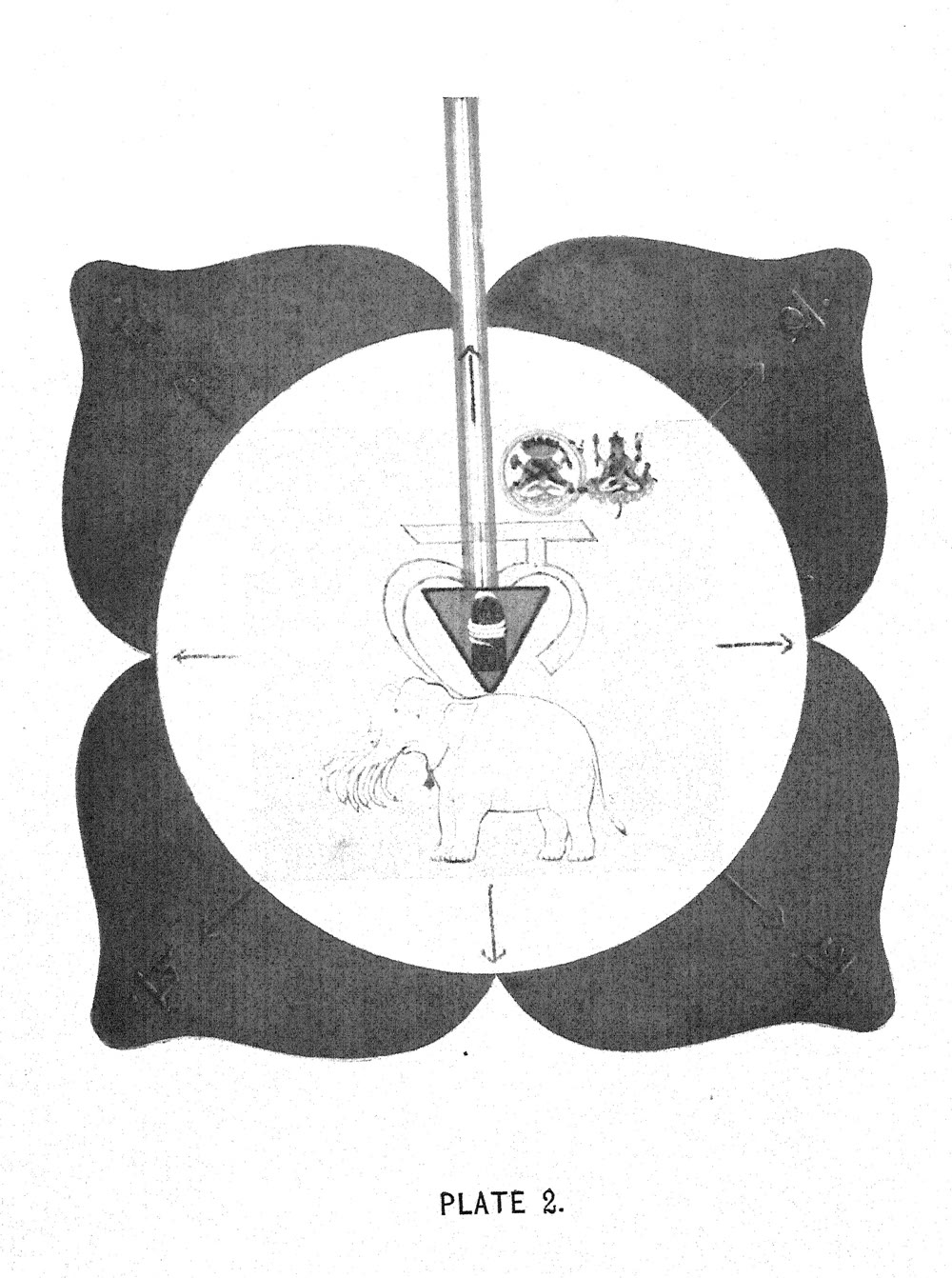
〈Plate II: a lotus drawn with its letters, its seed-mantra and its animal; the List of Illustrations (p. xv) names it Mūlādhāra Chakra〉 PLATE 2.
The Tattvas in the body pervaded by Prāna have certain special centres of predominance and influence therein, which are the Chakras (centres or circles or regions) or Padmas (lotuses) of which this work is a description.
Inside the Meru, or spinal column, are the six main centres of Tattvik operation, called Chakras or Padmas, which are the seats of Shakti, as the Sahasrāra above is the abode of Shiva.17 These are the Mūlādhāra, Svādhishthāna, Manipūra, Anāhata, Vishuddha, and Ājnā, which in the physical body are said to have their correspondences in the principal nerve plexuses and organs, commencing from what is possibly the sacro-coccygeal plexus to the “space between the eyebrows,” which some identify with the pineal gland, the centre of the third or spiritual eye, and others with the cerebellum. The Chakras18 themselves are, however, as explained later, centres of Consciousness (Chaitanya) as extremely subtle force (Shakti); but the gross regions which are built up by their coarsened vibrations, which are subject to their influence, and with which loosely and inaccurately they are sometimes identified, have been said to be various plexuses in the trunk of the body and the lower cerebral centres mentioned. In the portion of the body below the Mūlādhāra are the seven lower worlds, Pātāla and p. 118 others, together with the Shaktis which support all in the universe.
The first centre, or Mūlādhāra Chakra, which is so called from its being the root of Sushumnā where Kundalī rests,19 is at the place of meeting of the Kanda (root of all the Nādīs) and the Sushumnā Nādī, and is in the region midway between the genitals and the anus. It is thus the centre of the body for men.20 By this and similar statements made as regards the other lotuses, it is not meant that the Chakra proper is in the region of the gross body described, but that it is the subtle centre of that gross region, such centre existing in the spinal column which forms its axis. The reader must bear this observation in mind in the descriptions of the Chakras, or an erroneous notion will be formed of them. This crimson Mūlādhāra lotus21 is described as one of four petals, the Vrittis of which are the four forms of bliss known as Paramānanda, Sahajānanda, Yogānanda, and Vīrānanda.22 On these four petals are the golden letters Vang (वं), Shang (शं), Shang (षं), and Sang (सं).23 Each letter in its Vaikharī form is a gross manifestation of inner or subtle Shabda. On the petals are figured the letters, which are each a Mantra, and as such a Devatā. The petals are configurations made by the position of the Nādīs at any particular centre, and are in themselves Prānashakti manifested by Prānavāyu in p. 119 the living body. When that Vāyu departs they cease to be manifest. Each letter is thus a particular Shabda or Shakti and a surrounding (Āvarana) Devatā of the Principal Devatā and its Shakti of the particular Chakra. As Shakti they are manifestations of Kundalī, and in their totality constitute Her Mantra body, for Kundalī is both light (Jyotirmayī) and Mantra (Mantramayī). The latter is the Sthūla aspect of which Japa is done. The former is the Sūkshma aspect which is led up to in Yoga. Their specific enumeration and allocation denote the differentiation in the body of the total Shabda. This Lotus is the centre of the yellow Prithivī, or “earth” Tattva, with its quadrangular Mandala, the Bīja or Mantra of which Tattva is Lang (लं).24
- 19 Derived from Mūla (root) and Ādhāra (support). p. 118
- 20 Shāndilya Up., Ch. I, where also the centres for birds and other animals are given. In some (Kashmir “Nādīchakra”) Kundalī is represented above the position given in the Text. p. 118
- 21 This and other lotuses hang head downwards except when Kundalī passes through them, when they turn upwards. p. 118
- 22 These Vrittis or qualities (see post) denoting four forms of bliss are not given in the text here translated, but in Tarkālangkāra’s Commentary to the Mahānirvāna Tantra. p. 118
- 23 In this and other cases meditation is done from the right (Dakshināvartena). See v. 4, Shat-chakra-nirūpana cited as S.N. p. 118
- 24 The Dhyānabindu Up. associates the Bījas with the five Prānas. Thus “Lang” is associated with Vyāna. p. 119
At this centre is the Prithivī Tattva, the Bīja of which is “La,” with Bindu or the Brahma-consciousness presiding over this centre or “Lang” which is said to be the expression in gross (Vaikharī) sound of the subtle sound made by the vibration of the forces of this centre. So, again, the subtle Tejas Tattva and its Bīja Rang is in the Manipūra Chakra, and the gross fire known as Vaishvānara is in the physical belly, which the subtle centre governs. This Bīja represents in terms of Mantra the Tattva regnant at this centre, and its essential activity. With the symbolism used throughout this work, Bīja is said to be seated on the elephant Airāvata, which is here located. This and the other animals figured in the Chakras are intended to denote the qualities of the Tattvas there regnant. Thus, the elephant is emblematic of the strength, firmness, and solidity, of this Tattva of “Earth”. They are, further, the vehicles (Vāhana) of the Devatās there. Thus in this Chakra there is the seed-mantra p. 120 (Bīja) of Indra, whose vehicle is the elephant Airāvata. The Devatā of this centre is, according to the Text, the creative Brahmā, whose Shakti is Sāvitrī.25 There also is the Shakti known as Dākinī,26 who, as also the other Shaktis, Lākinī and the rest, which follow, are the Shaktis of the Dhātus or bodily substances27 assigned to this and the other centres. Here is the “female” triangle or Yoni known as Traipura, which is the Shaktipītha, in which is set the “male” Shivalingga known as Svayambhu, of the shape and colour of a young leaf, representing, as do all Devīs and Devas, the Māyā-Shakti and Chit-Shakti, aspects of the Brahman as manifested in the particular centres (vv. 4-14). The Linggas are four—Svayambhu, Bāna, Itara, Para. According to the Yoginīhridaya Tantra28 (Ch. I), they are so called because they lead to Chit. They are the Pīthas, Kāmarūpa, and the rest because they reflect Chit (Chitsphurattādhāratvāt). They are Vrittis of Manas, Ahangkāra, Buddhi, Chitta. To the first three are assigned certain forms and colours—namely, yellow, red, white, triangular, circular; as also certain letters—namely, the sixteen vowels, the consonants Ka to Ta (soft), and Tha to Sa. Para is formless, colourless, and letterless, being the collectivity (Samashti) of all letters in the form of bliss. The Traipura is the counterpart in the Jīva of the Kāmakalā of the Sahasrāra. The Devī Kundalinī, luminous as lightning, shining in the hollow of this lotus like a chain of brilliant lights, the World-bewilderer who maintains all breathing creatures,29 p. 121 lies asleep coiled three and a half times30 round the Linga, covering with Her head the Brahmadvāra.31
- 25 The Creator is called Savitā because He creates. p. 120
- 26 Who, according to Sammohana Tantra, Ch. II, acts as keeper of the door. p. 120
- 27 Viz., chyle, blood, flesh, fat, bone, marrow, seed. p. 120
- 28 Yoginīhridaya Tantra, Ch. I. p. 120
- 29 See v. 49, S.N. p. 120
- 30 These correspond with the three and a half Bindus of which the Kubjikā Tantra speaks. See ante. p. 121
- 31 Entrance to the Sushumnā. p. 121
The Svādhishthāna Chakra is the second lotus proceeding upwards, and is, according to the commentary, so called after Sva or the Param Lingam.32 It is a vermilion lotus of six petals placed in the spinal centre of the region at the root of the genitals. On these petals are the letters like lightning: Bang (बं), Bhang (भं), Mang (मं), Yang (यं), Rang (रं), Lang (लं). “Water” (Ap) is the Tattva of this Chakra, which is known as the white region of Varuna. The Tāttvik Mandala is in the shape of a crescent moon33 (Ardhendurūpalasitam). The Bīja of water (Varuna) is “Vang”. This, the Varuna Bīja, is seated on a white Makara34 with a noose in his hand. Hari (Vishnu) and Rākinī Shakti of furious aspect, showing Her teeth fiercely, are here (vv. 14—18).
- 32 For another definition see Dhyānabindu Up., where all the Chakras are named. Another derivation is “own abode” of (Shakti). p. 121
- 33 The diagrams or mandalas symbolic of the elements are also given, as here stated, in the first chapter of the Shāradā Tilaka and in the Vishvasāra Tantra, cited at p. 25 of the Prānatoshinī, with the exception that, according to the Vishvasāra Tantra, the Mandala of water is not a crescent, but eight-cornered (Ashtāsra). p. 121
- 34 An animal like an alligator. See Plate 3. p. 121
Above it, at the centre of the region of the navel, is the lotus Manipūra (Nābhipadma), so called, according to the Gautamīya Tantra, because, owing to the presence of the fiery Tejas, it is lustrous as a gem (Mani).35 It is a lotus of ten petals on which are the letters Dang (डं), Dhang (ढं), Nang (णं), Tang (तं), Thang (थं), Dang (दं), Dhang (धं), Nang (नं), Pang (पं), Phang (फं). This is the triangular region of the Tejas Tattva. The triangle has p. 122 three Svastikas. The red Bīja of fire, “Rang,” is seated on a ram, the carrier of Agni, the Lord of Fire. Here is the old red Rudra smeared with white ashes, and the Shakti Lākinī who as the Devatā of this digestive centre is said to be “fond of animal food, and whose breasts are ruddy with the blood and fat which drop from Her mouth”. Lākinī and the other special Shaktis of the centres here named are the Shaktis of the Yogī himself—that is, Shaktis of the Dhātus assigned to each of his bodily centres, and concentration on this centre may involve the satisfaction of the appetites of this Devatā. The Shaktis of the higher centres are not meat-eaters. From these three centres the gross Virāt, waking body, is evolved (vv. 19-21).
- 35 For another derivation, derived from Samaya worship, see Commentary on the Lalitā-Sahasranāma, vv. 88, 89. p. 121
Next above the navel lotus (Nābhipadma) is the Anāhata, in the region of the heart, which is red like a Bandhuka flower, and is so called because it is in this place that Munis hear that “sound (Anāhata shabda) which comes without the striking of any two things together,” or the “sound” of the Shabdabrahman, which is here the Pulse of Life. For it is here that the Purusha (Jīvātmā) dwells. This lotus is to be distinguished from the Heart Lotus of eight petals, which is represented in the place below it, where in mental worship the Patron Deity (Ishtadevatā) is meditated upon. (See Plate V.) Here is the Tree which grants all desires (Kalpataru) and the jewelled altar (Manipītha) beneath it. As the Vishvasāra Tantra cited in the Prānatoshinī says: “Shabdabrahman is said to be Deva Sadāshiva. That Shabda is said to be in the Anāhatachakra. Anāhata is the great Chakra in the heart of all beings. Ongkāra is said to be there in association with the three Gunas.”36 The Mahāsvachchhanda Tantra p. 123 says:37 “The great ones declare that Thy blissful form, O Queen, manifests in Anāhata, and is experienced by the mind inward-turned of the Blessed Ones, whose hairs stand on end and whose eyes weep with joy.” This is a lotus of ten petals with the vermilion letters Kang (कं), Khang (खं), Gang (गं), Ghang (घं), Ngang (ङं), Chang (चं), Chhang (छं), Jang (जं), Jhang (झं), Nyang (ञं), Tang (टं), Thang (ठं). This is the centre of the Vāyu Tattva. According to v. 22, the region of Vāyu is six-cornered (that is, formed by two triangles, of which one is inverted), and its colour that of smoke by reason of its being surrounded by masses of vapour.38 Its Bīja “Yang” is seated on a black antelope which is noted for its fleetness, and is the Vāhana of “Air” (Vāyu), with its property of motion. Here are Īsha, the Overlord of the first three Chakras; the Shakti Kākinī garlanded with human bones, whose “heart is softened by the drinking of nectar”; and the Shakti in the form of an inverted triangle (Trikona), wherein is the golden Bāna Linga, “joyous with a rush of desire” (Kāmodgamollasita), and the Hangsa as Jīvātmā, like “the steady flame of a lamp in a windless place” (vv. 22-27). The Ātmā is so described because just as the flame is undisturbed by the wind, so the Ātmā is in itself unaffected by the motions of the world.39
- 36 P. 10.
Shabdabrahmeti tang prāha sakshād devah sadāshivah
Anāhateshu chakreshu sa shabdah parikīrttyate p. 122 - 37 Cited by Bhāskararāya’s Comm. on Lalitā, v. 121, on the title of the Devī as Nādarūpā; and in v. 218, where she is described as Nādarūpinī, referring also to Yoginīhridaya Tantra. p. 123
- 38 According to the Shāradā, Ch. I (and to the same effect Prapanchasāra Tantra), the colours of the Bhūtas are as follows: Ākāsha (ether) is transparent (svachchha); Vāyu (air) is black (Krishna); Agni (fire) is red (Rakta); Ap (water) is white (Sveta); and Prithivī (earth) is yellow (Pīta). p. 123
- 39 This steady, still, state is that of the Ātmā. See Mandalabrāhmana Up., Brāhmanas II, III. p. 123
The seventeenth verse of the Ānanda-Laharī mentions that the Devatās Vashinī and others are to be worshipped in the two last-mentioned Chakras. Vashinī and others are eight in number.40
- 40 Pandit Ananta Shāstri’s Ānanda Laharī, pp. 47, 48, and translation of same by A. Avalon, “Wave of Bliss”. p. 124
(1) Vashinī, (2) Kāmeshvarī, (3) Modinī, (4) Vimalā, (5) Arunā, (6) Jayinī, (7) Sarveshvarī, and (8) Kālī or Kaulinī. These are respectively the Presiding Deities of the following eight groups of letters; (1) अ to अः, 16 letters; (2) क to ङ, 5 letters; (3) च to ञ, 5 letters; (4) ट to ण, 5 letters; (5) त to न, 5 letters; (6) प to 5 letters; (7) य to व, 4 letters; (8) श to क्ष or ळ, 5 letters.
The other beings in v. 17 of Ānanda-Laharī refer to the twelve Yoginīs, who are (1) Vidyāyoginī, (2) Rechikā, (3) Mochikā, (4) Amritā, (5) Dīpikā, (6) Jnānā, (7) Āpyāyanī, (8) Vyāpinī, (9) Medhā, (10) Vyomarūpā, (11) Siddhirūpā, and (12) Lakshmīyoginī.
These twenty Deities (eight Vashinīs and twelve Yoginīs) are to be worshipped in Manipūra and Anāhata centres. In respect of this, the Commentator quotes a verse from the Taittirīyāranyaka, and gives a description of these Deities, their respective colours, place, etc.
At the spinal centre of the region at the base of the throat (Kantha-mūla) is the Vishuddha Chakra or Bhāratīsthāna,41 with sixteen petals of a smoky purple hue, on which are the sixteen vowels with Bindu thereon—that is, Ang (अं), Āng (आं), Ing (इं), Īng (ईं), Ung (उं), Ūng (ऊं), Ring (ऋं), Rīng (ॠं), Lring (ऌं), Lrīng (ॡं), Eng (एं), Aing (ऐं), Ong (ओं), Aung (औं), and the two breathings Ang (अं), Ah (अः). According to the Devībhāgavata (VII. 35), the Chakra is so called because the Jīva is made pure (Vishuddha) by seeing the Hangsa. Here is the centre of the p. 125 white circular Ākāsha or Ether Tattva, the Bīja of which is “Hang”. Ākāsha is dressed in white and mounted on a white elephant. Its Mandala is in the form of a circle.42 Here is Sadāshiva in his androgyne or Arddhanārīshvara Mūrti, in which half the body is white and the other half gold. Here also is the white Shakti Shākinī, whose form is light (Jyotihsvarūpā). Here, too, is the lunar region, “the gateway of the great liberation”. It is at this place that the Jnānī “sees the three forms of time”. (Trikāladarshī). As all things are in the Ātmā, the Jnānī who has realised the Ātmā has seen them (vv. 28-31). Above the Vishuddha, at the root of the palate, is a minor Chakra called Lalanā, or in some Tantras Kalā Chakra, which is not mentioned in the works here translated. It is a red lotus with twelve petals bearing the following Vritti or qualities: Shraddhā (faith), Santosha (contentment), Aparādha (sense of error), Dama (self-command), Māna (anger)43 Sneha (affection),44 Shuddhatā (purity), Arati (detachment), Sambhrama (agitation),45 Ūrmmi (appetite).46 (V. post.)
- 41 That is, abode of the Devī of speech. p. 124
- 42 This is sometimes represented as a circle with a number of dots in it, for, as the Prapanchasāra Tantra says, Ākāsha has innumerable Sushira—that is, Chhidra, or spaces between its substance. It is because of its interstitial character that things exist in space. p. 125
- 43 This term is generally applied to cases arising between two persons who are attached to one another, as man and wife. p. 125
- 44 Usually understood as affection towards those younger or lower than oneself. p. 125
- 45 Through reverence or respect. p. 125
- 46 Or it may refer to the six which are technically called ūrmmi—that is, hunger, thirst, sorrow, ignorance (moha), decay, and death. p. 125
Before summarising the previous description, it is to be here observed that the Commentator Kālīcharana states the principle of this Yoga to be that that which is grosser is merged into that which is more subtle (Sthūlānām sūkshme layah). The grosser are lower in the body than the more subtle. The gross which are in and p. 126 below the Mūlādhāra or connected with it are—(1) the Prithivī Tanmātra; (2) the Prithivī Mahābhūta; (3) the nostrils with their sense of smell, which is the grossest of the senses of knowledge (Jnānendriya), and which is the quality (Guna) of the Prithivī Tanmātra; and (4) the feet, which are the grossest of the senses of action (Karmendriya), and “which have Prithivī (earth) for their support”. Here the nostrils are classified as the grossest of the Jnānendriyas, because therein is the sense which perceives the quality (Guna) of smell of the grossest Tanmātra (Gandha), from which is derived the Prithivī Sthūla Bhūta. Thus the Jnānendriyas have a relation with the Tanmātras through their Gunas (qualities), for the perception of which these senses exist. In the case, however, of the senses of action (Karmendriya), no such relation appears to exist between them and the Tanmātras. In the order of successive merging or Laya, the feet occur in the same grade as earth, hands in the same grade as water, anus in the same grade as fire, penis in the same grade as air, and mouth in the same grade as ether; not, apparently, because there is any direct relation between earth and feet, water and hands, fire and anus, and so forth, but because these organs are in the same order of comparative subtlety as earth, water, and fire, and so forth. Hands are supposed to be subtler agents than feet; the anus47 a subtler agent than the hands; the penis a subtler agent than the anus; and the mouth a subtler agent than the penis. This is also the order in which these agents are situated in the body, the hands coming second because they find their place between the feet and the anus when the arms are given their natural vertical position. It is to be remembered in this p. 127 connection that the Tantras here follow the Sāngkhya, and state the scheme of creation as it occurs also in the Purānas, according to which the Jnānendriyas and Karmendriyas and the Tanmātras issue from different aspects of the threefold Ahangkāra. There is a relation between the senses and the Tanmātras in the created Jīva, according to the Vedānta, for the senses are related to the Tanmātras, but the order, in that case, in which the senses occur is different from that given in this work. For, according to the Vedāntik scheme, earth is related to the sense of smell and penis; water to the sense of taste and anus; fire to the sense of sight and feet; air to the sense of touch and hands; and ether to the sense of hearing and mouth. Another explanation seemingly artificial, however, which has been given, is as follows: The feet are associated with “Earth” because the latter alone has the power of support, and the feet rest on it. “Water” is associated with the hands because in drinking water the hand is used. The word Pāni, which means hand, is derived from the root Pā, to drink (Pīyate anena iti pāni). “Fire” is associated with the anus because what is eaten is consumed by fire in the stomach, and the residue is passed out through the anus, whereby the body becomes pure. “Air” is associated with the penis because in procreation the Jīvātmā as Prāna Vāyu throws itself out through the penis. And so the Shruti says; “Ātmā itself is reborn in the son” (Ātmā vai jāyate putrah). “Ether” is associated with the mouth because by the mouth sound is uttered, which is the Guna (quality) of ether (Ākāsha).
- 47 At first sight this might appear not to be so, but the importance of the anus is well known to medical experts, its sensitivity having even given rise to what has been called a “Psychology of the anus”. p. 126
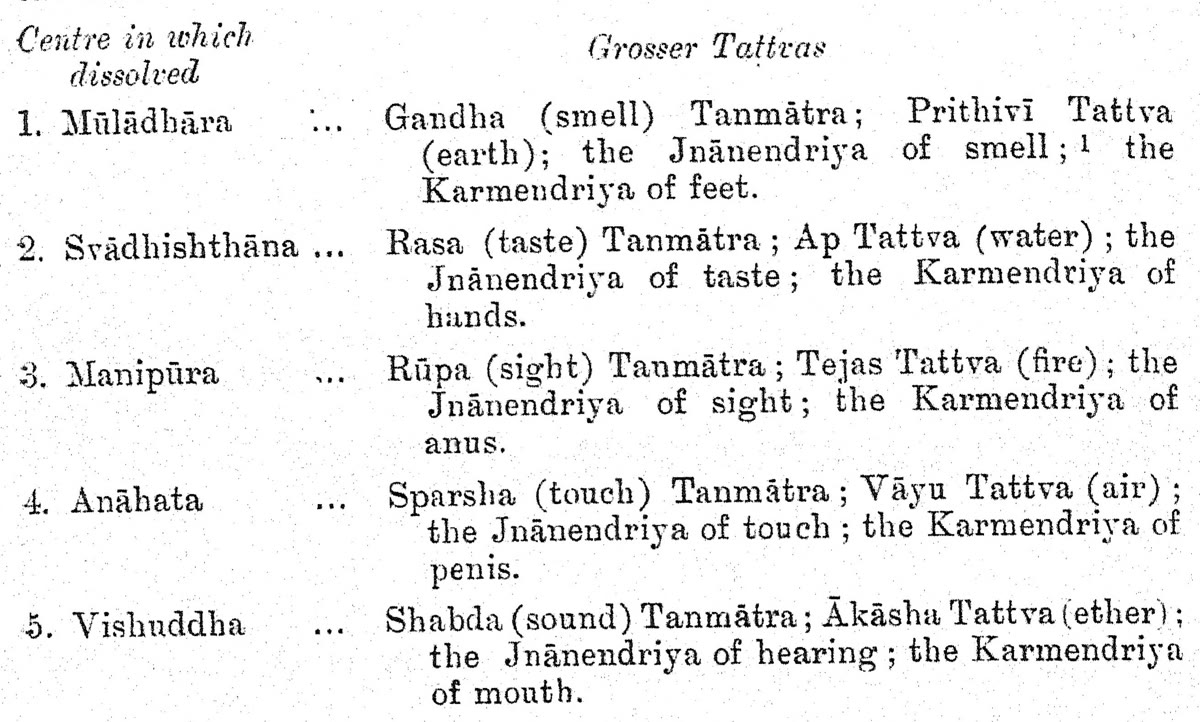
Hitherto we have dealt with the comparatively gross Tattvas. According to this work, the twenty p. 128 grosser Tattvas are associated (4×5) as in the following table:
〈The table on p. 128 as printed: the centre in which each of the grosser Tattvas is dissolved; its words follow as text〉
Centre in which dissolved—Grosser Tattvas
1. Mūlādhāra ... Gandha (smell) Tanmātra; Prithivī Tattva (earth); the Jnānendriya of smell;48 the Karmendriya of feet.
- 48 The nose is a centre at which sexual excitement may be aroused or subdued. Though the reproductive organ is higher up than the Mūlādhāra, the sexual force proceeds from the latter. p. 128
2. Svādhishthāna ... Rasa (taste) Tanmātra; Ap Tattva (water); the Jnānendriya of taste; the Karmendriya of hands.
3. Manipūra ... Rūpa (sight) Tanmātra; Tejas Tattva (fire); the Jnānendriya of sight; the Karmendriya of anus.
4. Anāhata ... Sparsha (touch) Tanmātra; Vāyu Tattva (air); the Jnānendriya of touch; the Karmendriya of penis.
5. Vishuddha ... Shabda (sound) Tanmātra; Ākāsha Tattva (ether); the Jnānendriya of hearing; the Karmendriya of mouth.
It will be observed that with each of the elements is associated an organ of sensation (Jnānendriya) and action (Karmendriya). In Chapter II of the Prapanchasāra Tantra it is said: “Ether is in the ears, air in the skin, fire in the eye, water in the tongue, and earth in the nostrils.” The Karmendriyas are possibly so arranged because the Tattvas of the respective centres in which they are placed are, as above stated, of similar grades of subtlety and grossness. As explained below, each class of Tattvas is dissolved in the next higher class, commencing from the lowest and grossest centre, the Mūlādhāra. So far the Tattvas have been those of the “matter” side of creation.
Progress is next made to the last or Ājnā Chakra, in which are the subtle Tattvas of Mind and Prakriti. The Chakra is so called because it is here that the command (Ājnā) of the Guru is received from above. It is a lotus of p. 129 two white petals between the eyebrows, on which are the white letters Hang (हं), and Kshang (क्षं). This exhausts the fifty letters. It will have been observed that there are fifty petals and fifty letters in the six Chakras. In the pericarp is the great Mantra “Om”. Each Lotus has either two or four more petals than the one immediately below it, and the number of the petals in the Vishuddha Chakra is the sum of the preceding differences. Here are Paramashiva in the form of Hangsa (Hangsa-rūpa), Siddhakālī, the white Hākinī Shakti “elated by draughts of ambrosia,” the inverted triangle or Yoni (Trikona), and the Itara Linga, shining like lightning, which is set in it. The three Lingas are thus in the Mūlādhāra, Anāhata, and Ājnā Chakras respectively; for here at these three Brahmagranthis the force of Māyā Shakti is in great strength. And this is the point at which each of the three groups of Tattva associated with fire, sun, and moon, converge.49 The phrase “opening the doors” refers to passage through these Granthi. Here in the Ājnā is the seat of the subtle Tattvas, Mahat and Prakriti. The former is the Antahkarana with Gunas—namely, Buddhi, Chitta, Ahangkāra and its product Manas (Sasangkalpavikalpaka). Commonly and shortly it is said that Manas is the Tattva of the Ājnā Chakra. As, however, it is the mental centre, it includes all the aspects of mind above stated, and the Prakriti whence they derive, as also the Ātmā in the form of the Pranava (Om) its Bīja. Here the Ātmā (Antarātmā) shines lustrous like a flame. The light of this region makes visible all which is between the Mūla and the Brahmarandhra. The Yogī by contemplation of this lotus gains further powers (Siddhi), and becomes Advaitāchāravādī (Monist). In connection with this Padma, the text (S.N., v. 36) explains how detachment is gained through the Yoni Mudrā. It is here that the Yogī at the p. 130 time of death places his Prāna, and then enters the supreme primordial Deva, the Purāna (ancient) Purusha, “who was before the three worlds, and is known by the Vedānta”. The same verse describes the method (Prānāropanaprakāra). From the last centre and the causal Prakriti is evolved the subtle body which individually is known as Taijasa, and collectively (that is, the Īshvara aspect) as Hiranyagarbha. The latter term is applied to the manifestation of the Paramātmā in the Antahkarana; as displayed in Prāna it is Sūtrātmā; and when manifested through these two vehicles without differentiation it is known as the Antaryāmin. The Chakras are the bodily centres of the world of differentiated manifestation, with its gross and subtle bodies arising from their causal body, and its threefold planes of consciousness in waking, sleeping, and dreamless slumber.
- 49 V. post. p. 129
Above the Ājnā-chakra (vv. 32—39) there are the minor Chakras called Manas and Soma, not mentioned in the texts here translated. The Manas Chakra is a lotus of six petals, on the petals of which are (that is, which is the seat of) the sensations of hearing, touch, sight, smell, taste, and centrally initiated sensations in dream and hallucination. Above this, again, is the Soma Chakra, a lotus of sixteen petals, with certain Vrittis which are detailed later.50 In this region are “the house without support” (Nirālambapurī), “where Yogīs see the radiant Īshvara,” the seven causal bodies (v. 39) which are intermediate aspects of Ādyā Shakti, the white twelve-petalled lotus by the pericarp of the Sahasrāra (vv. 32—39), in which twelve-petalled lotus is the A-ka-tha triangle, which surrounds the jewelled altar (Manipītha) on the isle of gems (Manidvīpa), set in the Ocean of Nectar,51 with Bindu p. 131 above and Nāda below, and the Kāmakalā triangle and the Guru of all, or Paramashiva. Above this, again, in the pericarp, are the Sūryya and Chandra Mandalas, the Parabindu surrounded by the sixteenth and seventeenth digits of the moon circle. In the Chandra Mandala there is a triangle. Above the Moon is Mahāvāyu, and then the Brahmarandhra with Mahāshangkhinī.
- 50 V. post. p. 130
- 51 In mental worship the jewelled altar of the Ishtadevatā is in the eight-petalled lotus below Anāhata (see Plate V). The Isle of Gems is a supreme state of Consciousness, and the Ocean of Nectar is the infinite Consciousness Itself. As to the causal bodies, see my “Garland of Letters” or “Studies in the Mantra Shāstra”. p. 130
The twelve-petalled lotus and that which is connected with it is the special subject of the short book Pādukāpanchaka Stotra here translated, which is a hymn by Shiva in praise of the “Fivefold Footstool,” with a commentary by Shrī Kālīcharana. The footstools are variously classified as follows: According to the first classification they are—(1) The white twelve-petalled lotus in the pericarp of the Sahasrāra lotus. Here there is (2) the inverted Triangle, the abode of Shakti called “A-ka-tha”. (3) The region of the altar (Manipītha), on each side of which are Nāda and Bindu. The eternal Guru, “white like a mountain of silver,” should be meditated upon, as on the Jewelled Altar (Manipītha). (4) The fourth Pādukā is the Hangsa below the Antarātmā; and (5) the Triangle on the Pītha. The differences between this and the second classification are explained in the notes to v. 7 of the Pādukā. According to this latter classification they are counted as follows: (1) The twelve-petalled lotus; (2) the triangle called A-ka-tha; (3) Nāda-Bindu; (4) the Manipītha-Mandala; and (5) the Hangsa, which makes the triangular Kāmakalā. This Triangle, the Supreme Tattva, is formed by the three Bindus which the text calls Chandra (Moon), Sūryya (Sun), and Vahni (Fire) Bindus, which are also known as Prakāsha, Vimarsha, and Mishra Bindu. This is the Hangsa p. 132 known as the triangular Kāmakalā, the embodiment of Purusha-Prakriti. The former is the Bindu Hangkāra at the apex of the triangle, and the two other Bindus called Visarga or Sa are Prakriti. This Kāmakalā is the Mūla (root) of Mantra.
The Shabdabrahman with its threefold aspect and energies is represented in the Tantras by this Kāmakalā, which is the abode of Shakti (Abalālayam). This is the Supreme Triangle, which, like all Yonipīthas, is inverted. It may be here noted that Shakti is denoted by a triangle because of its threefold manifestation as Will, Action, and Knowledge. (Ichchhā, Kriyā, Jnāna). So, on the material plane, if there are three forces, there is no other way in which they can be brought to interact except in the form of a triangle in which, while they are each separate and distinct from one another, they are yet related to each other and form part of one whole. At the corners of the Triangle there are two Bindus, and at the apex a single Bindu. These are the Bindus of Fire (Vahnibindu), Moon (Chandrabindu), and Sun (Sūryyabindu).52 Three Shaktis emanate from these Bindus, denoted by the lines joining the Bindus and thus forming a triangle. These lines are the line of the Shakti Vāmā, the line of the Shakti Jyeshthā, and the line of the Shakti Raudrī. These Shaktis are Volition (Ichchhā), Action (Kriyā), and Cognition (Jnāna). With them are Brahmā, Vishnu, and Rudra, associated with the Gunas Rajas, Sattva, and Tamas.
- 52 The Kāmakalāvilāsa says: “Bindu-trayamayas tejas-tritayah” (three Bindus and three fires). “Tripurasundarī sits in the Chakra which is composed of Bindus (Bindumaye chakre), Her abode being the lap of Kāmeshvara, whose forehead is adorned by the crescent moon. She has three eyes, which are Sun, Moon, and Fire.” p. 132
The lines of the triangle emanating from the three Bindus or Hangsah are formed by forty-eight letters of the alphabet. The sixteen vowels beginning with A form one p. 133 line; the sixteen consonants beginning with Ka form the second line; and the following sixteen letters beginning with Tha form the third line. Hence the triangle is known as the A-ka-tha triangle. In the inner three corners of the triangle are the remaining letters Ha, Lla, Ksha. The Yāmala thus speaks of this abode, “I now speak of Kāmakalā,” and, proceeding, says: “She is the eternal One who is the three Bindus, the three Shaktis, and the three Forms (Trimūrti).” The Brihat-Shrī-krama, in dealing with Kāmakalā, says: “From the Bindu (that is, the Parabindu) She has assumed the form of letters (Varnāvayavarūpinī).” The Kālī Ūrddhvāmnāya says: “The threefold Bindu (Tribindu) is the supreme Tattva, and embodies in itself Brahmā, Vishnu, and Shiva.”53 The triangle which is composed of the letters has emanated from the Bindu. These letters are known as the Mātrikā Varna. These form the body of Kulakundalinī54 the Shabdabrahman, being in their Vaikharī state various manifestations of the primal unmanifested “sound” (Avyaktanāda).
- 53 The Māheshvarī Sanghitā says: “Sūryya, Chandra, and Vahni, are the three Bindus; and Brahmā, Vishnu, and Shambhu, are the three lines.” p. 133
- 54 The Kāmakalāvilāsa says: “Ekapanchāshadaksharātmā” (She is in the form of the 51 letters). See A. Avalon’s edition and translation of this text, Vol. 9, Tāntrik Texts. p. 133
They appear as manifested Shabda on the self-division of the Parabindu; for this self-division marks the appearance of the differentiated Prakriti.
The commentary on the Pādukāpanchaka (v. 3) says that the Bindu is Parashakti itself, and its variations are called Bindu, Nāda, and Bīja, or Sun, Moon, and Fire; Bindu, the sun, being red, and Nāda, the moon, being white.55 These form the Chinmaya or Ānandamayakosha p. 134 (Pādukāpanchaka, v. 3). The two Bindus making the base of the triangle are the Visarga (ib., v. 4). In the Āgamakalpadruma it is said: “Hangkāra is Bindu or Purusha, and Visarga is Sah or Prakriti. Hangsah is the union of the male and female, and the universe is Hangsah.” The triangular Kāmakalā is thus formed by Hangsah (ib.). The Hangsa-pītha is composed of Mantras (ib., v. 6).
- 55 This appears to be in conflict with the previous statement of Rāghava Bhatta, that Bindu is Moon and Nāda the Sun. p. 133
As this subject is of great importance, some further authorities than those referred to in the work here translated are given. In his commentary to v. 124 of the Lalitā, in which the Devī is addressed as being in the form of Kāmakalā (Kāmakalārūpā), Bhāskararāya says: “There are three Bindus and the Hārdhakalā.56 Of these Bindus the first is called Kāma, and the Hakārārdha is named Kalā.”57 He adds that the nature of Kāmakalā is set forth in the Kāmakalāvilāsa in the verses commencing “Supreme Shakti (Parā Shakti) is the manifested union of Shiva and Shakti in the form of seed and sprout,” and ending with the lines “Kāma (means) desirableness, and the Kalā the same. The two Bindus are said to be the Fire and Moon”.58 Kāma, or creative Will, is both Shiva and Devī, and Kalā is their manifestation. Hence it is called Kāmakalā. This is explained in the Tripurāsiddhānta: “O Pārvatī, Kalā is the manifestation of Kāmeshvara and Kāmeshvarī. Hence She is known as Kāmakalā.”59 Or p. 135 She is the manifestation (Kalā) of desire (Kāma)60—that is, of Ichchhā. The Kālikā Purāna says: “Devī is called Kāma because She came to the secret place on the blue peak of the great mountain (Kailāsa) along with Me for the sake of desire (Kāma): thus Devī is called Kāmā. As She is also the giver or fulfiller of desire, desiring, desirable, beautiful, restoring the body of Kāma (Manmatha) and destroying the body of Kāma, hence She is called Kāma.”61 After Shiva (with whom She is one) had destroyed Kāma, when he sought by the instilment of passion to destroy His yoga; so She (with whom He is one) afterwards gave a new body to the “Bodiless One” (Ananga). They destroy the worlds and take them to themselves through the cosmic yoga path, and again by Their desire and will (Ichchhā) recreate them. These Bindus and Kalā are referred to in the celebrated Hymn “Waves of Bliss” (Ānandalaharī), attributed to the great Shangkarāchāryya.62
- 56 Also called Hakārārdha—that is, half the letter Ha (ह). p. 134
- 57 Bindu-trayang hārdhakalā cha ity atra prathamo binduh kāmākhyash charamā kalā cha iti pratyāhāranyāyena kāmakalety uchyate. p. 134
- 58 Tasyāh svarūpang sphutashivashakti-samāgamabījāngkurarūpinī parā shaktirityārabhya Kāmah kamanīyatayā kalā cha dahanenduvigrahau bindū ityantena nirnītang kāmakalāvilāse tadrūpetyarthah (ib.). p. 134
- 59 Kāmayoh kaleti vā, taduktang, Tripurāsiddhānte:
Tasya kāmeshvarākhyasya kāmeshvaryāsh cha Pārvvati
Kalākhyā salīlā sā cha khyātā kāmakaleti sā. p. 134 - 60 Kāmash chāsau kalārūpā cheti vā. p. 135
- 61 Kāmapadamātra-vāchyatāyāh Kālīpurāne pratipādanāt.
Kāmārtham āgatā yasmān mayā sārdhang mahāgirau
Kāmākhyā prochyate devī nīlakūtarahogatā
Kāmadā kāminī kāmyā kāntā kāmānggadāyinī
Kāmāngganāshinī yasmāt kāmākhyā tena kathyate
Iti shadaksharamidang nāma (ib.). p. 135 - 62 Mukhang bindung kritvā kuchayugam adhas tasya tadadho
Hakārārdhang dhyāyet haramahīshi te manmathakalām (v. 19).
(Let him contemplate on the first Bindu as the face of the Devī, and on the other two Bindus as Her two breasts, and below that on the half Ha.) Half Ha is the Yoni, the womb, and origin of all. See Lalitā, v. 206. p. 135
This Devī is the great Tripurasundarī. Bhāskararāya’s Guru Nrisinghānandanātha wrote the following verse, on which the disciple commentates: “I hymn Tripurā, the treasure of Kula,63 who is red of beauty; Her p. 136 limbs like unto those of Kāmarāja, who is adored by the three Devatās64 of the three Gunas; who is the desire (or will) of Shiva;65 who dwells in the Bindu and who manifests the universe.” She is called (says the commentator cited)66 Tripurā, as She has three (Tri) Puras (lit., cities), but, here meaning Bindus, angles, lines, syllables, etc. The Kālikā Purāna says: “She has three angles (in the triangular Yoni) as well as three circles (the three Bindus), and her Bhūpura67 has three lines. Her Mantra is said to be of three syllables,68 and She has three aspects. The Kundalinī energy is also threefold, in order that She may create the three Gods (Brahmā, Vishnu, Rudra). Thus, since She the supreme energy is everywhere triple, She is called Tripurasundarī.”69 These syllables are said by the commentator last cited70 to be the three Bijas of the three divisions (of the Panchadashī)—viz., Vāgbhava, Kāmarāja, and Shakti, which according to the Vāmakeshvara Tantra p. 137 are the Jnānashakti which confers salvation, and the Kriyā and Ichchhā Shaktis.
- 63 Kulanidhi. In its literal ordinary sense Kula means race or family, but has a number of other meanings: Shakti (Akula is Shiva), the spiritual hierarchy of Gurus, the Mūlādhāra, the doctrine of the Kaula Tantriks, etc. p. 135
- 64 Vishnu, Brahmā, and Rudra, of the Sattva, Rajas, and Tamas qualities respectively. p. 136
- 65 This is the Commentator’s meaning of Ekām tām. Eka—a+i=e. According to the Vishva Dictionary, “A” has among other meanings that of Īsha or Shiva, and, according to the Anekārthadhvanimanjarī Lexicon, I=Manmatha—that is, Kāma, or desire. Ekā is therefore the spouse of Siva, or Shivakāmā, the desire or will of Shiva. p. 136
- 66 Introduction to Lalitā. p. 136
- 67 The portion of the Yantra which is of common form and which encloses the particular design in its centre. Reference may, however, also be here made to the three outer lines of the Shrīchakra. p. 136
- 68 V. post. The Kāma Bīja is Klīng. Klīngkāra is Shivakāma. Here Īng means the Kāmakalā in the Turīya state through which Moksha is gained, and hence the meaning of the saying (ib., v. 176) that he who hears the Bīja without Ka and La does not reach the place of the good actions—that is, he does not go to the region attained by good actions, but to that attainable by knowledge alone (see ib., v. 189, citing Vāmakeshvara Tantra). p. 136
- 69 Other instances may be given, such as the Tripurārnava, which says that the Devī is called Tripurā because She dwells in the three Nādīs (Sushumnā, Pinggalā, and Idā; v. post) and in Buddhi Manas Chitta (v. post). p. 136
- 70 V. 177. p. 136
Three “Pāda” are also spoken of as Tripurā—white, red, and mixed.71 Elsewhere, as in the Varāha Purāna, the Devī is said to have assumed three forms—white, red, and black: that is, the Supreme energy endowed with the Sāttvik, Rājasik, and Tāmasik qualities.72 The one Shakti becomes three to produce effects.
- 71 According to a note of R. Anantakrishna Shāstrī, translator of the Lalitā, p. 213, the three “feet” are explained in another work of Bhāskararāya as follows: White, the pure Samvit (Consciousness) untainted by any Upādhis; red, the Parāhantā (Supreme Individuality), the first Vritti (modification) from the Samvit; and the mixed—the above-mentioned as one inseparable modification (the Vritti) of “I”. These are known as the “three feet” (Charana-tritaya), or Indu (white), Agni (red), Ravi (mixed). p. 137
- 72 So also the Devī Bhāgavata Pr. says: “The Shāmbhavī is white; Shrīvidyā, red; and Shyāmā, black.” The Yantra of Shrīvidyā is the Shrīchakra mentioned. p. 137
In the Kāmakalā meditation (Dhyāna) the three Bindus and Hārddhakalā are thought of as being the body of the Devī Tripurasundarī. The Commentator on the verse of the Ānanda-Laharī cited says:73 “In the fifth sacrifice (Yajna) let the Sādhaka think of his Ātmā as in no wise different from, but as the one only Shiva; and of the subtle thread-like Kundalinī which is all Shaktis, extending from the Ādhāra lotus to Paramashiva. Let him think of the three Bindus as being in Her body (Tripurasundarī), which Bindus indicate Ichchhā, Kriyā, Jnāna—Moon, Fire, and Sun; Rajas, Tamas, Sattva; Brahmā, Rudra, Vishnu; and then let him meditate on the Chitkalā who is Shakti below it.”74
- 73 Shangkarāchāryyagranthāvalī (Vol. II), ed. Shrī Prasanna Kumāra Shāstrī. The editor’s notes are based on the Commentary of Achyutānanda Svāmī. p. 137
- 74 Atha panchamayāge abhedabuddhyā ātmānang shivarūpam ekātmānang vibhāvya ādhārāt paramashivāntang sūtrarūpāng sūkshmāng kundalinīng sarvashaktirūpāng vibhāvya sattvarajastamogunasūchakang brahmavishnushivashaktyātmakang sūryāgnichandrarūpang bindutrayang tasyā angge vibhāvya adhash chitkalāng dhyāyet (Comm. to v. 19). p. 137
The Bindu which is the “face” indicates Virinchi75 (Brahmā) associated with the Rajas Guna. The two Bindus which are the “breasts,” and upon which meditation should be done in the heart, indicate Hari76 (Vishnu) and Hara77 (Rudra) associated with the Sattva and Tamas Gunas. Below them meditate in the Yoni upon the subtle Chitkalā, which indicates all three Gunas, and which is all these three Devatās.78 The meditation given in the Yoginī Tantra is as follows: “Think of three Bindus above Kalā, and then that from these a young girl sixteen years old springs forth, shining with the light of millions of rising suns, illuminating every quarter of the firmament. Think of Her body from crown to throat as springing from the upper Bindu, and that her body from throat to middle, with its two breasts and three belly lines of beauty (Trivalī), arise from the two lower Bindus. Then imagine that the rest of Her body from genitals to feet is born from Kāma. Thus formed, She is adorned with all manner of ornaments and dress, and is adored by Brahmā, Īsha, and Vishnu. Then let the Sādhaka think of his own body as such Kāmakalā.”79 The Shrītattvārnava says: “The glorious men who worship in that body in Sāmarasya80 are freed from the waves of poison in the untraversable sea of the world (Sangsāra).”
- 75 That is, He who creates, from Vi+rich. p. 138
- 76 He who takes away or destroys (harati) all grief and sin. p. 138
- 77 The same. p. 138
- 78 Mukhang bindung kritvā rajogunasūchakang virinchyātmakang bindung mukhang kritvā, tasyādho hridayasthāne sattvatamogunasūchakang hariharātmakang bindudvayang kuchayugang kritvā, tasyādhah yonigunatrayasūchikāng hariharavirinchyātmikāng sūkshmāng chitkalāng hakārārdhang kritvā yonyantargata-trikonākriting kritvā dhyāyet (ib.). p. 138
- 79 See p. 199, et seq., Nityapūjāpaddhati, by Jaganmohana Tarkālangkāra. p. 138
- 80 That is equal, feeling; or being one with; homogeneity; union of Shiva and Shakti. p. 138
To the same effect are the Tantrik works the Shrīkrama81 and Bhāvachūdāmani82 cited in the Commentary to the Ānanda-Laharī. The first says: “Of the three Bindus, O Mistress of the Devas, let him contemplate the first as the mouth and in the heart the two Bindus as the two breasts. Then let him meditate upon the subtle Kalā Hakārārdha in the Yoni.” And the second says: “The face in the form of Bindu, and below twin breasts, and below them the beauteous form of the Hakārādha.” The three Devatās Brahmā, Vishnu, and Rudra, with their Shaktis, are said to take birth from the letters A, U, M, of the Ongkāra or Pranava.83 Ma, as the Prapanchasāra Tantra84 says, is the Sun or Ātmā among the letters, for it is Bindu. From each of these ten Kalās arise.
- 81 Tathā cha Shrīkrame:
Bindutrayasya deveshi prathamang devi vaktrakang
Bindudvayang stanadvandvang hridi sthāne niyojayet.
Hakārārdhang kalāng sūkshmāng yonimadhye vichintayet. p. 139 - 82 Taduktang Bhāvachūdāmanau:
Mukhang binduvadākārang
Tadadhah kuchayugmakam
Tadadhashcha hakārārdhang
Suparishkritamandalam.
The third line of this verse is also printed Tadadhah saparārdhang cha. But this means the same thing. Sapara is Hakāra, as Ha follows Sa. For further Dhyānas and mode of meditation, see p. 199 of the Nityapūjāpaddhati of Jaganmohana Tarkālangkāra. p. 139 - 83 Phetkārinī Tantra, Ch. I:
Tebhya eva samutpannā varnā ye vishnu-shūlinoh
Mūrtayah shaktisangyuktā uchyante tāh kramena tu.
And so also Vishvasāra Tantra (see Prānatoshinī, 10):
Shivo brahmā tathā vishnurongkāre cha pratishthitāh
Akārash cha bhaved brahmā ukārah sachchidātmakah
Makāro rudra ityukta iti tasyārthakalpanā. p. 139 - 84 Ch. III. p. 139
Verse 8 of the first work translated says that in the Mūlādhāra centre there is the Triangle (Trikona) known as Traipura, which is an adjective of Tripura. It is so called because of the presence of the Devī Tripurā within p. 140 the Ka inside the triangle. This Ka is the chief letter of the Kāma Bīja, and Kang85 is the Bīja of Kāminī, the aspect of Tripurasundarī in the Mūlādhāra. Here also, as the same verse says, there are the three lines Vāmā, Jyeshthā, and Raudrī, and, as the Shatchakra-vivriti adds, Ichchhā, Jnāna, and Kriyā.86 Thus the Traipura Trikona is the gross or Sthūla aspect of that subtle (Sūkshma) Shakti which is below the Sahasrāra, and is called Kāmakalā. It is to this Kāminī that in worship the essence of Japa (Tejorūpajapa) is offered, the external Japa being offered to the Devatā worshipped in order that the Sādhaka may retain the fruits of his worship.87 There are also two other Lingas and Trikonas at the Anāhata and Ājnā centres, which are two of the Knots or Granthis, and which are so called because Māyā is strong at these points of obstruction, at which each of the three groups converge. The Traipura Trikona is that, however, in the Mūlādhāra which is the grosser correspondence of the Kāmakalā, which is the root (Mūla) of all Mantras below the Sahasrāra, and which, again, is the correspondence in Jīva of the Tribindu of Īshvara.
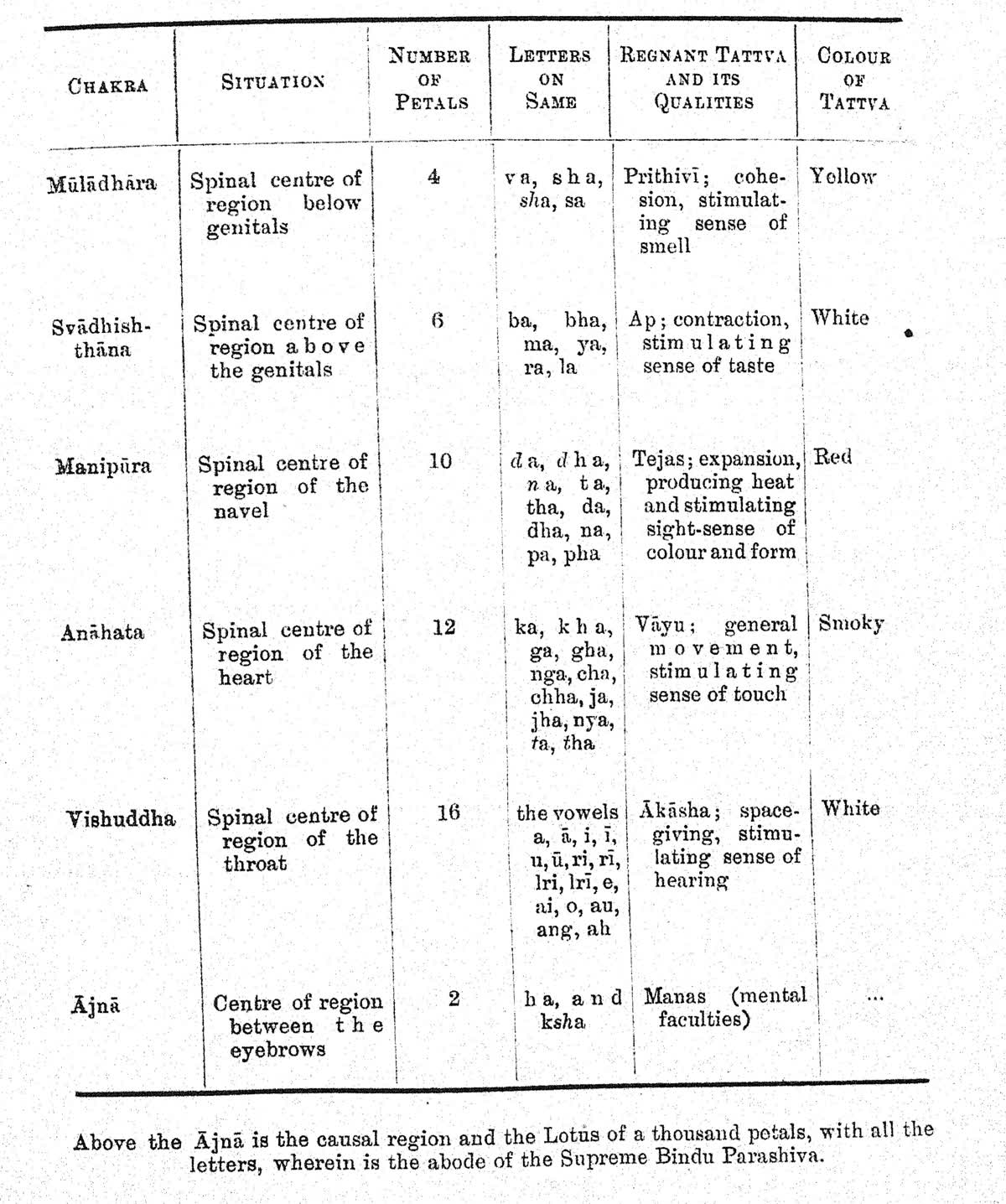
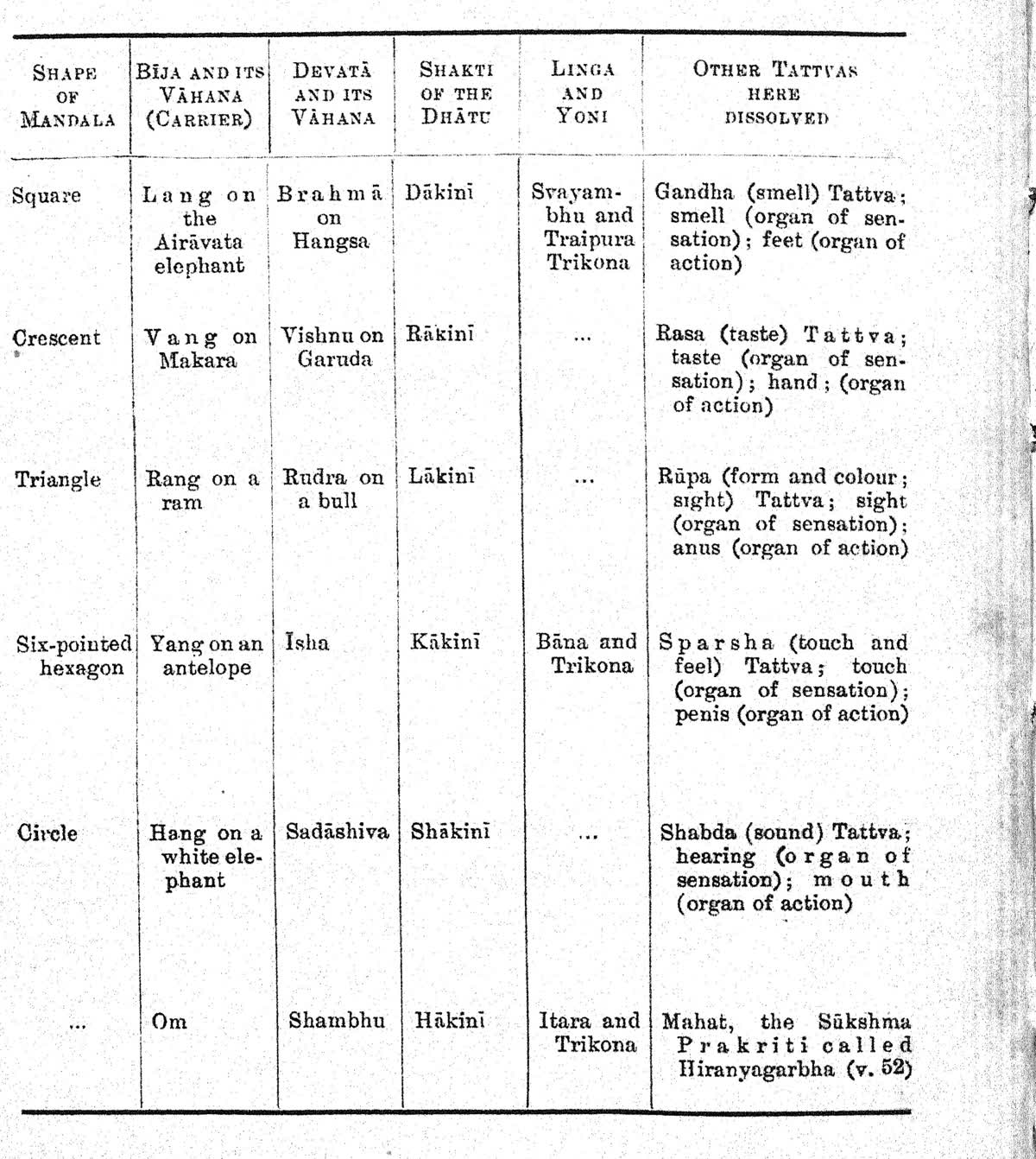
Before, however, dealing in detail with the Sahasrāra, the reader will find it convenient to refer to the tables on pp. 143 and 144, which summarises some of the details above given up to and including the Sahasrāra.
In the description of the Chakras given in this work, no mention is made of the moral and other qualities and things (Vritti) which are associated with the Lotuses in other books, such as the Adhyātmaviveka,88 commencing p. 141 with the root-lotus and ending with the Soma Chakra. Thus, the Vrittis, Prashraya, Avishvāsa, Avajnā, Mūrchhā, Sarvanāsha, Krūratā,89 are assigned to Svādhishthāna; Lajjā, Pishunatā, Īrshā, Trishnā, Sushupti, Vishāda, Kashāya, Moha, Ghrinā, Bhaya,90 to the Manipūra; Āshā, Chintā, Cheshtā, Mamatā, Dambha, Vikalatā, Ahangkāra, Viveka, Lolatā, Kapatatā, Vitarka, Anutāpa,91 Kripā, Mridutā, Dhairyya, Vairāgya, Dhriti, Sampat, Hāsya, Romāncha, Vinaya, Dhyāna, Susthiratā, Gāmbhīryya, Udyama, Akshobha, Audārya, Ekāgratā,92 to the secret Somachakra; and so forth. In the Mūlādhāra, which has been described as the “source of a massive pleasurable æsthesia,” there are the four forms of bliss already mentioned; in the Vishuddha the seven subtle “tones,” Nishāda, Rishabha, Gāndhāra, Shadja, Madhyama, Dhaivata, Panchama; certain Bījas, Hung, Phat, Vaushat, Vashat, Svadhā, Svāhā, Namah; in the eighth petal “venom,” and in the sixteenth “nectar”;93 and in the petals and pericarp of the Ājnā the three Gunas, and in the former the Bījas Hang and Kshang; and in the six-petalled Manas Chakra above the Ājnā are Shabdajnāna, Sparshajnāna, Rūpajnāna, Āghrānopalabdhi, Rasopabhoga, and Svapna, with their opposites, denoting the sensations p. 142 of the sensorium—hearing, touch, sight, smell, taste, and centrally initiated sensations in dream and hallucination. It is stated that particular Vrittis are assigned to a particular lotus, because of a connection between such Vritti and the operation of the Shaktis of the Tattva at the centre to which it is assigned. That they exist at any particular Chakra is said to be shown by their disappearance when Kundalī ascends through the Chakra. Thus the bad Vritti of the lower Chakras pass away in the Yogī who raises Kundalī above them.
- 88 Quoted in the Dīpikā to v. 7 of the Hangsopanishad. p. 140
- 89 Credulity, suspicion, disdain, delusion (or disinclination), false knowledge (lit., destruction of everything which false knowledge leads to), pitilessness. p. 141
- 90 Shame, treachery, jealousy, desire, supineness, sadness, worldliness, ignorance, aversion (or disgust), fear. p. 141
- 91 Hope, care or anxiety, endeavour, mineness (resulting in attachment), arrogance or hypocrisy, sense of languor, egoism or self-conceit, discrimination, covetousness, duplicity, indecision, regret. p. 141
- 92 Mercy, gentleness, patience or composure, dispassion, constancy, prosperity (spiritual) cheerfulness, rapture or thrill, humility or sense of propriety, meditativeness, quietude or restfulness, gravity (of demeanour), enterprise or effort, emotionlessness (being undisturbed by emotion), magnanimity, concentration. p. 141
- 93 Both were extracted at the churning of the ocean, and, as so spoken of, represent the destructive and upbuilding forces of the world. p. 141
Moral qualities (Vritti) appear in some of the lower Chakras and in the secret twelve-petalled lotus called the Lalanā (and in some Tantras Kalā) Chakra, situate above the Vishuddha, at the root of the palate (Tālumūla), as also in the sixteen-petalled lotus above the Manas Chakra, and known as the Soma Chakra. It is noteworthy that the Vritti of the two lower Chakras (Svādhishthāna and Manipūra) are all bad; those of the Anāhata centre are mixed,94 those of the Lalanā Chakra are predominantly good, and those of the Somachakra wholly so; thus indicative of an advance as we proceed from the lower to the higher centres, and this must be so as the Jīva approaches or lives in his higher principles. In the twelve-petalled white lotus in the pericarp of the Sahasrāra is the abode of Shakti, called the Kāmakalā, already described.
- 94 E.g., with Dambha (arrogance), Lolatā (covetousness), Kapatatā (duplicity), we find Āshā (hope), Cheshtā (endeavour), Viveka (discrimination). p. 142
Between Ājnā and Sahasrāra, at the seat of the Kārana Sharīra of Jīva, are the Varnāvalirūpā Viloma Shaktis, descending from Unmanī to Bindu. Just as in the Īshvara or cosmic creation there are seven creative Shaktis from Sakala Parameshvara to Bindu; and in the microcosmic or Jīva creation seven creative Shaktis from
〈The table on p. 143 as printed: each Chakra with its situation, number of petals, letters, regnant Tattva and colour; its words follow as text〉
Chakra | Situation | Number of Petals | Letters on Same | Regnant Tattva and its Qualities | Colour of Tattva
Mūlādhāra | Spinal centre of region below genitals | 4 | va, sha, sha, sa | Prithivī; cohesion, stimulating sense of smell | Yellow
Svādhishthāna | Spinal centre of region above the genitals | 6 | ba, bha, ma, ya, ra, la | Ap; contraction, stimulating sense of taste | White
Manipūra | Spinal centre of region of the navel | 10 | da, dha, na, ta, tha, da, dha, na, pa, pha | Tejas; expansion, producing heat and stimulating sight-sense of colour and form | Red
Anāhata | Spinal centre of region of the heart | 12 | ka, kha, ga, gha, nga, cha, chha, ja, jha, nya, ta, tha | Vāyu; general movement, stimulating sense of touch | Smoky
Vishuddha | Spinal centre of region of the throat | 16 | the vowels a, ā, i, ī, u, ū, ri, rī, lri, lrī, e, ai, o, au, ang, ah | Ākāsha; space-giving, stimulating sense of hearing | White
Ājnā | Centre of region between the eyebrows | 2 | ha, and ksha | Manas (mental faculties) | ...
Above the Ājnā is the causal region and the Lotus of a thousand petals, with all the letters, wherein is the abode of the Supreme Bindu Parashiva.
〈The table on p. 144 as printed, continued from p. 143: each Chakra's Mandala, Bīja, Devatā, Shakti, Linga and the Tattvas dissolved there; its words follow as text〉
Shape of Mandala | Bīja and its Vāhana (Carrier) | Devatā and its Vāhana | Shakti of the Dhātu | Linga and Yoni | Other Tattvas here dissolved
Square | Lang on the Airāvata elephant | Brahmā on Hangsa | Dākinī | Svayambhu and Traipura Trikona | Gandha (smell) Tattva; smell (organ of sensation); feet (organ of action)
Crescent | Vang on Makara | Vishnu on Garuda | Rākinī | ... | Rasa (taste) Tattva; taste (organ of sensation); hand; (organ of action)
Triangle | Rang on a ram | Rudra on a bull | Lākinī | ... | Rūpa (form and colour; sight) Tattva; sight (organ of sensation); anus (organ of action)
Six-pointed hexagon | Yang on an antelope | Īsha | Kākinī | Bāna and Trikona | Sparsha (touch and feel) Tattva; touch (organ of sensation); penis (organ of action)
Circle | Hang on a white elephant | Sadāshiva | Shākinī | ... | Shabda (sound) Tattva; hearing (organ of sensation); mouth (organ of action)
... | Om | Shambhu | Hākinī | Itara and Trikona | Mahat, the Sūkshma Prakriti called Hiranyagarbha (v. 52)
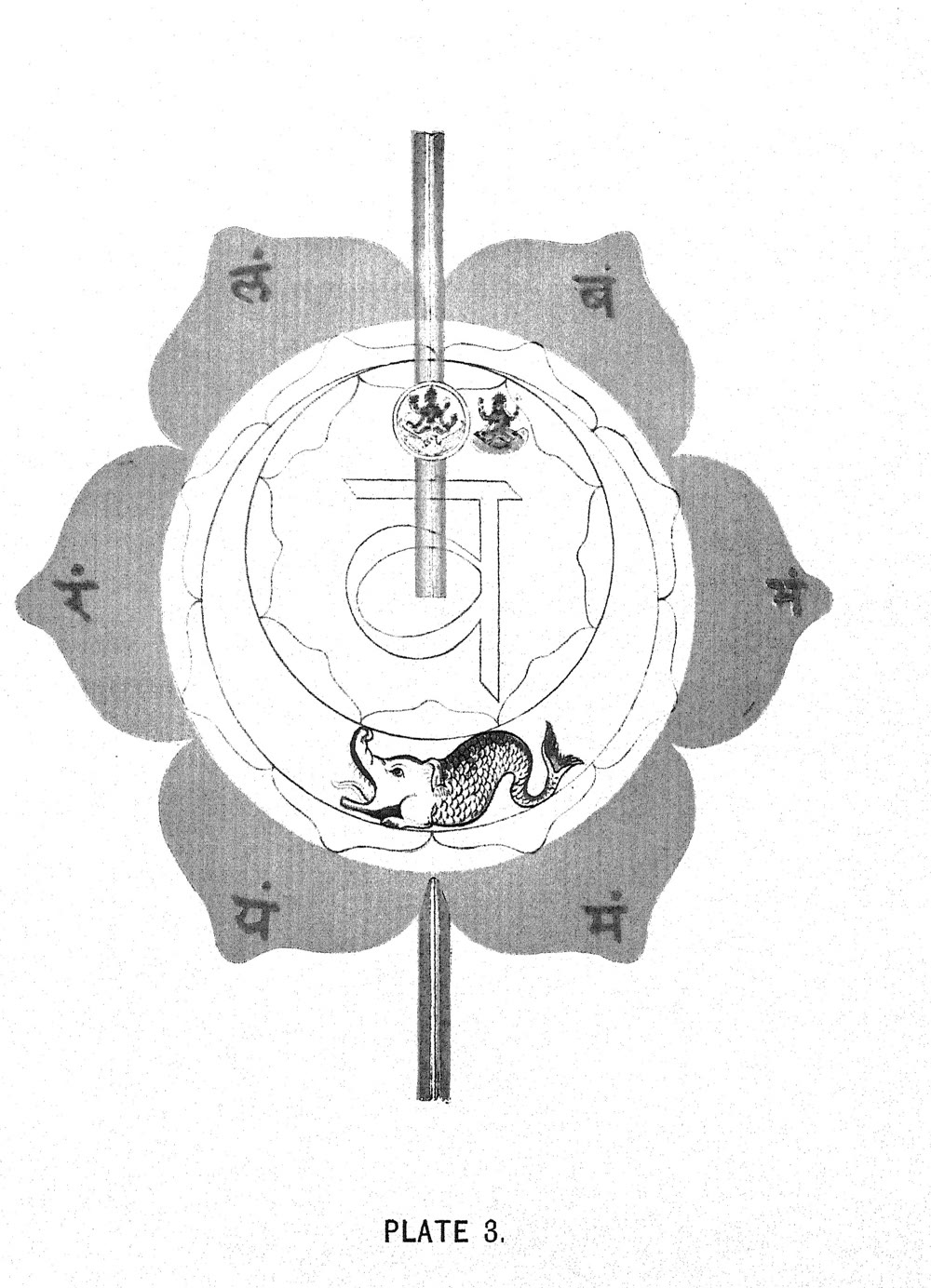
〈Plate III: a lotus drawn with its letters, its seed-mantra and its animal; the List of Illustrations (p. xv) names it Manipūraka〉 PLATE 3.
Kundalinī, who is in the Mūlādhāra, to Bindu, both of which belong to what is called the Anuloma order:95 so in the region between the Ājnā Chakra and Sahasrāra, which is the seat of the causal body (Kārana Sharīra) of Jīva, there are seven Shaktis,96 which, commencing with the lowest, are Bindu (which is in Īshvara Tattva), Bodhinī, Nāda, Mahānāda or Nādānta (in Sadākhya Tattva), Vyāpikā, Samanī (in Shakti Tattva), and Unmanī (in Shiva Tattva). Though these latter Shaktis have a cosmic creative aspect, they are not here co-extensive with and present a different aspect from the latter. They are not co-extensive, because the last-mentioned Shaktis are, as here mentioned, Shaktis of the Jīva. Hangsa, Jīva or Kundalī is but an infinitesimal part of the Parabindu. The latter is in the Sahasrāra, or thousand-petalled lotus, the abode of Īshvara, who is Shiva-Shakti and is the seat of the aggregate Kundalī or Jīva. And hence it is said that all the letters are here twentyfold (50×20=1,000). In the Sahasrāra are Parabindu, the supreme Nirvāna Shakti, Nirvāna Kalā, Amākalā,97 and the fire of Nibodhikā. In the Parabindu is the empty void (Shūnya) which is the supreme Nirguna Shiva.
- 95 That is, the ordinary as opposed to the reversed (viloma) order. Thus, to read the alphabet as A to Z is anuloma; to read it backwards, Z to A, is viloma. In the above matter, therefore anuloma is creation (srishti) or the forward movement, and viloma (nivritti) the path of return. p. 145
- 96 See my Garland of Letters or “Studies in Mantra Shāstra”: “Causal Shaktis of the Pranava.” p. 145
- 97 See my Garland of Letters or “Studies in Mantra Shāstra”: “Kalās of the Shaktis.” p. 145
Another difference is to be found in the aspect of the Shaktis. Whilst the cosmic creative Shaktis are looking outwards and forwards (Unmukhī), the Shaktis above the Ājnā are, in Yoga, looking backwards towards dissolution. The Īshvara of the Sahasrāra is not then the creative p. 146 aspect of Īshvara. There He is in the Nirvāna mood, and the Shaktis leading up to Nirvāna Shakti are “upward moving”—that is, liberating Shaktis of the Jīva.
These seven states or aspects of Bindumayaparashakti (S. N., v. 40) leading up to Unmanī, which are described in this and other Tantrik books, are called causal forms (Kāranarūpa). The commentary to the Lalitā98 apparently enumerates eight, but this seems to be due to a mistake, Shakti and Vyāpikā being regarded as distinct Shaktis instead of differing names for the third of this series of Shaktis.
- 98 V. 121, Lalitā-Sahasranāma. p. 146
Below Visarga (which is the upper part of the Brahmarandhra, in the situation of the fontenelle) and the exit of Shangkhinī Nādī is the Supreme White (or, as some call it, variegated) Lotus of a thousand petals (S.N., vv. 40—49), known as the Sahasrāra, on which are all the letters of the Sanskrit alphabet, omitting according to some the Vaidik Lakāra, and according to others Ksha. These are repeated twenty times to make the 1,000, and are read from beginning to end (Anuloma), going round the Lotus from right to left. Here is Mahāvāyu and the Chandramandala, in which is the Supreme Bindu (O), “which is served in secret by all the Devas”. Bindu as such implies Guna, but it also means the void of space, and in its application to the Supreme Light, which is formless, is symbolical of its decaylessness. This subtle Shūnya (Void), which is the Ātmā of all being (Sarvvātmā), is spoken of in S.N., vv. 42—49. Here in the region of the Supreme Lotus is the Guru, the Supreme Shiva Himself. Hence the Shaivas call it Shivasthāna, free of all illusion, and the abode of bliss where the Ātmā is realised. Here, too, is the Supreme Nirvāna Shakti, the Shakti in the Parabindu, and the Mother of all the three worlds. He who has truly and fully known the Sahasrāra is not reborn in p. 147 the Sangsāra, for he has by such knowledge broken all the bonds which held him to it. His earthly stay is limited to the working out of the Karma already commenced and not exhausted. He is the possessor of all Siddhi, is liberated though living (Jīvanmukta), and attains bodiless liberation (Moksha), or Videha Kaivalya, on the dissolution of his physical body.
In the fourteenth verse and commentary thereon of the Ānandalaharī the Deity in the Sahasrāra is described.99
- 99 See Pandit R. Ananta Shāstrī’s Ānandalaharī, p. 42 et seq. The passage within quotation marks is taken from that work.
See “Wave of Bliss,” by A. Avalon. p. 147
“She is above all the Tattvas. Every one of the six centres represents a Tattva. Every Tattva has a definite number of rays. The six centres, or Chakras, are divided into three groups. Each of these groups has a knot or apex where converge the Chakras that constitute that group. The names of the groups are derived from those of the Presiding Deities. The following table clearly puts the above:
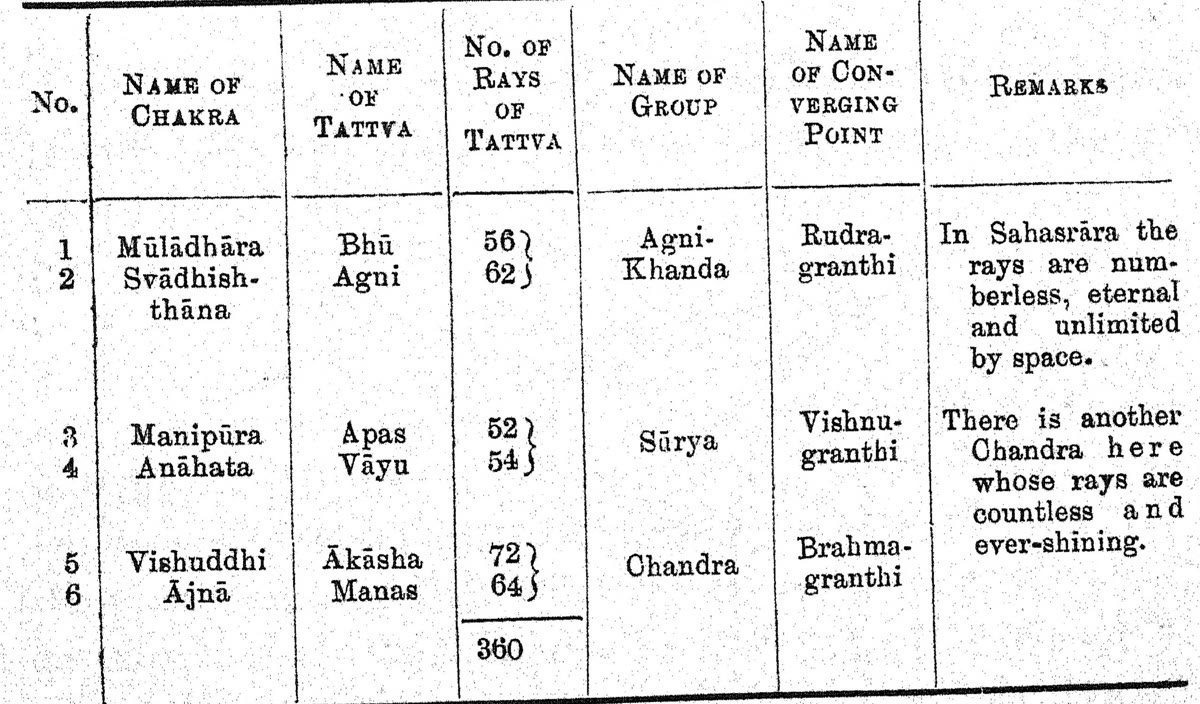
〈The table on p. 147 as printed: the Chakras' Tattvas, their rays, groups and converging points; its words follow as text〉
No. | Name of Chakra | Name of Tattva | No. of Rays of Tattva | Name of Group | Name of Converging Point | Remarks
1, 2 | Mūlādhāra, Svādhishthāna | Bhū, Agni | 56, 62 | Agni-Khanda | Rudra-granthi | In Sahasrāra the rays are numberless, eternal and unlimited by space.
3, 4 | Manipūra, Anāhata | Apas, Vāyu | 52, 54 | Sūrya | Vishnu-granthi | There is another Chandra here whose rays are countless and ever-shining.
5, 6 | Vishuddhi, Ājnā | Ākāsha, Manas | 72, 64 | Chandra | Brahma-granthi |
| | | 360 | | |
“Lakshmīdhara quotes the Taittirīyāranyaka in support of his commentary, from which we have taken the notes above given. The extracts which he makes from ‘Bhairava Yāmala’ are very valuable. In discoursing about Chandra, Shiva addresses (vv. 1—17, Chandrajnānavidyāprakarana) Pārvati, his consort, thus:
“‘Welcome, O Beauty of the three worlds, welcome is Thy question. This knowledge (which I am about to disclose) is the secret of secrets, and I have not imparted it to anyone till now. (But I shall now tell thee the grand secret. Listen, then, with attention’:)
“‘Shrīchakra (in the Sahasrāra) is the form of Parāshakti. In the middle of this Chakra is a place called Baindava, where she, who is above all Tattvas, rests united with Her Lord Sadāshiva. O Supreme One, the whole Cosmos is a Shrīchakra formed of the twenty-five Tattvas—5 elements+5 Tanmātras+10 Indriyas+Mind+Māyā, Shuddhavidyā, Mahesha, and Sadāshiva.100 Just as it is in Sahasrāra, so cosmically, also, Baindava is above all Tattvas. Devī, the cause of the creation, protection, and destruction, of the universe, rests there ever united with Sadāshiva, who as well is above all Tattvas and ever-shining. Uncountable are the rays that issue forth from Her body; O good one, they emanate in thousands, lacs—nay, crores. But for this light there would be no light at all in the universe ... 360 of these rays illumine the world in the form of Fire, Sun, and Moon. These 360 rays are made up as follows: Agni (Fire) 118, Sun 106, Moon 136. O Shankari, these three luminaries enlighten the macrocosm as well as the microcosm, and give rise to the calculation of time—the Sun for the day, the Moon for the p. 149 night, Agni (Fire) occupying a mean position between the two.’101
“Hence they constitute (or are called) Kāla (time), and the 360 days (rays) make a year. The Veda says: ‘The year itself is a form of the Lord. The Lord of time, the Maker of the world, first created Marīchi (rays), etc., the Munis, the protectors of the world. Everything has come to exist by the command of Parameshvarī.’
“Dindima takes a quite different view of this verse. He interprets it as meaning that, having already described the Antaryāga (inner worship), the author recommends here the worship of the Āvarana Devatās—i.e., Deities residing in each of the Chakras or centres—without propitiating whom it is impossible for the practitioner to lead the Kundalinī through these Chakras. He enumerates all the 360 Deities and describes the mode of worshipping each of them.
“There are other commentators who understand the 360 rays esoterically, and connect the same with the 360 days of the year, and also with the human body. Every commentator quotes the Taittarīyāranyaka, first chapter, to support his views. Thus it seems that Taittarīyāranyaka contains much esoteric matter for the mystic to digest. The first chapter of the Āranyaka referred to is chanted in worshipping the Sun. It is called Ārunam because it treats of Arunā (red-coloured Devī).”102
- 102 Pp. 42—45 of Pandit Ananta Shāstrī’s Ānandalaharī. p. 149
An Indian physician and Sanskritist has expressed the opinion that better anatomy is given in the Tantras than in the purely medical works of the Hindus.103 It is easier, however, to give a statement of the present and ancient p. 150 physiology than to correlate them. Indeed, this is for the present a difficult matter. In the first place, the material as regards the latter is insufficiently available and known to us, and those native scholars and Sādhakas (nowadays, probably, not numerous) who are acquainted with the subject are not conversant with Western physiology, with which it is to be compared. It is, further, possible to be practically acquainted with this Yoga without knowing its physiological relations, a knowledge of which is not so important as is sometimes supposed. Working in what is an unexplored field, I can only here put forward, on the lines of the Text and such information as I have gathered, explanations and suggestions which must in some cases be of a tentative character, in the hope that they may be followed up and tested by others.
- 103 Dr. B. D. Basu, of the Indian Medical Service, in his Prize Essay on the Hindu System of Medicine, published in the Guy’s Hospital Gazette (1889), cited in Vol. XVI, “Sacred Books of the Hindus,” by Professor Benoy Kumar Sarkar. p. 149
It is clear that the Merudanda is the vertebral column, which as the axis of the body is supposed to bear the same relation to it as does Mount Meru to the earth. It extends from the Mūla (root) or Mūlādhāra to the neck. It and the connected upper tracts, spinal bulb, cerebellum, and the like, contain what has been described as the central system of spinal nerves (Nādī) and cranial nerves (Shiro-nādī). The Sushumnā, which is undoubtedly a Nādī within the vertebral column, and as such is well described by the books as the principal of all the Nādīs, runs along the length of the Merudanda, as does the spinal cord of Western physiology, if we include therewith the filum terminale. If we include the filum, and take the Kanda to be between the anus and penis, it starts from practically the same (sacro-coccygeal) region, the Mūlādhāra, and is spoken of as extending to the region of the Brahmarandhra,104 or to a point below the p. 151 twelve-petalled lotus (v. 1)—that is, at a spot below but close to the Sahasrāra, or cerebellum, where the nerve Chitrinī also ends. The position of the Kanda is that stated in this work (v. 1). It is to be noted, however, that according to the Hathayogapradīpikā the Kanda is higher up, between the penis and the navel.105 The place of the union of Sushumnā and Kanda is known as the “Knot” (Granthisthāna), and the petals of the Mūla lotus are on four sides of this (v. 4). It is in this Sushummā (whatever for the moment we take it to be) that there are the centres of Prāna Shakti which are called Chakras or Lotuses. The spinal cord ends blindly in the filum terminale, and is apparently closed there. The Sushumnā is said to be closed at its base, called the “gate of Brahman” (Brahmadvāra), until, by Yoga, Kundalī makes its way through it. The highest of the six centres called Chakra in the Sushumnā is the Ājnā, a position which corresponds frontally with the space between the eyebrows (Bhrūmadhya), and at the back with the pineal gland, the pituitary body, and the top of the cerebellum. Close by it is the Chakra called Lalanā, and in some Tantras Kalā Chakra, which is situate at the root of—that is, just above—the palate (Tālumūla). Its position as well as the nature of the Ājnā would indicate that it is slightly below the latter.106 The Sushumnā passes into the ventricles of the brain, as does the spinal cord, which enters the fourth ventricle.
- 104 Sammohana Tantra, II, 7, or, according to the Tripurāsārasamuchchaya, cited in v. 1, from the head to the Ādhāra. p. 150
- 105 V. post. p. 151
- 106 And not, as I wrote in the Introduction to the Mahānirvāna Tantra, p. lxii, above it. On further consideration, I think the position as stated in the text is correct, though in any case the two are very close together. p. 151
Above the Lalanā are the Ājnā Chakra with its two lobes and the Manas Chakra with its six lobes, which it has been suggested are represented in the physical body p. 152 by the Cerebellum and Sensorium respectively. The Soma Chakra above this, with its sixteen “petals,” has been said to comprise the centres in the middle of the Cerebrum above the Sensorium. Lastly, the thousand-petalled lotus Sahasrāra corresponds to the upper Cerebrum of the physical body, with its cortical convolutions, which will be suggested to the reader on an examination of the Plate VIII, here given of that centre. Just as all powers exist in the seat of voluntary action, so it is said that all the fifty “letters” which are distributed throughout the spinal centres of the Sushumnā exist here in multiplied form—that is, 50×20. The nectar-rayed moon107 is possibly the under part of the brain, the convolutions or lobes of which, resembling half-moons, are called Chandrakalā, and the mystic mount Kailāsa is undoubtedly the upper brain. The ventricle connected with the spinal cord is also semilunar in shape.
- 107 See Shiva-Sanghitā, II, 6. p. 152
As above stated, there is no doubt that the Sushumnā is situated in the spinal column, and it has been said that it represents the central canal. It is probable that its general position is that of the central canal. But a query may be raised if it is meant that the canal alone is the Sushumnā. For the latter Nādī, according to this work, contains within it two others—namely, Vajrinī and Chitrinī. There is thus a threefold division. It has been suggested that the Sushumnā when not considered with its inner Nādīs as a collective unit, but as distinguished from them, is the white nervous matter of the spinal cord, Vajrinī the grey matter, and Chitrinī the central canal, the inner Nādī of which is known as the Brahmanādī, and, in the Shivasanghitā, Brahmarandhra.108 But as against such suggestion it is to be noted that v. 2 of this work describes Chitrinī p. 153 as being as fine as a spider’s thread (Lūtā-tantūpameyā), and the grey matter cannot be so described, but is a gross thing. We must therefore discard this suggestion, and hold to the opinion either that the central canal is the Sushumnā or that the latter is in the canal, and that within or part of it are two still more subtle and imperceptible channels of energy, called Vajrinī and Chitrinī. I incline to the latter view. The true nature of the Chitrinī Nādī is said in v. 3 to be pure intelligence (Shuddha-bodhasvabhāvā) as a force of Consciousness. As v. 1 says, the three form one, but considered separately they are distinct. They are threefold in the sense that Sushumnā, “who is tremulous like a woman in passion,” is as a whole composed of “Sun,” “Moon,” and “Fire,” and the three Gunas. It is noteworthy in this connection that the Kshurikā Upanishad,109 which speaks of the Sushumnā, directs the Sādhaka “to get into the white and very subtle Nādī, and to drive Prānavāyu through it”. These three, Sushumnā, Vajrinī, and Chitrinī, and the central canal, or Brahmanādī, through which, in the Yoga here described, Kundalinī passes, are all, in any case, part of the spinal cord. And, as the Shivasanghitā and all other Yoga works say, the rest of the body is dependent on Sushumnā, as being the chief spinal representative of the central nervous system. There seems also to be some ground to hold that the Nādīs, Idā and Pinggalā, or “moon” and “sun,” are the left and right sympathetic cords respectively on each side of the “fiery” Sushumnā. It is to be noted that, according to one and a common notion reproduced in this work, these Nādīs, p. 154 which are described as being pale and ruddy respectively (v. 1), do not lie merely on one side of the cord, but cross it alternating from one side to the other (see v. 1), thus forming with the Sushumnā and the two petals of the Ājnā Chakra the figure of the Caduceus of Mercury, which according to some represents them. Elsewhere (v. 1), however, it is said that they are shaped like bows. That is, one is united with Sushumnā and connected with the left scrotum. It goes up to a position near the left shoulder, bending as it passes the heart, crosses over to the right shoulder, and then proceeds to the right nostril. Similarly, the other Nādī connected with the right scrotum passes to the left nostril. It has been suggested to me that Idā and Pinggalā are blood-vessels representing the inferior Vena Cava and Aorta. But the works and the Yoga process itself indicate not arteries, but nerves. Idā and Pinggalā when they reach the space between the eyebrows make with the Sushumnā a plaited threefold knot called Trivenī, and proceed to the nostrils. This, it has been said, is the spot in the medulla where the sympathetic cords join together or whence they take their origin.
There remains to be considered the position of the Chakras. Though this work speaks of six, there are, according to some, others. This is stated by Vishvanātha in his Shatchakra-Vivriti. Thus we have mentioned Lalanā, Manas, and Soma Chakras. The six here given are the principal ones. Indeed, a very long list exists of Chakras or Ādhāras, as some call them. In a modern Sanskrit work called “Advaitamārtanda” the author110 gives twenty, numbering them as follows: (1) Ādhāra, (2) Kuladīpa, (3) Vajra or Yajna, (4) Svādhishthāna, (5) Raudra, p. 155 (6) Karāla, (7) Gahvara, (8) Vidyāprada, (9) Trimukha, (10) Tripada, (11) Kāladandaka, (12) Ukāra, (13) Kāladvāra, (14) Karangaka, (15) Dīpaka, (16) Ānandalalitā, (17) Manipūraka, (18) Nākula, (19) Kālabhedana, (20) Mahotsāha. Then for no apparent reason, many others are given without numbers, a circumstance, as well as defective printing, which makes it difficult in some cases to say whether the Sanskrit should be read as one word or two.111 They are apparently Parama, Pādukam, Padam (or Pādakampadam), Kalpajāla, Poshaka, Lolama, Nādāvarta, Triputa, Kangkālaka, Putabhedana, Mahāgranthivirākā, Bandhajvalana (printed as Bandhejvalana), Anāhata, Yantraputa (printed Yatra), Vyomachakra, Bodhana, Dhruva, Kalākandalaka, Kraunchabherundavibhava, Dāmara, Kulapīthaka, Kulakolāhala, Hālāvarta, Mahadbhaya, Ghorābhairava, Vishuddhi, Kantham, Uttamam (quære Vishuddhikantham or Kanthamuttamam), Pūrnakam, Ājnā, Kākaputtam, Shringātam, Kāmarūpa, Pūrnagiri, Mahāvyoma, Shaktirūpa. But, as the author says, in the Vedas (that is, Yogachūdāmanī, Yogashikhā Upanishads, and others) we read of only six Chakras—namely, those italicised in the above list, and described in the works here translated—and so it is said: “How can there be any Siddhi for him who knows not the six Chakras, the sixteen Ādhāras, the five Ethers, and three Lakshas, in his own body?”
- 110 Brahmānanda Svāmī, a native of Palghat, in the Madras Presidency, late Guru of H.H. the Mahārāja of Kashmir. The work is printed at Jummoo. p. 154
- 111 I am not sure that the author himself was aware of this in all cases. He may have been quoting himself from some lists without other knowledge on the subject. The list has, to my eyes, in some respects an uncritical aspect—e.g., apart from bracketed notes in the text, Kāmarūpa and Pūrnagiri are Pīthas, the others, Jālandhara and Auddīyāna, not being mentioned. The last quotation he makes draws a distinction between the Chakras and Ādhāras. p. 155
I have already pointed out that the positions of the Chakras generally correspond to spinal centres of the anatomical divisions of the vertebræ into five regions, and it has been stated that the Padmas or Chakras correspond with p. 156 various plexuses which exist in the body surrounding those regions. Various suggestions have been here made. The Author of a recent work112 identifies (commencing with the Mūlādhāra and going upwards) the Chakras with the sacral, prostatic, epigastric, cardiac, laryngeal (or pharyngeal), and cavernous plexuses, and the Sahasrāra with the Medulla. In passing it may be noted that the last suggestion cannot in any event be correct. It is apparently based on verse 120 of chapter v. of the Shiva Sanghitā.113 But this work does not in my opinion support the suggestion. Elsewhere the Author cited rightly identifies Mount Kailāsa with the Sahasrāra, which is undoubtedly the upper cerebrum. The anatomical position of the Medulla is below that assigned to the Ājnā Chakra. Professor Sarkar’s work contains some valuable appendices by Dr. Brojendranath Seal on, amongst others, Hindu ideas concerning plant and animal life, physiology, and biology, including accounts of the nervous system in Charaka and in the Tantras.114 After pointing out that the cerebro-spinal axis with the connected sympathetic system contains a number of ganglionic p. 157 centres and plexuses (Chakras, Padmas), from which nerves (Nādī, Shirā, and Dhamanī) radiate over the head, trunk, and limbs, the latter says, as regards the ganglionic centres and plexuses constituting the sympathetic spinal system:
- 112 “The Positive Background of Hindu Sociology,” by Professor Benoy Kumar Sarkar. p. 156
- 113 P. 54 of the translation of Srīsha Chandra Vasu, to which I refer because the author cited does so. The rendering, however, does not do justice to the text, and liberties have been taken with it. Thus, a large portion has been omitted without word or warning, and at p. 14 it is said that Kundalinī is “of the form of electricity”. There is no warrant for this in the text, and Kundalinī is not, according to the Shāstra, mere electricity.
I cannot too strongly protest against attempts to represent Indian Shāstra, not as it actually is, but what some who are concerned with it would like it to be. State accurately what is in the Shāstra, and then disapprove of it if you will. p. 156 - 114 Both the work of Professor Sarkar and the Appendices of Dr. Seal are of interest and value, and gather together a considerable number of facts of importance on Indian Geography, Ethnology, Mineralogy, Zoology, Botany, and Hindu Physiology, Mechanics, and Acoustics. These Appendices have since been republished separately as a work entitled “Positive Sciences of the Hindus”. p. 156
“Beginning with the lower extremity, the centres and plexuses of the connected spinal and sympathetic systems may be described as follows:
“(1) The Ādhāra Chakra, the sacro-coccygeal plexus, with four branches, nine Angulis (about six inches and a half) below the solar plexus (Kanda, Brahmagranthi); the source of a massive pleasurable æsthesia; voluminous organic sensations of repose. An inch and a half above it, and the same distance below the membrum virile (Mehana), is a minor centre called the Agni-sikhā. (2) The Svādhishthāna Chakra, the sacral plexus, with six branches (Dalāni—petals) concerned in the excitation of sexual feelings, with the accompaniments of lassitude, stupor, cruelty, suspicion, contempt.115 (3) The Nābhikanda (corresponding to the solar plexus, Bhānubhavanam), which forms the great junction of the right and left sympathetic chains (Pinggalā and Idā) with the cerebro-spinal axis. Connected with this is the Manipūraka, the lumbar plexus, with connected sympathetic nerves, the ten branches116 of which are concerned in the production of sleep and thirst, and the expressions of passions like jealousy, shame, fear, stupefaction. (4) The Anāhata Chakra, possibly the cardiac plexus of the sympathetic chain, with twelve branches, connected with the heart, the seat of the egoistic sentiments, hope, anxiety, doubt, remorse, conceit, egoism, etc. (5) The Bhāratīsthāna,117 p. 158 the junction of the spinal cord with the medulla oblongata, which, by means of nerves like the pneumogastric, etc., regulate the larynx and other organs of articulation. (6) The Lalanā Chakra, opposite the uvula, which has twelve leaves (or lobes), supposed to be the tract affected in the production of ego-altruistic sentiments and affections, like self-regard, pride, affection, grief, regret, respect, reverence, contentment, etc. (7) The sensori-motor tract, comprising two Chakras: (a) the Ājnā Chakra (lit., the circle of command over movements) with its two lobes (the cerebellum); and (b) the Manas Chakra, the sensorium, with its six lobes (five special sensory for peripherally initiated sensations, and one common sensory for centrally initiated sensations, as in dreams and hallucinations). The Ājnā-vahā Nādīs, efferent or motor nerves, communicate motor impulses to the periphery from this Ājnā Chakra, this centre of command over movements; and the afferent or sensory nerves of the special senses, in pairs, the Gandhavahā Nādī (olfactory sensory), the Rūpavahā Nādī (optic), the Shabdavahā Nādī (auditory), the Rasavahā Nādī (gustatory), and the Sparshavahā Nādī (tactile), come from the periphery (the peripheral organs of the special senses) to this Manaschakra, the sensory tract at the base of the brain. The Manaschakra also receives the Manovahā Nādī, a generic name for the channels along which centrally initiated presentations (as in dreaming or hallucination) come to the sixth lobe of the Manaschakra. (8) The Somachakra, a sixteen-lobed ganglion, comprising the centres in the middle of the cerebrum, above the sensorium; the seat of the altruistic sentiments and volitional control—e.g., compassion, gentleness, patience, renunciation, meditativeness, gravity, earnestness, resolution, determination, magnanimity, etc. And lastly p. 159 (9) the Sahasrāra Chakra, thousand-lobed, the upper cerebrum with its lobes and convolutions, the special and highest seat of the Jīva, the soul.”118
- 115 These and other Vritti, as they are called, are enumerated in the Introduction to my first edition of the Mahānirvāna Tantra. p. 157
- 116 That is, petals. p. 157
- 117 This is a name for the Vishuddha Chakra as abode of the Goddess of Speech (Bhāratī). p. 157
- 118 The author cited refers to the Jnāna Sangkalinī Tantra, Sanghitāratnākara, and for functions of Ājnā-vahā Nādī and Manovahā Nādī to Shangkara Mishra’s Upaskāra. p. 159
Then, dealing with the cerebro-spinal axis and the heart, and their respective relations to the conscious life, the Author cited says:
“Vijnānabhikshu, in the passage just quoted, identifies the Manovahā Nādī (vehicle of consciousness) with the cerebro-spinal axis and its ramifications, and compares the figure to an inverted gourd with a thousand-branched stem hanging down. The Sushumnā, the central passage of the spinal cord, is the stem of this gourd (or a single branch). The writers on the Yoga (including the authors of the various Tantrik systems) use the term somewhat differently. On this view, the Manovahā Nādī is the channel of the communication of the Jīva (soul) with the Manaschakra (sensorium) at the base of the brain. The sensory currents are brought to the sensory ganglia along afferent nerves of the special senses. But this is not sufficient for them to rise to the level of discriminative consciousness. A communication must now be established between the Jīva (in the Sahasrāra Chakra, upper cerebrum) and the sensory currents received at the sensorium, and this is done by means of the Manovahā Nādī. When sensations are centrally initiated, as in dreams and hallucinations, a special Nādī (Svapnavahā Nādī), which appears to be only a branch of the Manovahā Nādī, serves as the channel of communication from the Jīva (soul) to the sensorium. In the same way, the Ājnāvahā Nādī brings down the messages of the Soul from the Sahasrāra (upper cerebrum) to the Ājnā p. 160 Chakra (motor tract at the base of the brain), messages which are thence carried farther down, along efferent nerves, to various parts of the periphery. I may add that the special sensory nerves, together with the Manovahā Nādī, are sometimes generally termed Jnānavahā Nādī—lit., channel of presentative knowledge. There is no difficulty so far. The Manovahā Nādī and the Ājnāvahā Nādī connect the sensori-motor tract at the base of the brain (Manas Chakra and Ājnā Chakra) with the highest (and special) seat of the soul (Jīva) in the upper cerebrum (Sahasrāra), the one being the channel for carrying up the sensory, and the other for bringing down the motor messages. But efforts of the will (Ājnā, Prayatna) are conscious presentations, and the Manovahā Nādī must therefore co-operate with the Ājnāvahā in producing the consciousness of effort. Indeed, attention, the characteristic function of Manas, by which it raises sense-presentations to the level of discriminative consciousness, implies effort (Prayatna) on the part of the soul (Ātmā, Jīva), an effort of which we are conscious through the channel of the Manovahā Nādī. But how to explain the presentation of effort in the motor nerves? Shangkara Mishra, the author of the Upaskāra on Kanāda’s Sūtras, argues that the Nādīs (even the volitional or motor nerves) are themselves sensitive, and their affections are conveyed to the sensorium by means of the nerves of the (inner) sense of touch (which are interspersed in minute fibrillæ among them). The consciousness of effort, then, in any motor nerve, whether Ājnāvahā (volitional motor) or Prānavahā (automatic motor), depends on the tactile nerves (or nerves of organic sensation) mixed up with it. Thus the assimilation of food and drink by the automatic activity of the Prānas implies an (automatic) effort (Prayatna) accompanied by a vague organic consciousness, which is due to p. 161 the fact that minute fibres of the inner touch-sense are interspersed with the machinery of the automatic nerves (the Prānavahā Nādīs).”
To a certain extent the localisations here made must be tentative. It must, for instance, be a matter of opinion whether the throat centre corresponds with the carotid, laryngeal, or pharyngeal, or all three; whether the navel centre corresponds with the epigastric, solar, or lumbar, the Ājnā with the cavernous plexus, pineal gland, pituitary body, cerebellum, and so forth. For all that is known to the contrary each centre may have more than one of such correspondences. All that can be said with any degree of certainty is that the four centres, above the Mūlādhāra, which is the seat of the presiding energy, have relation to the genito-excretory, digestive, cardiac, and respiratory functions, and that the two upper centres (Ājnā and Sahasrāra) denote various forms of cerebral activity, ending in the repose of pure Consciousness. The uncertainty which prevails as regards some of those matters is indicated in the Text itself, which shows that on various of the subjects here debated differing opinions have been expressed as individual constructions of statements to be found in the Tantras and other Shāstras.
There are, however, if I read them correctly, statements in the above-cited accounts with which, though not uncommonly accepted, I disagree. It is said, for instance, that the Ādhāra Chakra is the sacro-coccygeal plexus, and that the Svādhishthāna is the sacral plexus, and so forth. This work, however, not to mention others, makes it plain that the Chakras are in the Sushumnā. Verse 1 speaks of the “Lotuses inside the Meru (spinal column); and as the Sushumnā supports these (that is, the lotuses) She must needs be within the Meru”. This is said in answer to those who, on the strength of a passage in the Tantrachūdāmani, p. 162 erroneously suppose that Sushumnā is outside the Meru. In the same way the Commentator refutes the error of those who, relying on the Nigamatattvasāra, suppose that not only Sushumnā, but Idā and Pinggalā, are inside the Meru. Verse 2 says that inside Vajrā (which is itself within Sushumnā) is Chitrinī, on which the lotuses are strung as it were gems, and who like a spider’s thread pierces all the lotuses which are within the backbone. The Author in the same place combats the view, based on the Kalpa Sūtra, that the lotuses are within Chitrinī. These lotuses are in the Sushumnā; and as Chitrinī is within the latter, she pierces but does not contain them. Some confusion is raised by the statement in v. 51, that the lotuses are in or on the Brahmanādī. But by this is meant appertaining to this Nādī, for they are in Sushumnā, of which the Brahmanādī is the central channel. The commentator Vishvanātha, quoting from the Māyā Tantra, says that all the six lotuses are attached to the Chitrinī Nādī (Chitrinī-grathitam). One conclusion emerges clearly from all this—namely, that the Lotuses are in the vertebral column in Sushumnā, and not in the nerve plexuses which surround it. There in the spinal column they exist as extremely subtle vital centres of Prānashakti and centres of consciousness. In this connection I may cite an extract from an article on the “Physical Errors of Hinduism,”119 for which I am indebted to Professor Sarkar’s work: “It would indeed excite the surprise of our readers to hear that the Hindus, who would not even touch a dead body, much less dissect it, should possess any anatomical knowledge at all.... It is the Tantras that furnish us with some extraordinary pieces of information concerning the human body.... But of all the Hindu Shāstras extant, the Tantras lie in the p. 163 greatest obscurity.... The Tantrik theory, on which the well-known Yoga called ‘Shatchakrabheda’ is founded, supposes the existence of six main internal organs, called Chakras or Padmas, all bearing a special resemblance to that famous flower, the lotus. These are placed one above the other, and connected by three imaginary chains, the emblems of the Ganges, the Yamunā, and the Saraswatī.... Such is the obstinacy with which the Hindus adhere to these erroneous notions, that, even when we show them by actual dissection the non-existence of the imaginary Chakras in the human body, they will rather have recourse to excuses revolting to common sense than acknowledge the evidence of their own eyes. They say, with a shamelessness unparalleled, that these Padmas exist as long as a man lives, but disappear the moment he dies.”120 This, however, is nevertheless quite correct, for conscious and vital centres cannot exist in a body when the organism which they hold together dies. A contrary conclusion might indeed be described as “shameless” stupidity.121
- 119 Published in Vol. XI, pp. 436—440, of the Calcutta Review. p. 162
- 120 “Physical Errors of Hinduism,” Calcutta Review, Vol. XI, pp. 436—440. p. 163
- 121 This reminds one of the story of a materialistic doctor in Calcutta who said he had done hundreds of post-mortem examinations, but had never yet discovered the trace of a soul. p. 163
The Author of the work from which this citation is made says that, though these Chakras cannot be satisfactorily identified, the Tantriks must nevertheless have obtained their knowledge of them by dissection. By this he must refer to the physical regions which correspond on the gross plane to, and are governed by, the Chakras proper, which as subtle, vital, and conscious centres in the spinal cord are invisible to any but a Yogī’s vision,122 p. 164 existing when the body is alive and disappearing when vitality (Prāna) leaves the body as part of the Lingasharīra.
- 122 So it is said: Tāni vastūni tanmātrādīni pratyakshavishayāni (Such things as the Tanmātra and others are subject of immediate perception by Yogins only). A Yogī “sees” the Chakras with his mental eye (Ājnā). In the case of others they are the matter of inference (Anumāna). p. 163
It is a mistake, therefore, in my opinion, to identify the Chakras with the physical plexuses mentioned. These latter are things of the gross body, whereas the Chakras are extremely subtle vital centres of various Tāttvik operations. In a sense we can connect with these subtle centres the gross bodily parts visible to the eyes as plexuses and ganglia. But to connect or correlate and to identify are different things. Indian thought and the Sanskrit language, which is its expression, have a peculiarly penetrative and comprehensive quality which enables one to explain many ideas for which, except by paraphrase, there is no equivalent meaning in English. It is by the Power or Shakti of the Ātmā or Consciousness that the body exists. It is the collective Prāna which holds it together as an individual human unit, just as it supports the different Principles and Elements (Tattva) of which it is composed. These Tattvas, though they pervade the body, have yet various special centres of operation. These centres, as one might otherwise suppose, lie along the axis, and are the Sūkshma Rūpa, or subtle forms of that which exists in gross form (Sthūla Rūpa) in the physical body which is gathered around it. They are manifestations of Prānashakti. In other words, from an objective standpoint the subtle centres, or Chakras, vitalise and control the gross bodily tracts which are indicated by the various regions of the vertebral column and the ganglia, plexuses, nerves, arteries, and organs, situate in these respective regions. It is only therefore (if at all) in the sense of being the gross outer representatives of the spinal centres that we can connect the plexuses and so forth with the Chakras p. 165 spoken of in the Yoga books. In this sense only the whole tract, which extends from the subtle centre to the periphery, with its corresponding bodily elements, may be regarded as the Chakra. As the gross and subtle are thus connected, mental operation on the one will affect the other. Certain forces are concentrated in these Chakras, and therefore and by reference to their function they are regarded as separate and independent centres. There are thus six subtle centres in the cord with grosser embodiments within the cord itself, with still grosser sheaths in the region pervaded by the sympathetics Idā and Pinggalā, and other Nādīs. Out of all this and the gross compounded elements of the body are fashioned the organs of life, the vital heart of which is the subtle Chakra by which they are vivified and controlled. The spiritual aspects of the six centres according to Tantrik doctrine must not be overlooked whilst attention is paid to the gross or physiological aspect of the body. As previously and in the Commentary to the thirty-fifth verse of the Ānandalaharī explained, there are six Devas—viz., Shambhu, Sadāshiva, Īshvara, Vishnu, Rudra, Brahmā—whose abodes are the six Lokas or regions: viz., Maharloka, Tapoloka, Janaloka, Svarloka, Bhuvarloka, and Bhūrloka (the Earth). It is these Divinities who are the forms of Consciousness presiding over the Shatchakra. In other words, Consciousness-feeling (Chit), as the ultimate experiencing principle, pervades and is at base all being. Every cell of the body has a consciousness of its own. The various organic parts of the body which the cells build have not only particular cell-consciousness, but the consciousness of the particular organic part which is other than the mere collectivity of the consciousness of its units. Thus there may be an abdominal consciousness. And the consciousness of such bodily region is its Devatā—that is, that aspect of Chit p. 166 which is associated with and informs that region. Lastly, the organism as a whole has its consciousness, which is the individual Jīva. Then there is the subtle form or body of these Devatās, in the shape of Mind—supersensible “matter” (Tanmātra); and sensible “matter”—namely, ether, air, fire, water, earth, with their centres at the Ājnā, Vishuddha, Anāhata, Manipūra, Svādhishthāna and Mūlādhāra. Of these six Tattvas, not only the gross human body, but the vast macrocosm, is composed. The six Chakras are therefore the divine subtle centres of the corresponding physical and psychical sheaths. The seventh or supreme centre of consciousness is Paramashiva, whose abode is Satyaloka, the Cosmic aspect of the Sahasrāra in the human body. The Supreme, therefore, descends through its manifestations from the subtle to the gross as the six Devas and Shaktis in their six abodes in the world-axis, and as the six centres in the body-axis or spinal column. The special operation of each of the Tattvas is located at its individual centre in the microcosm. But, notwithstanding all such subtle and gross transformations of and by Kula-Kundalinī, She ever remains in Her Brahman or Svarūpa aspect the One, Sat, Chit, and Ānanda, as is realised by the Yogī when drawing the Devī from Her world-abode in the earth centre (Mūlādhāra) he unites Her with Paramashiva in the Sahasrāra in that blissful union which is the Supreme Love (Ānanda).
In a similar manner other statements as regards these Chakras should be dealt with, as, for instance, those connected with the existence of the “Petals,” the number of which in each case has been said to be determined by characteristics of the gross region which the particular Chakra governs. The centres are said to be composed of petals designated by certain letters. Professor Sarkar123 p. 167 expresses the opinion that these petals point to either the nerves which go to form a ganglion or plexus, or the nerves distributed from such ganglion or plexus. I have been told that the disposition of the Nādīs at the particular Chakra in question determines the number of its petals.124 In the five lower Chakras their characteristics are displayed in the number and position of the Nādīs or by the lobes and sensory and motor tracts of the higher portions of the cerebro-spinal system. As I have already explained, the Chakra is not to be identified with the physical ganglia and plexuses, though it is connected with, and in a gross sense represented by, them. The lotuses with these petals are within the Sushumnā, and they are there represented as blooming upon the passage through them of Kundalī. The letters are on the petals.
- 123 Op. cit., p. 292. p. 166
- 124 See my Mahānirvāna Tantra (first Edition), p. lvii. My reference there to the lotus as a plexus of nādīs is to the gross sheath of the subtle centre, which gross sheath is said to contain the determinant, though in another sense it is the effect, of the characteristics of the subtle centre. p. 167
The letters in the six Chakras are fifty in number—namely, the letters of the Sanskrit alphabet less Ksha, according to the Kangkālamālinī Tantra cited in v. 40, or the second La (ib.). All these letters multiplied by 20 exist potentially in the Sahasrāra, where they therefore number 1,000, giving that Lotus its name. There are, on the other hand, 72,000 Nādīs which rise from the Kanda. Further, that these letters in the Chakras are not gross things is shown by vv. 28 and 29, which say that the vowels of the Vishuddha are visible to the enlightened mind (Dīptabuddhi) only—that is, the Buddhi which is free of impurity resulting from worldly pursuits, as the effect of the constant practice of Yoga. Verse 19 and other verses speak of the letters there mentioned as being coloured. Each object of perception, whether gross or subtle, has an aspect which p. 168 corresponds to each of the senses. It is for this reason that the Tantra correlates sound, form, and colour. Sound produces form, and form is associated with colour. Kundalī is a form of the Supreme Shakti who maintains all breathing creatures. She is the source from which all sound or energy, whether as ideas or speech, manifests. That sound Mātrikā when uttered in human speech assumes the form of letters and prose and verse, which is made of their combinations. And sound (Shabda) has its meaning—that is, the objects denoted by the ideas which are expressed by sound or words. By the impulse of Ichchhā Shakti acting through the Prānavāyu (vital force) of the Ātmā is produced in the Mūlādhāra the sound power called Parā, which in its ascending movement through other Chakras takes on other characteristics and names (Pashyantī and Madhyamā), and when uttered by the mouth appears as Vaikharī in the form of the spoken letters which are the gross aspect of the sound in the Chakras themselves (see vv. 10 and 11). Letters when spoken are, then, the manifested aspect in gross speech of the subtle energy of the Shabdabrahman as Kundalī. The same energy which produces these letters manifesting as Mantras produces the gross universe. In the Chakras is subtle Shabda in its states as Parā, Pashyantī, or Madhyamā Shakti, which when translated to the vocal organ assumes the audible sound form (Dhvani) which is any particular letter. Particular forms of energy of Kundalī are said to be resident at particular Chakras, all such energies existing in magnified form in the Sahasrāra. Each manifested letter is a Mantra, and a Mantra is the body of a Devatā. There are therefore as many Devatās in a Chakra as there are petals which are surrounding (Āvarana) Devatās or Shaktis of the Devatā of the Chakra and the subtle element of which He is the presiding Consciousness. Thus, Brahmā p. 169 is the presiding Consciousness of the Mūlādhāra lotus, indicated by the Bindu of the Bīja La (Lang), which is the body of the earth Devatā; and around and associated with these are the subtle forms of the Mantras, which constitute the petals and the bodies of associated energies. The whole human body is in fact a Mantra, and is composed of Mantras.
These sound powers vitalise, regulate, and control, the corresponding gross manifestations in the regions surrounding them. Why, however, particular letters are assigned to particular Chakras is the next question. Why, for instance, should Ha be in the Ājnā and Sa in the Mūlādhāra? It is true that in some places in the Tantras certain letters are assigned to particular elements. Thus, there are certain letters which are called Vāyava Varna, or letters pertaining to the Vāyu Tattva; but an examination of the case on this basis fails to account for the position of the letters, as letters which are assigned to one element may be found in a Chakra the predominant Tattva of which is some other element. It has been said that in the utterance of particular letters the centres at which they are situated are brought into play, and that this is the solution of the question why those particular letters were at their particular centre. A probable solution is that given by me in my “Shakti and Shākta”.125 Apart from this one can only say that it is either Svabhāva or the nature of the thing, which in that case is as little susceptible of ultimate explanation as the disposition in the body of the gross organs themselves; or the arrangement may be an artificial one for the purpose of meditation, in which case no further explanation is necessary.
- 125 Second Edition. See Chapter on Kundalīyoga. p. 169
The four Bhāvas, or states of sound, in the human body are so called as being states in which sound or movement is produced or becomes, evolving from Parā p. 170 Shakti in the body of Īshvara to the gross Vaikharī Shakti in the body of Jīva. As already stated, in the bodily aspect (Adhyātmā) the Kārana Bindu resides in the Mūlādhāra centre, and is there known as the Shakti Pinda126 or Kundalinī.127 Kundalī is a name for Shabdabrahman in human bodies. The Āchāryya, speaking of Kundalinī, says: “There is a Shakti called Kundalinī who is ever engaged in the work of creating the universe. He who has known Her never again enters the mother’s womb as a child or suffers old age.” That is, he no longer enters the Sangsāra or world of transmigration.128 This Kārana Bindu exists in a non-differentiated condition.129
- 126 She is so called because all the Shaktis are collected or “rolled into one mass” in Her. Here is the Kendra (centre) of all the Shaktis. The Svachchhanda as also the Shāradā say:
Pindang Kundalinī-shaktih
Padang hangsah prakīrtitah
Rūpang bindur iti khyātang
Rūpātītas tu chinmayah.
[Kundalinī Shakti is Pinda, Hangsah is Pada; Bindu is Rūpa, but Chinmaya (Chit) is formless.] The first, as potentiality of all manifested power, is in the Mūlādhāra Chakra; the second, as Jīvātmā, is in Anāhata, where the heart beats, the life-pulse. Bindu, the causal form body, as Supreme Shakti, is in Ājnā, and the formless Consciousness passing through Bindu Tattva manifesting as Hangsa, and again resting as Kundalinī, is in the Brahmarandhra (see Tīkā of first Sangketa of Yoginīhridaya Tantra). p. 170 - 127 Adhyātmantu kāranabinduh shaktipindakundalyādishabdavāchyo mūlādhārasthah (Bhāskararāya, Comm. Lalitā, v. 132). p. 170
- 128 “Shaktih kundalinīti vishvajananavyāpārabaddhodyamāng
Jnāttvaithāng na punar vishanti jananīgarbhe ’rbhakatvang narāh”
ityādirītyāchāryyair vyavahritah (ib.). p. 170 - 129 So’yam avibhāgāvasthah kāranabinduh (ib.). p. 170
The body of Kundalī is composed of the fifty letters or sound-powers. Just as there is an apparent evolution130 p. 171 in the cosmic body of Īshvara, represented in the seven states preceding from Sakala Parameshvara to Bindu, so there is a similar development in the human body in Kundalī, who is the Īshvarī therein. There are evolved by this form the following states, corresponding with the cosmic development—viz., Shakti, Dhvani, Nāda, Nirodhikā, Ardhendu, Bindu. These are all states of Kundalī Herself in the Mūlādhāra, and are known as Parā sound. Each one of the letters composing the body of Kundalī exists in four states as Parā Shakti, or in the succeeding states of sound, Pashyantī, Madhyamā, and Vaikharī, to which reference is later made. The first is a state of undifferentiated sound, which exists in the body of Īshvara; the second and third as existing in the body of Jīva are stages towards that complete manifestation of differentiated sound in human speech which is called Vaikharī Bhāva. In the cosmic aspect these four states are Avyakta, Īshvara, Hiranyagarbha, and Virāt. The Arthasrishti (object creation) of Kundalinī are the Kalās, which arise from the letters such as the Rudra and Vishnu Mūrtis and their Shaktis, the Kāmas and Ganeshas and their Shaktis, and the like. In the Sakala Parameshvara or Shabdabrahman in bodies—that is, Kundalinī Shakti—the latter is called Chit Shakti or Shakti simply, “when Sattva enters”—a state known as the Paramākāshāvasthā. When She into whom Sattva has entered is next “pierced” by Rajas, She is called Dhvani, which is the Aksharāvasthā. When She is again “pierced” by Tamas, she is called Nāda. This is the Avyaktāvasthā, the Avyakta Nāda which is the Parabindu. Again, She in whom Tamas abounds is, as Rāghava Bhatta says, called Nirodhikā; She in whom Sattva abounds is called Arddhendu; and the combination of the two (Ichchhā and Jnāna) in which Rajas as Kriyā Shakti works is called Bindu. Thus it has been p. 172 said: “Drawn by the force of Ichchhā Shakti (will), illumined by Jnāna Shakti (knowledge), Shakti the Lord appearing as male creates (Kriyā Shakti, or action).”
- 130 Vikāra or Vikriti is something which is really changed, as curd from milk. The former is a Vikriti of the latter. Vivarta is apparent but unreal change, such as the appearance of what was and is a rope as a snake. The Vedāntasāra thus musically defines the two terms:
Satattvato ’nyathāprathā vikāra ityudīritah
Atattvato ’nyathāprathā vivarta ityudāhritah. p. 170
When the Kārana Bindu “sprouts” in order to create the three (Bindu, Nāda, and Bīja) there arises that unmanifested Brahman-word or Sound called the Shabdabrahman (Sound Brahman).131 It is said: “From the differentiation of the Kārana Bindu arises the unmanifested ‘Sound’ which is called Shabdabrahman by those learned in Shruti.”132 It is this Shabdabrahman which is the immediate cause of the universe, which is sound and movement manifesting as idea and language. This sound, which is one with the Kārana Bindu, and is therefore all-pervading, yet first appears in man’s body in the Mūlādhāra. “It is said in the Mūlādhāra in the body the ‘air’ (Prānavāyu) first appears. That ‘air’ acted upon by the effort of a person desiring to speak, manifests the all-pervading Shabdabrahman.”133 The Shabdabrahman which is in the form of the Kārana Bindu when it remains motionless (Nishpanda) in its own place (that is, in Kundalī, who is Herself in the Mūlādhāra) is called Parā Shakti or speech. The same Shabdabrahman manifested by the same air proceeding as far as the navel, united with the Manas, possessing the nature of the manifested Kāryya Bindu with general (Sāmānyaspanda) motion, is named p. 173 Pashyantī speech.134 Pashyantī, which is described as Jnānātmaka and Bindvātmaka (in the nature of Chit and Bindu), extends from the Mūlādhāra to the navel, or, according to some accounts, the Svādishthāna.
- 131 Ayamevacha yadā kāryabindvāditrayajananonmukho bhidyate taddashāyām avyaktah shabdabrahmābhidheyo ravas tatrotpadyate (ib.). p. 172
- 132 Tadapyuktam:
Bindos tasmād bhidyamānād avyaktātmā ravo ’bhavat,
Sa ravah shrutisampannaih shabdabrahmeti gīyate (ib.). p. 172 - 133 So’yang ravah kāranabindutādātmyāpannatvāt sarvagato’ pi vyanjakayatnasangskritapavanavashāt prāninang mūlādhāra eva abhivyajyate. Taduktang:
Dehe’pi mūlādhāre’smin samudeti samīranah,
Vivakshorichchhayotthena prayatnena susangskritah,
Sa vyanjayati tatraiva shabdabrahmāpi sarvagam (ib.). p. 172 - 134 Tad idang kāranabindvātmakam abhivyaktang shabdabrahmasvapratishthatayā nishpandam tadeva cha parā vāg ityuchyate. Atha tadeva nābhiparyantamāgachchhatā tena pavanenābhivyaktam vimarsharūpena manasā yuktam sāmānyaspandaprakāsharūpakāryyabindumayang sat pashyantī vāg uchyate (ib.). p. 173
Next, the Shabdabrahman manifested by the same air proceeding as far as the heart, united with the Buddhi, possessing the nature of the manifested Nāda and endowed with special (Visheshaspanda) motion, is called Madhyamā speech.135 This is Hiranyagarbha sound, extending from the region of Pashyantī to the heart. Next,136 the same Shabdabrahman manifested by the same air proceeding as far as the mouth, developed in the throat, etc., articulated and capable of being heard by the ears of others, possessing the nature of the manifested Bīja with quite distinct articulate motion (Spashtatara), is called Vaikharī speech.137 This is the Virāt state of sound, so called because it “comes out”.
- 135 Atha tad eva shabdabrahma tenaiva vāyunā hridayaparyantamabhivyajyamānang nishchayātmikayā buddhyā yuktang visheshaspandaprakāsharūpanādamayang sat madhyamāvāgityuchyate (ib.). p. 173
- 136 Atha tad eva vadanaparyyantang tenaiva vāyunā kanthādisthāneshvabhivyajyamānam akārādivarnarūpang parashrotra-grahanayogyang spashtataraprakāsharūpabījātmakang sat vaikharī vāg uchyate (ib.). p. 173
- 137 That is, Shabda in its physical form. Bhāskararāya, in his commentary to the same verse (132) of the Lalitā, gives the following derivations: Vi=much; khara=hard. According to the Saubhāgya-Sudhodaya, Vai=certainly; kha=cavity (of the ear); ra=to go or enter. But according to the Yoga Shāstras, the Devī who is in the form of Vaikharī (Vaikharīrūpā) is so called because she was produced by the Prāna called Vikhara. p. 173
This matter is thus explained by the Āchāryya: “That sound which first arises in the Mūlādhāra is called Parā; next Pashyantī; next, when it goes as far as the heart and p. 174 is joined to the Buddhi, it is called ‘Madhyamā’.” This name is derived from the fact that She abides “in the midst”. She is neither like Pashyantī nor does She proceed outward like Vaikharī, with articulation fully developed. But She is in the middle between these two.
The full manifestation is Vaikharī of the man wishing to cry out. In this way articulated sound is produced by air.138 The Nityā Tantra also says: “The Parā form rises in the Mūlādhāra produced by ‘air’; the same ‘air’ rising upwards, manifested in the Svādhishthāna, attains the Pashyantī139 state. The same slowly rising upwards and manifested in the Anāhata united with the understanding (Buddhi), is Madhyamā. Again rising upwards, and appearing in the Vishuddha, it issues from the throat as Vaikharī.”140 As the Yogakundalī Upanishad141 says: “That Vāk (power of speech) which sprouts in Parā gives forth leaves in Pashyantī, buds forth in Madhyamā, and blossoms in Vaikharī. By reversing the above order sound is absorbed. Whosoever realises the great Lord of Vāk the p. 175 undifferentiated illuminating Self is unaffected by any word, be it what it may.”
- 138 Taduktamāchāryyaih:
Mūlādhārāt prathamam udito yash cha bhāvah parākhyah,
Pashchāt pashyanty atha hridayago buddhiyug madhyamākhyah,
Vyakte vaikhary atha rurudishor asya jantoh sushumnā,
Baddhas tasmāt bhavati pavanapreritā varnasangjnā, (Bhāskararāya, op. cit.). p. 174 - 139 Bhāskararāya cities Her other name, Uttīrnā (risen up), and the Saubhāgya-Sudhodaya, which says: “As She sees all in Herself, and as She rises (Uttīrnā above the path of action, this Mother is called Pashyantī and Uttīrnā”). p. 174
- 140 Nityātantre’pi:
Mūlādhārāt samutpannah parākhyo nādasambhavah.
Sa evordhvatayā nītah svādhishthāne vijrimbhitah,
Pashyāntyākhyām avāpnoti tathaivordhvang shanaih shanaih,
Anāhate buddhi-tattvasameto madhyamābhidhah,
Tathā tayordhvang nunnah san vishuddhau kanthadeshatah
Vaikharyākhya ityādi (Bhāskararāya, op. cit.).
See also Ch. II, Prapanchasāra Tantra, Vol. III of Tantrik Texts, ed. A. Avalon. p. 174 - 141 Ch. III. p. 174
Thus, though there are four kinds of speech, gross-minded men (Manushyāh sthūladrishah)142 who do not understand the first three (Parā etc.), think speech to be Vaikharī alone,143 just as they take the gross body to be the Self, in ignorance of its subtler principles. Shruti says: “Hence men think that alone to be speech which is imperfect”—that is, imperfect in so far as it does not possess the first three forms.144 Another Shruti also says:145 “Four are the grades of speech—those Brāhmanas who are wise know them: three are hidden and motionless; men speak the fourth.” The Sūta Sanghitā also says: “Apada (the motionless Brahman) becomes Pada (the four forms of speech), and Pada may become Apada. He who knows the distinction between Pada146 and Apada, he really sees (i.e., himself becomes Brahman).”147
- 142 That is, men who see and accept only the gross aspect of things. p. 175
- 143 Itthang chaturvidhāsu mātrikāsu parāditrayam ajānanto manushyāh sthūladrisho vaikharīm eva vāchang manvate (Bhāskararāya, ib.). p. 175
- 144 Tathā cha shrutih: Tasmād yadvācho’ nāptang tanmanushyā upa jīvanti iti, anāptam apūrnang tisribhir virahitam ityartha iti vedabhāshye. p. 175
- 145 Shrutyantare’pi: chatvāri vākparimitā padāni tāni vidur brāhmanā ye manīshinah, guhā trīni nihitā nenggayanti, turīyang vācho manushyā vadantīti (ib.). p. 175
- 146 The Pada, or word, is that which has a termination. Pānini says (Sūtra, I, iv, 14): “That which ends in Sup (nominal endings) and in Tin (verbal terminations) is called Pada.” Again, the Sup (termination) has five divisions. p. 175
- 147 Bhāskararāya, loc. cit. p. 175
Thus, the conclusions of Shruti and Smriti are that the “That” (Tat) in the human body has four divisions (Parā, etc.). But even in the Parā form the word Tat only denotes the Avyakta with three Gunas, the cause of Parā, and not the unconditioned Brahman who is above Avyakta. The word “Tat” which occurs in the transcendental sayings means the Shabdabrahman, or p. 176 Īshvara endowed with the work of creation, maintenance, and “destruction,” of the Universe. The same word also indicates indirectly (Lakshana) the unconditioned or supreme Brahman who is without attributes. The relation between the two Brahmans is that of sameness (Tādātmya). Thus, the Devī or Shakti is the one essence of consciousness (Chidekarasarūpinī)—that is, She is ever inseparate from Chit. The relation of the two Brahmans is possible, as the two are one and the same. Though they appear as different (by attributes), yet at the same time they are one.
The commentator cited then asks, How can the word Tat in the Vaikharī form indicate Brahman? and replies that it only does so indirectly. For sound in the physical form of speech (Vaikharī) only expresses or is identified with the physical form of Brahman (the Virāt), and not the pure Supreme Brahman.
The following will serve as a summary of correspondences noted in this and the previous Chapter. There is first the Nirguna Brahman, which in its creative aspect is Saguna Shabdabrahman, and assumes the form of Parabindu, and then of the threefold (Tribindu); the four who are represented in the sense above stated by the four forms of speech, sound or state (Bhāva).
The causal (Kārana) or Supreme Bindu (Parabindu) is unmanifest (Avyakta), undifferentiated Shiva-Shakti, whose powers are not yet displayed, but are about to be displayed from out the then undifferentiated state of Mūlaprakriti. This is the state of Supreme Speech (Parā Vāk), the Supreme Word or Logos, the seat of which in the individual body is the Mūlādhāra Chakra. So much is clear. There is, however, some difficulty in co-ordinating the accounts of the threefold powers manifesting p. 177 upon the differentiation of the Great Bindu (Mahābindu). This is due in part to the fact that the verses in which the accounts appear are not always to be read in the order of the words (Shabda Krama), but according to the actual order in fact, whatever that may be (Yathā sambhavam).148 Nextly, there is some apparent variance in the commentaries. Apart from names and technical details, the gist of the matter is simple and in accordance with other systems. There is first the unmanifested point (Bindu), as to which symbol St. Clement of Alexandria says149 that if from a body abstraction be made of its properties, depth, breadth, and length, that which remains is a point having position, from which, if abstraction be made of position,150 there is the state of primordial unity. There is one Spirit, which appears threefold as a Trinity of Manifested Power (Shakti). As so manifesting, the one (Shiva-Shakti) becomes twofold, Shiva and Shakti, and the relation (Nāda) of these two (Tayor mithah samavāyah) makes the threefold Trinity common to so many religions. The One first moves as the Great Will (Ichchhā), then as the Knowledge or Wisdom (Jnāna) according to which Will acts, and then as Action (Kriyā). This is the order of Shaktis in Īshvara. So, according to the Paurānik account, at the commencement of creation Brahmā wakes. The Sangskāras p. 178 then arise in His mind. There arises the Desire to create (Ichchhā Shakti); then the Knowledge (Jnāna Shakti) of what He is about to create; and, lastly, the Action (Kriyā) of creation. In the case of Jīva the order is Jnāna, Ichchhā, Kriyā. For He first considers or knows something. Informed by such knowledge, He wills and then acts. The three powers are, though counted and spoken of as arising separately, inseparable and indivisible aspects of the One. Wherever there is one there is the other, though men think of each separately and as coming into being—that is, manifested in time—separately.
- 148 As pointed out by the author of Prānatoshinī, p. 9, when citing the verse from the Goraksha Sanghitā:
Ichchhā kriyā tathā jnānang gaurī brāhmī tu vaishnavī
Tridhā shaktih sthitā yatra tatparang jyotir Om iti.
According to this account of the Devas of different Ādhāras of Prānashakti upāsanā the order is (according to sequence of words): Ichchhā=Gaurī; Kriyā=Brāhmī; Vaishnavī=Jnāna. p. 177 - 149 Stromata, Book V, Ch. II, in Vol. IV, Antenicene Library. So also in “Les Mystères de la Croix,” an eighteenth-century mystical work, we read: “Ante omina punctum exstitit; non mathematicum sed diffusivum.” p. 177
- 150 See my “Garland of Letters or Studies in the Mantrashāstra”. p. 177
According to one nomenclature the Supreme Bindu becomes threefold as Bindu (Kāryya), Bīja, Nāda. Though Shiva is never separate from Shakti, nor Shakti from Shiva, a manifestation may predominantly signify one or another. So it is said that Bindu is in the nature of Shiva (Shivātmaka) and Bīja of Shakti (Shaktyātmaka), and Nāda is the combination of the two (Tayor mithah samavāyah). These are also called Mahābindu (Parabindu), Sitabindu (White Bindu), Shonabindu (Red Bindu), and Mishrabindu (Mixed Bindu). These are supreme (Para), subtle (Sūkshma), gross (Sthūla). There is another nomenclature—viz., Sun, Fire, and Moon. There is no question but that Bīja is Moon, that from Bīja issues the Shakti Vāmā, from whom comes Brahmā, who are in the nature of the Moon and Will-Power (Ichchhā Shakti).151 Ichchhā Shakti in terms of the Gunas of Prakriti is Rajas Guna, which impels Sattva to self-display. This is Pashyantī Shabda, the seat of which is in the Svādhishthāna Chakra. From Nāda similarly issue Jyeshthā Shakti and Vishnu, and from Bindu Raudrī p. 179 and Rudra, which are Madhyamā and Vaikharī Shabda, the seats of which are the Anāhata and Vishuddha Chakras respectively. According to one account152 Bindu is “Fire” and Kriyā Shakti (action), and Nāda is “Sun” and Jnāna Shakti, which in terms of the Gunas are Tamas and Sattva respectively.153 Rāghavabhatta, however, in his Commentary on the Shāradā, says that the Sun is Kriyā because, like that luminary, it makes all things visible, and Jnāna is Fire because knowledge burns up all creation. When Jīva through Jnāna knows itself to be Brahman it ceases to act, so as to accumulate Karma, and attains liberation (Moksha). It may be that this refers to the Jīva, as the former represents the creation of Īshvara.
- 151 Raudrī bindos tato nādāj jyeshthā bījād ajāyata
Vāmā tābhyah samutpannā rudrabrahmaramādhipāh
Sangjnānechchhākriyātmāno vahnīndvarka-svarūpinah.
(Shāradā Tilaka, Ch. I.) p. 178 - 152 Yoginīhridaya Tantra; Commentary already cited referring to Saubhāgyasudhodaya and Tattvasandoha. See also Tantrāloka, Ch. VI. p. 179
- 153 The following shows the correspondence according to the texts cited:
Bīja, Shonabindu: Shakti, Moon, Vāmā, Brahmā, Bhāratī, Ichchhā, Rajas, Pashyantī, Svādhishthāna.
Nāda, Mishrabindu: Shiva-Shakti, Sun, Jyeshthā, Vishnu, Vishvambhara, Jnāna, Sattva, Madhyamā, Anāhata.
Bindu, Sitabindu: Shiva, Fire, Raudrī, Rudra, Rudrānī, Kriyā, Tamas, Vaikharī, Vishuddha. p. 179
In the Yoginīhridaya Tantra it is said that Vāmā and Ichchhā Shakti are in the Pashyantī body; Jnāna and Jyeshthā are called Madhyamā; Kriyā Shakti is Raudrī; and Vaikharī is in the form of the universe.154 The evolution of the Bhāvas is given in the Shāradā Tilka155 as follows: the all-pervading Shabdabrahman or Kundalī emanates Shakti, and then follow Dhvani, Nāda, Nirodhikā, Arddhendu, Bindu. Shakti is Chit with Sattva (Paramākāshāvasthā); Dhvani is Chit with Sattva and p. 180 Rajas (Aksharāvasthā); Nāda is Chit with Sattva, Rajas, Tamas (Avyaktāvasthā); Nirodhikā is the same with abundance of Tamas (Tamah-prāchuryāt); Arddhendu the same with abundance of Sattva; and Bindu the combination of the two. This Bindu is called by the different names of Parā and the rest, according as it is in the different centres, Mūlādhāra and the rest. In this way Kundalī, who is Ichchhā, Jnāna, Kriyā, who is both in the form of consciousness (Tejorūpā) and composed of the Gunas (Gunātmikā), creates the Garland of Letters (Varnamālā).
The four Bhāvas have been dealt with as coming under Nāda, itself one of the following nine manifestations of Devī.
Pandit Ananta Shāstrī, referring to Lakshmīdhara’s commentary on v. 34 of Ānandalaharī, says:156
- 156 Ananta Shāstrī, op. cit., p. 72. p. 180
“‘Bhagavatī is the word used in the text to denote Devī. One that possesses Bhaga is called a Bhagavatī (feminine). Bhaga signifies the knowledge of (1) the creation, (2) destruction of the universe, (3) the origin of beings, (4) the end of beings, (5) real knowledge or divine truth, and (6) Avidyā, or ignorance. He that knows all these six items is qualified for the title Bhagavān. Again, Bha=9. “Bhagavatī” refers to the nine-angled Yantra (figure) which is used in the Chandrakalāvidyā.’
“According to the Āgamas, Devī has nine manifestations, which are:
“1. Kāla group—lasting from the twinkling of an eye to the Pralaya time. The sun and moon are included in this group. Time.
“2. Kula group—consists of things which have form and colour. Form.
“3. Nāma group—consists of things which have names. Name.
“4. Jnāna group—Intelligence. It is divided into two branches: Savikalpa (mixed and subject to change) and Nirvikalpa (pure and unchanging). Chit.
“5. Chitta group—consists of (1) Ahangkāra (egoism), (2) Chitta, (3) Buddhi, (4) Manas, and (5) Unmanas. Mind.
“6. Nāda group—consists of (1) Rāga (desire),157 (2) Ichchhā (desire strengthened, or developed desire), (3) Kriti (action, or active form of desire), and (4) Prayatna (attempt made to achieve the object desired). These correspond, in order, to (1) Parā (the first stage of sound, emanating from Mūlādhāra), (2) Pashyantī (the second stage), (3) Madhyamā (the third stage), and (4) Vaikharī (the fourth stage of sound as coming out of the mouth). Sound.
- 157 Rāga should be translated as “interest,” as in Rāga-kanchuka. Ichchhā is the will towards action (Kriyā) in conformity therewith. Desire is a gross thing which comes in with the material world. p. 181
“7. Bindu group—consists of the six Chakras from Mūlādhāra to Ājnā. Psychic Essence, the Spiritual Germ.158
- 158 I cite the passage as written, but these terms are not clear to me. p. 181
“8. Kalā group—consists of fifty letters from Mūlādhāra to Ājnā. Keynotes.159
- 159 I do not know what the Pandit means by this term. p. 181
“9. Jīva group—consists of souls in the bondage of matter.
“The Presiding Deities or Tattvas of the four constituent parts of Nāda are Māyā, Shuddhavidyā, Mahesha, and Sadāshiva. The Commentator deals with this subject fully, quoting extracts from occult works. The following is a translation of a few lines from Nāmakalāvidyā,160 p. 182 a work on phonetics, which will be of interest to the reader:
- 160 “This work is not easily available to Pandits or scholars; we do not find this name in any of the catalogues prepared by European or Indian scholars. The make-secret policy has spoiled all such books. Even now, if we find any MS. dealing with occult matters in the houses of any ancient Pandits, we will not be allowed even to see the book; and actually these works have for a long time become food for worms and white ants” (Ananta Shāstrī). p. 181
“‘Parā is Ekā (without duality); its opposite is the next one (Pashyantī); Madhyamā is divided into two, gross and subtle forms: the gross form consists of the nine groups of letters; and the subtle form is the sound which differentiates the nine letters.... One is the cause, and the other the effect; and so there is no material difference between the sound and its gross forms.’
“Com. ‘Ekā’: When the three Gunas, Sattva, Rajas, and Tamas, are in a state of equilibrium (Sāmya), that state is called Parā. Pashyantī is the state when the three Gunas become unequal (and consequently produce sound). The next stage is called Madhyamā; the subtle form of this is called Sūkshmamadhyamā, and the second and gross form is called Sthūlamadhyamā, which produces nine distinct forms of sound represented by nine groups of letters: viz., अ (and all the other vowels), क (Kavarga, 5 in number), च (Chavarga, 5), ट (Tavarga, 5), त (Tavarga, 5), प (Pavarga, 5), य (Ya, Ra, La and Va), श (Sha, Sha, Sa and Ha), and क्ष (Ksha). These letters do not in reality exist, but represent only the ideas of men. Thus all the forms and letters originate from Parā, and Parā is nothing but Chaitanya (Consciousness).
“The nine groups or Vyūhas (manifestations of Devī) above enumerated are, again, classed under the following three heads: (1) Bhoktā (enjoyer)—comprises No. 9, Jīva-vyūha. (2) Bhogya (objects of enjoyment)—comprises groups Nos. 1, 2, 3, 5, 6, 7, and 8. (3) Bhoga (enjoyment)—comprises No. 4, Jnānavyūha.
“The above is the substance of the philosophy of the Kaulas as expounded by Shrī Shankarāchārya in this shloka of Ānanda Laharī (No. 34). In commenting on this, p. 183 Lakshmīdhara quotes several verses from the Kaula Āgamas, of which the following is one:
“‘The blissful Lord is of nine forms. This God is called Bhairava. It is he that confers enjoyment (bliss) and liberates the souls (from bondage). His consort is Ānandabhairavī, the ever-blissful, the Chaitanya. When these two become equal (unite in harmony), the universe comes into existence.’
“The Commentator remarks here that the power of Devī predominates in creation, and that of Shiva in dissolution.”