Yoga is sometimes understood as meaning the result and not the process which leads to it. According to this meaning of the term, and from the standpoint of natural dualism, Yoga has been described to be the union of the individual spirit with God.
But if Jīva and Paramātmā are really one, there can be no such thing as union, which term is strictly applicable to the case of the coming together of two distinct beings. Samādhi (ecstasy) consists in the realisation that the Jīvātmā is Paramātmā; and Yoga means, not this realisation, but the means by which it is attained. Yoga is thus a term for those physical and psychical processes which are used to discover man’s inner essence, which is the Supreme.
It is thus not a result, but the process, method, or practice, by which this result is attained. This result is possible, according to Advaita Vedānta, because Chit, as the true being of every Jīva, is not really fettered, but only appears to be so. Were Ātmā not truly free, Liberation (Moksha) would not be possible. Liberation or Moksha therefore is potentially in the possession of every Jīva. His identity with Paramātmā exists now as then, but is not realised owing to the veil of Māyā, through which Jīvātmā and Paramātmā appear as separate. As ignorance of the identity of the Jīvātmā and Paramātmā is due to Avidyā, p. 185 the realisation of such identity is attained by Vidyā or Jnāna.
The latter alone can immediately produce liberation (Sadyomukti). Jnāna is used in a twofold sense—namely, Svarūpa Jnāna and Kriyā Jnāna. The first is Pure Consciousness, which is the end and aim of Yoga; the second is those intellective processes which are the means taken to acquire the first. Jnāna considered as means or mental action (Mānasī Kriyā) is an intellective process that is the discrimination between what is and what is not Brahman; the right understanding of what is meant by Brahman, and the fixing of the mind on what is thus understood until the Brahman wholly and permanently occupies the mind to the displacement of all else. Mind is then absorbed into Brahman or Consciousness, which alone remains; this is realisation or the attainment of the state of pure consciousness, which is Jnāna in its true (Svarūpa) sense. Liberating Yoga short of perfect Jnāna effects what is called Kramamukti—that is, the Yogī attains Sāyujya with Brahman in Satya-loka, which is thence perfected into complete Mukti through the Devatā with whom he is thus united. What the Siddha (complete) Jnānayogī or Jīvanmukta himself accomplishes in this life is thereafter attained as the sequel to Brahmasāyujya. But man is not only intellect. He has feeling and devotion. He is not only these, but has a body. Other processes (Yogas) are therefore associated with and in aid of it, such as those belonging to worship (Upāsanā) and the gross (Sthūla Kriyā) and subtle processes (Sūkshma Kriyā) of Hathayoga.
Mind and body are the instruments whereby the ordinary separative worldly experience is had. As long, however, as they are so used they are impediments in the way of attainment of the state of pure Consciousness (Chit). For such attainment all screenings (Āvarana) of Chit must p. 186 be cleared away. Yoga therefore is the method whereby mental intellection and feeling (Chittavritti) and Prāna are first controlled and then stayed.1 When the Chitta, Vritti, and Prāna, are stilled, then Chit or Paramātmā stands revealed. It supervenes without further effort on the absorption of matter and mind into the primordial Power (Shakti) whence they sprang, of whom they are manifested forms, and who is Herself as Shivā one with Him who is Shiva or Consciousness. Yoga thus works towards a positive state of pure consciousness by the negation of the operation of the principle of unconsciousness which stands in the way of its uprising. This pruning action is well illustrated by the names of a Shakti which in this work is variously described as Nibodikā and Nirodhikā. The first means the Giver of Knowledge, and the second That which obstructs—that is, obstructs the affectation of the mind by the objective world through the senses. It is by the prohibition of such impressions that the state of pure consciousness arises. The arising of such state is called Samādhi—that is, the ecstatic condition in which the “equality” that is identity of Jīvātmā and Paramātmā is realised. The experience is achieved after the absorption (Laya) of Prāna and Manas and the cessation of all ideation (Sangkalpa). An unmodified state (Samarasatvam) is thus produced which is the natural state (Sahajāvasthā) of the Ātmā. Until then there is that fluctuation and modification (Vritti) which is the mark of the conditioned consciousness, with its self-diremption of “I” and “Thou”. The state of Samādhi is “like that of a grain of salt, which mingled in water becomes one with it”.2 It is, in p. 187 the words of the Kulārnava Tantra, “that form of contemplation (Dhyāna) in which there is neither ‘here’ nor ‘not here,’ in which there is illumination and stillness as of some great ocean, and which is the Void Itself.”3
The all-knowing and venerable Teacher has said, “One who has attained complete knowledge of the Ātmā reposes like the still waters of the deep” (v. 31). The Māyā Tantra defines Yoga as the unity of Jīva and Paramātmā (v. 51); that by which oneness is attained with the Supreme (Paramātmā), and Samādhi, or ecstasy, is this unity of Jīva and Ātmā (ib.).4 Others define it as the knowledge of the identity of Shiva and Ātmā. The Āgamavādīs proclaim that the knowledge of Shakti (Shaktyātmakang jnānam) is Yoga. Other wise men say that the knowledge of the “Eternal Purusha” (Purāna Purusha) is Yoga, and others, again, the Prakritivādīs, declare that the knowledge of the union of Shiva and Shakti is Yoga (ib.). All such definitions refer to one and the same thing—the realisation by the human spirit that it is the Great Spirit, the Brahman, who as the Ruler of the worlds is known as God. As the Hathayogapradīpikā says:5 “Rājayoga, Samādhi, Unmanī,6 Manonmanī, Amaratvam (Immortality), Shūnyāshūnya (void yet non-void),7 Paramapada8 (the Supreme State), Amanaska (without Manas—suspended operation of mental functioning),9 Advaita (non-dual), Nirālamba (without support—i.e., detachment of the Manas from the external p. 188 world),10 Niranjana (stainless),11 Jīvanmukti (liberation in the body), Sahajāvasthā (natural state of the Ātmā), and Turīya (Fourth State), all mean one and the same thing—that is, the cessation of both mental functioning (Chitta) and action (Karma), on which there arises freedom from joy and sorrow and a changeless (Nirvikāra) state. This on the dissolution of the body is followed by bodiless (Videhakaivalya) or supreme liberation (Paramamukti), which is the permanent existence of the real state (Svarūpāvasthānam). Whilst the aim and the end of all Yoga is the same, the methods by which it is attained vary.
- 4 As water poured into water the two are undistinguishable (Kulārnava Tantra, IX, 15). p. 187
- 5 Ch. IV, vv. 3, 4. p. 187
- 6 State of mindlessness. See Nādabindu Up. p. 187
- 7 See Hathayogapradīpikā, IV, v. 37. The Yogī, like the Consciousness with which he is one, is beyond both. p. 187
- 8 The root pad=“to go to,” and Padam therefore is that to which one has access (Comm. on v. 1, Ch. IV, of Hathayogapradīpikā). p. 187
- 9 See Mandalabrāhmana Up., II, III. p. 187
- 10 This is the Nirālambapurī referred to in the Text. p. 188
- 11 Anjana=Māyopādhi (the Upādhi, or apparently limiting condition produced by Māyā, or appearance); therefore Niranjana=destitute of that (Tadrahitam), or Shuddham (pure)—that is, the Brahman. Comm. Hathayogapradīpikā, IV, v. 1. p. 188
There are, it is commonly said, four forms of Yoga, called Mantrayoga, Hathayoga, Layayoga, and Rājayoga.12 These are all various modes of practice (Sādhanā) whereby the feelings and intellectual activities of the mind (Chittavritti) are brought into control and the Brahman is in various ways realised (Brahmasākshātkāra). Each of these forms has the same eight subservients, which are called the “eight limbs” (Ashtāngga). Each of these has the same aim—namely, spiritual experience or realisation of Brahman; they differ, however, as to the means employed and, it is said, in degree of result. The Samādhi of the first has been described as Mahābhāva, of the second as Mahābodha, of the third as Mahālaya, and by Rājayoga and Jnānayoga, it is said, the liberation called Kaivalyamukti is obtained.
- 12 Varāha Upanishad, Ch. V, II; Yogatattva Up. A useful analysis of Yoga will be found in Rajendra Ghose’s “Shangkara and Rāmānuja”. Mention is also made of a threefold division corresponding to the three Vaidik Kāndas, viz., Karma Yoga (Karma Kānda), Bhakti Yoga (Upāsanā Kānda), Jnāna or Rāja Yoga (Jnāna Kānda). Karma Yoga is good action without desire for its fruit. Bhakti Yoga is devotion to God. p. 188
It is to be noted, however, that in the estimation of the practitioners of Kundalī Yoga it is the highest Yoga in which a perfect Samādhi is gained by the union with Shiva of both mind and body, as hereafter described. In Rāja and Jnāna Yoga intellective processes are the predominant where they are not the sole means employed. In Mantra Yoga worship and devotion predominate. In Hathayoga there is more stress on physical methods, such as breathing. Each, however, of these Yogas employs some methods of the others. Thus, in Hatha Layayoga there is Kriyājnāna. But whereas the Jnāna Yogī attains Svarūpa Jnāna by his mental efforts without rousing Kundalī, the Hathayogī gets this Jnāna through Kundalinī Herself. For Her union with Shiva in the Sahasrāra brings, and in fact is, Svarūpa Jnāna.
It will be convenient, therefore, to deal with the general subservients (Ashtāngga) which are common to all forms of Yoga, and then follow with an account of Mantra and the lower Hatha Yogas as a preliminary to that form of Layayoga which is the subject of this work, and includes within itself elements to be found both in Mantra and such Hathayogas.
The prerequisites of all Yoga are the eight limbs or parts, Yama, Niyama, and others. Morality, religious disposition and practice, and discipline (Sādhanā), are essential prerequisites of all Yoga which has as its aim the attainment of the Supreme Experience.13 Morality (Dharma) is the expression of the true nature of being. The word Dharma, which includes both ethics and religion, but has also a wider context, comes from the root dhri, p. 190 to sustain, and is therefore both the sustainer and the act of sustaining. The Universe is sustained (Dhāryate) by Dharma, and the Lord who is its Supreme Sustainer is embodied in the eternal law and is the Bliss which its fulfilment secures. Dharma is thus the law governing the universal evolution, or the path of outgoing (Pravritti), and involution, or the path of return (Nivritti).14 And only those can attain the liberation to which the latter path leads who by adherence to Dharma co-operate in the carrying out of the universal scheme. For this reason it is finely said, “Doing good to others is the Supreme Duty” (Paropakāro hi paramo dharmah).
- 13 There are forms of Yoga, such as that with the elements giving “powers” (Siddhi) over them, to which different considerations apply. This is a part of magic, and not of religion. So the uniting of Prāna with the Tejas Tattva in the navel (Āgneyīdhāranā mudrā) is said to secure immunity from fire. p. 189
- 14 This grand concept, therefore, is a name for all those laws (of which religion is but one) which hold the universe together. It is the inherent law of all manifested being. It is thus the Law of Form, which is beyond that is beyond both Dharma or Adharma. As pain follows wrong-doing, the Vaisheshika Darshana describes Dharma as “that by which happiness is attained in this and the next world, and birth and suffering are brought to an end (Mokshadharma)”. p. 190
In this scheme the Jīva passes from Shabdavidyā, with its Tapas involving egoism and fruit attained through the “Path of the Gods,” its Karma (rites), which are either Sakāma (with desire for fruit) or Nishkāma (disinterested), to Brahmavidyā (knowledge of the Brahman) or Theosophy as taught by the Upanishads. This transition is made through Nishkāma Karma. By Sakāma Karma is attained the “Path of the Fathers” (Pitri), Dharma, Artha (wealth), Kāma (desire and its fulfilment). But Nishkāma Karma produces that purity of mind (Chitta-shuddhi) which makes man competent for Brahmavidyā, or Theosophy, which leads to, and in its completest sense is, liberation (Moksha).
It is obvious that before the pure blissful state of the Ātmā can be attained the Jīva must first live that ordered life which is its proper expression on this plane.
To use theological language, only those who follow Dharma can go to its Lord. The disorder of an immoral life is not a foundation on which such a Yoga can be based. I do not use the term “immorality” in the absurdly limited meaning which ordinary English parlance gives it, but as the infringement of all forms of moral law. All such infringements are founded on selfishness. As the object of Yoga is the destruction of the limited self even in its more ordered manifestation, its doctrines clearly presuppose the absence of a state disordered by the selfishness which is the grossest obstacle to its attainment. The aim of Yoga is the achievement of complete detachment from the world. In a life governed by Dharma, there is that natural attachment to worldly objects and sense of separateness even in acts of merit which must exist until by the destruction of Manas the Unmanī state is attained. Where, however, there is unrighteousness (Adharma), attachment (Rāga) exists in its worst and most injurious form, and the sense of separateness (Dvaitabhāva) which Yoga seeks to overcome is predominantly present in sin. The body is poisoned by the secretion of passions’ poisons, and vitality or Prāna is lessened and injured. The mind under the influence of anger,15 lust, malice, and other passions, is first distracted, and then, on the principle what a man thinks that he “becomes,” is centred on, and is permanently moulded into and becomes, the expression of Adharma (unrighteousness) itself. In such a case the Jīva is not merely bound to the world by the Māyā which affects both him and the virtuous Sakāma Sādhaka, but suffers Hell (Naraka), and “goes down” in the scale of Being.
- 15 According to Indian notions, anger is the worst of sins. p. 191
Dharma in its devotional aspect is also necessary. Desire to achieve the highest aim of Yoga can only spring from a religious disposition, and such a disposition and p. 192 practice (Sādhanā) furthers the acquisition of those qualities which Yoga requires. Indeed, by persevering devotion to the Mother, Samādhi may be achieved.
Therefore is it that the Commentator in v. 50 of the first of these works says:
“He alone whose nature has been purified by the practice of Yama and Niyama and the like (referring to the Sādhanā hereinafter described) will learn from the mouth of the Guru the means whereby the way to the great Liberation is discovered.”
He adds, however, that the practice of Yama and the like is only necessary for those whose minds are disturbed by anger, lust, and other evil propensities. If, however, a man through merit acquired in previous births is by good fortune of a nature which is free of these and other vices, then he is competent for Yoga without this preliminary preparation.
All forms of Yoga, whether Mantra, Hatha, or Rāja, have the same eight limbs (Ashtāngga) or preparatory subservients: Yama, Niyama, Āsana, Prānāyāma, Pratyāhāra, Dhāranā, Dhyāna, and Samādhi.16 Yama is of ten kinds: Avoidance of injury to all living creatures (Ahingsā); truthfulness (Satyam); restraint from taking what belongs to another, or covetousness (Āsteyam); sexual continence in mind, speech, or body (Brahmacharyya);17 forbearance, p. 193 the bearing patiently of all things pleasant or unpleasant (Kshamā); fortitude in happiness or unhappiness (Dhriti); mercy, kindliness (Dayā); simplicity (Ārjavam); moderation18 in and regulation19 of diet (Mītāhāra), suited to the development of the Sattvaguna; and purity of body and mind (Shaucham). The first form of purity is the external cleansing of the body, particularly dealt with by Hathayoga (v. post); and the second is gained through the science of self (Adhyātmavidyā).20
- 16 Varāha Up., Ch. V. The preliminaries are necessary only for those who have not attained. For those who have, Niyama, Āsana, and the like, are needless. Kulārnava Tantra, XI, 28, 29. p. 192
- 17 As the Hathayogapradīpikā says: “He who knows Yoga should preserve his semen. For the expenditure of the latter tends to death, but there is life for him who preserves it.”
Evang sangrakshayet bindung mrityung jayati yogavit
Maranang bindupātena jīvanang bindudhāranāt.
See also Yogatattva Up., which says that Hathayoga secures such personal beauty to the Yogī that all women will desire him, but they must be resisted. And see also v. 90, which shows the connection between semen, mind, and life. In the early stages of Hathayoga Sādhanā the heat goes upwards, the penis shrinks, and sexual powers are largely lost. Coition with emission of semen at this stage is likely to prove fatal. But a Siddha regains his sexual power and can exercise it. For if fire and the other elements cannot hurt him, what can a woman do? Presumably, however, the dictum cited applies, for continence must in all cases tend to strength and longevity. It may, however, be that the physical perfection assumed negatives the ill effects observed in ordinary men. p. 192 - 18 Yogiyājnavalkya (Ch. I) says: “32 mouthfuls for a householder, 16 for a forest recluse, and 8 for a Muni.” p. 193
- 19 For foods detrimental to Yoga, see Yogatattva Up., Yogakundalī Up. p. 193
- 20 Shāndilya Up., Ch. I; see also Mandalabrāhmana Up. p. 193
Niyama is also of ten kinds: Austerities, such as fasts and the like, in the nature of purificatory actions (Tapah); contentment with that which one has unasked (Santosha); belief in Veda (Āstikyam) charity (Dānam)—that is gifts to the deserving of what one has lawfully acquired; worship of the Lord or Mother (Īshvarapūjanam) according to His or Her various forms; hearing of Shāstric conclusions, as by study of the Vedānta (Siddhāntavākyashravanam); modesty and shame felt in the doing of wrong actions (Hrī); a mind rightly directed towards knowledge revealed and practice enjoined by the Shāstra (Mati); recitation of Mantra (Japa);21 and Homa sacrifice p. 194 (Hutam)22—that is, religious observances in general (Vrata). The Pātanjala Sūtra mentions only five Yamas—the first four and freedom from covetousness (Parigraha). Ahingsā is the root of those which follows. Shaucham, or cleanliness, is included among the Niyama. Five of the latter are stated—namely, cleanliness (Shaucham), contentment (Santosha), purificatory action (Tapah), study of the Scriptures leading to liberation (Svādhyāya), and devotion to the Lord (Īshvarapranidhāna).23
- 21 Which is either spoken (which, again, is loud or soft) or mental (Shāndilya Up.). p. 193
- 22 See Ch. I, vv. 16, 17, Hathayogapradīpikā, and p. 133, 2nd vol. of Tantrik Texts, ed. A. Avalon. The Shāndilya Up., Ch. I, gives Vrata as the last, which is described as the observance of actions enjoined and refraining from actions prohibited. See also Ch. V, Varāha Up. p. 194
- 23 Patanjali’s Yoga Sūtra, Ch. II, 30, 32. p. 194
The statement of such obvious truths would hardly be necessary were it not that there are still some who see in Yoga mere “Shamanism,” feats of breathing, “acrobatic posturing,” and so forth. On the contrary, no country since the Middle Ages and until our own has laid greater stress on the necessity of the association of morality and religion with all forms of human activity, than India has done.24
- 24 So, as was the case in our Mediæval guilds, religion inspires Indian Art; and Indian speculation is associated with religion as was the scholastic philosophy. In modern times in the West, the relevancy of religion in these matters has not been generally considered to be apparent, craftsmanship in the one case and intelligence in the other being usually thought to be sufficient. p. 194
The practice of Yama and Niyama leads to renunciation of, and detachment from, the things of this world and of the next,25 arising from the knowledge of the permanent p. 195 and impermanent, and intense desire for and incessant striving after emancipation, which characterises him who is Mumukshu, or longs for Liberation.
- 25 Such as the Sudhā (nectar) which is gained in the heavens (Hathayogapradīpikā, Comm. to v. 9, Ch. I). Renunciation may doubtless be practised by giving up what one wants, but renunciation or abandonment (Tyāga) here means the want of desire of enjoyment (Tyāgah=bhogechchhābhāvah) (ib.). Those who seek the joys of any heaven can never attain the end of high Yoga. p. 194
Yama and Niyama are the first two of the eight accessories of Yoga (Ashtānggayoga). These accessories or limbs may be divided into five exterior methods26 (Bahirangga), chiefly concerned with the subjugation of the body, and three inner methods27 (Antarangga), or states affecting the development of the mind.
Attention is paid to the physical body, which is the vehicle of the Jīva’s existence and activity. Purity of mind is not possible without purity of the body in which it functions and by which it is affected. Purity of mind is here used in the Hindu sense. According to English parlance, such purity merely connotes absence of irregular sexual imaginations. This, though creditable, particularly in a civilisation which almost seems designed to fan every desire, is yet obviously insufficient for the purpose in hand. Proper thought and conduct in all its forms is but the alphabet of a school in which they are merely the first step to the conquest of greater difficulties to follow. What is here meant is that state of the mind or approach thereto which is the result of good functioning, clear thinking, detachment, and concentration. By these the Manas is freed of all those modifications (Vritti) which enshroud by their illusions the Ātmā from Itself. It is turned inward on the Buddhi which becomes Laya in Prakriti, and the Ātmatattva or Brahman.
Provision therefore is made in respect both of Āsana (posture) and Prānāyāma, or breath development, both of which are shortly dealt with later in connection with p. 196 Hathayoga, of which they are particular processes. Pratyāhāra is the restraint of and subjection of the senses to the mind, which is thereby steadied.28 The mind is withdrawn from the objects of the senses. The mind is by nature unsteady, for it is at every moment being affected by the sight, sounds, and so forth, of external objects which Manas through the agency of the senses (Indriyas) perceives. It must therefore be detached from the objects of the senses, withdrawn from whatsoever direction it may happen to tend, freed from all distraction, and kept under the control of the dominant self. Steadiness (Dhairya) therefore is the aim and result of Pratyāhāra.29 The three processes known as the “inner limbs” (Antaranga)—namely, Dhāranā, Dhyāna, and Savikalpa Samādhi—complete the psychic and mental discipline. These are concentration of the mind on an object; unity of the mind by contemplation with its object; resulting in the last or consciousness of the object only. The first is the “holding by”—that is, fixing the Chitta, or thinking principle, on—a particular object of thought or concentration (Dhāranā). The mind, having been drawn away from the objects of the senses by Pratyāhāra, is fixed on one object, such as the Devatās of the Bhūtas, alone. Uniform contemplation on the subject which the Chitta holds in Dhāranā is Dhyāna (meditation). Dhyāna has been defined to be the state of the Antahkarana (mind) of those whose Chaitanya holds to and is occupied by the thought of one object, having first p. 197 cast away thought of all other objects.30 Through Dhyāna is acquired the quality of mental realisation (Pratyaksha). It is of two kinds: Saguna, or meditation of a form (Mūrti); and Nirguna, in which the self is its own object.31
- 28 See Gheranda Sanghitā, Fourth Upadesha; Shāndilya Up., Ch. I; Amritanāda Up.; Mandalabrāhmana Up., First Brāhmana. The Shāradā Tilaka defines Pratyāhāra as “the forcible obstruction of the senses wandering over their objects” (Indriyānāng vicharatāng vishayeshu balād āharanam tebhyah pratyāhārah vidhīyate). The Shāndilya Up. (loc. cit.) speaks of five kinds of Pratyāhāra, the last of which is Dhāranā on eighteen important points of the body. p. 196
- 29 Shāndilya Up., Ch. I; Amritanāda Up.; Mandalabrāhmana Up., First Brāhmana. p. 196
- 30 Vijātīyapratyayatiraskārapūrvaka-sajātīyavrittikābhih nirantara (vyāpti)-vishayīkritachaitanyang yasya, tat tādrishang chittam antahkaranang yeshām (Comm. on v. 35 of the Trishatī, on the title of the Devī as Ekāgrachittanirdhyātā). p. 197
- 31 Shāndilya Up., Ch. I; Mandalabrāhmana Up., First Brāhmana. p. 197
Samādhi has been defined to be the identification of Manas and Ātmā as salt in water,32 that state in which all is known as one (equal)33 and the “nectar of equality” (oneness).34 Complete Samādhi is thus the state of Parāsamvit or Pure Consciousness. Of Samādhi there are two degrees, in the first of which (Savikalpa) the mind in a lesser degree, and in the second (Nirvikalpa) in a complete degree, continuously and to the exclusion of all other objects, assumes the nature and becomes one with the subject of its contemplation.
There are in Advaita Vedānta three states (Bhūmikā) of Samprajnāta (Savikalpa) Samādhi—namely, Ritambharā, Prajnālokā, Prashāntavāhitā.35 In the first the content of the mental Vritti is Sachchidānanda. There is still a separate knower. The second is that in which every kind of Āvarana (screening) is cast away, and there is Sākshātkāra Brahmajnāna passing into the third state of Peace in which the mind is void of all Vritti and the self exists as the Brahman alone:36 “On which being known everything is known” (Yasmin vijnāte sarvvam idam p. 198 vijnātam bhavati). Entrance is here made into Nirvikalpa Samādhi by Rājayoga.
These three—Dhāranā, Dhyāna, Savikalpa Samādhi—called Sangyama, are merely stages in the mental effort of concentration, though, as later stated, according to the Hathayoga aspect, they are progressions in Prānāyāma, each stage being a longer period of retention of Prāna.37 Thus by Yama, Niyama, Āsana, the body is controlled; by these and Prānāyāma the Prāna is controlled; by these and Pratyāhāra the senses (Indriyas) are brought under subjection. Then through the operation of Dhāranā, Dhyāna, and the lesser Samādhi (Savikalpa or Samprajnāta), the modifications (Vritti) of the Manas cease and Buddhi alone functions. By the further and long practice of dispassion or indifference to both joy and sorrow (Vairāgya) Buddhi itself becomes Laya, and the Yogī attains the true unmodified state of the Ātmā, in which the Jīva who is then pure Buddhi is merged in Prakriti, and the Brahman as salt in the waters of ocean and as camphor in the flame.
- 37 See Yogatattva Upanishad. p. 198
Passing then to the processes38 peculiar to the different Yogas, Mantrayoga comprises all those forms of Sādhanā in which the mind is controlled by the means of its own object—that is, the manifold objects of the world of name and form (Nāmarūpa). The whole universe is made up of names and forms (Nāmarūpātmaka) which are the objects (Vishaya) of the mind. The mind is itself modified into the form of that which it perceives. These modifications are called its Vritti, and the mind is not for one moment devoid of ideas and feelings. It is the feeling or intention (that is, Bhāva) with which an act is done which determines p. 199 its moral worth. It is on this Bhāva that both character and the whole outlook on life depend. It is sought therefore to render the Bhāva pure. As a man who falls on the ground raises himself by means of the same ground, so to break worldly bonds the first and easiest method is to use those bonds as the means of their own undoing.39 The mind is distracted by Nāmarūpa, but this Nāmarūpa may be utilised as the first means of escape therefrom. In Mantrayoga, therefore, a particular form of Nāmarūpa, productive of pure Bhāva, is given as the object of contemplation. This is called Sthūla or Saguna Dhyāna of the five Devatās, devised to meet the requirements of different natures. Besides the ordinary “eight limbs” (Ashtānga)40 cammon to all forms of Yoga, certain modes of training and worship are prescribed. In the latter material media are utilised as the first steps whereby the formless One is by Jnānayoga attained—such as images (Mūrti),41 emblems (Linga, Shālagrama), pictures (Chitra), mural markings (Bhittirekhā), Mandalas and Yantras (diagrams),42 Mudrās,43 Nyāsa.44 With this the prescribed Mantra is said (Japa) either aloud or softly only. The source of all Bīja-Mantra (Seed-Mantra), the Pranava (Om), or Brahman, is the articulate equivalent of that primal “Sound” which issued from the first vibration of the Gunas of Mūlaprakriti, and the other Bīja-Mantras are the same equivalents p. 200 of the various Saguna forms, Devas and Devīs, which thereafter appeared when Prakriti entered the Vaishamyāvasthā state. In Mantrayoga the state of Samādhi is called Mahābhāva. This is the simplest form of Yoga practice, suited for those whose powers and capacities are not such as to qualify them for either of the other methods.
- 38 See two publications by the Shrī Bhāratadharmmamahāmandala—Mantrayoga and Hathayoga in the Dharma Prachāra Series. (Benares.) The latter in a short compass explain the main essentials of each of the four systems. p. 198
- 39 This is an essentially Tantrik principle. See Kulārnava, Ch. II. p. 199
- 40 Vide ante, p. 192. p. 199
- 41 “The Deva of the unawakened (Aprabuddha) is in Images; of the Vipras in Fire; of the wise in the Heart. The Deva of those who know the Ātmā is everywhere” (Kulārnava Tantra, IX, 44). “O Beautiful-Eyed! Not in Kailāsa, Meru, or Mandara, do I dwell. I am there where the knowers of Kula doctrine are” (ib., v. 94). p. 199
- 42 See Introduction, Mahānirvāna Tantra. p. 199
- 43 Ib. These ritual Mudrās are not to be confused with the Yoga Mudrās later described. p. 199
- 44 See Introduction, Mahānirvāna Tantra. p. 199
Hathayoga comprises those Sādhanās, or prescribed methods of exercise and practice, which are concerned primarily with the gross or physical body (Sthūla Sharīra). As the latter is connected with the superphysical or subtle body (Sūkshma Sharīra), of which it is the outer sheath, control of the gross body affects the subtle body with its intellection, feelings, and passions. In fact, the Sthūla Sharīra is expressly designed to enable the Sūkshma Sharīra to work out the Karma it has incurred. As the former is constructed according to the nature of the latter, and both are united and interdependent, it follows that operation in and upon the gross body affects the subtle body; the physical processes of this Yoga have been prescribed for particular temperaments, in order that, the physical body being first mastered, the subtle body with its mental functioning may be brought under control.45 These merely physical processes are auxiliary to others. As the Kulārnava Tantra says:46 “Neither the lotus seat nor fixing the gaze on the tip of the nose are Yoga. It is the identity of Jīvātmā and Paramātmā, which is Yoga.” The special features of this Yoga may be first contrasted with Mantra Yoga. In the latter there is concern with things outside the physical body, and special attention is given to outward observances of ceremonials. Due regard must be paid to the laws of the caste and stages of life (Varnāshrama p. 201 Dharma), and the respective duties of men and women (Kula Dharma). So the Mantra which is given to the male initiate may not be given to a woman. Nor is the Mantra given to a Brāhmana suitable for a Shūdra. The objects of contemplation are Devas and Devīs in their various manifestations and concrete symbols, and the Samādhi called Mahābhāva is attained by contemplation of and by means of Nāmarūpa. In Hathayoga, on the other hand, the question of the fitness or otherwise of a novice is determined from the physical point of view, and rules are prescribed to procure and increase health and to free the body of disease. In Hathayoga contemplation is on the “Light,” and the Samādhi called Mahābodha is attained by the aid of control of breath and other vital Vāyus (Prānāyāma), whereby the mind is also controlled. As already observed, Āsana and Prānāyāma, which are parts of Hathayoga, are also parts of Mantrayoga. Those who practise the latter will derive benefit from taking advantage of some of the other exercises of Hathayoga, just as the followers of the latter system will be helped by the exercises of Mantrayoga.
The word Hatha is composed of the syllables Ha and Tha, which mean the “Sun” and “Moon”—that is, the Prāna and Apāna Vāyus. In v. 8 of the Shatchakranirūpana it is said that the Prāna (which dwells in the heart draws Apāna (which dwells in the Mūlādhāra), and Apāna draws Prāna, just as a falcon attached by a string is drawn back again when he attempts to fly away. These two by their disagreement prevent each other from leaving the body, but when they are in accord they leave it. Both their union or Yoga in the Sushumnā and the process leading thereto is called Prānāyāma. Hathayoga or Hathavidyā is therefore the science of the Life-Principle,47 p. 202 using that word in the sense of the various forms of vital Vāyu into which Prāna is divided. Prāna in the body of the individual is a part of the Universal Breath (Prāna), or the “Great Breath”. An attempt, therefore, is first made to harmonise the individual breath, known as Pinda or Vyashti Prāna, with the cosmic or collective breath, or the Brahmānda or Samashti Prāna. Strength and health are thereby attained. The regulation of the harmonised breath helps to the regulation and steadiness of mind, and therefore concentration.
- 47 In my volume on “Life”. p. 201
In correspondence with the threefold division Adhyātma, Adhidaiva, Adhibhūta, Mind (Manas), Prāna (vitality), and Vīryya (semen), are one. Therefore the subjection of Manas causes the subjection of Prāna or Vāyu and Vīryya. Similarly, by controlling Prāna, Manas and Vīryya are automatically controlled. Again, if the Vīrya is controlled, and the substance which under the influence of sexual desire develops into gross seed,48 is made to flow upwards (Ūrddhvaretas), control is had over both Manas and Prāna. With Prānāyāma the semen (Shukra) dries up. The seminal force ascends and comes back as the nectar (Amrita) of Shiva-Shakti.
- 48 According to Hindu ideas semen (Shukra) exists in a subtle form throughout the whole body. Under the influence of the sexual will it is withdrawn and elaborated into a gross form in the sexual organs. To be ūrddhvaretas is not merely to prevent the emission of gross semen already formed but to prevent its formation as gross seed, and its absorption in the general system. The body of a man who is truly ūrddhvaretas has the scent of a lotus. A chaste man where gross semen has formed may on the other hand smell like a buck goat. Some Yogīs can make both the Penis and testes disappear in the pubic arch so that the body has the appearance of that of a woman. p. 202
Prānāyāma is recognised as one of the “limbs” of all the (Ashtāngga) forms of Yoga. But whereas it is used in Mantra, Laya and Rāja Yoga, as an auxiliary, the Hathayogī as such regards this regulation and Yoga of breath as the chief means productive of that result p. 203 (Moksha), which is the common end of all schools of Yoga. This school, proceeding on the basis that the Vritti or modification of the mind always follows Prāna,49 and on the sufficiency of that fact, held that by the aid of the union of Ha and Tha in the Sushumnā, and the leading of the combined Prānas therein to the Brahmarandhra, Samādhi was attained. Though the reciprocal action of matter and mind is common knowledge, and bodily states influence psychic or mental states as the latter the former, the Hathayoga method is preponderantly a physical one, though the gross physical acts of the preparatory stages of this Yoga are succeeded by Kriyājnāna and subtle vital processes which have Prāna as their subject.
- 49 Chitta has two causes—Vāsanā and Prāna. If one is controlled, then both are controlled (Yoga Kundalī Up., Ch. I). p. 203
Under the heading of gross physical training come provisions as to the place of residence, mode of life as regards eating, drinking, sexual function, exercise, and so forth.
The practice and exercises connected with Hathayoga are divided into seven parts or stages—namely, cleansing (Shodhana) by the six processes (Shatkarma); the attainment of strength or firmness (Dridhatā) by bodily postures (Āsana); of fortitude (Sthiratā) by bodily positions (Mudrā); of steadiness of mind (Dhairya) by restraint of the senses (Pratyāhāra); of lightness (Lāghava) by Prānāyāma; of realisation (Pratyaksha) by meditation (Dhyāna); and of detachment (Nirliptatva) in Samādhi.
Those who suffer from inequality of the three “humours”50 are required to practise the “six acts” (Shatkarma) which purify the body and facilitate Prānāyāma. For others who are free from these defects they are not necessary p. 204 in such case, and according to some teachers the practice of Prānāyāma alone is sufficient. These form the first steps in the Hathayoga. On this cleansing (Shodhana) of the body and Nādīs, health is gained, the internal fire is rendered more active, and restraint of breath (Kumbhaka) is facilitated. Recourse is also had, if necessary, to Oshadhiyoga, in which herbal preparations are administered to cure defective health.
- 50 Vāta, Kapha and Pitta. These will be found described in my Introduction to the Prapanchasāra Tantra, Vol. III of Tantrik Texts, and in my volume on “Life”. p. 203
Cleansing (Shodhana) is effected by the six processes known as the Shatkarma. Of these, the first is Dhauti, or washing, which is fourfold, or inward washing (Antardhauti), cleansing of the teeth, etc. (Dantadhauti), of the “heart” that is throat and chest (Hriddhauti), and of the anus (Mūladhauti). Antardhauti is also fourfold—namely, Vātasāra, by which air is drawn into the belly and then expelled; Vārisāra, by which the body is filled with water, which is then evacuated by the anus51; Vahnisāra, in which the Nābhigranthi is made to touch the spinal column (Meru); and Vahishkrita, in which the belly is by Kākinīmudrā52 filled with air, which is retained half a Yāma,53 and then sent downward. Dantadhauti is fourfold, consisting in the cleansing of the root of the teeth and tongue, the ears, and the “hollow of the skull” (Kapālarandhra). By Hriddhauti phlegm and bile are removed. This is done by a stick (Dandadhauti) p. 205 or cloth (Vāsodhauti) pushed into the throat, or swallowed, or by vomiting (Vamanadhauti). Mūladhauti is done to cleanse the exit of the Apānavāyu, either with the middle finger and water or the stalk of a turmeric plant.
- 51 The intestines are depleted of air and then by the action of the anal muscles water is sucked in. It naturally flows in to fill the void created by the depletion of air in the intestines. Another feat which I have seen is the drawing in of air and fluid into the urethra, from there into the bladder and out again. Apart from its medical value as a lavement of the bladder it is a mudrā used in sexual connection whereby the Hathayogī sucks into himself the forces of the woman without ejecting any of his force or substance—a practice which (apart from any other ground) is to be condemned as injurious to the woman who “withers” under such treatment. p. 204
- 52 Gheranda Sanghitā, Third Upadesha (v. 86); see also Hathayogapradīpikā, II, 21—38. p. 204
- 53 A Yāma is three hours. p. 204
Vasti, the second of the Shatkarma, is twofold, and is either of the dry (Shushka) or watery (Jala) kind. In the second form the Yogī sits in the Utkatāsana54 posture in water up to the navel, and the anus is contracted and expanded by Ashvinī Mudrā; or the same is done in the Pashchimottānāsana,55 and the abdomen below the navel is gently moved. In Neti the nostrils are cleansed with a piece of string. Laulikī is the whirling of the belly from side to side (see Plate X). In Trātaka the Yogī, without winking, gazes at some minute object until the tears start from his eyes. By this the “celestial vision” (Divya Drishti) so often referred to in the Tāntrik Upāsanā is acquired. Kapālabhāti is a process for the removal of phlegm, and is threefold: Vātakrama, by inhalation and exhalation; Vyūtkrama, by water drawn through the nostrils and ejected through the mouth; and Shītkrama, the reverse process.
- 54 Gheranda Sanghitā, Second Upadesha (v. 23). That is, squatting resting on the toes, the heels off the ground, and buttocks resting on heels. A Hathayogī can give himself a natural enema by sitting in water and drawing it up through the anus. The sphincter muscles are opened and shut, and suction established. p. 205
- 55 Ibid., v. 20. p. 205
These are the various processes by which the body is cleansed and made pure for the Yoga practice to follow.
Āsana, or posture, is the next, and when the Shatkarma are dispensed with, is the first stage of Hathayoga.
Dridhatā, or strength or firmness, the acquisition of which is the second of the above-mentioned processes, is attained by Āsana.
The Āsanas are postures of the body. The term is generally described as modes of seating the body. But the posture is not necessarily a sitting one; for some Āsanas are done on the belly, back, hands, etc. It is said56 that the Āsanas are as numerous as living beings, and that there are 8,400,000 of these; 1,600 are declared to be excellent, and out of these thirty-two are auspicious for men, which are described in detail. Two of the commonest of these are Muktapadmāsana57 (the loosened lotus seat), the ordinary position for worship, and Baddhapadmāsana.58 Kundalīyoga is ordinarily done in an Āsana and Mudrā in which the feet press upon the region of the genital centre and close the anal aperture, the hands closing the others—nostrils, eyes, ears, mouth (Yonimudrā). The right heel is pressed against the anus and the left against the region of the genital centre and in order to close the aperture of the penis, it is contracted and withdrawn into the pubic arch so that it is no longer seen. The tongue is turned back in Khecharī Mudrā so as to close the throat also where these two Mudrās are combined.
- 56 Gheranda Sanghitā, Second Upadesha. In the Shiva Sanghitā (Ch. III, vv. 84—91) eighty-four postures are mentioned, of which four are recommended—viz., Siddhāsana, Ugrāsana, Svastikāsana, and Padmāsana. Another account given me added four more—Baddhapadmāsana, Trikonāsana, Mayūrāsana, Bhujangāsana. p. 206
- 57 The right foot is placed on the left thigh, the left foot on the right thigh, and the hands are crossed and placed similarly on the thighs; the chin is placed on the breast, and the gaze fixed on the tip of the nose (see also Shiva Sanghitā, Ch. I, v. 52). p. 206
- 58 The same, except that the hands are passed behind the back, and the right hand holds the right toe and the left hand the left toe. By this, increased pressure is placed on the Mūlādhāra, and the nerves are braced with the tightening of the body. The position is figured in Plate XVII. p. 206
There are certain other Āsanas which are peculiar to the Tantras, such as Mundāsana, Chitāsana, and Shavāsana, in which skulls, the funeral pyre, and a p. 207 corpse,59 respectively, form the seat of the Sādhaka. These, though they have other ritual and magical objects, also form part of the discipline for the conquest of fear and the attainment of indifference, which is the quality of a Yogī. And so the Tantras prescribe as the scene of such rites the solitary mountain-top, the lonely empty house and riverside, and the cremation ground. The interior cremation ground is there where the Kāmik body and its passions are consumed in the fire of knowledge.60
- 59 In successful Shavāsana the Devī appears to the Sādhaka. In Shavasādhanā the Sādhaka sits astride on the back of a corpse (heading the north), on which he draws a Yantra and then does Japa of Mantra with Shodhānyāsa and Pūjā on its head. A corpse is selected as being a pure form of organised matter, since the Devatā which is invoked into it is the Mahāvidyā whose Svarūpa is Nirgunabrahman, and by such invocation becomes Saguna. The corpse is free from sin or desire. The only Vāyu in it is the Dhananjaya, “which leaves not even a corpse”. The Devatā materialises by means of the corpse. There is a possession of it (Āvesha)—that is, entry of the Devatā into the dead body. At the conclusion of a successful rite the head of the corpse turns round, and, facing the Sādhaka, speaks, bidding him name his boon, which may de spiritual or worldly advancement as he wishes. This is part of Nīla Sādhanā done by the “Hero” (Vīra), for it and Shavāsana are attended by many terrors. p. 207
- 60 As the Yogakundalī Upanishad says (Ch. III), the outer burning is no burning at all. p. 207
Patanjali, on the subject of Āsana, merely points out what are good conditions, leaving each one to settle the details for himself according to his own requirements.
Āsana is an aid to clear and collect the thought. The test of suitability of Āsana is that which is steady and pleasant, a matter which each will settle for himself. Posture becomes perfect when effort to that end ceases, so that there is no more movement of the body.61 The Rajas Guna, the action of which produces fickleness of mind, is restrained. A suitable steady Āsana produces mental equilibrium. Hathayoga, however, prescribes a very large number of Āsanas, to each of which a peculiar effect is p. 208 ascribed. These are more in the nature of a gymnastic than an Āsana in its sense of a seated posture. Some forms of this gymnastic are done seated, but others are not so, but standing upright, bending, lying down, and standing on the head. This latter is Vrikshāsana. Thus, again, in Chakrāsana the Yogī stands and bends and touches his feet with his hand, a familiar exercise, as is also Vāmadakshinapadāsana, a kind of goose step, in which, however, the legs are brought up to right angles with the body. These exercises secure a fine physical condition and freedom from disease.62 They also bring different portions of the body into such a position as to establish a direct contact of Prāna-vāyu between them. They are also said to assist in Prānāyāma, and to help to effect its object, including the rousing of Kundalinī. The author of the work last cited says63 that as among the Niyamas the most important is Ahingsā, and among Yamas Mitāhāra, or a moderate diet (a significant choice), so is Siddhāsana (in which the Mūlādhāra is firmly pressed by the heel and the Svādhishthāna region by the other foot) among the Āsanas. (See Plates XI, XII). Mastery of this helps to secure the Unmanī Avasthā, and the three Bandhas (v. post) are achieved without difficulty.
Sthiratā, or fortitude, is acquired by the practice of the Mudrās.64 The Mudrā dealt with in works of Hathayoga are positions of the body.65 They are gymnastic, health-giving, and destructive of disease and of death, p. 209 such as the Jālandhara66 and other Mudrās. They also preserve from injury by fire, water, or air. Bodily action and the health resulting therefrom react upon the mind, and by the union of a perfect mind and body, Siddhi is by their means attained. The Mudrā is also described as the key for opening of the door of Kundalinī Shakti. It is not (as I understand it) that all keys are necessarily to be employed in each case, but only such as are necessary to accomplish the purpose in that particular case; what is necessary in one case may not be necessary in another. The Gheranda Sanghitā describes a number of Mudrās, of which (with the eight Āsanas mentioned at p. 205) ten are said to be of importance in Kundalī Yoga, of which Khecharī is the chief as Siddhāsana is chief amongst Āsanas. In Yonimudrā, the Yogī in Siddhāsana stops with his fingers the ears, eyes, nostrils, and mouth, so as to shut out all external impressions. As already stated he presses with his heel the Sīvanī or centre of the perinæum closing the anal aperture and withdrawing the penis into the pubic arch (See Plate XV). He inhales Prānavāyu by Kākinīmudrā,67 and unites it with Apānavāyu. Meditating in their order upon the six Chakras, he arouses the sleeping Kulakundalinī by the Mantra “Hūng Hangsah”.68 With “Hang,” p. 210 or the Sun, heat is produced, and this heat is made to play on Kundalī Shakti. By “Sah” the Kāma or will (Ichchhā) is made active. The vital air (Vāyu) in the Mūlādhāra is in the form of both Moon and Sun (Somasūryyarūpī). With “Hangsah” She is roused, Hang rousing Her with his heat, and Sah lifting Her upwards. He raises Her to the Sahasrāra; then deeming himself pervaded with the Shakti, and in blissful union (Sanggama) with Shiva, he meditates upon himself as, by reason of that union, Bliss Itself and the Brahman.69 Ashvinīmudrā consists of the repeated contraction and expansion of the anus for the purpose of Shodhana, or of contraction to restrain the Apānavāyu in Shatchakrabheda. Shaktichālana employs the latter Mudrā, which is repeated until Vāyu manifests in the Sushumnā. Shaktichālana is the movement of the abdominal muscle from left to right and right to left; the object being to arouse Kundalinī by this spiraline movement. The process is accompanied by inhalation and the union of Prāna and Apāna whilst in Siddhāsana.70
- 64 According to the Commentary on the Hathayogapradīpikā (Ch. IV, v. 37), Mudrā is so called because it removes pain and sorrow (Mudrayati klesham iti mudrā). See my Introduction to Mahānirvāna Tantra, 1st Ed. CXXVII and Ch. III of Gheranda Sanghitā. p. 208
- 65 Gheranda Sanghitā, Third Upadesha. p. 208
- 66 Ibid., v. 12. p. 209
- 67 The lips are formed to resemble the beak of a crow, and the air gently drawn in (Gheranda Sanghitā, III. 86, 87). p. 209
- 68 Hūng is called Kūrcha Bīja. Hung is Kavacha Bīja=“May I be protected.” Hūng stands for Kāma (desire) and Krodha (anger). Kāma here means creative will (Srishti), and Krodha its reverse, or dissolution (Laya). So-called “angry” Devatās are not angry in the ordinary sense, but are then in that aspect in which they are Lords of Dissolution, an aspect which seems angry or terrible to the worldly-minded. It is said of the Tārāmantra that the Hūng in it is the sound of the wind as it blew with force on the Chola lake to the west of Meru what time She manifested. Hangsah=Prakriti (Sah) and Purusha (Hang) or Jīvātmā. This Mantra is used in taking Kundalinī up, and So’ham (He I am) in bringing Her down. Hang also=Sun (Sūryya), and Sah=Moon (Indu)=Kāma=Ichchhā. p. 209
- 69 Gheranda Sanghitā, Third Upadesha. p. 210
- 70 Ibid., vv. 37, 49, 82. p. 210
Yoni Mudrā is accompanied by Shaktichālana Mudrā,71 which should be well practised first before the Yoni Mudrā is done. The rectal muscle is contracted by Ashvinī Mudrā until the Vāyu enters the Sushumnā, a fact which is indicated by a peculiar sound which is heard there.72 And with the Kumbhaka the Serpent goes upwards to the Sahasrāra roused by the Mantra “Hūng Hangsah”. The Yogī should then think himself to be pervaded with Shakti and in a state of blissful union (Sanggama) with Shiva. He then contemplates: “I am the Bliss Itself,” “I am p. 211 the Brahman”.73 Mahāmudrā74 and Mahāvedha are done in conjunction with Mahābandha, already described. In the first the Yogī presses the Yoni (Mūlādhāra) with the left heel, and, stretching out the right leg, takes hold of the two feet with both hands. (See Plate XVI). Jālandhara Bandha is then done. When Kundalinī is awakened, the Prāna enters the Sushumnā, and Idā and Pinggalā, now that Prāna has left them, become lifeless. Expiration should be done slowly, and the Mudrā should be practised an equal number of times on the left and right side of the body. This Mudrā, like other Hathayoga Mudrās, is said to ward off death and disease. In Mahāvedha75 the Yogī assumes the Mahābandha posture, and, concentrating his mind, stops by methods already described the upward and downward course of the Prāna. Then, placing the palms of his hands on the ground, he taps the ground with his buttocks (Sphich),76 and the “Moon,” “Sun,” and “Fire”—that is, Idā, Pinggalā, and Sushumnā—become united upon the entry of the Prāna into the latter Nādī. Then the body assumes a death-like aspect, which disappears with the slow expiration which follows. According to another mode of rousing Kundalinī, the Yogī seated in Vajrāsana takes firm hold of his feet a little above the ankles, and slowly taps the Kanda (v. post) with them. Bhastra Kumbhaka is done and the abdomen is contracted.77
- 71 Ibid., III, vv. 49—61. p. 210
- 72 Hathayogapradīpikā, Commentary to Ch. II, v. 72. p. 210
- 73 The Mantra Hangsah is the breath held in Kumbhaka. p. 211
- 74 Gheranda Sanghitā, III. 37—42. The Yoni Mudrā “which detaches the Manas from the objective world,” is described in the Com. to v. 36 of work here first translated, post. p. 211
- 75 Ib., v. 25 et seq. p. 211
- 76 See as to this tapping Plate IX which shows the position off the ground before or after it has been tapped. p. 211
- 77 Gheranda Sanghitā, Ch. III, v. 114 et seq. p. 211
The Khecharī Mudrā,78 which, as well as the Yoni Mudrā, is referred to in the text translated, is the lengthening of the tongue until it reaches the space between the eyebrows. It is then turned back in the throat, and closes the exit of the breath previously inspired. The mind is fixed in the Ājnā79 until with Siddhi this “path of the upward Kundalī” (Ūrddhvakundalinī) conquers the whole universe, which is realised in the Yogī’s body as not different from Ātmā.80 It is said that sometimes the frænum is cut but others can do the Mudrā without doing a physical injury which interferes with the putting out and withdrawing the tongue without manual help. In Shāmbhavī Mudrā is the mind kept free from Vritti or functioning in Siddhāsana.
- 78 So called, according to the Dhyānabindu Up., because Chitta moves in Kha (Ākāsha), and the tongue through this Mudrā enters Kha. p. 212
- 79 Gheranda Sanghitā, Ch. III, vv. 25—27. Suspension of breath and insensibility result, so that the Yogī may be buried in the ground without air, food, or drink, as in the case of the Yogī spoken of in the accounts of Dr. McGregor and Lieut. A. H. Boileau, cited in N. C. Paul’s “Treatise on the Yoga Philosophy,” p. 49. In Ch. IV, v. 80, of the Hathayogapradīpikā, it is said that concentration between the eyebrows is the easiest and quickest way of attainment of Unmanī Avasthā. See Shāndilya Up., Ch. I; Dhyānabindu Up. p. 212
- 80 Yogakundalī Up., Ch. II. p. 212
The term Mudrā also includes what are called Bandha (bindings), certain physical methods of controlling Prāna. Three important ones which are referred to in the texts here translated are Uddīyāna, Mūla and Jālandhara.81 (See Plates XI, XII, XIV.) In the first the lungs are p. 213 emptied by a strong expiration, and drawn against the upper part of the thorax, carrying the diaphragm along with them, and Prāna is made to rise and enter the Sushumnā. Through Mūlabandha (see Plate XIV) the Prāna and Apāna unite82 and go into the Sushumnā. Then the inner “sounds” are heard—that is, a vibration is felt—and Prāna and Apāna, uniting with Nāda of the cardiac Anāhata Chakra, go to the heart, and are thereafter united with Bindu in the Ājnā. In Mūlabandha the perinæl region (Yoni) is pressed with the foot, the rectal muscle contracted (by Ashvinī Mudrā), and the Apāna drawn up.83 The natural course of the Apāna is downwards, but by contraction at the Mūlādhāra it is made to go upwards through the Sushumnā when it meets Prāna. When the latter Vāyu reaches the region of fire below the navel,84 the fire becomes bright and strong, being fanned by Apāna. The heat in the body then becomes very powerful, and Kundalinī, feeling it, awakes from Her sleep “just as a serpent struck by a stick hisses and straightens itself”. Then it enters the Sushumnā. Jālandhara Bandha is done by deep inspiration and then contraction of the thoracic region (wherein is situated the Vishuddha Chakra), the chin being held firmly pressed against the root of the neck at a distance of about four fingers (Anguli) from the heart. This is said to bind the sixteen Ādhāras,85 or vital centres, and the nectar (Pīyūsha) which flows from p. 214 the cavity above the palate,86 and is also used to cause the breath to become Laya in the Sushumnā. If the thoracic and perinæal regions are simultaneously contracted, and Prāna is forced downward and Apāna upward, the Vāyu enters the Sushumnā.87 This union of the three Nādīs, Idā, Pinggalā and Sushumnā, may be also effected by the Mahābandha,88 which also aids the fixation of the mind in the Ājnā. Pressure is done on the perinæal region between the anus and penis with the left heel, the right foot being placed on the left thigh. Breath is inspired and the chin placed firmly on the root of the neck that is top of the breast-bone as in Jālandhara, (see position in plate XVI) or alternatively the tongue is pressed firmly against the base of the front teeth; and while the mind is centred on the Sushumnā the Vāyu is contracted. After the breath has been restrained as long as possible, it should be expired slowly. The breath exercise should be done first on the left and then on the right side. The effect of this Bandha is to stop the upward course of the breath through all the Nādīs except the Sushumnā.
- 81 Ib., Ch. III, vv. 55—76. There is also the Mahābandha. (See Plate XIII.) Ch. II, v. 45, says that Jālandhara should be done at the end of Pūraka; and Uddīyāna Bandha at the end of Kumbhaka and beginning of Rechaka. See also Yogakundalī Up., Ch I. Ib., Ch. III, v. 57; Yogatattva Up., Dhyānabindu Up. The Varāha Up., Ch. V, says that as Prāna is always flying up (Uddīyāna), so this Bandha, by which its flight is arrested, is called Uddīyānabandha. Yogakundalī Up., Ch. I, says, because Prānah uddīyate (goes up the Sushumnā) in this Bandha, it is called Uddīyāna. p. 212
- 82 The Shāndilya Up., Ch. I, defines Prānāyāma to be the union of Prāna and Apāna. Nāda and Bindu are thus united. p. 213
- 83 See Āgamakalpadruma, cited in notes to S.N., v. 50, post, comm., and Dhyānabindu Up. The Yogakundalī Up., Ch. I, says that the downward tendency of Apāna is forced up by bending down. p. 213
- 84 Vahner mandalang trikonang nābher adhobhāge (Hathayogapradīpikā, ib., v. 66). p. 213
- 85 See Commentary, post, v. 33. p. 213
- 86 The “Moon” is situate in the palatal region near the Ājnā. Here is the Somachakra under the Ājnā, and from the Somachakra comes a stream of nectar which, according to some, has its origin above. It descends to the “Sun” near the navel, which swallows it. By the process of Viparītakarana these are made to change positions, and the internal fire (Jatharāgni) is increased. In the Viparīta position the Yogī stands on his head. p. 214
- 87 Hathayogapradīpikā, II, vv. 46, 47; Yogatattva Up., Dhyānabindu Up. Yogakundalī Up. (Ch. I) says that the contraction of the upper part of the body is an impediment to the passage of the Vāyu upwards. p. 214
- 88 Dhyānabindu Up., ib., III, v. 19, done in conjunction with Mahāmudrā and Mahāvedha, described post; ib., v. 25, and Yogatattva Upanishad. p. 214
As the Dhyānabindu Upanishad says, the Jīva oscillates up and down under the influence of Prāna and Apāna and is never at rest, just as a ball which is hit to p. 215 the earth with the palm of the hand uprises again, or like a bird which, tied to its perch by a string, flies away and is drawn back again. These movements, like all other dualities, are stayed by Yoga, which unites the Prānas.
When the physical body has been purified and controlled, there follows Pratyāhāra to secure steadiness (Dhairya), as already described. With this the Yogī passes from the physical plane, and seeks to acquire the equipoise of, and control over, the subtle body. It is an advanced stage in which control is acquired over both mind and body.
From the fifth or Prānāyāma arises lightness (Lāghava)—that is, the levitation or lightening of the body.
The air which is breathed through the mouth and nostrils is material air (Sthūla Vāyu). The breathing is a manifestation of a vitalising force called Prāna Vāyu. By control over the Sthūla Vāyu the Prāna Vāyu (Sūkshma Vāyu or subtle air) is controlled; the process concerned with this is called Prānāyāma.
Prānāyāma is frequently translated “breath control”. Having regard to the processes employed, the term is not altogether inappropriate if it is understood that “breath” means not only the Sthūla but the Sūkshma Vāyu. But the word does not come from Prāna (breath) and Yama (control), but from Prāna and Āyāma, which latter term, according to the Amarakosha, means length, rising, extensity, expansion;89 in other words, it is the process whereby the ordinary and comparatively slight manifestation of Prāna is lengthened and strengthened and developed. This takes place firstly in the Prāna as it courses in Idā and Pinggalā, and then by its transference to the Sushumnā, when it is said to bloom (Sphurati)90 or to display itself in p. 216 its fulness. When the body has been purified by constant practice, Prāna forces its way with ease through Sushumnā in their middle.91 From being the small path of daily experience, it becomes the “Royal Road”92 which is the Sushumnā. Thus, Sūryabheda Kumbhaka is practised until Prāna is felt to pervade the whole of the body from head to toe; Ujjāyī until the breath fills the body from throat to heart; and in Bhastrā the breath is inhaled and exhaled again and again rapidly, as the blacksmith works his bellows. The breath is controlled only in the sense that it is made the subject of certain initial processes. These processes, however, do not control in the sense of confine, but expand. The most appropriate term, therefore, for Prānāyāma is “breath control and development,” leading to the union of Prāna and Apāna. Prānāyāma is first practised with a view to control and develop the Prāna. The latter is then moved into Sushumnā by the stirring of Kundalinī, who blocks the entry (Brahmadvāra) thereto. With the disappearance of Prāna therefrom, Idā and Pinggalā “die,”93 and the Prāna in Sushumnā by means of the Shakti Kundalinī pierces the six Chakras which block the passage in the Brahmanādi, and eventually becomes Laya in the Great Breath which is the final end and aim of this process.
- 89 Dairghyam āyāma ārohah parināho vishālatā (Amarakosha Dictionary). p. 215
- 90 Comm. Hathayogapradīpikā, III, v. 27. p. 215
- 91 Shāndilya Up., Ch. I. p. 216
- 92 Prānasya shūnyapadavī tathā rājapathāyate (ib., vv. 2, 3). p. 216
- 93 That is, they are relaxed and devitalised, as every part of the body is from which the Prāna Shakti is withdrawn. p. 216
Prānāyāma94 should be practised according to the instructions laid down by the Guru, the Sādhaka living on a p. 217 nutritious but moderate diet, with his senses under control. As already stated, mind and breath react upon one another, and when the latter is regulated so is the mind, and therefore rhythmic breathing is sought. This Prānāyāma is said to be successful only when the Nādīs are purified, for unless this is so the Prāna does not enter the Sushumnā.95 The Yogī, assuming the Padmāsana posture, inhales (Pūraka) and exhales (Rechaka) alternately through the left (Idā) and right (Pinggalā) nostrils, retaining the breath meanwhile (Kumbhaka) for gradually increasing periods. The Devatās of these elements of Prānāyāma are Brahmā, Rudra, and Vishnu.96 The Prāna enters Sushumnā, and if retained sufficiently long goes, after the piercing of the Chakras, to the Brahmarandhra. The Yoga manuals speak of various forms of Prānāyāma according as commencement is made with Rechaka or Pūraka, and according as the breath is suddenly stopped without Pūraka and Rechaka. There are also various forms of Kumbhaka, such as Sahita Kumbhaka, which resembles the first two above mentioned, and which should be practised until the Prāna enters the Sushumnā; and Kevala, in which the breath is restrained without Pūraka and Rechaka.97 Then there are others which cure excess of Vāta, Pitta, and Kapha, and the diseases arising therefrom; and Bhastrā, which is an important Kumbhaka, as it operates in the case of all three Doshas,98 p. 218 and aids the Prāna to break through the three Granthis, which are firmly placed in the Sushumnā.99
- 94 The Shāndilya Up., Ch. I, says: “As lions, elephants, and tigers, are gradually tamed, so also the breath when rightly managed comes under control; else it kills the practitioner.” It should not, therefore, be attempted without instruction. Many have injured themselves and some have died through mistakes made in the processes, which must be adapted to the needs of each person. Hence the necessity for an experienced Guru. p. 216
- 95 Hathayogapradīpikā, Ch. II. vv. 1—6 (see p. cxxviii of my Introduction to the Mahānirvāna Tantra). p. 217
- 96 Dhyānabindu Up., and see Amritanāda Up., Varāha Up., Ch. V, Mandalabrāhmana Up. p. 217
- 97 The Shāndilya Up., Ch. I, says that by Kevala the knowledge of Kundalī arises, and man becomes Ūrddhvaretas—that is, his seminal energy goes upward instead of developing into the gross seed which is thrown by Apāna downwards. Bindu (seminal energy) must be conquered, or the Yoga fails. As to the Bhedas associated with Sahita, see Ch. I, Yogakundalī Upanishad. p. 217
- 98 See Introduction to Prapanchasāra Tantra, Tantrik Texts, Vol. III, p. 11, et seq. p. 217
- 99 Hathayogapradīpikā, II. 44—75. p. 218
It will be observed that all the methods previously and subsequently described practically subserve one object, the making of the Prāna enter Sushumnā, and then become Laya in the Sahasrāra after the Prāna Devatā Kundalinī has pierced the intervening Chakras; for when Prāna flows through the Sushumnā the mind becomes steady. When Chit is absorbed in Sushumnā, Prāna is motionless.100 This object colours also the methods Pratyāhāra, Dhāranā, Dhyāna, and Samādhi; for whereas in the Rājayoga aspect they are various mental processes and states, from the Hathayoga point of view, which is concerned with “breathing,” they are progressions in Prānāyāma. Therefore it is that some works describe them differently to harmonise them with the Hatha theory and practice, and explain them as degrees of Kumbhaka varying according to the length of its duration.101 Thus, if the Prāna is retained for a particular time it is called Pratyāhāra, if for a longer time it is called Dhāranā, and so on until Samādhi is attained, which is equivalent to its retention for the longest period.102
All beings say the Ajapā Gāyatrī,103 which is the expulsion of the breath by Hangkāra, and its inspiration by Sahkāra, 21,600 times a day. Ordinarily the breath goes forth a distance of 12 fingers’ breadth, but in singing, eating, walking, sleeping, coition, the distances are 16, 20, 24, 30, and 36 breadths, respectively. In violent exercise these distances are exceeded, the greatest distance being p. 219 96 breadths. Where the breathing is under the normal distance, life is prolonged. Where it is above that, it is shortened. Pūraka is inspiration, and Rechaka expiration. Kumbhaka is the retention of breath between these two movements. Kumbhaka is, according to the Gheranda Sanghitā, of eight kinds: Sahita, Sūryyabheda, Ujjāyī, Shītalī, Bhastrikā, Bhrāmarī, Mūrchchhā, and Kevalī. Prānāyāma similarly varies. Prānāyāma awakens Shakti, frees from disease, produces detachment from the world, and bliss. It is of varying values, viz., best (Uttama) middling (Madhyama) and inferior (Adhama). The value is measured by the length of the Pūraka, Kumbhaka, and Rechaka. In Adhama Prānāyāma it is 4, 16, and 8 respectively=28. In Madhyama it is double of that, viz., 8 32, 16,=56. In Uttama it is double of the last, viz., 16, 64, 32 respectively=112. The number given is that of the recitation of the Pranava Mantra. The Sādhaka passes through three different stages in his Sādhanā which are similarly named. In Adhama perspiration is produced, in Madhyama tremor, and Uttama done for a 100 times is said to result in levitation.
- 103 This is the Mantra Hangsah manifested by Prāna. See Dhyānabindu-Up. Hangsah is Jīvātmā, and Paramahangsa is Paramātmā. See Hangsa-Upanishad. p. 218
It is necessary that the Nādī should be cleansed, for air does not enter those which are impure. Months or years may be spent in the preliminary process of cleansing the Nādīs. The cleansing of the Nādī (Nādīshuddhi) is either Samanu or Nirmanu—that is, with or without the use of Bīja. According to the first form, the Yogī in Padmāsana does Gurunyāsa according to the directions of the Guru. Meditating on “Yang,” he does Japa through Idā of the Bīja 16 times, Kumbhaka with Japa of Bīja 64 times, and then exhalation through the solar Nādī and Japa of Bīja 32 times. Fire is raised from Manipūra and united with Prithivī. Then follows inhalation by the solar Nādī with the Vahni Bīja 16 times, Kumbhaka with 64 p. 220 Japa of the Bīja, followed by exhalation through the lunar Nādī and Japa of the Bīja 32 times. He then meditates on the lunar brilliance, gazing at the tip of the nose, and inhales by Idā with Japa of the Bīja “Thang” 16 times. Kumbhaka is done with the Bīja Vang 64 times. He then thinks of himself as flooded by nectar, and considers that the Nādīs have been washed. He exhales by Pinggalā with 32 Japa of the Bīja Lang, and considers himself thereby as strengthened. He then takes his seat on a mat of Kusha grass, a deerskin, etc., and, facing east or north, does Prānāyāma. For its exercise there must be, in addition to Nādī Shuddhi (purification of “nerves”), consideration of proper place, time, and food. Thus, the place should not be so distant as to induce anxiety, nor in an unprotected place, such as a forest, nor in a city or crowded locality, which induces distraction. The food should be pure and of a vegetarian character. It should not be too hot or too cold, pungent, sour, salt, or bitter. Fasting, the taking of one meal a day and the like are prohibited. On the contrary, the Yogī should not remain without food for more than one Yāma (three hours). The food taken should be light and strengthening. Long walks and other violent exercise should be avoided, as also—certainly in the case of beginners—sexual intercourse. The stomach should only be half filled. Yoga should be commenced, it is said, in spring or autumn. As stated, the forms of Prānāyāma vary. Thus, Sahita, which is either with (Sagarbha) or without (Nirgarbha) Bīja, is, according to the former form, as follows: The Sādhaka meditates on Vidhi (Brahmā), who is full of Rajoguna, red in colour, and the image of Akāra. He inhales by Idā, in six measures (Mātrā). Before Kumbhaka he does the Uddīyānabandha Mudrā. Meditating on Hari (Vishnu) as Sattvamaya and the black Bīja Ukāra, he does Kumbhaka with 64 Japa of the Bīja; then, meditating p. 221 on Shiva as Tamomaya and his white Bīja Makāra, he exhales through Pinggalā with 32 Japa of the Bīja; then, inhaling by Pinggalā, he does Kumbhaka, and exhales by Idā with the same Bīja. The process is repeated in the normal and reversed order.
Dhyāna, or meditation, is, according to the Gheranda Sanghitā, of three kinds: (1) Sthūla, or gross; (2) Jyotih; (3) Sūkshma, or subtle.104 In the first the form of the Devatā is brought before the mind. One form of Dhyāna for this purpose is as follows: Let the Sādhaka think of the great Ocean of Nectar in his heart. In the middle of that ocean is the island of gems, the shores of which are made of powdered gems. The island is clothed with a Kadamba forest in yellow blossom. This forest is surrounded by Mālatī, Champaka, Pārijāta, and other fragrant trees. In the midst of the Kadamba forest there rises the beautiful Kalpa tree, laden with fresh blossom and fruit. Amidst its leaves the black bees hum and the Koel birds make love. Its four branches are the four Vedas. Under the tree there is a great Mandapa of precious stones, and within it a beautiful couch, on which let him picture to himself his Ishtadevatā. The Guru will direct him as to the form, raiment, Vāhana, and the title of the Devatā.
- 104 Gheranda Sanghitā, Sixth Upadesha. It is said by Bhāskararāya, in the Lalitā (v. 53), that there are three forms of the Devī which equally partake of both the Prakāsha and Vimarsha aspects—viz., the physical (Sthūla), the subtle (Sūkshma), and the supreme (Para). The physical form has hands, feet, etc., the subtle consists of Mantra, and the supreme is the Vāsanā, or, in the technical sense of the Mantra Shāstra, real or own. The Kulārnava Tantra divides Dhyāna into Sthūla and Sūkshma (IX, 3) beyond which, it says, is Samādhi. p. 221
Jyotirdhyāna is the infusion of fire and life (Tejas) into the form so imagined. In the Mūlādhāra lies the snake-like Kundalinī. There the Jīvātmā, as it were the tapering flame of a candle, dwells. The Sādhaka then meditates upon the Tejomaya (Light) Brahman, or, p. 222 alternatively, between the eyebrows on the Pranavātmaka flame (the light which is Om) emitting its lustre.
Sūkshmadhyāna is meditation on Kundalinī with Shāmbhavī Mudrā after She has been roused. By this Yoga (vide post) the Ātmā is revealed (Ātmasākshātkāra).
Lastly, through Samādhi the quality of Nirliptatva, or detachment, and thereafter Mukti (Liberation) is attained.
This Samādhi Yoga is, according to the Gheranda Sanghitā, of six kinds:105 (1) Dhyānayogasamādhi, attained by Shāmbhavī Mudrā,106 in which, after meditation on the Bindu-Brahman and realisation of the Ātmā (Ātmapratyaksha), the latter is resolved into the Mahākāsha or the Great Ether. (2) Nādayoga, attained by Khecharī Mudrā,107 in which the tongue is lengthened until it reaches the space between the eyebrows, and is then introduced in a reversed position into the mouth. This may be done with or without cutting of the frænum. (3) Rasānandayoga, attained by Kumbhaka,108 in which the Sādhaka in a silent place closes both ears and does Pūraka and Kumbhaka until he hears Nāda in sounds varying in strength from that of the cricket’s chirp to that of the large kettledrum. By daily practice the Anāhata sound is heard, and the Light (Jyotih) with the Manas therein is seen, which is ultimately dissolved in the supreme Vishnu. (4) Layasiddhiyoga accomplished by the celebrated Yonimudrā already described.109 The Sādhaka, thinking of himself as Shakti and the Paramātmā as Purusha, feels himself in union (Sanggama) with Shiva, and enjoys with Him the bliss p. 223 which is Shringārarasa,110 and becomes Bliss itself, or the Brahman. (5) Bhakti Yoga, in which meditation is made on the Ishtadevatā with devotion (Bhakti) until, with tears flowing from the excess of bliss, the ecstatic condition is attained. (6) Rājayoga, accomplished by aid of the Manomūrchchhā Kumbhaka.111 Here the Manas, detached from all worldly objects, is fixed between the eyebrows in the Ājnāchakra, and Kumbhaka is done. By the union of the Manas with the Ātmā, in which the Jnānī sees all things, Rājayogasamādhi is attained.
- 105 Seventh Upadesha. p. 222
- 106 Ibid., Third Upadesha, v. 65 et seq. p. 222
- 107 Ibid., v. 25 et seq. p. 222
- 108 Ibid., Fifth Upadesha, v. 77 et seq. p. 222
- 109 In the Lalitā (v. 193) the Devī is addressed as Layakarī—the cause of Laya or absorption. p. 222
- 110 Shringgāra is the love sentiment or sexual passion and sexual union. Here Shringārarasa is the cosmic root of that. The first of the eight or nine Rasas (sentiments)—viz., Shringgāra, Vīra (heroism), Karunā (compassion), Adbhuta (wondering), Hāsya (humour), Bhayānaka (fear), Bībhatsa (disgust), Raudra (wrath), to which Mammathabhatta, author of the Kāvyaprakāsha, adds Shānti (peace). What the Yogī enjoys is that supersensual bliss which manifests on the earthly plane as material Shringāra. p. 223
- 111 Ibid., Fifth Upadesha, v. 82. p. 223
The Hathayogapradīpikā says that on perfection being attained in Hatha the body becomes lean and healthy, the eyes are bright, the semen is concentrated, the Nādīs are purified, the internal fire is increased, and the Nāda sounds above-mentioned are heard.112 These sounds (Nāda) issue from Anāhata Chakra in the cardiac region, for it is here that the Shabdabrahman manifested by Vāyu and in association with Buddhi, and of the nature of manifested Nāda endowed with a special motion (Vishesha Spanda), exists as Madhyamā speech. Though sound (Shabda) is not distinct and heard by the gross senses until it issues in the form of Vaikharī speech, the Yogī is said to hear this subtle Nāda when, through the various Bandhas and Mudrās described, Prāna and Apāna have united in the Sushumnā. This combined Prāna and Nāda proceed upwards and unite with Bindu.
- 112 Ch. II, v. 78. p. 223
There is a particular method by which Laya (absorption) is said to be attained by hearing the various bodily sounds.113 The Yogī in Muktāsana and with Shāmbhavī Mudrā concentrates on the sounds heard in the right ear; then after closing the sense apertures by Shanmukhī Mudrā and after Prānāyāma a sound is heard in the Sushumnā. In this Yoga there are four stages. When the Brahmagranthi has been pierced, the sweet tinkling sound of ornaments is heard in the ethereal void (Shūnya) of the heart; in the second stage the Prāna united with Nāda pierces the Vishnugranthi. In this, the further void (Atishūnya) of the thoracic region, sounds are heard like those of a kettle-drum. In the third stage a drum-like sound (Mardala) is heard in the Ājnā or Mahāshūnya, the seat of all powers (Siddhis). Then the Prāna, having forced the Rudragranthi or Ājnā, goes to the abode of Īshvara. On the insetting of the fourth stage, when the Prāna goes to Brahmarandhra, the fourth or Nishpatti state occurs. During the initial stages the sounds are loud, and gradually become very subtle. The mind is kept off all external objects, and is centred first on the loud and then on the subtle sounds. The mind thus becomes one with Nāda, on which it is fixed. Nāda is thus like a snare for catching a deer, for like a hunter it kills the mind. It first attracts it and then slays it. The mind absorbed in Nāda is freed from Vrittis.114 The Antahkarana, like a deer, is attracted to the sound of the bells, and, remaining immovable, the Yogī like a skilful archer kills it by directing his breath to the Brahmarandhra through the Sushumnā, which becomes one with that at which it is p. 225 aimed. Chit exists within these sounds, which are its Shaktis, and by union with Nāda the self-effulgent Chaitanya (Consciousness) is said to be attained. As long as sound is heard the Ātmā is with Shakti. The Laya state is soundless.115 There are also other methods116 by which Laya is achieved, such as Mantrayoga, or the recitation of Mantras according to a particular method.
- 113 As the Nādabindu-Up. says, the sound controls the mind which roves in the pleasure-garden of the senses. p. 224
- 114 As the Amritanāda-Upanishad says (v. 24), the Akshara (imperishable) is that which is Aghosha (without sound), which is neither vowel nor consonant and is not uttered. p. 224
- 115 Hathayogapradīpikā, Ch. IV, vv. 65—102. p. 225
- 116 Amritanāda-Upanishad, Ch. IV, v. 66, says that Shiva has given out a quarter of a crore (2,500,000) of ways for the attainment of Laya, though Nāda is the best of them all. p. 225
Layayoga is the third and higher form of Hathayoga, which, in connection with other auxiliary Hatha processes, is the subject-matter of the works here translated. Both Sachchidānanda or Shiva and Sachchidānandā or Shakti are present in the body, and Layayoga consists in the control of Chittavritti by merging the Prakriti Shakti in the Purusha Shakti according to the laws which govern the Pinda (individual—Vyashti) and Brahmānda (cosmic—Samashti) bodies, and thereby gaining Liberation (Moksha).
As in the case of the preceding systems, Layayoga has special features of its own.117 Speaking in a general way, ordinary Hathayoga is specially, though not exclusively, concerned with the physical body, its power and functions; and affects the subtle body through the gross body. Mantrayoga is specially, though not exclusively, concerned with the forces and powers at work outside, though affecting the body. Layayoga deals with the supersensible Pīthas (seats or centres) and the supersensible forces and functions of the inner world of the body. These Pīthas, or seats of the Devatās, are the Chakras already described, ranging from the Sahasrāra, the abode of the unattached (Nirlipta) Sachchidānandamaya Paramātmā, to the Mūlādhāra, the seat of Prakriti-Shakti, called Kulakundalinī in p. 226 the Yoga Shāstras. The object of this Yoga is therefore to take and merge this Shakti in Purusha when Samādhi is attained. In Hathayoga the contemplation of “Light” is in particular prescribed, though, as already stated, its Dhyāna is threefold. In Mantrayoga the material forms in which Spirit clothes Itself are contemplated. After Prakriti-Shakti in the form of Kulakundalinī has according to this method of Layayoga been roused by constant practice, its reflection is manifested as a Light between the eyebrows, which when it is fixed by practice and contemplation becomes the subject of Bindudhyāna. Kundalī is aroused by various Hatha and other processes hereafter described. Methods are followed which are common to all the systems, such as Yama, Niyama, Āsana, though only a limited number of these and of the Mudrās of Hathayoga are used. These belong to the physical processes (Sthūlā Kriyā), and are followed by Prānāyāma,118 Pratyāhāra, Dhāranā, Dhyāna (on Bindu), which are superphysical exercises (Sūkshmā Kriyā). In addition to these are certain features peculiar to this Yoga. There are, besides those already noted, Svarodaya, or the science relating to the Nādīs; Panchatattva Chakra, Sūkshmaprāna, and the like inner forces of nature; and the Layakriyā, leading through Nāda and Bindu to the Samādhi, which is called Mahālaya.
The hearing of the Nāda sounds is included under Pratyāhāra, and under Dhāranā the rousing of Kundalī. As Japa, or recitation of Mantra, is the chief element in Mantrayoga, and Prānāyāma in the ordinary Hathayoga, so Dhāranā is, with the last as a preliminary, the most important part of Layayoga. It is to be observed, however, that Prānāyāma is only a preliminary method to secure mastery of the breath. It is the lower door at p. 227 which the already perfect in this matter need not enter. Some processes described are for practice (Sādhanā) only. An expert (Siddha) can raise and lower Kundalī Shakti within an hour.
It is said that as Ananta, the Lord of Serpents, supports the whole universe, so is Kundalinī, “by whom the body is supported,”119 the support of all Yoga practice,120 and that “as one forces open a door with a key,” so the Yogī should force open the door of liberation (Moksha) by the aid of Kundalinī121 (the coiled one), who is known by various names, such as the Shakti, Īshvarī (Sovereign Lady), Kutilāngī (the crooked one), Bhujanggī (serpent), Arundhatī (unstayable helper to good action).122 This Shakti is the Supreme Shakti (Parashakti) in the human body, embodying all powers and assuming all forms. Thus the sexual force is one of such powers and is utilised. Instead, however, of descending into gross seminal fluid, it is conserved as a form of subtle energy, and rises to Shiva along with Prāna. It is thus made a source of spiritual life instead of one of the causes of physical death. With the extinction of sexual desire, mind is released of its most powerful bond.123
- 119 Varāha Upanishad, Ch. V. p. 227
- 120 Hathayogapradīpikā, Ch. III, v. 1: Sarveshāng yogatantrānāng tathādhārā hi Kundalī. p. 227
- 121 Hathayogapradīpikā, Ch. III, v. 105:
Udghātayet kapātan tu yathā kunchikayā hathāt
Kundalinyā tathā yogī mokshadvārang vibhedayet.
The same verse occurs in Ch. III, v. 5, of the Gheranda Sanghitā. p. 227 - 122 The Yogakundalī-Up., Ch. I, calls Sarasvatī Arundhatī, saying that it is by arousing Her that Kundalī is aroused. When Kundalī wishes to go up nothing can stop Her. Therefore She is called Arundhatī, which is also the name of a Nādī. p. 227
- 123 Yogakundalī Upanishad, Ch. I. p. 227
She the “Serpent Power” sleeps coiled up in the Mūlādhāra, closing with Her mouth the entry to the Sushumnā p. 228 called the “door of Brahman” (Brahmadvāra). She sleeps above what is called the Kanda or Kandayoni, which is four fingers in length and breadth, and is covered by a “soft white cloth”—that is, membrane like the egg of a bird. It is generally described as being two fingers (Anguli) above the anus (Guda) and two fingers below the penis (Medhra).124 From this Kanda spring the 72,000 Nādīs which here both unite and separate. Kulakundalinī is the Shabdabrahman, and all Mantras are Her manifestation (Svarūpavibhūti). For this reason one of the names of this, the Mantradevatā, whose substance is “letters,” is Mātrikā—that is, the Genetrix of all the universes. She is Mātrikā, for She is the Mother of all and not the child of any. She is the world-consciousness (Jagachchaitanya), the Virāt consciousness of the world as a whole.125 Just as in space sound is produced by movements of air, so also in the ether within the Jīva’s body currents flow, owing to the movements of the vital air (Prānavāyu), and its inward and outward passage as inhalation and exhalation. Verse 12 describes Kundalinī as the revered supreme Parameshvarī (Sovereign Lady), the Omnipotent Kalā in the form of Nādashakti. She, the subtlest of the subtle, holds within Herself the mystery of creation,126 and the stream of Ambrosia which flows from the attributeless Brahman. By Her radiance the universe is illumined, and by it eternal knowledge is p. 229 awakened127—that is, She both binds as Creatrix (Avidyā Shakti) and is the means as Vidyā Shakti whereby Liberation may be attained. For this reason it is said in the Hathayogapradīpikā that She gives liberation to Yogīs and bondage to the ignorant. For he who knows Her knows Yoga, and those who are ignorant of Yoga are kept in the bondage of this worldly life. As vv. 10 and 11 of the Shatchakranirūpana says: “She the World-bewilderer is lustrous as lightning; Her sweet murmur is like the indistinct hum of swarms of love-mad bees.128 She is the source of all Speech. It is She who maintains all the beings of the world by means of inspiration and expiration,129 and shines in the hollow of the Mūla lotus like a chain of brilliant lights.” Mantras are in all cases manifestations (Vibhūti) of Kulakundalinī Herself, for She is all letters and Dhvani130 and the Paramātmā Itself. Hence Mantras are used in the rousing of Kundalinī. The substance of Mantras is the Eternal Shabda or Consciousness, though their appearance and expression is in words. Words in themselves seem lifeless (Jada), but the Mantra power which they embody is Siddha—that is, the truth and capable of teaching it, because it is a manifestation of Chaitanya, which is Satya Itself. So Veda, which is the formless (Amūrti) Brahman in Veda-form (Vedamūrti), is the self-illumined Principle of Experience131 (Chit) itself, and is displayed in words p. 230 (Siddhashabda) which are without human authorship (Apaurusheya),132 incessantly revealing knowledge133 of the nature of Brahman, or Pure Being, and of Dharmma,134 or those principles and laws, physical and psychical and spiritual, by which the universe is sustained (Dhāryate). And so the Divine Mother is said to be Brahman-knowledge (Brahmavidyā) in the form of that immediate experience135 which is the fruit of the realisation of the great Vedāntic sayings (Mahāvākya).136 As, notwithstanding the existence of feeling-consciousness in all things, it does not manifest without particular processes, so, although the substance of Mantras is feeling-consciousness, that feeling-consciousness is not perceptible without the union of the Sādhaka’s Shakti (derived from Sādhanā) with Mantrashakti. Hence it has been said in the Shāradā Tilaka: “Although Kulakundalinī, whose substance is Mantras, shines brilliant as lightning in the Mūlādhāra of every Jīva, yet it is only in the lotuses of the hearts of Yogīs that She reveals Herself and dances in Her own joy. (In other cases, though existing in subtle form,) She does not reveal Herself. Her substance is all Vedas, all Mantras, and all Tattvas. She is the Mother of the three p. 231 forms of energy, ‘Sun,’ ‘Moon,’ and ‘Fire,’ and Shabdabrahman Itself.” Kundalinī is therefore the mightiest manifestation of creative power in the human body. Kundalī is the Shabdabrahman—that is, Ātmā as manifested Shakti—in bodies, and in every power, person, and thing. The Six Centres and all evolved therefrom are Her manifestation. Shiva “dwells” in the Sahasrāra. The latter is the upper Shrīchakra, as the six centres are the lower. Yet Shakti and Shiva are one. Therefore the body of Kundalinī Shakti consists of eight parts (Angas)—namely, the six centres of psychic and physical force, Shakti, and Sadāshiva Her Lord.137 In the Sahasrāra Kundalī is merged in the Supreme Ātma-Shakti. Kundalinī is the great Prānadevatā which is Nādātmā, and if Prāna is to be drawn up through the “middle path,” the Sushumnā towards the Brahmarandhra, it must of necessity pierce the lotuses or Chakras which bar the way therein. Kundalinī being Prānashakti, if She is moved Prāna is moved.
- 124 As given by Yājnavalkya, cited in Commentary to v. 113, Ch. III, of Hathayogapradīpikā, which also refers to the Gorakshashataka. The verse itself appears to fix its position as between the penis and navel (Nābhi), twelve fingers (Vitasti) above the Mūlasthāna. Kanda is also applied to the seat of Prāna, the heart (see Shatchakranirūpana, v. 8). p. 228
- 125 See Vol. II, “Principles of Tantra,” Ch. XI, XII, et seq. It is because She is Mantradevatā that She is roused by Mantra. p. 228
- 126 She is creation itself (Srishtirūpā), vv. 10, 11, post, in Her are creation, maintenance, and dissolution (Srishtisthitilayātmikā), ib. p. 228
- 127 For She is also beyond the universe (Vishvātītā), and is the form of knowledge itself (Jnānarūpā), ib. As such She is thought of as going upwards, as in descending She creates and binds. p. 229
- 128 Vishvanātha the Commentator says that She makes this sound when awakened. According to the Commentator Shangkara, this indicates the Vaikharī state of Kundalinī. p. 229
- 129 Thus, Prāna and Apāna are declared to be the maintainers of animate being (v. 8, post). p. 229
- 130 See “Principles of Tantra,” Vol. II, Ch. XI and XII. p. 229
- 131 Veda is one with Chaitanya. As Shangkara says (comm. Trishatī, v. 19), dealing with the Panchadashī Mantra: Sarve vedā yatra ekam bhavanti, etc. Shrutyā vedasya ātmābhedena svaprakāshatayā. p. 229
- 132 And because it is without such authorship and is “heard” only, it is called Shruti (“what is heard”): Shruyata eva na tu kena chit kriyate (Vāchaspati Misra in Sāngkhya Tattva Kaumudī); and see the Yāmala cited in Prānatoshinī, 19: “Veda is Brahman; it came out as His breathing.” p. 230
- 133 The term Veda is derived from the root vid, to know. p. 230
- 134 Veda, according to Vedānta, is that word without human authorship which tells of Brahman and Dharmma: Dharmabrahmapratipādakam apaurusheyam vākyam. p. 230
- 135 Sākshātkāra—that is, actual Spiritual Experience (Aparoksha jnāna) as opposed to indirect (paroksha) or merely intellectual knowledge. p. 230
- 136 Vedānta-mahāvākyajanya-sākshātkārarūpa-brahmavidyā (Shangkara’s Comm. on Trishatī, v. 8). The Vedānta here means Upanishad, and not any particular philosophy so called. p. 230
- 137 See Lakshmīdhara’s Comm. on v. 9, Ānandalaharī. Dindima on v. 35, ib., says that the eight forms are the six (Mind to “Earth”), the Sun and Moon. p. 231
The Āsanas, Kumbhakas, Bandhas, and Mudrās, are used to rouse Kundalinī, so that the Prāna withdrawn from Idā and Pinggalā may by the power of its Shakti, after entry into the Sushumnā or void (Shūnya), go upwards towards the Brahmarandhra.138 The Yogī is then said to be free of the active Karma, and attains the natural state.139 The object, then, is to devitalise the rest of the body by getting the Prāna from Idā and Pinggalā into Sushumnā, which is for this reason regarded as the most important of all the Nādīs and “the delight of the Yogī,” and then to make it ascend through the lotuses p. 232 which “bloom” on its approach. The body on each side of the spinal column is devitalised, and the whole current of Prāna thrown into that column. The Manonmanī state is said to arise with the Laya of Prāna, for on this ensues Laya of Manas. By daily practising restraint of Prāna in Sushumnā, the natural effort of the Prāna along its ordinary channels is weakened and the mind is steadied. For when there is movement (Parispanda) of Prāna there is movement of mind; that is, it feeds upon the objects (Vishaya) of the objective world.
But when Prāna is in Sushumnā “there is neither day nor night,” for “Sushumnā devours time”.140 When there is movement of Prāna (Prānaspanda), there is no cessation of Vritti (mind functioning). And, as the Yogavāshishtha says, so long as Prāna does not cease to exist there is neither Tattvajnāna nor destruction of Vāsanā, the subtle cause of the will towards life which is the cause of rebirth. For Tattvajnāna, or supreme knowledge, is the destruction of both Chitta and Vāsanā.141 Restraint of breath also renders the semen firm. For the semen fluctuates as long as Prāna does so. And when the semen is not steady the mind is not steady.142 The mind thus trained detaches itself from the world. These various results are said to be achieved by rousing Kundalinī, and by the subsequent processes for which She is the “key.” “As one forces open a door with a key, so the Yogī should force open the door of liberation by Kundalinī.”143 For it is She who sleeps in the Mūlādhāra, closing with Her mouth the channel (Sushumnā) by which ascent may be made to the p. 233 Brahmarandhra. This must be opened when the Prāna naturally enters into it. “She, the young widow, is to be despoiled forcibly.” It is prescribed that there shall be daily practice, with a view to acquire power to manipulate this Shakti.144
- 140 Ib., vv. 16 and 17, Commentary thereto. p. 232
- 141 Ib., vv. 19—21, and Commentary (Tattvajnānang manonāsho vāsanākshaya eva cha). p. 232
- 142 See ante, and Varāha-Up., Ch. V. p. 232
- 143 Ib., Ch. III, v. 106. See Bhūtashuddhi Tantra cited under v. 50, post. p. 232
- 144 Ib., Ch. III, v. 112 et seq. p. 233
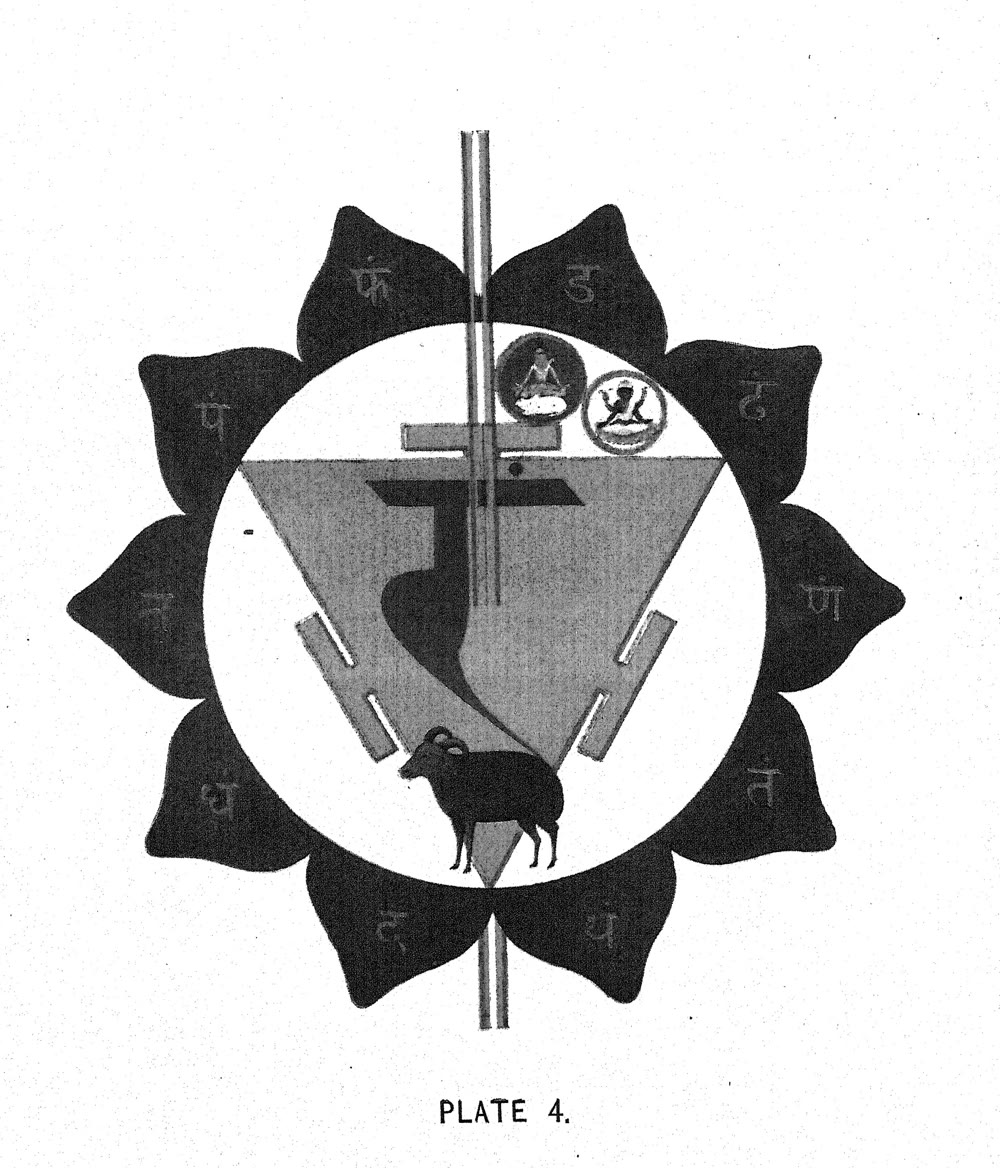
〈Plate IV: a lotus drawn with its letters, its seed-mantra and its animal; the List of Illustrations (p. xv) names it Svādhishthāna〉 PLATE 4.
It generally takes years from the commencement of the practice to lead the Shakti to the Sahasrāra, though in exceptional cases it may be done in a short time.145 At first She can only be led to a certain point, and then gradually higher. He who has led Her to a particular centre can reach the same centre more easily at the next attempt. But to go higher requires further effort. At each centre a particular kind of bliss (Ānanda) is experienced, and particular powers, such as the conquest of the elementary forms of sensible matter (Bhūta) are gained, until at the Ājnā centre the whole universe is experienced. In the earlier stages, moreover, there is a natural tendency of the Shakti to return. In the continued practice facility and greater control are gained. Where the Nādīs are pure it is easy to lead Her down even from the Sahasrāra. In the perfection of practice the Yogī can stay as long as he will in the Sahasrāra, where the bliss is the same as that experienced in liberation (subject in this case to return), or he may transfer himself into another body, a practice known to both the Indian and Tibetan Tantras, in the latter of which it is called Phowa.
- 145 As related by Yogī from a Girnar speaking of his own case. p. 233
The principle of all the methods to attain Samādhi is to get the Prāna out of Idā and Pinggalā. When this is achieved these Nādīs become “dead, because vitality has gone out of them. The Prāna then enters the Sushumnā, and, after piercing by the aid of Kundalinī, the p. 234 six Chakras in the Sushumnā becomes Laya or absorbed in the Sahasrāra. The means to this end, when operating from the Mūlādhāra, seem to vary in detail, but embody a common principle—namely, the forcing of Prāna downward and Apāna upwards146 (that is, the reverse of their natural directions) by the Jālandhara and Mūla Banda, or otherwise, when by their union the internal fire is increased. The position is thus similar to a hollow tube in which a piston is working at both ends without escape of the central air, which thus becomes heated. Then the Serpent Force Kundalinī, aroused by the heat thus generated, is aroused from Her potential state called “sleep,” in which She lies curled up; She then hisses and straightens Herself, and enters the Brahmadvāra, or enters into the Sushumnā, when by further repeated efforts the Chakras in the Sushumnā are pierced. This is a gradual process which is accompanied by special difficulties at the three knots (Granthis) where Māyāshakti is powerful, particularly the abdominal knot, the piercing of which may, it is admitted, involve considerable pain, physical disorder, and even disease. As already explained, these “knots” are the points at which converge the Chakras of each of the three groups. Some of the above-mentioned processes are described in the present work, to which we now proceed, and which on this matter may be summarised as follows:
- 146 See Varāha Upanishad, Ch. III. p. 234
The preliminary verse (and in the reference to the verses I include the Commentary) says that only those who are acquainted with the Six Lotuses can deal with them; and the first verse says that Yoga by means of the method here described cannot be achieved without knowledge of the Chakras and Nādīs. The first verse says that the Brahman will be realised. The next question p. 235 is, How is this effected? The Commentator in the preliminary verse says that the very merciful Pūrnānanda Svāmī, being wishful to rescue the world sunk in the mire of misery, has undertaken the task firstly of instructing it as regards the union of the Shakti Kundalinī with the vital centres, or Chakras, and secondly of imparting that knowledge of Brahman (Tattvajnāna) which leads to Liberation. The former—that is, knowledge concerning the Chakras, and so forth—is the “first shoot” of the Yoga plant. Brahman, as the Commentator says, is the Supreme Consciousness which arises upon the acquisition of knowledge. The first cause of such knowledge is an acquaintance with and practice of the Tantrik Yoga Sādhanā, which is concerned with the Chakras, Nādis, and Kundalinī; the next cause is the realisation of that Sādhanā by the rousing of Kundalinī; and the final result is the experiential realisation of the Brahman, which is the effect of the action of Kundalinī, who is the Shakti or power of Will (Ichchhā), Action (Kriyā), and Knowledge (Jnāna), and exists in forms both subtle and gross. Mind is as much one of the forms of Kundalī as is that which is called “matter”. Both are equally products of Prakriti-shakti, which is a grosser form of the Nādamayī Shakti. Kundalī takes the form of the eight Prakritis.147 It is necessary to bear this well in mind, or there is likely to be uninstructed criticism of the system on the ground of its supposed “materialism,” and so forth. The Power which is aroused is in itself (Svarūpa) Consciousness, and when aroused and taken to the upper cerebral centre is the giver of true knowledge (Svarūpa Jnāna), which is the Supreme Consciousness.
- 147 Shāndilya Upanishad, Ch. I; Yogakundalī-Up., Ch. I. p. 235
The arousing of this force is achieved both by will and mind power (Yogabala), accompanied by suitable physical p. 236 action. The Sādhaka148 sits himself in the prescribed Āsana and steadies his mind by the Khecharī Mudrā, in which concentration is between the eyebrows. Air is inhaled (Pūraka) and then retained (Kumbhaka). The upper part of the body is then contracted by Jālandharabandha,149 so that the upward breath (Prāna) is checked. By this contraction the air so inhaled is prevented from escape. The air so checked tends downwards. When the Yogī feels that the air within him, from the throat to the belly, is tending downwards through the channels in the Nādīs, the escape of Vāyu as Apāna is again checked by the Mūlabandha and Ashvinī Mudrā, in which the anal muscle is contracted. The air (Vāyu) thus stored becomes an instrument by which, under the direction of mind and will, the potentialities of the vital force in the Mūlādhāra may be forced to realisation. The process of mental concentration on this centre is described as follows: With mental Japa of the Mantra prescribed and acquisition thereby of Mantrashakti, Jīvātmā (individual Consciousness), which is thought of as being in the shape of the tapering flame of a lamp, is brought from the region of the heart to the Mūlādhāra. Jīvātmā here spoken of is the Ātmā of the subtle body—that is, the Antahkarana or mind as Buddhi (including therein Ahangkāra) and Manas, the faculties of sense (Indriya) or mind operating to receive impression through the sense organs, and Prāna;150 the constituents of the second, third, and fourth bodily sheaths. Following such concentration and impact of the retained Vāyu on this centre, the Vāyu is again raised with the p. 237 Bīja “Yang”. A revolution from left to right is given to the “air of Kāma” or Kandarpa (Kāmavāyu).151 This is a form of Ichchhā Shakti. This, the pressure of the Prāna and Apāna held in Kumbhaka, the natural heat arising therefrom, and the Vahni Bīja (Fire Mantra) “Rang,” kindle the fire of Kāma (Kāmāgni). The fire encircles and arouses the slumbering serpent Kundalinī, who is then, in the language of the Shāstra, seized with the passion of “desire” for Her Spouse, the Parahangsah or Paramashiva. Shakti thus rendered active is drawn to Shiva, as in the case of ordinary positive and negative electric charges, which are themselves but other manifestations of the universal polarity which affects the manifested world.
- 148 The account here given follows and amplifies the text. See Commentary to v. 50, post. p. 236
- 149 Vide ante and Dhyānabindu-Up. p. 236
- 150 According to the Vedāntik definition; or the five Tanmātras, according to Sāngkhya. The Chitta (mind) therefore enters Sushumnā along with Prāna (Yogatattva-Upanishad and Dhyānabindu-Up.). p. 236
- 151 A form of Apāna Vāyu. p. 237
The Yogakundalī Upanishad152 states the following methods and others mentioned: When Prāna is passing through Idā, assume Padmāsana and lengthen the Ākāsha of 12 points by 4—that is, as in exhalation Prāna goes out in 16 measures, and in inhalation comes in 12, inhale for 16 and thus gain power. Then, holding the sides by each hand, stir up Kundalinī with all one’s strength from right to left fearlessly for 48 minutes. Draw the body up a little to let Kundalī enter Sushumnā. The Yogī does a drawing-up movement in which the shoulders are raised and dropped. Prāna enters of itself with Her. Compressing above and expanding below, and vice versa, Prāna rises.
- 152 Ch. I. p. 237
In the commentary153 on verse 32 of the Ānandalaharī it is said: “The sun and the moon, as they move always in Devayāna and Pitriyāna (northern and southern orbs) in the Macrocosm, are travelling (incessantly in the Microcosm) by Idā and Pinggalā day and night. The moon, ever travelling by the left Nādī (Idā), bedews the p. 238 whole system with her nectar. The sun, travelling by the right Nādī (Pinggalā), dries the system (thus moistened by nectar). When the sun and the moon meet at Mūlādhāra, that day is called Amāvasyā (new moon day.) ... The Kundalī also sleeps in Ādhārakunda.... When a Yogī whose mind is under control is able to confine the moon in her own place, as also the sun, then the moon and sun become confined, and consequently the moon cannot shed its nectar nor the sun dry it. Next, when the place of nectar becomes dried by the fire with the help of Vāyu, then the Kundalī wakes up for want of food and hisses like a serpent. Afterwards, breaking through the three knots, She runs to Sahasrāra and bites the Chandra (moon), which is in the middle of the same. Then the nectar begins to flow, and wets the (other) Chandra Mandala in Ājnāchakra. From the latter the whole body becomes bedewed with nectar. Afterwards the fifteen eternal Kalās (parts) of Chandra (moon) in Ājnā go to Vishuddhi and move thereon. The Chandra Mandala in Sahasrāra is also called Baindava. One Kalā remains there always. That Kalā is nothing but Chit Itself, which is also called Ātman. We call Her Tripurasundarī. It is understood by this that, in order to rouse the Kundalī, one should practise in the lunar fortnight alone, and not in the solar one.”
- 153 Ānandalaharī, ed. Pandit R. Ananta Shāstrī, pp. 69, 70. p. 237
Kundalinī is led upwards “as a rider guides trained mare by the reins,” through the aperture hitherto closed by Her own coils, but now open, within the entrance of the Chitrinī Nādī. She then pierces, in that Nādī, each of the lotuses, which turn their heads upwards as She passes through them. As Kundalinī united with the subtle Jīvātmā passes through each of these lotuses, She absorbs into Herself the regnant Tattvas of each of these centres, and all that has been above described to be in p. 239 them. As the ascent is made, each of the grosser Tattvas enters into the Laya state, and is replaced by the energy of Kundalinī, which after the passage of the Vishuddha Chakra replaces them all. The senses which operate in association with these grosser Tattvas are merged in Her, who then absorbs into Herself the subtle Tattvas of the Ājnā. Kundalinī Herself takes on a different aspect as She ascends the three planes, and unites with each of the Lingas in that form of Hers which is appropriate to such union. For whereas in the Mūlādhāra She is the Shakti of all in their gross or physical manifested state (Virāt), at the stage of Ājnā, She is the Shakti of the mental and psychic or subtle body (Hiranyagarbha), and in the region of the Sahasrāra She is the Shakti of the spiritual plane (Īshvara), which, though itself in its Brahman aspect undifferentiated, contains in its Power-aspect all lower planes in a concealed potential state. The Māyā Tantra (see v. 51, post) says that the four sound-producing Shaktis—namely, Parā, Pashyantī, Madhyamā, and Vaikharī—are Kundalī Herself (Kundalinyabhedarūpā). Hence, when Kundalī starts to go to Sahasrāra, She in Her form as Vaikharī bewitches Svayambhu Linga; She then similarly bewitches Bāna Linga in the heart as Madhyamā and Itara Linga in the eyebrows as Pashyantī. Then, when She reaches the stage of Parabindu, She attains the state of Parā (Parābhāva).
The upward movement is from the gross to the more subtle, and the order of dissolution of the Tattvas is as follows: Prithivī with the Indriyas (smell and feet), the latter of which have Prithivī (the earth as ground) as their support, is dissolved into Gandha Tattva, or Tanmātra of smell, which is in the Mūlādāhra; Gandha Tattva is then taken to the Svādhishthāna, and it, Ap, and its connected Indriyas (taste and hands), are dissolved in p. 240 Rasa (Taste) Tanmātra; the latter is taken to the Manipūra and there Rasa Tattva, Tejas, and its connected Indriyas (sight and anus), are dissolved into Rūpa (Sight) Tanmātra; then the latter is taken into the Anāhata, and it, Vāyu, and the connected Indriyas (touch and penis), are dissolved in Sparsha (Touch) Tanmātra; the latter is taken to the Vishuddha, and there it, Ākāsha, and associated Indriyas (hearing and mouth), are dissolved in the Shabda (Sound) Tanmātra; the latter is then taken to the Ājnā, and, there and beyond, it and Manas are dissolved in Mahat, Mahat in Sūkshma Prakriti, and the latter is united with Parabindu in the Sahasrāra. In the case of the latter merger there are various stages which are mentioned in the text (v. 52), as of Nāda into Nādānta, Nādānta into Vyāpikā, Vyāpikā into Samanī, Samanī into Unmanī, and the latter into Vishnuvaktra or Pungbindu, which is also Paramashiva. When all the letters have been thus dissolved, all the six Chakras are dissolved as the petals of the lotuses bear the letters.
On this upward movement, Brahmā, Sāvitrī, Dākinī, the Devas, Mātrikās, and Vrittis, of the Mūlādhāra, are absorbed in Kundalinī, as is also the Mahīmandala or Prithivī, and the Prithivī Bīja “Lang” into which it passes. For these Bījas, or sound powers, express the subtle Mantra aspect of that which is dissolved in them. Thus “earth” springs from and is dissolved in its seed (Bīja), which is that particular aspect of the creative consciousness which propelled it. The uttered Mantra (Vaikharī Shabda) or “Lang” is the expression in gross sound of that.
When the Devī leaves the Mūlādhāra, that lotus, which by reason of the awakening of Kundalinī and the vivifying intensity of the Prānik current had opened and turned its flower upwards, again closes and hangs its head downwards. p. 241 As Kundalinī reaches the Svādhishthāna, that lotus opens out and lifts its flower upwards. Upon Her entrance, Vishnu, Lakshmī, Sarasvatī, Rākinī, Mātrikās and Vritti, Vaikunthadhāma, Goloka, and the Deva and Devī residing therein, are dissolved in the body of Kundalinī. The Prithivī or Earth Bīja “Lang” is dissolved in the Tattva water, and water converted into its Bīja “Vang” remains in the body of Kundalinī. When the Devī reaches the Manipūra Chakra or Brahmagranthi, all that is in that Chakra merges in Her. The Varuna Bīja “Vang” is dissolved in fire, which remains in Her body as the Bīja “Rang”. The Shakti next reaches the Anāhata Chakra, which is known as the Knot of Vishnu (Vishnugranthi), where also all which is therein is merged in Her. The Bīja of Fire “Rang” is sublimed in air, and air converted into its Bīja “Yang” is absorbed in Kundalinī. She then ascends to the abode of Bhāratī or Sarasvatī, the Vishuddha Chakra. Upon Her entrance, Arddhanārīshvara Shiva, Shākinī, the 16 vowels, Mantra, etc., are dissolved in Her. The Bīja of Air “Yang” is dissolved in ether, which, itself being transformed into the Bīja “Hang,” is merged in the body of Kundalinī. Piercing the concealed Lalanā Chakra, the Devī reaches the Ājnā known as the “Knot of Rudra” (Rudragranthi), where Paramashiva, Siddhakālī, the Devas, and all else therein, are dissolved in Her. At length the Bīja of Vyoma (ether) or “Hang” is absorbed into the subtle Tattvas of the Ājnā, and then into the Devī. After passing through the Rudragranthi, Kundalinī unites with Paramashiva. As She proceeds upwards from the two-petalled lotus, the Nirālambapurī, Pranava, Nāda, etc., are merged in the Devī. She has thus in Her progress upwards absorbed in Herself the twenty-three Tattvas, commencing with the gross elements, and then remaining Herself Shakti, the cause of all Shaktis, unites with Paramashiva.
By this method of mental concentration, aided by the physical and other processes described, the gross is absorbed into the subtle, each dissolving into its immediate cause and All into the Chidātmā or the Ātmā which is Chit. In language borrowed from the world of human passion, which is itself but a gross reflection on our physical plane of corresponding, though more subtle, supersensual activities and bliss, the Shakti Kundalinī who has been seized by desire for Her Lord is said to make swift way to him, and, kissing the Lotus mouth of Shiva, enjoys him (S.N., v. 51). By the term Sāmarasya is meant the sense of enjoyment arising from the union (Sāmarasya) of male and female. This the most intense form of physical delight symbolises the Supreme Bliss arising from the union of Shiva and Shakti in the spiritual plane upon which it is enacted. So Daksha, the Dharmashāstrakāra, says: “The Brahman is to be known by Itself alone, and to know It is as the bliss of knowing a virgin.”154 Similarly, the Sādhaka in Layasiddhiyoga, thinking of himself as Shakti and the Paramātmā as Purusha, feels himself in union (Sanggama) with Shiva, and enjoys with him the bliss which is Shringārarasa, the first of the nine Rasa, or the love sentiment and bliss. This Ādirasa (Shringāra) which is aroused by Sattvaguna155 is impartite (Akhanda), self-illuminating (Svaprakāsha) bliss (Ānanda) whose substance is Chit (Chinmaya).156 It is so intense and all-exclusive as to render the lover p. 243 unconscious of all other objects of knowledge (Vedyāntarasparsha-shūnyah), and the own brother157 of Brahma-bliss (Brahmasvādasahodara).158 But as the Brahma-bliss is known only to the Yogī, so, as the Alangkāra Shāstra last cited observes, even the true love-bliss of the mortal world “is known to a few knowers only” (Jneyah kaishchit pramātribhih), such as poets and others. Sexual as well as other forms of love are reflections or fragments of the Brahman-bliss.
- 154 Svasangvedyam etad brahma kumārī-strī-sukhang yathā, cited in Commentary to v. 15 of Ch. I of the Hathayogapradīpikā. p. 242
- 155 So all the eight Bhāvas commencing with Sveda, Stambha, including the well-known Romāncha or thrill in which the hair stands on end (Pulaka), the choking voice (Svarabhanga), pallor (Vaivarnya), and so forth, are all Sāttvik. The objection of an Indian friend, that these Bhāvas could not be Sāttvik inasmuch as Sattva was “spiritual,” is an apt instance of the disassociation from Indian thought effected by English education. p. 242
- 156 It is not a Tāmasik thing such as dream or madness, etc. p. 242
- 157 Sahodara—that is, brothers born of the same mother. Sexual-bliss is the reflection (faint comparatively though it be) of Brahman bliss. p. 243
- 158 Sāhitya Darpana, Ch. III. p. 243
This union of the Shakti Kundalinī with Shiva in the body of the Sādhaka is that coition (Maithuna) of the Sāttvika Panchatattva which the Yoginī Tantra says is “the best of all unions for those who have already controlled their passions,” and are thus Yati.159 Of this the Brihat Shrīkrama (vide S.N., v. 51, post) says: “They with the eye of knowledge see the stainless Kalā, united with Chidānanda on Nāda. He is the Mahādeva, white like a pure crystal, and is the effulgent Cause (Vimbarūpanidāna), and She is the lovely woman of beauteous limbs which are listless by reason of Her great passion.” On their union nectar (Amrita) flows, which in ambrosial stream runs from the Brahmarandhra to the Mūlādhāra, flooding the Kshudrabrahmānda, or microcosm, and satisfying the Devatās of its Chakras. It is then that the Sādhaka, forgetful of all in this world, is immersed in ineffable bliss. Refreshment, increased power and enjoyment, follows upon each visit to the Well of Life.
- 159 Ch. VI:
Sahasrāropari bindau kundalyā melanam shive.
Maithunang paramang dravyang yatīnām parikīrtitam. p. 243
In the Chintāmanistava, attributed to Shrī Shangkarāchāryya, it is said: “This family woman (i.e., Kundalinī), p. 244 entering the royal road (i.e., Sushumnā), taking rest at intervals in the sacred places (i.e., Chakras), embraces the Supreme Husband (Parashiva) and makes nectar to flow (i.e., from the Sahasrāra).”
The Guru’s instructions are to go above the Ājnā Chakra, but no special directions are given: for after this Chakra has been pierced, the Sādhaka can, and indeed must, reach the Brahmasthāna, or abode of Brahman, unaided by his own effort. Above the Ājnā the relationship of Guru and Shishya (Master and disciple) ceases. Kundalinī having pierced the fourteen “Knots” (Granthis)—viz., three Lingas, six Chakras, and the five Shivas which they contain, and then Herself drunk of the nectar which issues from Parashiva, returns along the path whence She came to Her own abode (Mūlādhāra).160 As She returns She pours from Herself into the Chakras all that She had previously absorbed therefrom. In other words, as Her passage upwards was Layakrama, causing all things in the Chakras to pass into the Laya state (dissolution), so Her return is Srishtikrama, as She “recreates” or makes them manifest. In this manner She again reaches the Mūlādhāra, when all that has been already described to be in the Chakras appears in the positions which they occupied before Her awakening. In fact, the descending Jīvātmā makes for himself the idea of that separated multiple and individualised world which passed from him as he ascended to and became one with the Cause. She as Consciousness absorbs what She as conscious Power projected. In short, the return of Kundalinī is the setting again of the Jīvātmā in the phenomenal world of the lowest plane of being after he had been raised therefrom in a state of ecstasis, or Samādhi. The Yogī thus knows (because he experiences) the nature p. 245 and state of Spirit and its pathway to and from the Māyik and embodied world. In this Yoga there is a gradual process of involution of the gross world with its elements into its Cause. Each gross element (Mahābhūta), together with the subtle element (Tanmātra) from which it proceeds and the connected organ of sense (Indriya), is dissolved into the next above it until the last element, ether, with the Tanmātra sound and Manas, are dissolved in Egoism (Ahangkāra), of which they are Vikritis. Ahangkāra is merged in Mahat, the first manifestation of creative ideation, and the latter into Bindu, which is the Supreme Being, Consciousness, and Bliss of the Brahman. Kundalī when aroused is felt as intense heat. As Kundalinī ascends, the lower limbs become as inert and cold as a corpse; so also does every part of the body when She has passed through and leaves it. This is due to the fact that She as the Power which supports the body is leaving Her centre. On the contrary, the upper part of the head becomes “lustrous,” by which is not meant any external lustre (Prabhā), but brightness, warmth, and animation. When the Yoga is complete, the Yogī sits rigid in the posture selected, and the only trace of warmth to be found in the whole body is at the crown of the head, where the Shakti is united with Shiva. Those, therefore, who are sceptical can easily verify the facts should they be fortunate enough to find a successful Yogī who will let them see him at work. They may observe his ecstasis and the coldness of the body, which is not present in the case of what is called the Dhyāna Yogī, or a Yogī operating by meditation only, and not rousing Kundalinī. This cold is an external and easily perceptible sign. Its progression may be seen, obviously denoting the passing away of something which supplied the previous heat. The body seems lifeless, indicating that its supporting power has p. 246 (though not entirely) left it. The downward return of the Shakti thus moved is, on the other hand, indicated by the reappearance of warmth, vitality, and the normal consciousness. The return process is one of evolution from the highest state of attainment to the point of departure.
- 160 As to the Samaya practice, v. post, p. 250 et seq. p. 244
Though not dealt with in this work, reference may here be made to the Sādhanā accompanying the return of Kundalinī to Her resting-place in the ritual practice called Bhūtashuddhi, where the ascent and descent are imagined only.
The Sādhaka, thinking of the Vāyu Bīja “Yang” as being in the left nostril, inhales through Idā, making Japa of the Bīja sixteen times. Then, closing both nostrils, he makes Japa of the Bīja sixty-four times. He then thinks of the “black man of sin” (Pāpapurusha161) in the left162 cavity of the abdomen as being dried up (by the air), and so thinking he exhales through the right nostril Pinggalā, making Japa of the Bīja thirty-two times. The Sādhaka then, meditating upon the red-coloured Bīja “Rang” in the Manipūra, inhales, making sixteen Japa of the Bīja, and then closes the nostrils, making sixteen Japa. Whilst making Japa he thinks that the body of the “man of sin” is being burnt and reduced to ashes (by the fire). He then inhales through the right nostril with thirty-two Japa, and then meditates upon the white Chandrabīja “Thang”. He next inhales through Idā, making Japa of the Bīja sixteen times, closes both nostrils with Japa done sixty-four times, and exhales through Pinggalā with thirty-two Japa. During inhalation, holding of breath, and exhalation, he should consider that a new p. 247 celestial body is being formed by the nectar (composed of all the Mātrikā-varna, or sound-powers, embodied in their Vaikharī form as lettered sound) dropping from the “Moon.” In a similar way with the Bīja of water “Vang” the formation of the body is continued, and with the Bīja “Lang” of the cohesive Prithivī Tattva it is completed and strengthened. Lastly, with the Mantra “So’ham” (“He I am”) the Sādhaka leads the Jīvātmā into its place in the heart. Some forms of meditation are given in v. 51.
Kundalī does not at first stay long in Sahasrāra. The length of stay depends on the strength of the Yogī’s practice. There is then a natural tendency on the part of Kundalī to return. The Yogī will use all effort at his disposal to retain Her above, for the longer this is done the nearer approach is made to the time when She can be in a permanent manner retained there.163 For it is to be observed that liberation is not gained by merely leading Kundalī to the Sahasrāra, and of course still less is it gained by stirring it up in the Mūlādhāra or fixing it in any of the lower centres. Liberation is gained only when Kundalī takes up Her permanent abode in the Sahasrāra, so that She only returns by the will of the Sādhaka. It is said that after staying in Sahasrāra for a time, some Yogins lead the Kundalinī back to Hridaya (heart), and worship her there. This is done by those who are unable to stay long in Sahasrāra. If they take the Kundalinī lower than Hridaya—i.e., worship her in the three Chakras below Anāhata—they no longer, it is said, belong to the Samaya group.164
- 163 Great power (Siddhi) is had by the man who can keep Kundalī Shakti in the Sahasrāra three days and three nights. p. 247
- 164 Lakshmīdhara, cited by Ananta Shāstrī, op. cit., p. 71. What this means is more than I can say, as I am not familiar with the views of the school which Lakshmīdhara (cited also post) quotes. p. 247
Thus, when by the preliminary Sādhanā purity of physical and mental function is gained, the Sādhaka learns how to open the entrance of the Sushumnā, which is ordinarily closed at the base. This is the meaning of the statement that the Serpent with its coil closes the gate of Brahmā. At the base of the Sushumnā Nādī and in the Ādhāra lotus the Shakti Kundalinī lies slumbering coiled round the Linga, the Shiva or Purusha aspect in that centre of the Shabdabrahman, of which She is the Prakriti aspect. Kundalī in the form of Her creative emanations as mind and matter is the whole moving body, but She Herself exists at the Mūlādhāra or earth centre as a gross aspect of Shakti in its sleeping form. This is the normal abode of the Shakti who is the Shabdabrahman Itself. For having so completely manifested Herself She rests or sleeps in what is her grossest and concluding manifestation. The residual vital force in this centre there exists in a latent and potential state. If its aid towards Yoga is sought, the first process must be that by which the Serpent is aroused from its slumber. In other words, this force is raised from its latent potential state to one of activity, and there reunited with Itself in its other aspect as the Spiritual Light which shines165 in the cerebral centre.
- 165 For this reason the Sahasrāra is also called Bhāloka (from the root bhā, “to shine”). p. 248
Kundalī Shakti is Chit, or Consciousness, in its creative aspect as Power. As Shakti it is through Her activity that the world and all beings therein exist. Prakriti Shakti is in the Mūlādhāra in a state of sleep (Prasuptā)—that is, latent activity looking outwards (Vahirmukhī). It is because She is in this state of latent activity that through Her all the outer material world functions of life are being performed by man. And it is for this reason that man is engrossed in the world, and p. 249 under the lure of Māyā takes his body and egoism to be the real Self, and thus goes round the wheel of life in its unending cycle of births and deaths. When the Jīva thinks the world to be different from himself and the Brahman, it is through the influence of Kundalinī who dwells within him. Her sleep in the Mūlādhāra is, therefore, for the bondage of the ignorant.166 As long as She remains in the Mūlādhāra lotus—namely, in that state of Hers which is the concomitant of the cosmic appearance—so long must that appearance endure. In short, when She is asleep man is in the waking state (Jāgrat). Hence it is said167 that the Shakti of the initiate is awake, that of the Pashu asleep. She is therefore aroused from sleep, and when awake returns to Her Lord, who is but Herself in another aspect; Her return is, in fact, the withdrawal of that activity of Hers which produces the world of appearances, and which with such withdrawal disappears. For on Her upward Path She absorbs into Herself all the Tattvas which had emanated from Her. The individual consciousness of the Yogī, the Jīvātmā, being united with the world-consciousness in Her, or Kundalī, then becomes the universal consciousness, or Paramātmā, from which it appeared to be different only by reason of the world-creating and bewildering activity of Kundalī which is thus withdrawn. The establishment through Her of the pure state of Being-Consciousness-Bliss is Samādhi.
In short, Kundalī is the individual bodily representative of the great Cosmic Power (Shakti) which creates and sustains the universe. When this individual Shakti manifesting as the individual consciousness (Jīva) is merged in the consciousness of the Supreme Shiva, the world is for p. 250 such Jīva destroyed, and Liberation (Mukti) is obtained. Under, however, the influence of the Cosmic Shakti, the universe continues for those who are not liberated until the great Dissolution (Mahāpralaya), at the close of which the universe again evolves into those Jīvas whose Karma has not been exhausted, and who have therefore not been liberated. The rousing and stirring up of Kundalī or Kundalī Yoga is thus a form of that merger of the individual into the universal consciousness which is the end of every system of Indian Yoga.
Pandit R. Ananta Shāstrī says168 that “The Samaya method of worshipping Shakti, called the Samayāchāra,169 is dealt with in five treatises whose reputed authors are the great sages Sanaka, Sananda, Sanatkumāra, Vashishtha, and Shuka. The following is a summary of the teachings contained in these Samaya Āgamas, each of which goes after the name of its author:
- 168 Ānandalaharī, p. 8. The passage is given by way of citation only. There are statements in it which I have not verified, and some from which I dissent, and some which I do not understand. p. 250
- 169 This term is apparently of varying significance. It seems to be used here in a sense opposed to, some forms at least of, Kulāchāra, and is yet used in the Kaula Shāstras to denote their worship with the Panchatattva. p. 250
“The Shakti or energy, the development of which is the subject of these treatises, is called the Kundalinī. The place where it resides is called the Mūlādhāra (original abode). By a successful development and working of this Shakti, the liberation of the soul is attained. In the ordinary condition Kundalinī sleeps quietly at the Mūlādhāra. The first purpose of the practitioners is to awaken this sleeping snake, and this is effected in two ways:
“(1) By Tapas. Here Tapas refers to the process of Prānāyāma, which means the regulation of the breath and p. 251 holding it for stated periods of time. This is also the course advocated by the Yoga Shāstras.
“(2) By Mantras. The pupil is initiated in the chanting of certain Mantras which he has to repeat a fixed number of times at particular hours of the day, all the while having before his mind’s eye the figure of the Mūrti or God connoted by the Mantra he chants. The most important of these Mantras is said to be the Panchadashī.
“When it is thus roused up, the Kundalinī ascends from (1) Mūlādhāra, where it was sleeping, to the next higher centre, called the (2) Svādhishthāna (own place). Thence with great effort this Shakti is carried to the following centres in regular ascending order: (3) Manipūra (full of rays); (4) Anāhata (sound, not emanating from the collision of bodies)—the Shakti here is transformed into sound; (5) Vishuddhi (place of purity)—here it becomes a pure Sattvic element; and (6) Ājnā (ā-jnā, a little knowledge). At this stage the practitioner may be said to have so far been successful in securing a command over this Shakti, which now appears to him, though only for a moment, in the form of a sharp flash of lightning.
“The passage of the Kundalinī from the Mūlādhāra through the above centres of energy up to Ājnā constitutes the first part of the ascent. The disciple who takes to this practice has to undergo a course of Upāsanā (contemplation and worship of the prescribed Deity) and Mantra Japa (chanting of incantations),170 into which he will be initiated by his Guru (teacher and guide). The six centres of energy above enumerated from Mūlādhāra to Ājnā, joined together by imaginary straight lines, form a p. 252 double-faced triangle—a hexagon, the six-pointed star—which is called the Shrīchakra in Sanskrit. The Anāhata centre (the heart) is the critical point in the course of this ascent, and hence much is found written in the Āgamas about this centre.
- 170 In this and other citations from the Pandit the English equivalents of Sanskrit terms are incorrect, as might be expected in one to whom English is not his own tongue. Japa is not “chanting”. In fact, in Upāngshu Japa nothing is heard, and “incantations” provoke another set of ideas to the English mind. p. 251
“These centres in the body of man (Pindānda) have their correspondence in the cosmic planes, and each of these has its own quality, or Guna, and a Presiding Deity. When the disciple ascends centre by centre, he passes through the corresponding Lokas, or cosmic planes. The following table gives the correspondences, Guna, and Presiding Deity:
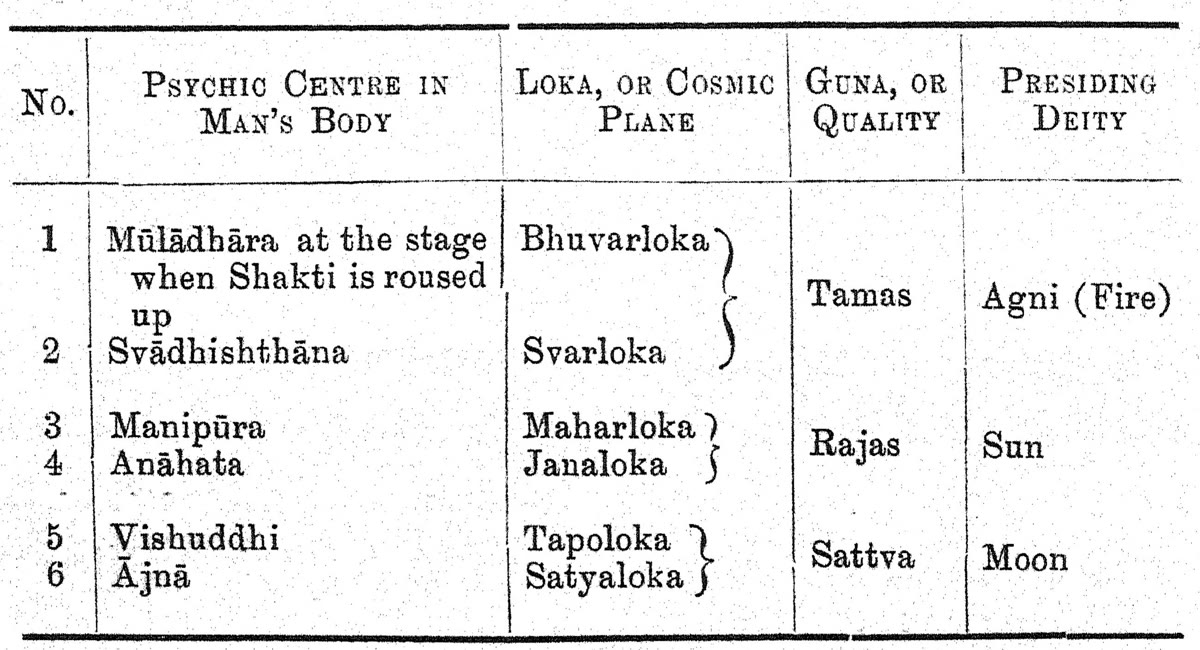
〈The table on p. 252 as printed: the psychic centres with their Lokas, Gunas and presiding deities; its words follow as text〉
No. | Psychic Centre in Man’s Body | Loka, or Cosmic Plane | Guna, or Quality | Presiding Deity
1 | Mūlādhāra at the stage when Shakti is roused up | Bhuvarloka | Tamas | Agni (Fire)
2 | Svādhishthāna | Svarloka | Tamas | Agni (Fire)
3 | Manipūra | Maharloka | Rajas | Sun
4 | Anāhata | Janaloka | Rajas | Sun
5 | Vishuddhi | Tapoloka | Sattva | Moon
6 | Ājnā | Satyaloka | Sattva | Moon
“If one should die after attaining any of these stages, he is born again having all the advantages of the stages gained; thus, a man dies after leading the Shakti to the Anāhata: in his next birth he begins where he has last left, and leads the Shakti onwards from the Anāhata.
“This aspiration to unify one’s soul with the Eternal One has been held by some to be an attempt of a Tāmasa origin to rid itself of all Tamas and Rajas in it. Therefore the aspirant in the first and second stages is said to have more Tamas than in the succeeding stages, and to be p. 253 therefore in the Tāmasic stage, which is presided over by Agni. In the next two stages he is similarly said to be in the Rājasic stage, presided over by the Sun. In the next two he is in the Sāttvic stage, presided over by the Moon, the Deity which is assigned a higher plane than the Sun and Agni. But it is to be noticed that the aspirant does not get at pure Sattva until he passes on to the Sahasrāra, and that Tamas, Rajas, and Sattva, referred to in the above table, are but relative, and bear no comparison with their common acceptation.
“Kundalinī is the grossest form of the Chit, the twenty-fourth Tattva, which lives in the Mūlādhāra; later on we shall have to speak of it in detail in our treatment of the second part of the aspirant’s ascent. This Kundalinī, as soon as it is awakened, is in the Kumārī (girl) stage. On reaching the Anāhata, it attains the Yoshit stage (womanhood). Hence the indication that it is the most difficult and important step in the ascent. The next stage is in the Sahasrāra, of which we shall speak hereafter, and the Shakti in that stage is called Pativratā (devoted to husband). See Taittirīyāranyaka, 1. 27. 12.
“The second part of the ascent of Kundalinī consists of only one step; the Shakti should be taken into the Sahasrāra from the Ājnā, where we left her. The Sahasrāra (lit., a thousand-petalled lotus) forms in itself a Shrīchakra. The description of this place in Sanskrit is too difficult to be rendered satisfactorily into English. In the Sahasrāra there is a certain place of lustre known as Chandra Loka (a world of nectar). In this place live in union the Sat (Sadāshiva) and the Chit, the twenty-fifth and the twenty-fourth Tattvas. The Chit, or Shuddha Vidyā, is also called Sadākhyā, the 16th Kalā of the moon. These two Tattvas are always in union, and this union itself is taken to be the twenty-sixth Tattva. It is this p. 254 union of Sat and Chit that is the goal of the aspirant. The Kundalinī which has been led all the way to the Sahasrāra should be merged into this union; this is the end of the aspirant’s journey; he now enjoys beatitude itself (Paramānanda).
“But this Kundalinī does not stay in the Sahasrāra for a long time. It always tends to return, and does return to its original position. The process should again and again be repeated by the aspirant several times, until the Shakti makes a permanent stay with her Pati (husband)—namely, Sadāshiva—or until the union of Sadāshiva and Chit is complete, and becomes Pativratā, as already mentioned. The aspirant is then a Jīvan-mukta, or pure Sattva. He is not conscious of this material limitation of the soul. He is all joy, and is the Eternal itself. See vv. 9 and 10. So much of Samayāchāra.
“Now to the other methods of Shākta worship; the Kaulas worship the Kundalinī without rousing her from her sleep171 in the Mūlādhāra, which is called Kula; and hence Kaulas (Sans. Ku=earth, Prithivī; so Mūlādhāra). Beyond the Mūlādhāra they do not rise; they follow the Vāmāchāra or black magic,172 and gain their temporal p. 255 objects and enjoy; they are not liberated from birth and death; they do not go beyond this earth. Nay, more, the Kaulas are now so far degraded that they have left off altogether the worship of the Kundalinī in the Mūlādhāra, and have betaken themselves to practices most inhuman, which are far from being divine.173 The Mishras are far above the Kaulas. They perform all Karmas, worship the Devī or Shakti in the elements, such as the sun, air, etc., and do Upāsanā with Yantras made of gold or other metals. They worship the Kundalinī, awake her, and attempt to lead her on. Some of the Mishra worshippers rise even as far as the Anāhata.
- 171 A statement by the same author at p. 85 is in apparent contradiction with this. He there says, citing Lakshmīdhara: “The Kaulas who worship Kundalinī in the Mūlādhāra have no other aim than awakening it from its sleep. When this is done, they think that they have attained their object, and there they stop. In their own words, the Kaulas have Nirvāna always near at hand.” p. 254
- 172 Vāmāchāra is not “black magic,” the nearest Sanskrit equivalent for which is Abhichāra. There may have been, as the Mahākāla Samhitā says (Ullāsa II), some Kaulas who, like the Vaidikas, sought enjoyment in this and the next world, and not Liberation (Aihikārtham kāmayanti amrite ratim na kurvanti). But to state baldly that Kaulas as a whole do not rouse Kundalinī and lead her to the Sahasrāra is incorrect. Pūrnānanda Svāmī, the author of the Text (S.N.) here translated, was himself a Kaula, and the whole object of the work is to secure Liberation (Moksha). So much ignorance of, and prejudice against, the Kaula schools prevail that statements adverse to them should always be tested. This is not to say that some practices may be blameworthy. p. 254
- 173 The Pandit here apparently adopts the opinion of Lakshmīdhara, a follower of the so-called Samaya school, and an opponent of the Kaulas. If (as is probably the case) “inhuman” is the Pandit’s phraseology it is inapt. The practices apparently referred to—namely, the worship, so little understood, with wine, meat, woman—is, in part, a continuance of the most ancient Vaidik usages in differing forms (see my “Shakti and Shākta”). It may be admitted that some forms of Sādhanā are dangerous or blameworthy, and that some details of the ritual will be generally considered repellent, as will also be (I may add by way of example) the Vaidik “horse-sacrifice” (Ashvamedha)—at any rate, as Mahīdhara and others interpret it. The worst charge which can be successfully maintained against some of the lower order of the class referred to is black magic proper, through improper use of the Shatkarma. As Shiva in the Kulārnava Samhitā (not the generally known Tantra) says, “In Kali all men are lustful for money, and will even destroy beings to gain it. But I will destroy all such as does fire dry grass.” The abuses of some of the followers are not to be laid to the charge of the true Shāstra. It must also not be forgotten that there have been different communities with very differing views and practice, e.g., a Brahma Kaula and a Kāpālika. p. 255
“We learn from the Commentators that this whole subject of Shakti-worship is treated of in detail in the ‘Taittarīya Āranyaka’ (1st chapter). Some of them even quote from that ‘Āranyaka’ in support of their explanations. This subject is vast and a very difficult one. It is not possible for one to go into the intricacies of the subject p. 256 unless one be a great Guru of vast learning and much personal experience;174 great works have been written on even single points in the ascent of the aspirant up the psychic centres.”175
“The followers of the Samaya group are prohibited from worshipping Devī in the Macrocosm. They should worship Her in any of the Chakras in the human body, choosing that centre which their practice and ability permits them to reach. They should contemplate on Devī and Her Lord Shiva as (1) having the same abode (Adhishthānasāmya), (2) occupying the same position (Avasthānasāmya), (3) performing the same functions (Anushthānasāmya), (4) having the same form (Rūpa), and (5) as having the same name (Nāma). Thus, in worshipping Devī in the Ādhārachakra, Shiva and Shakti (1) have Mūlādhāra for their seat, (2) both of them occupy the position of dancers, (3) both together perform the function of creating the universe, (4) both are red in colour, (5) Shiva is called Bhairava, and Shakti Bhairavī.
“Similarly for other Chakras mentioned in the preceding Shlokas. This is the way how beginners have to practise. Advanced students worship Devī in the Sahasrāra, and not in the lower centres. How is the worship to be carried on in Sahasrāra?
“The worshipper should fix his attention on Baindava, which is the locality where the ever-existing 26th Tattva—the union of Shiva and Shakti—resides. It lies above all the 25 Tattvas, and is situated in Chandramandala (the sphere of the moon) in Sahasrāra. He should contemplate on the said union and identify himself with it. This shows that those who carry on Bāhya Pūjā, or worship in the external world, do not belong to the Samaya School. As regards p. 257 the identification of oneself with the union of Shiva and Shakti at Baindava just spoken of, there are two ways of realising it; one is known as the fourfold path, and the other the sixfold path. These should be learnt from the Guru.
“A novitiate in the Samaya school has to go through the following course:
“(1) He should cherish the utmost regard for and confidence in his Guru. (2) He should receive the Panchadashī Mantra from his Guru, and chant the same according to instructions, with a knowledge of its seer (Rishi), metre (Chhandas), and the Deity (Devatā).176 (3) On the eighth day in the bright fortnight of Āshvayuja month, Mahānavamī, he should at midnight prostrate himself at his Guru’s feet, when the latter will be pleased to initiate him in some Mantra and the real nature of the six Chakras and of the sixfold path of identification.
- 176 The Rishi of the Mantra is he to whom it was first revealed; the metre is that in which it was first uttered by Shiva; and the Devatā is the Artha of the Mantra as Shabda. The Artha is fivefold as Devatā, Adhidevatā, Pratyadhidevatā, Varnādhidevatā, Mantrādhidevatā. p. 257
“After he is thus qualified, Lord Mahādeva177 gives him the knowledge or capacity to see his inner soul.... Then the Kundalinī awakes, and, going up suddenly to Manipūra, becomes visible to the devotee-practitioner. Thence he has to take Her slowly to the higher Chakras one after another, and there performs the prescribed worship, and She will appear to him more and more clearly. When the Ājnāchakra is crossed, the Kundalinī quickly darts away like a flash of lightning to Sahasrāra, and enters the Island of Gems surrounded by the Kalpa trees in the Ocean of Nectar, unites with Sadāshiva there, and enjoys with Him.
- 177 Shiva initiates him in the knowledge of Brahman. Thus, Shiva is considered the Teacher of all spiritual Gurus (Ādinātha). p. 257
“The practitioner should now wait outside the veil178 until Kundalinī returns to Her own place, and on Her return continue the process until She is joined for ever with Sadāshiva in the Sahasrāra, and never returns.
- 178 This, as well as some other details of this description, I do not follow. Who is waiting outside the veil? The Jīva is, on the case stated, within, if there be a veil, and what is it? p. 258
“The process heretofore described and others of a similar nature are always kept secret; yet the commentator says he has out of compassion towards his disciples given here an outline of the method.
“Even in the mere expectation of the return of Kundalinī from Sahasāra, the aspirant feels Brahmānanda (Brahma bliss). He who has once taken Kundalinī to Sahasrāra is led to desire nothing but Moksha (Liberation), if he has no other expectation. Even if any of the Samaya practitioners have some worldly expectations, they must still worship in the microcosm only.
“‘Subhagodaya’ and other famous works on Shrīvidyā say that the practitioner should concentrate his mind on Devī who resides in Sūryamandala (the sun’s disc), and so on. This statement is not at variance with the teaching contained in this book, for the Sūryamandala referred to applies to the Pindānda (microcosm), and not to Brahmānda (macrocosm). Similarly, all the verses advocating outer worship are to be applied to the corresponding objects in the Pindānda.”179
- 179 Comm. on Ānandalaharī, ed. by Pandit R. Ānanta Shāstri, p. 85 et seq., who adds: “For full particulars of these principles vide ‘Shuka Samhitā,’ one of the five Samhitās of the Samaya group.” p. 258
The last, highest and most difficult form of Yoga is Rāja Yoga. By means of Mantra, Hatha and Laya Yoga the practitioner by gradual attainment of purity becomes fit for Savikalpa Samādhi. It is through Rāja Yoga alone that he can attain to Nirvikalpa Samādhi. The former p. 259 Samādhi or Ecstasy is one in which unless it perfects into the second kind there is a return to the world and its experience. This is not so in the Samādhi of Rāja Yoga in which there is not the slightest seed of attachment to the world and in which therefore there is no return thereto but eternal unity with Brahman. The first three kinds of Yoga prepare the way for the fourth.180 In the Samādhi of Mantra Yoga the state of Mahābhāva is attained marked by immobility and speechlessness. In the Samādhi of Hatha Yoga respiration ceases and to outward experience the Yogī is without sign of animation and like a corpse. In the Samādhi of Laya Yoga described in this book the Yogī has no outer consciousness and is also immersed in the Ocean of Bliss. The Samādhi of Raja Yoga is complete (Chit-svarūpa-bhāva) and final (Nirvikalpa) Liberation.181 There are, it is said, four states of detachment (Vairāgya) from the world182 corresponding to the four Yogas, the mildest form of Vairāgya being the mark of the first or Mantra Yoga and the greatest degree of detachment being the mark of the highest Yoga or Rāja Yoga. Another mark of distinction is the prominence given to the mental side. All Yoga is concerned with mental practices but this is more specially so of Rāja Yoga which has been described183 as the discrimination of the real from the unreal, that is the infinite and enduring from the finite and transient by their reasoning with the help of the Upanishads and the recognised systems of Philosophy.
- 180 Rāja-Yoga, by Swāmī Dayānanda, published by Shrī Bhārata Dharma Mahāmandala, Benares. p. 259
- 181 Ibid., 19, 20. p. 259
- 182 Mridu (intermittent, vague and weak), Madhyama (middling), Adhimātra (high degree when worldly enjoyment even becomes a source of pain), Para (highest when the mind is turned completely from worldly objects and cannot be brought back to them under any circumstances). p. 259
- 183 Ibid., 5. p. 259
The English reader must not however identify it with mere philosophising. It is the exercise of Reason by the morally pure and intellectually great under the conditions and subject to the discipline above described with Vairāgya or Renunciation. In the man of Knowledge (Jnānī) Buddhi or Reason holds full sway. Rāja Yoga comprises sixteen divisions. There are seven varieties of Vichāra (reasoning) in seven planes of knowledge (Bhūmikā) called Jnānadā, Sannyāsadā, Yogadā, Līlonmukti, Satpadā, Ānandapadā and Parātparā.184 By exercise therein the Rāja-Yogī gradually effectively practises the two kinds of Dhāranā,185 viz., Prakrityāshraya and Brahmāshraya dependent on Nature or Brahman respectively. There are three kinds of Dhyāna whereby the power of self-realisation (Ātmapratyaksha) is produced. There are four forms of Samādhi. There are three aspects of Brahman, viz., Its gross aspect as immanent in the universe known as the Virāt Purusha, Its subtle aspect as the creator, preserver and dissolver of all this is the Lord (Īshvara) and the supreme aspect beyond that is Sachchidānanda. Rāja Yoga lays down different modes of Dhyāna for the three aspects.186 Of the four Samādhis won by these exercises the two first or Savichāra, that is there is still a subtle connection with the conscious working or the power of Vichāra (reasoning, discernment), and the last two are without this or Nirvichāra. On reaching this fourth state the Rāja-Yogī attains liberation even when living in the body (Jīvanmukta) and is severed from the Karmāshaya.187 It is only by Rāja Yoga that this Nirvikalpa Samādhi is attained.
- 184 Similarly there are seven Bhūmikās or planes of Karma, viz., Vividishā or Shubhechchhā, Vichāranā, Tanumānasā, Sattāpatti, Asangsakti, Padārthabhāvinī, Turyagā and also seven planes of Worship (Upāsanā Bhūmikā), viz., Nāmapara, Rūpapara, Vibhūtipara, Shaktipara, Gunapara, Bhāvapara, Svarūpapara. p. 260
- 185 See p. 207, ante. p. 260
- 186 Rāja-Yoga, by Dayānanda Svāmī, 19. p. 260
- 187 The mass of Karma Sangskāras in their Seed (Bīja) state. p. 260